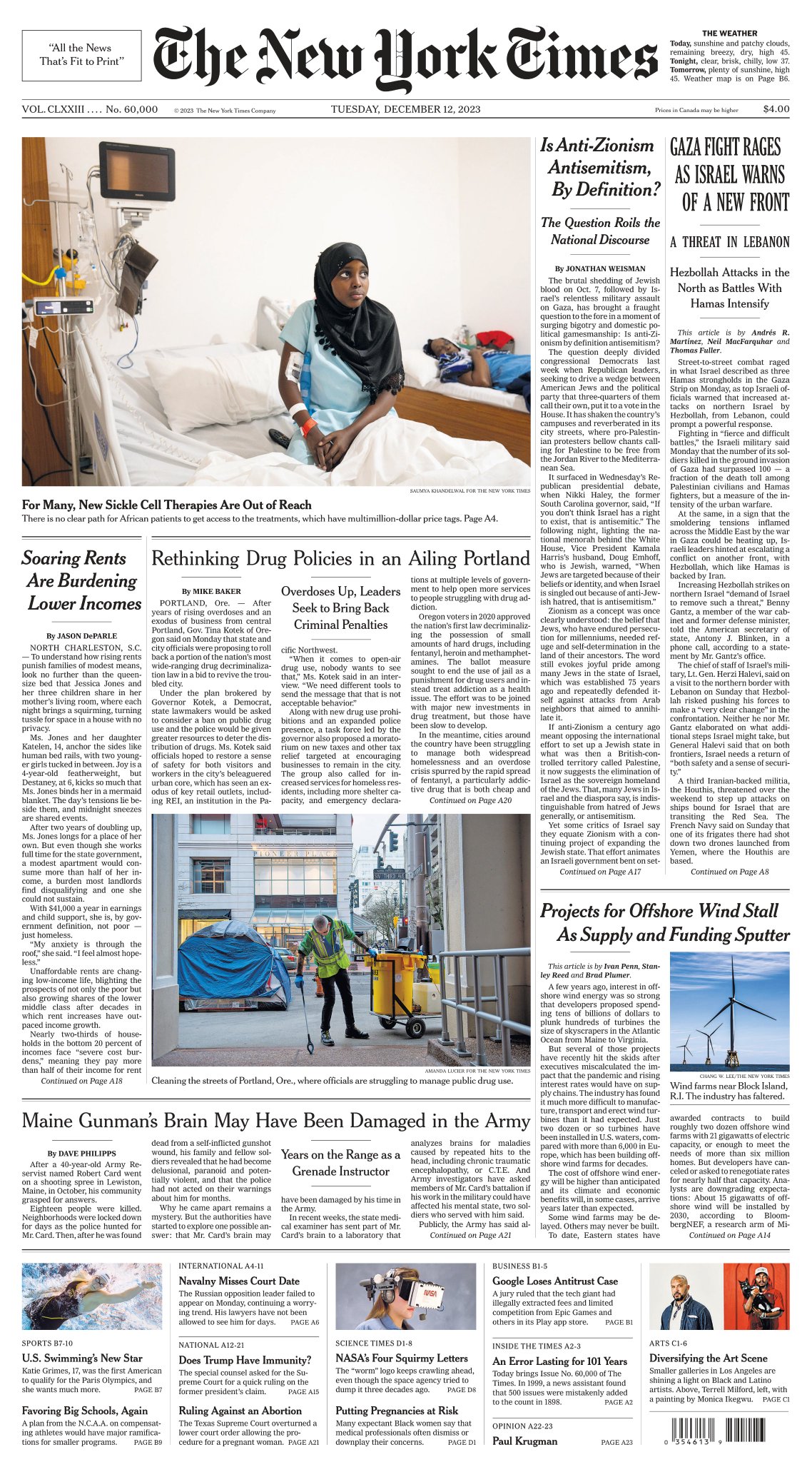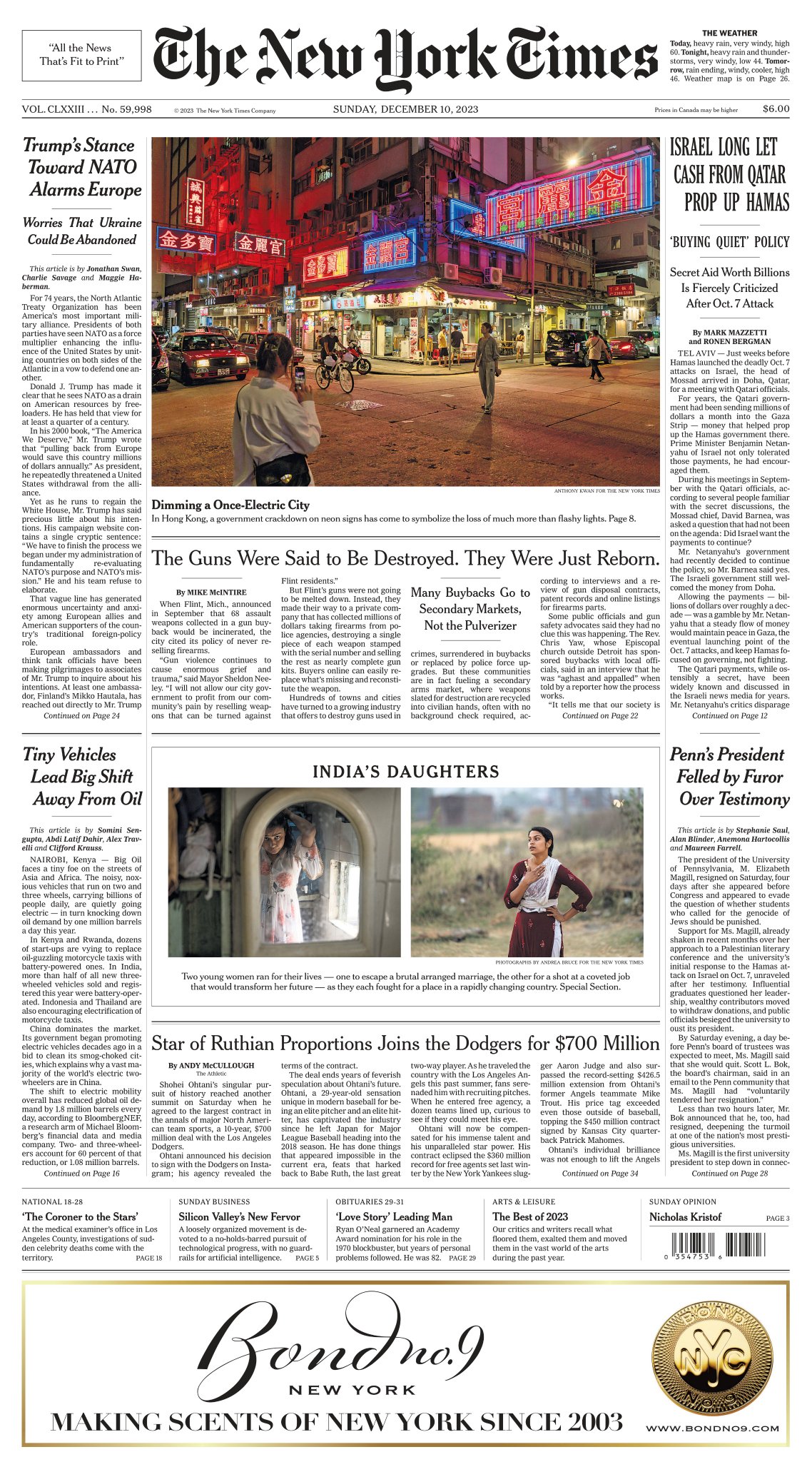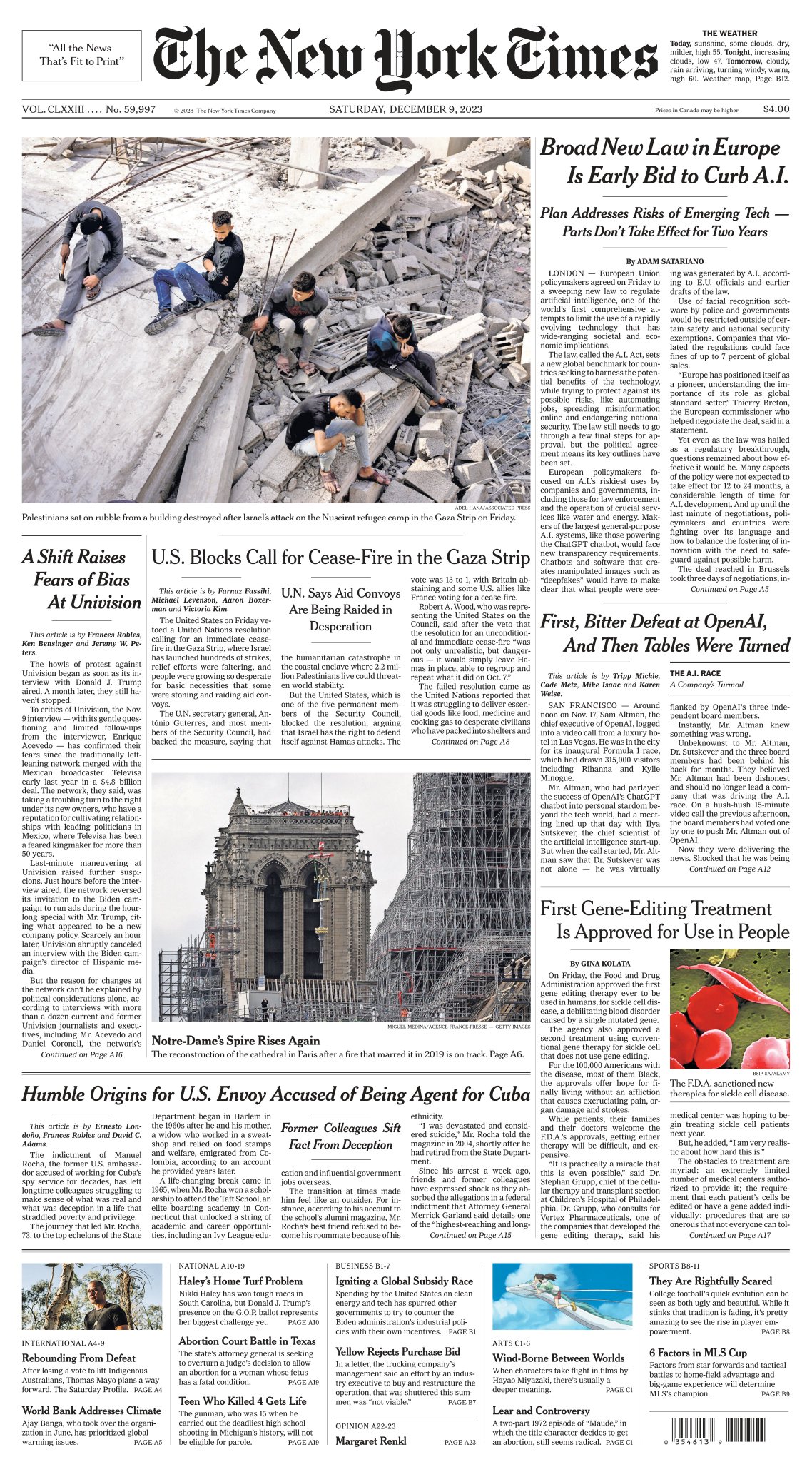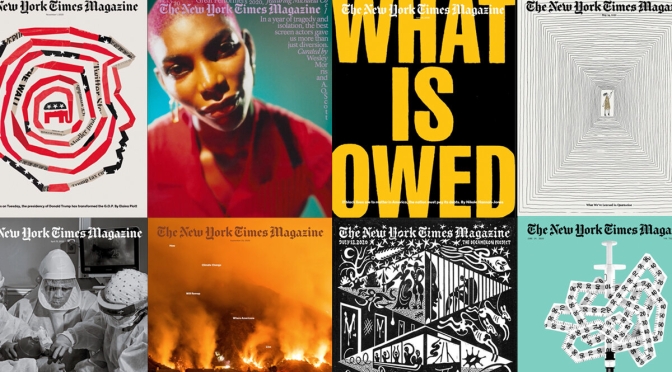
THE NEW YORK TIMES BOOK REVIEW (November 12, 2023): This week’s issue features ‘Fear of Flying’ turns 50 – With its feminist take on sexual pleasure, Erica Jong’s novel caused a sensation in 1973; The 2023 New York Times/New York Public Library Best Illustrated Children’s Books, and more…
With its feminist take on sexual pleasure, Erica Jong’s novel caused a sensation in 1973. But the revolution Jong promoted never came to pass.
By Jane Kamensky
Fifty years ago last month, Erica Jong published a debut novel that went on to sell more than 20 million copies. “Fear of Flying,” a book so sexually frank that you may have found it hidden in your mother’s underwear drawer, broke new ground in the explicitness of writing by and for women. Jong’s heroine, Isadora Wing, was a live wire. She was also a dead end, certainly for Jong, and maybe for feminism, too.
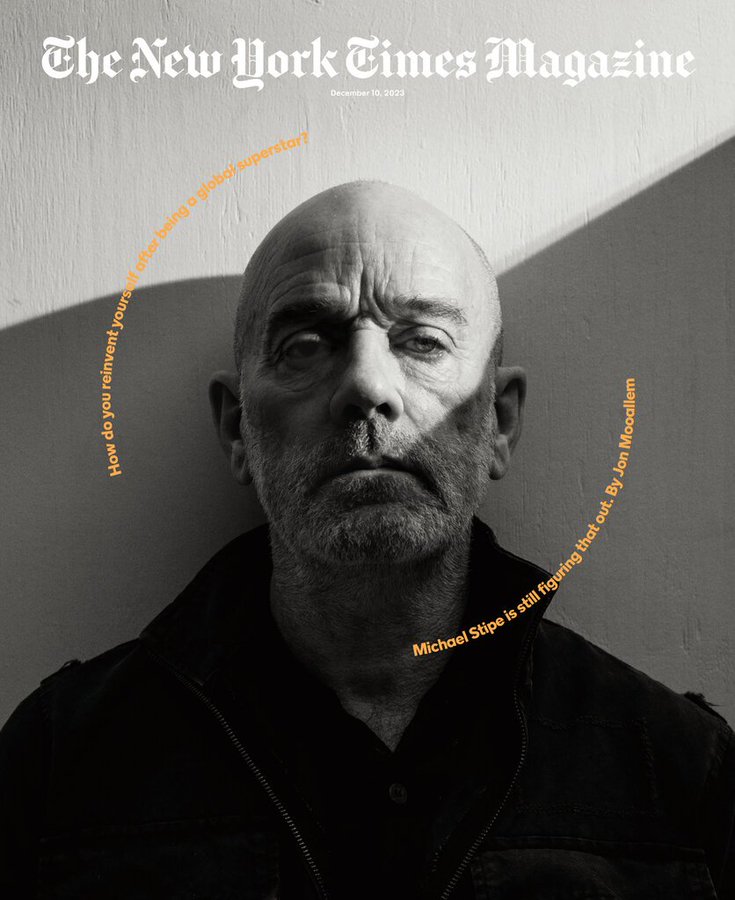
THE NEW YORK TIMES MAGAZINE (November 10, 2023): The latest issue features A Beginner’s Guide to Looking at the Universe; What Does the U.S. Space Force Actually Do? – Inside the highly secretive military branch responsible for protecting American interests in a vulnerable new domain; Their Final Wish? A Burial in Space. – Why some people decide to send their remains into orbit.
A stunning advancement in a long history of stargazing, the James Webb telescope reveals light where once we saw only darkness. Our view of the universe will never be the same.
The decision by Senator Joe Manchin III will leave open a seat in a deeply red state, threatening Democrats’ hold on the Senate.
Vatican Says Transgender People Can Be Baptized and Become Godparents
A document approved by Pope Francis lays out nuanced guidance in keeping with his vision of a more inclusive church, but it does not amount to a policy change in the church, the Vatican says.
A New Law Supercharged Electric Car Manufacturing, but Not Sales
President Biden’s 2022 climate act spurred big investments in U.S. battery factories, but it has not similarly boosted E.V. sales.
THE NEW YORK TIMES STYLE MAGAZINE (November 12, 2023) – T’S TRAVEL ISSUE features the writer Aatish Taseer embarked on an epic 40,000-mile journey through Bolivia, Mongolia and Iraq. What he learned was less a life-altering revelation and more a lesson in curiosity itself.
A tourist camp about 50 miles east of Erdene Zuu monastery in Mongolia. Richard Mosse
The writer Aatish Taseer embarked on a journey through Bolivia, Mongolia and Iraq. What he learned was less a life-altering revelation and more a lesson in curiosity itself.
Travel, the movement of people from one place to another, has always existed. But long before we thought to travel for pleasure, we traveled for purpose: for commerce, and for faith.
Even the most casual student of the Silk Road, that fearsome, wondrous network of routes that people began plying in the second century B.C. (and did so for approximately the next 1,600 years) knows that the two — business and God, whoever or whatever your god was — often intermingled. Merchants and adventurers returned with new kinds of goods, but also with new kinds of ideas: of art, of architecture, of ideology, of faith. The Silk Road brought Islam to India, and Buddhism to Japan. It’s why travel has always been both thrilling and dangerous. You never know how a new land is going to change you; it never knows how you’re going to change it.
The Island of the Sun in Bolivia’s Lake Titicaca, a pilgrimage site since before the Inca Empire.Credit…Stefan Ruiz
The dozens of books that T writer Aatish Taseer read before his journey through Bolivia, Mongolia and Iraq, and what he learned from each pilgrimage.
Eighteen months ago, when the New York-based T writer at large Aatish Taseer began planning his reporting trips for this month’s three-part feature story — an exploration of religious travel in Bolivia, Mongolia and Iraq — he was already well acquainted with the idea of pilgrimage. His first book, the 2009 memoir “Stranger to History,” opens with what is arguably the world’s best-known faith-motivated journey, the hajj to Mecca, and ends with what he describes as a personal pilgrimage to meet his estranged father in Pakistan. In Delhi, India, where Taseer grew up, quick trips for the purpose of worship were commonplace. “People would do a pilgrimage on an ordinary Sunday,” he says, “instead of going to an amusement park.”
Hamas leaders say they waged their Oct. 7 attack on Israel because they believed the Palestinian cause was slipping away, and that only violence could revive it.
The State Constitution will protect access to the procedure. The result sends a strong signal that voters are still angry about the demise of Roe.
What the Golden Gate Is (Finally) Doing About Suicides
After years of pressure from victims’ families, the installation of $217 million in steel netting is almost complete.
A fence at the base of the Golden Gate Bridge is a makeshift memorial for those who have died there. An estimated 2,000 people have jumped to their death since the bridge opened in 1937.
Hungry (but Not for Human Contact), Americans Head for the Drive-Through
A national fixture is enjoying a fresh surge as post-pandemic customers crave speed and solitude. And restaurants are responding with a raft of innovations.
Israel’s military surrounded Gaza City as the enclave plunged into another communications blackout, sowing panic among relatives fearful of the fate of loved ones who remain there.
Polls by The New York Times and Siena College show his strength in key swing states, in part because of concerns about President Biden’s age. But a conviction could be the difference in 2024.
Tech Start-Ups Try to Sell a Cautious Pentagon on A.I.
Shield AI, a tech start-up, already has a drone run by artificial intelligence being used by the Israeli military. But persuading the Pentagon to embrace the technology remains a big challenge.
Trump Assails Judge and Concedes a Role in Valuing His Empire’s Property
The former president, who also railed against New York’s attorney general in front of a packed courtroom, denied he committed fraud and called the trial “very unfair.”
Voters in battleground states said they trusted Donald J. Trump over President Biden on the economy, foreign policy and immigration, as Mr. Biden’s multiracial base shows signs of fraying.
Israel wants 24,000 assault rifles. Itamar Ben-Gvir, a far-right minister overseeing the police, has given rifles to civilians and is forming “security squads.”
After Lewiston Shooting, Maine’s Deaf Community Seeks to Rise Above, Again
The attack, in which four of the 18 people killed were Deaf, resurfaced previous traumas and came after decades of efforts to be recognized.
Mayor’s 25-Year-Old Fund-Raising Chief in Spotlight After F.B.I. Raid
A recent college graduate, Brianna Suggs was an unusual choice to run Eric Adams’s big-money fund-raising operation as he campaigned for mayor.
Israeli settlers and Palestinians have been locked in a cycle of bloodshed for decades. But extremist settler attacks could send the conflict out of control.
Many U.S. troops who fired vast numbers of artillery rounds against the Islamic State developed mysterious, life-shattering mental and physical problems. But the military struggled to understand what was wrong.3h ago.
Across the Echo Chamber, a Quiet Conversation About War and Race
When two acquaintances in Atlanta sat down to find common ground on the Israel-Hamas war, they found themselves in a painful conversation about race, power and whose suffering is recognized.
Prime Minister Benjamin Netanyahu of Israel appeared to rebuff the Biden administration’s request, saying that any cease-fire would be contingent on the release of Israeli hostages taken by Hamas.
Fears are rising that the conflict could spread to the occupied West Bank, where tensions are soaring among Palestinians angered over deadly Israeli airstrikes in Gaza.
Why the Abortion Ballot Question in Ohio Is Confusing Voters
Ballot questions have been a winning strategy for abortion rights, even in red states. But complicated ballot language and misinformation have some abortion rights supporters worried.
A Tangle of Rules to Protect America’s Water Is Falling Short
The Times asked all 50 states how they manage groundwater. The answers show why the country’s aquifers are in trouble.
News, Views and Reviews For The Intellectually Curious