Tag Archives: The Local Project

Tours: ‘Te Arai Beach House’ In New Zealand

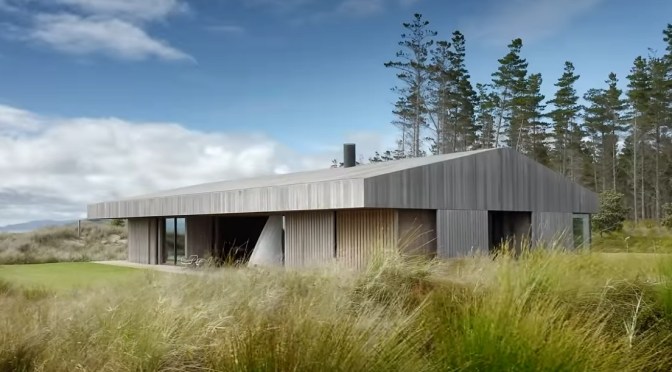
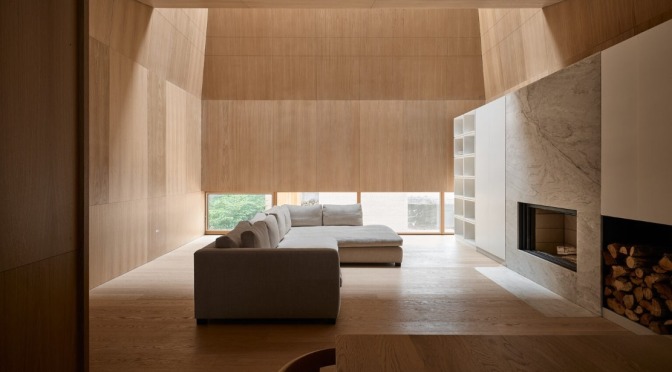
THE LOCAL PROJECT (January 31, 2025): Nestled between the forest and the ocean on the east coast of New Zealand’s North Island, Te Arai Beach House manifests as a contemporary cabin in the woods. “The power of the site when we first visited was in the ocean, the forest and the sand dunes.

Video timeline: 00:00 – Introduction to the cabin in the woods 01:27 – The early design discussions 02:12 – Interior designers own home 03:27 – The layout of the home 04:30 – A warm material palette 06:56 – Collaborating with artists 07:38 – Rewarding Aspects 08:08 – Proud Moments

So we wanted to provide a building that doesn’t challenge or reduce the sense of beauty that’s already there,” says Tim Hay, design director and co-founder at Fearon Hay. “We instantly looked, in terms of the architecture, to references that related to those different thresholds – the ability to emerge from the forest, discover the ocean, but still have a sense of protection,” notes Hay. “So this idea of the cabin in the woods was an idea that stuck from very early on.”

From afar, Te Arai Beach House appears to be a series of simple, unambiguous silhouettes. However, as one moves closer, complexity is revealed through blurred thresholds, operable screens and considered openings. The first building is a cabin that contains a garage and guest occupation. “This sits between an open space that frames a courtyard and the main building, which is set to the ocean, and is fundamentally a pair of open suites that capture an open plan living space between them,” explains Hay.
Architecture Tour: ‘OG House’ In Halifax, Canada

The Local Project (January 23, 2024) – OG House by Omar Gandhi is an architects own home in Halifax, the capital of the Canadian province of Nova Scotia. Defined by a deft understanding of light and form, it is a deeply personal home and a compelling piece of architecture, as seen in The Local Project’s house tour.

Video timeline: 00:00 – Introduction to the Architects Own Home 00:55 – The Family Centred Brief 01:58 – The Layout and Walkthrough of the Home 03:42 – A Focus on the Light and Sculpted Areas 04:28 – The Neutral Material Palette 04:59 – Customised Furniture Pieces 05:57 – Proud Moments and Favourite Aspects

As the project’s architect, Omar, says, the brief for this home was to create a house for his family as well as a new studio space for his budding practice. As it happens, his architecture studio grew rapidly over the course of the build, and as such, the ground floor studio space is now an extension of his original waterfront studio and a place to work on community projects with his team. This project illustrates a seamless understanding of how domestic and non-domestic principles can coexist within an architects own home.

The footprint of this house was heavily defined by the site and its setbacks from abutting properties and to the street. Cleverly, Omar has used these parameters to gently guide the architecture and ensuing build. In the house tour of an architects own home, Omar highlights the site’s various constraints, which have been reinterpreted as opportunities in designing a compelling piece of architecture. As Omar says, “the volume was resolved from the outset, so it became a process of articulation and sculpting, and in some cases, sacrificing overall square footage for moments of joy, delight and surprise.”

Pre-Fab Tiny Home Tours: ‘The Cutting’ In Australia

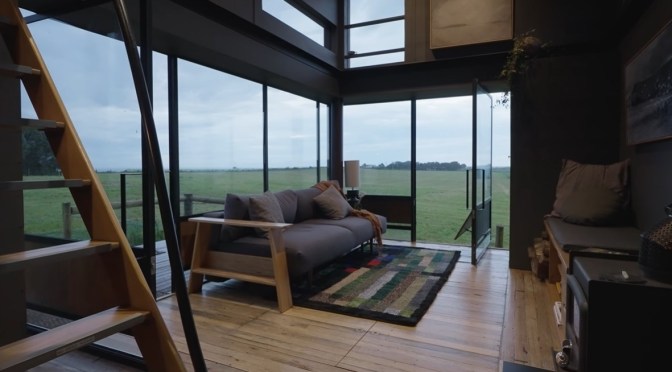
The Local Project – The Cutting by Small and Ample is a DIY pre-fab tiny home that encompasses sustainable living. Designed to shatter the idea that small homes cannot be generous, Aaron Shields, Director at Ample, and aspiring architect Nick Lane collaborate on The Cutting, a DIY pre-fab tiny home.

Video timeline: 00:00 – Introduction to the DIY Tiny Home 00:36 – The Brief – Small but Generous 00:54 – Situated on a Patch of Farmland with Views of The Cutting 01:11 – A Tour of the Tiny Home 02:30 – The Challenges in Designing a Small and Transportable Home 03:14 – A Reclaimed and Recycled Material Palette 03:35 – Textural Materiality 03:52 – The Aussie Shed

Promoting a better future with the idea that less is more, the designers have provoked others to think outside the box when crafting residential projects. Looking over The Cutting, an area where the sea cuts into the sand dunes, the home provides plentiful living within its 30 square meters. The house tour of the small home begins at arrival, with basalt pavers that lead up towards the DIY pre-fab tiny home. A set of steps – made from cow trough supports, reclaimed hardwood and perforated mesh salvaged from an old farm shed on the property – brings the occupants to the front door that pivots into the passive house.

Once inside, the kitchen, dining and living spaces are infused with warm timbers and bamstone cobbles, which together pare back the interior and tie the cabin into the surrounding landscape. At the south-western end of the DIY pre-fab tiny home, a double-glazed and steel window section with operable awnings allows for cross flow ventilation throughout the small home. Up on the mezzanine level, a study nook has been inserted into the floor and blurs the connection between upstairs and downstairs.

To cooperate with Victorian road rules, Aaron and Nick needed to design to specific dimensions in order to make the DIY pre-fab tiny home transportable. After collapsing the roof by 1500 millimetres, the small home can then be moved to its new location and settled on the land. With a hope to change the perception surrounding how homes can contribute to sustainability agendas, the designers use reclaimed materials. By doing so, every piece of furniture within the DIY pre-fab tiny home is built from reclaimed wood.

The floor is recycled iron bark, while many of the other timber elements have been sourced from other structures. Futhermore, the designers have championed the idea of the Australian shed with the use of timber and metal on the exterior, reflecting the history of the landscape. Overall, Aaron and Nick have created a modest home with an unexpected perceived spatial generosity that celebrates the value of materials.

Tours: Pepper Tree House In Unanderra, Australia

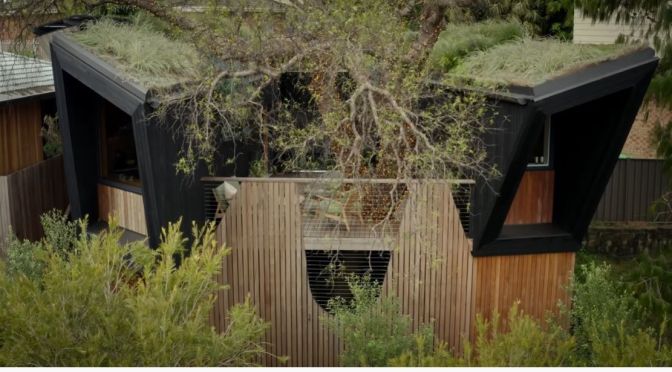
Creating a sustainable extension for the family home of client and builder Souter Built, Alexander Symes Architects motivates sustainable living through every detail. Featured as part of The Sustainability Series, Pepper Tree Passive House is a personal project crafted between cousins and sees the extension explore a passion for passive house and sustainable living.

Video timeline: 00:00 – Introduction 00:41 – Unanderra Country 01:12 – The Builder and The Owner 01:42 – Building Around The Pepper Tree 02:17 – A Walkthrough Pepper Tree Passive House 02:56 – A Two Fold Concept and Brief 03:22 – Exploring The Concept of A Passive House 03:43 – Using Resources In Respectful Ways 04:00 – Wood Is Good 04:31 -Using Minimal Intervention on The Existing Home 04:59 – The Challenges Faced 05:20 – The Positives of Being The Building & The Client 06:00 – Moments To Celebrate

Following a twofold brief, Alexander Symes Architect created an office space, guest house and entertainment area with recycled and renewable materials that echo the ethos of likeminded sustainable buildings. Extending the family home over a slopping landscape and around a tree protection zone, both architect and builder worked cohesively with each other to reflect the positive aspects of sustainable design. What transpired from this effort was an office space, living area, kitchen and guest living space that wrap around the home’s namesake, the pepper tree.

Covered by the canopy of the pepper tree, the garden was transformed, seeing hand-poured pavers lead guests up towards the passive house. Evidence of the passive house concept is also seen at the home’s entrance; wood and convict bricks are used similarly throughout the interior design, seeing sustainable living enhanced through natural thermal heating and cooling. Due to its north-facing position, the convict bricks add a thermal structure throughout, soaking up the natural heat of the sun, whilst the shade of the canopy does the same in the warmer months.

From planning to building to completion, Pepper Tree Passive House passionately showcases the skillset required for sustainable living, alongside Souter Built’s philosophy for sustainable building. Through the architecture and design choices, guests and clients alike can see firsthand how using recycled materials, instead of depleting natural resources, can leave a better footprint for the future of sustainable buildings.

Home Design: ‘Wyoming House’ In Kew, Australia

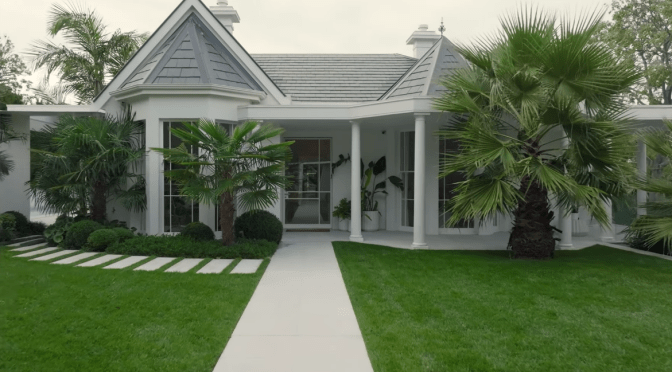
Embodying a specific set of client stipulations, Wyoming is a modernist-inspired home with innate flexibility. Crafted by Inarc Architects, the open plan residence exceeds expectations for a house of its kind. Located in the Victorian suburb of Kew, in close proximity to the Yarra River,

Video Timeline: 00:00 – The Local Project’s Print Publication 00:14 – Introduction to Wyoming 00:55 – A Walkthrough Wyoming 01:11 – Melbourne and Metropolitan Board of Works Plan from 1911 01:29 – Sticking to A Strict Brief 02:14 – Matching Old to New 02:50 – Interior Lighting 03:21 – Creating A Gallery Space 04:12 – Adopting Modernist Principles 04:50 – Inarc’s Favourite Aspects of Wyoming 05:42 – Subscribe to The Local Project’s Print Publication

Wyoming stands as a rejuvenated dwelling. Originally built in 1911, the settlement of the modernist-inspired home proposes the unique experience of feeling close to the city whilst accessing the countryside lifestyle. The clients requested that the modernist-inspired home include areas for entertaining. To this end, Inarc Architects reimagines the original front rooms of the house as entertainment spaces which flow to the modern addition. In response to the clients’ passion for the outdoors,

Inarc Architects reinforces the sense of privacy attached to the garden space. An old hedge on the northern boundary is replaced by one of a similar style, exuding a sense of visual protection. Aesthetically, the modernist-inspired home champions white, as per the client’s request. White honed granite floors combine with classic Italian carrara to establish the limited colour palette.

Benefitting from meticulous spatial planning – both indoors and out – Wyoming offers a flowing, effortless living experience. Inarc Architects answers the clients’ requests with rigour, resulting in a highly-personal, modernist-inspired home.

Design Tour: Crown Jewel Penthouse In Canberra

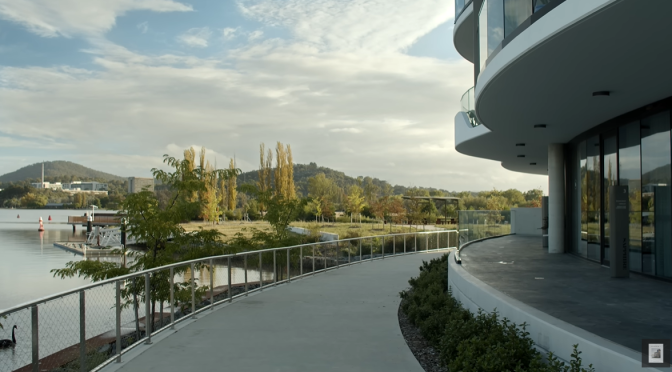
Named in relation to its amazing city views, Crown Jewel is a luxury penthouse capturing some of Canberra’s most striking vistas. Inside a penthouse crafted by Parallel Workshop Architects, residents are immediately met with a strong sense of natural connection.

Video timeline: 00:00 – Introduction to the Penthouse 00:30 – Creating the Clients Dream Home 01:01 – Incorporation of the Natural Landscape 01:15 – Catering for Different Occasions 01:44 – Referencing the Structural Architecture 02:05 – Creating a Kingdom from the Penthouse 03:10 – The Design Strategy 03:29 – Favourable Aspects of the Penthouse 03:52 – The Freedom of Design

Situated on the southern shore of Lake Burley Griffin in Canberra, Crown Jewel is one of six penthouses in the lavish Sapphire development. From inside a penthouse, occupants can enjoy amazing city views including those of Lake Burley Griffin, Kingston Harbour and the lush wetlands. A tranquil experience inside a penthouse often begins with the occupant feeling settled in place.

Parallel Workshop Architects connects residents to the character of Canberra by reflecting elements of the natural landscape in the architecture and interior design of the home. While joining the apartment to its natural context, Parallel Workshop Architects pays homage to the clients’ request for luxury inside a penthouse. The deep, rich colours of the Australian landscape are featured in the immersive architecture and interior design, including the navy furnishings, muted green finishes and consistent interplays of light and dark grey.

Translating both the surrounds and design brief into a cohesive architectural outcome, Parallel Workshop Architects establishes a family life in place. Functional and aesthetically generous, Crown Jewel is equipped to provide for multiple generations, fostering an authentic love for living inside a penthouse in Canberra.

Australian Architecture: ‘Fitzroy Bridge House’

A modern house, Fitzroy Bridge House is a work of collaboration led by Matt Gibson Architecture + Design. Featuring a glass bridge – from which the project receives its name – the home emerges as a considered and personal dwelling that celebrates its older architectural elements.

Video timeline: 00:00 – The Local Project’s Print Publication 00:20 – The Name Behind Fitzroy Bridge House 00:57 – South Fitzroy Heritage Precinct 01:36 – Moving Through the Home 01:53 – Dissolution of Interior and Exterior 02:16 – The Bridge 02:40 – The Rear Retreat 03:14 – Involvement of the Clients and Their Non-Negotiables 03:57 – Key Sustainable Moves 04:51 – The Cellar

Located in the southern Fitzroy heritage precinct, Fitzroy Bridge House sits an enviable two kilometres from the Melbourne CBD. The residence occupies a long, thin site and is comprised of distinct pavilions, encapsulating both the pre-existing architecture and the work of the modern house.

As Fitzroy Bridge House is situated in a heritage overlay, the exterior of the home could not be altered in relation to the front two rooms. Entering the home, residents move through the Victorian-style environments before reaching the rear architecture of the modern house that features a refined internal courtyard settled into the dining room interior design.

Connecting two pavilions, the glass bridge forms the focal point of the modern house. The bold feature provides a view down to the manicured garden in the Japanese-inspired courtyard – a fine work of landscape architecture requested by the client and executed by Robyn Barlow. A product of collaboration, Fitzroy Bridge House is closely connected to the client. Warm, inviting and personal, the modern house expresses its own built narrative, enabling the client to retell the story of its creation for years to come.

Home Design: Crane Lodge In Palm Beach, Australia

A luxury getaway home settled on a unique site, Crane Lodge immerses visitors in its natural context. Designed by Secret Gardens, the landscape architecture of the home enhances the sensory experience of the outdoors.

Video timeline: 00:00 – Crane Lodge as an Experience 00:44 – The Client’s Vision 01:05 – The Garden and The Setting 01:58 – Lodged Unusually High 02:21 – The Inclusion of Amenities 02:37 – The Team Involved 03:04 – Major Site Components 03:34 – A Strong Connection to The Outdoors 03:49 – A Natural Watering Hole 04:28 – Sympathetic Materials and Beautiful Features

Located in the Sydney suburb of Palm Beach, Crane Lodge sits on an elevated site. The design brief for the landscape of the luxury getaway home centred on creating a sense of arrival whilst allowing access to the house across the terrain. Employing an inclinator, Secret Gardens instils the arrival process with a sense of anticipation and discovery.

Many endangered species of plant are championed in the landscape design of the luxury getaway home and are designed to appear slightly unkempt. Secret Gardens also includes indigenous plants for cooking and educational purposes. A smattering of boulders surrounds the luxury getaway home, contributing to the impressive character of its external environment.

Secret Gardens purposefully positions the swimming pool adjacent to boulders, creating the impression that the amenity emerged naturally. The materials chosen for the landscape architecture of Crane Lodge express a sympathetic approach to nature. As a result, the luxury getaway home entirely embraces its context, with a landscape design that captures the essence of a bushwalk experience.

Australian Architecture: Rose Park House, Adelaide

Rose Park House is a luxury house designed to create a journey of discovery. Carefully crafted by studio gram, the robust residence represents a legacy project for the clients; a home to last a lifetime and house generations to come.

Video timeline: 00:00 – The Local Project Print Publication 00:16 – Introduction to Rose Park House 00:40 – A Legacy Project 01:06 – The History of The Queen Anne Villa 01:29 – Materials and Architecture That Leave a Legacy 02:26 – A Wine Room for the Ages 03:02 – Key Components of The Extension 03:40 – Practical and Fully Accessible 04:14 – Longevity & Long Lasting Relationships 04:53

Sitting at the fringe of the Adelaide Park Lands, Rose Park House is the final architectural project to be initiated by the clients. The design brief for the luxury house entailed a structure that could stand the test of time and was a reimagination of the existing residence which was originally built in the 1900s.

Studio gram selects durable materials for Rose Park House. Dark-toned limestone and American walnut speak to a sense of longevity and visually contrast the bright natural light that fills the internal spaces. An investigation of the pre-existing home revealed architecture comprised of off-form concrete. The modern extension of the luxury house continues the materiality of the original dwelling.

Rose Park House is also designed with a focus on accessibility. Accessible ramps, flush thresholds and wide apertures are featured in consideration of occupants who use wheelchairs. Smoothly integrated into the overall scheme, the features demonstrate that in a luxury house, form and function are not necessarily conceived as competing interests.

As a luxury house, Rose Park House is imbued with a feeling that is almost ineffable; a feeling of permeating goodness and rightful being. Achieving longevity and timelessness, studio gram crafts a luxury house with a growing legacy.

Architecture Tour: Light Scoop House In Australia

Situated on a site measuring only 6 metres wide, Light Scoop House required a compelling architectural response. As is necessary when an architect designs a narrow home, Molecule Studio enables function in a compact space, crafting a serene residence well-suited to the lifestyle of the client. Understandably, when an architect designs a narrow home, access to natural sunlight is given high priority.

00:00 – The Local Project Print Publication 00:18 – Introduction to a Narrow Home That is Only 6 Meters Wide 00:47 – The Clients Original Goal 01:06 – The Architects Pre-Design Process 01:25 – Zen Vibes and Interconnected Design 02:05 – Behind the Narrowness of The Home 02:39 – Landscape Courtyards and Garden Connection 03:06 – Architectural Elements within The Home 03:37 – Central Materials and Their Links to Light 04:46 – Achievements of The Original Brief 05:54 – Subscribe to The Local Project Print Publication

Located in the bay-side suburb of Brighton, Light Scoop House is named in reference to its tapered-edge pavilion roofs which pull natural light into the home and lift the gaze upwards. If an architect designs a narrow home without considering the lifestyle of the occupant, the design will not succeed. Molecule Studio thoroughly examines the personal likes, dislikes and daily habits of the client, producing a tranquil home that captures sunlight across its textural surfaces. Molecule Studio punctuates the spatial plan of Light Scoop House with landscaped courtyards. In doing so, the architect designs a narrow home that fosters a distinct feeling of retreat, effortlessly connecting the occupant to nature. Light Scoop House demonstrates that when an architect designs a narrow home, the outcome can exceed expectations. Using a limited materiality, Molecule Studio creates a sense of calm and careful construction that extends far beyond the demands of the brief. 00:00 – The Local Project Print Publication 00:18 – Introduction to a Narrow Home That is Only 6 Meters Wide 00:47 – The Clients Original Goal 01:06 – The Architects Pre-Design Process 01:25 – Zen Vibes and Interconnected Design 02:05 – Behind the Narrowness of The Home 02:39 – Landscape Courtyards and Garden Connection 03:06 – Architectural Elements within The Home 03:37 – Central Materials and Their Links to Light 04:46 – Achievements of The Original Brief 05:54 – Subscribe to The Local Project Print Publication