Tag Archives: The Guardian Weekly

Previews: The Guardian Weekly – March 3, 2023

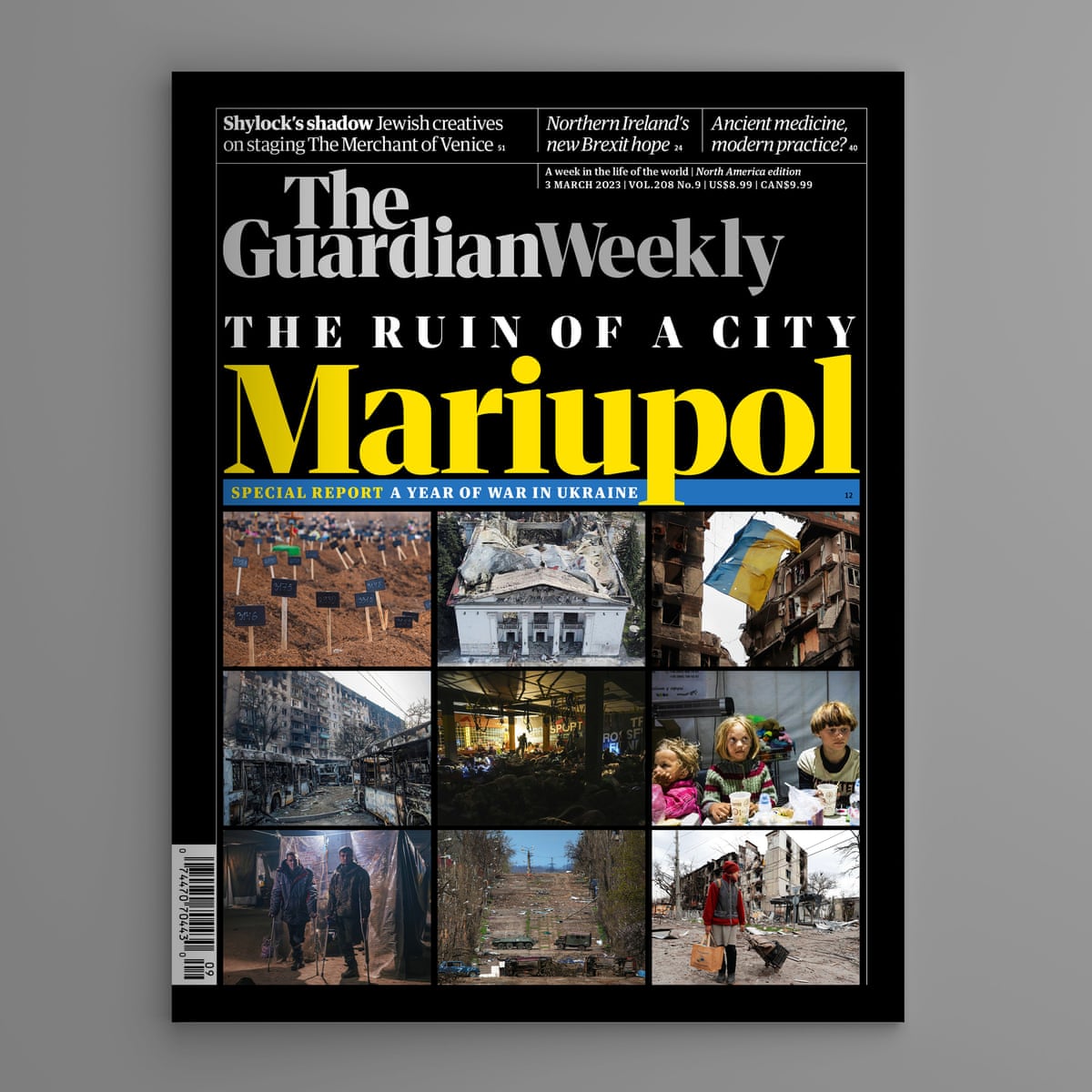
The ruin of Mariupol: inside the 3 March Guardian Weekly | Ukraine | The  Guardian

The Guardian Weekly (March 3, 2023) – A year on from the invasion of Ukraine and there seems little end in sight to a conflict that has, unquestionably, changed the world. The Guardian Weekly’s big story this week outlines five possible routes to peace (some more hopeful than others), but the main focus is a stunning collaboration from Guardian reporters detailing the fate of the port of Mariupol, the battle for which has perhaps been the bloodiest and most shocking chapter of the war to date.

It’s an extraordinary account of the devastation, partial reconstruction, and Russification of a thriving city. “You learn to only voice your opinions with those you know you can trust,” says Darya, a student opposed to the occupation. “Otherwise, you keep your thoughts to yourself.”

On Monday the UK government finally agreed a deal with the EU to end a long-running Brexit dispute over customs arrangements and legal oversight in Northern Ireland. Our Brexit correspondent Lisa O’Carroll unpicks the key points of the new agreement and what it means for the region.

In 2003, when the US army occupied Iraq after the fall of Saddam Hussein, the Guardian writer Ghaith Abdul-Ahad was aged 28 and living in Baghdad. He recounts his front-row view of the fall of the regime, the arrival of the so-called liberators and the unfolding of a sectarian war.
Previews: The Guardian Weekly – February 24, 2023

Image

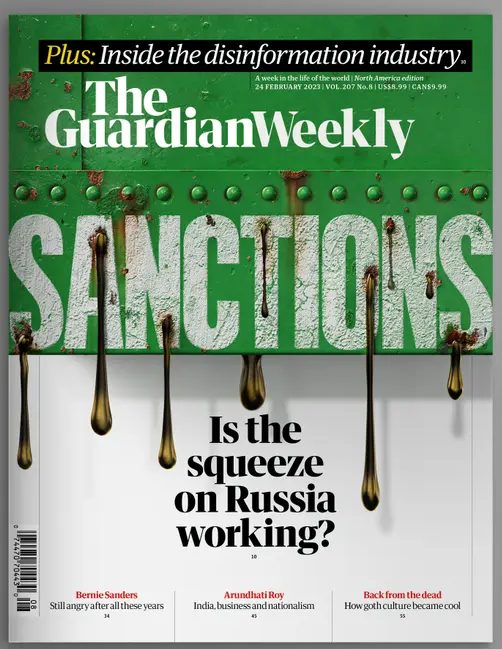
The Guardian Weekly 24 February 2022 – exactly a year since the date of this week’s Guardian Weekly magazine – Vladimir Putin unleashed his brutal offensive on Ukraine. As our senior international affairs correspondent, Emma Graham-Harrison, wrote in the following day’s Guardian newspaper: “The continent awoke to the shock of scenes it once believed it had left in the 20th century: helicopters strafing homes outside the capital, long lines of tanks ploughing ever deeper towards Ukraine’s heartland, roads choked with refugees, and civilians huddled in underground stations to escape bombardment.”

Much has been written since then about the state of the war and how it might end, but this week we focus on a key plank of the west’s response: the wide-ranging economic sanctions against Moscow that it was hoped would throttle Putin’s war effort.

Previews: The Guardian Weekly – February 10, 2023

Image

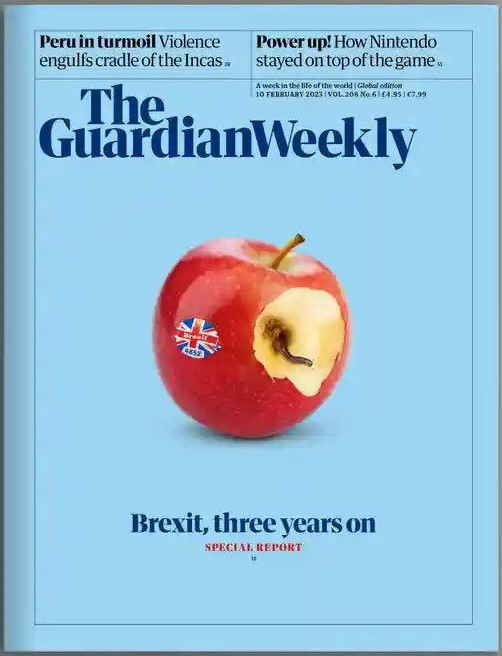
The Guardian Weekly (February 10, 2023) – Three years have passed since Britain officially left the European Union, but the country feels a long way from the “sunlit uplands” once memorably envisioned by Boris Johnson. Indeed, according to several polls released last week, more of the British population than ever are unhappy with the outcomes of Brexit – including, crucially, those who voted for it in the first place.

The Observer’s Michael Savage and Toby Helm consider what’s behind the upsurge in “Bregret” and ask what realistic hopes exist of Britain ever returning to the bloc. Then, opinion writer Nesrine Malik warns that, while many on the left may see validation in the current trends, it’s important to understand many of the UK’s structural problems stem from before the time of the Brexit referendum in 2016.

Previews: The Guardian Weekly – February 3, 2023

Boomers Daily | News, Views and Reviews for the 55+

The Guardian Weekly (February 3, 2023) – In the trenches of eastern Ukraine, much of the conflict with Russia has been frozen for several months now. But, as the northern winter moves on, that could be about to change. The initial invasion has been followed by a period of attrition, and a third phase of the war now appears imminent.

Military activity along parts of the front is increasing and it is assumed that, sooner or later, one side will try to break the deadlock. The question, as Julian Borger writes this week for the Guardian Weekly magazine’s big story, is who will strike first and where?

As Julian explains, it is likely to be “an all-out battle for decisive advantage using combined arms … to overcome fixed positions. Europe has witnessed nothing of its sort since the second world war.”

That’s not to say there aren’t signs of anxiety among Ukraine’s regional allies, though. Germany’s decision last week to send its Leopard tanks to Ukraine may yet prove critical in the coming battle, but as German journalist Jan-Philipp Hein points out, Berlin’s military support for Kyiv remains far from wholehearted.

In the UK, the sacking of Nadhim Zahawi as Tory chairman over an undeclared tax dispute while he was the chancellor (and thus in charge of tax collection) kept the pressure on prime minister Rishi Sunak, political editor Pippa Crerar reports; while in Opinion, Nesrine Malik says the episode reveals much about Britain’s networks of power and influence.

Previews: The Guardian Weekly – January 27, 2023

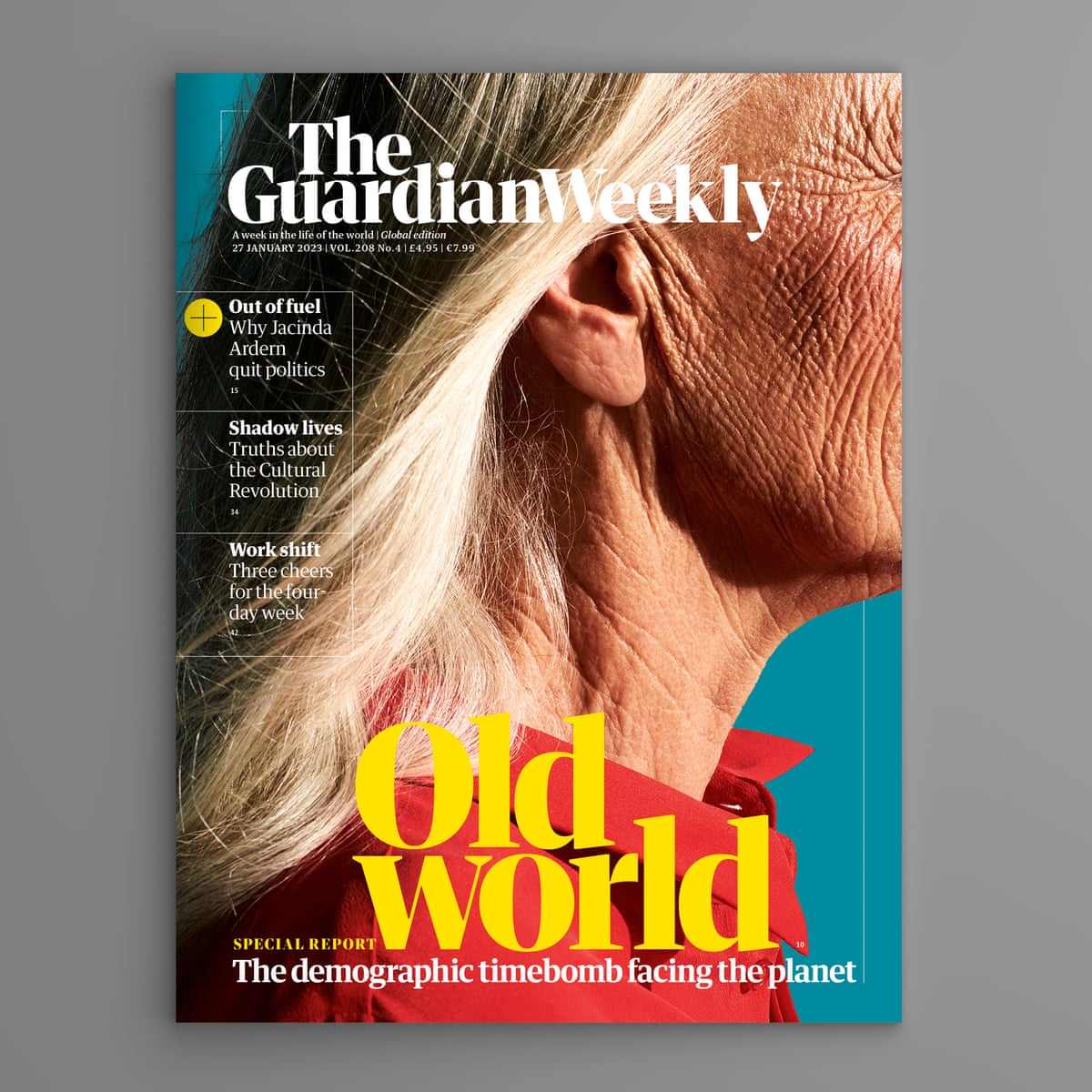
Old world – Inside the 27 January Guardian Weekly | Population | The  Guardian

The Guardian Weekly – January 27, 2023 Issue:

It’s an age-old question: how should nations around the world adjust to their elderly societies? Japan has faced such realities for a while now, but the challenges are becoming increasingly common across the developed world where families are getting smaller, and people are living longer.

Even India – which will soon overtake China as the world’s most populous country – is now seeing an older demographic become more prevalent in some states. The countries of sub-Saharan Africa, meanwhile, look most likely to enjoy the benefits of a younger population as the century progresses. For the Guardian Weekly magazine’s big story this week, Emma Graham-Harrison and Justin McCurry assess what ageing populations hold in store for the world. And Verna Yu reports on the reasons why many young people in China seem reluctant to start families.

Previews: The Guardian Weekly – January 13, 2023

Image

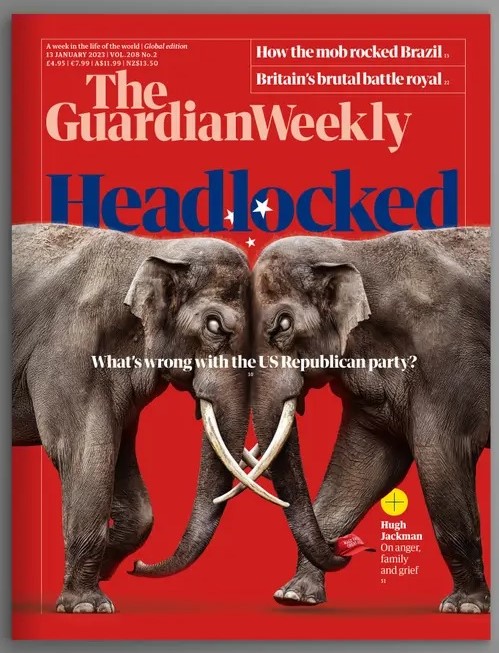
The Guardian Weekly (January 13, 2023) – In Washington, the new Republican majority in the House of Representatives took 15 attempts just to fulfil its primary duty of appointing a speaker. Kevin McCarthy eventually squeaked through by four votes, after quelling a days-long revolt from a bloc of far-right conservatives. But, with a wafer-thin majority, and few powers, Nancy Pelosi’s successor looks set to be one of the weakest speakers in history.

For our big story, Washington bureau chief David Smith examines the chaos within Republican ranks and what it means for the party. It’s a theme picked up for this week’s cover by illustrator Justin Metz, who took the traditionally harmless-looking motif of the Republican elephant and turned it into something altogether more confrontational.

In Brazil, meanwhile, supporters of the former president Jair Bolsonaro stormed congress buildings in scenes eerily reminiscent of Washington on 6 January 2021. Latin America correspondent Tom Phillips reports on a dark day for Brazilian democracy, while Richard Lapper considers the potential fallout for the new president, Luiz Inácio Lula da Silva, and a deeply fractured nation.

There’s a feast of great writing elsewhere in this week’s magazine. British food writer Jack Monroe, who taught us how to eat well on a shoestring, opens up to Simon Hattenstone about her struggles with addiction.

And Chris Stringer, who has received a CBE for his work on human evolution, tells how his remarkable quest as a young researcher transformed understanding of our species.

Previews: The Guardian Weekly – December 23, 2022

The cover of the 23 December edition of the Guardian Weekly.

The Guardian Weekly (December 23, 2022) issue:

As we near the end of another tumultuous year, one story has dominated the news agenda on almost every level. Vladimir Putin’s invasion of Ukraine in February had been signposted for months, but the shattering of Europe’s postwar order still came as a seismic shock.

The economic and human cost inflicted by Russia on Ukraine has been enormous, while the concurrent shock waves of energy, food and migration crises have reverberated around the world. In a special essay for the final Guardian Weekly magazine of 2022, diplomatic editor Patrick Wintour examines the competing grand narratives of the past that lie at the heart of the conflict – and which make it so difficult to resolve.

In other reflections on 2022, we look back at a year of scientific successes, from medicine to mathematics via the moon. From the Observer, we remember those we lost over the course of the year, by those who knew them best. There’s a stunning photo gallery featuring work from the agency photographers of the year, and a comprehensive look at the best film and music of 2022 – not forgetting the now traditional roundup of the Guardian Weekly team’s must-see TV.

From Montreal came some hopeful news to round off an otherwise alarming year for the environment. The Cop15 biodiversity summit reached international agreement to try to halt the destruction of Earth’s ecosystems, including targets to protect 30% of the planet for nature by the end of the decade and restore 30% of degraded water, coastal and marine ecosystems. Biodiversity reporters Patrick Greenfield and Phoebe Weston have the details.

Previews: The Guardian Weekly – December 16, 2022

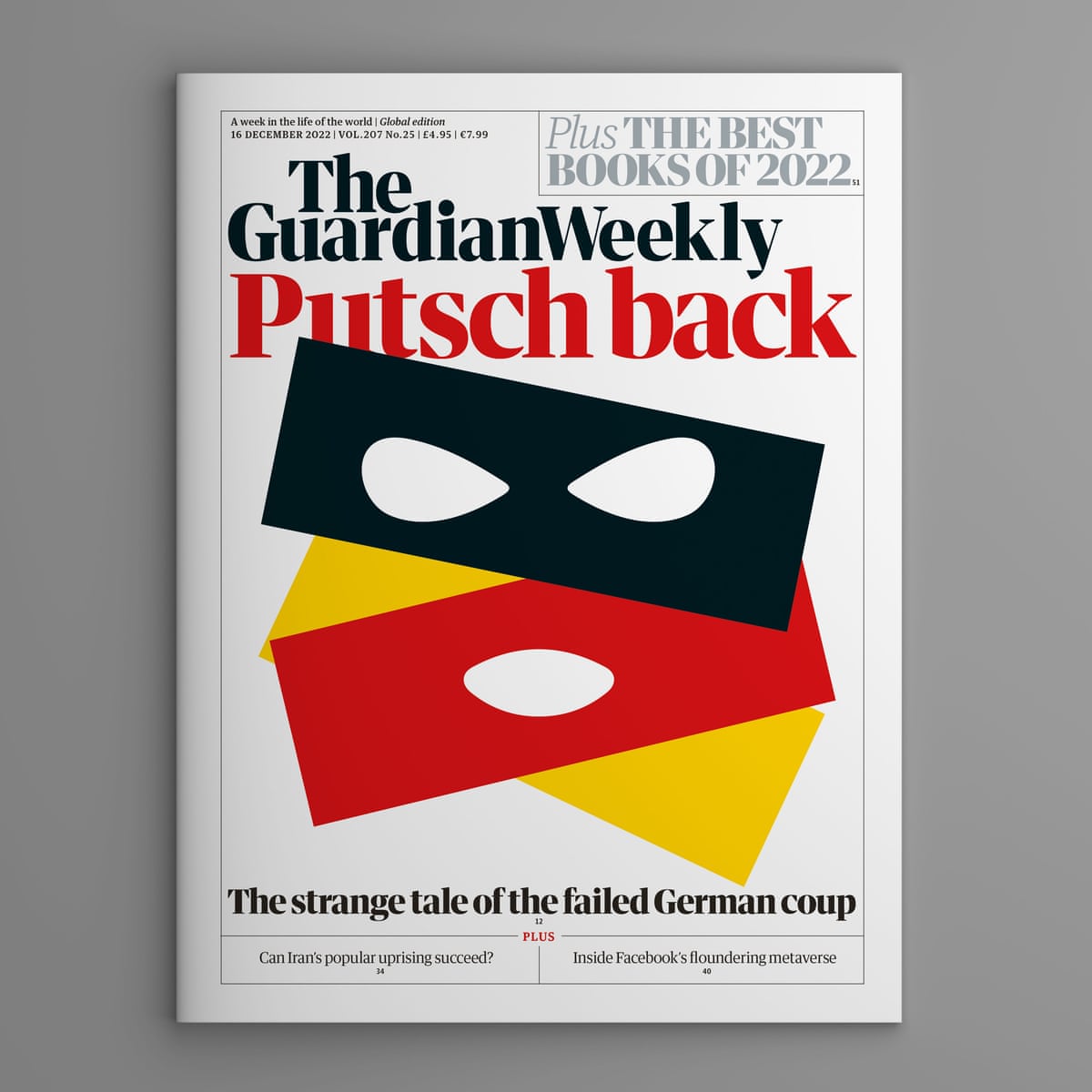
Putsch back – Inside the 16 December Guardian Weekly | Germany | The  Guardian

The Guardian Weekly (December 16, 2022): In  Germany, 25 conspirators were arrested and accused of plotting to overthrow the government. The eclectic grouping, known as the Reichsbürger plotters, espoused a far-right ideology but hailed largely from the centre of respectable German society, headed up by an elderly minor aristocrat and including in their ranks family doctors, judges, a celebrity chef and an opera singer.

Three months have passed since fervent anti-regime demonstrations began in Iran. As more grim details emerged of public executions of protesters and the grotesque targeting of women by security forces, Christopher de Bellaigue takes a deep look at the movement, in particular the role played by women and young people, and asks what it might take for a popular revolution to succeed.

Mark Zuckerberg, the CEO of Meta (formerly Facebook) has spent $100bn building a virtual reality world known as the metaverse, which he believes will replace the conventional internet. The problem is, hardly anyone seems to prefer its clunky headsets and empty landscapes to the real world. With poor financial results and redundancies at Meta, has it all been a hugely expensive mistake? Steve Rose ventures into the metaverse, so you don’t have to.

Previews: The Guardian Weekly – December 2, 2022

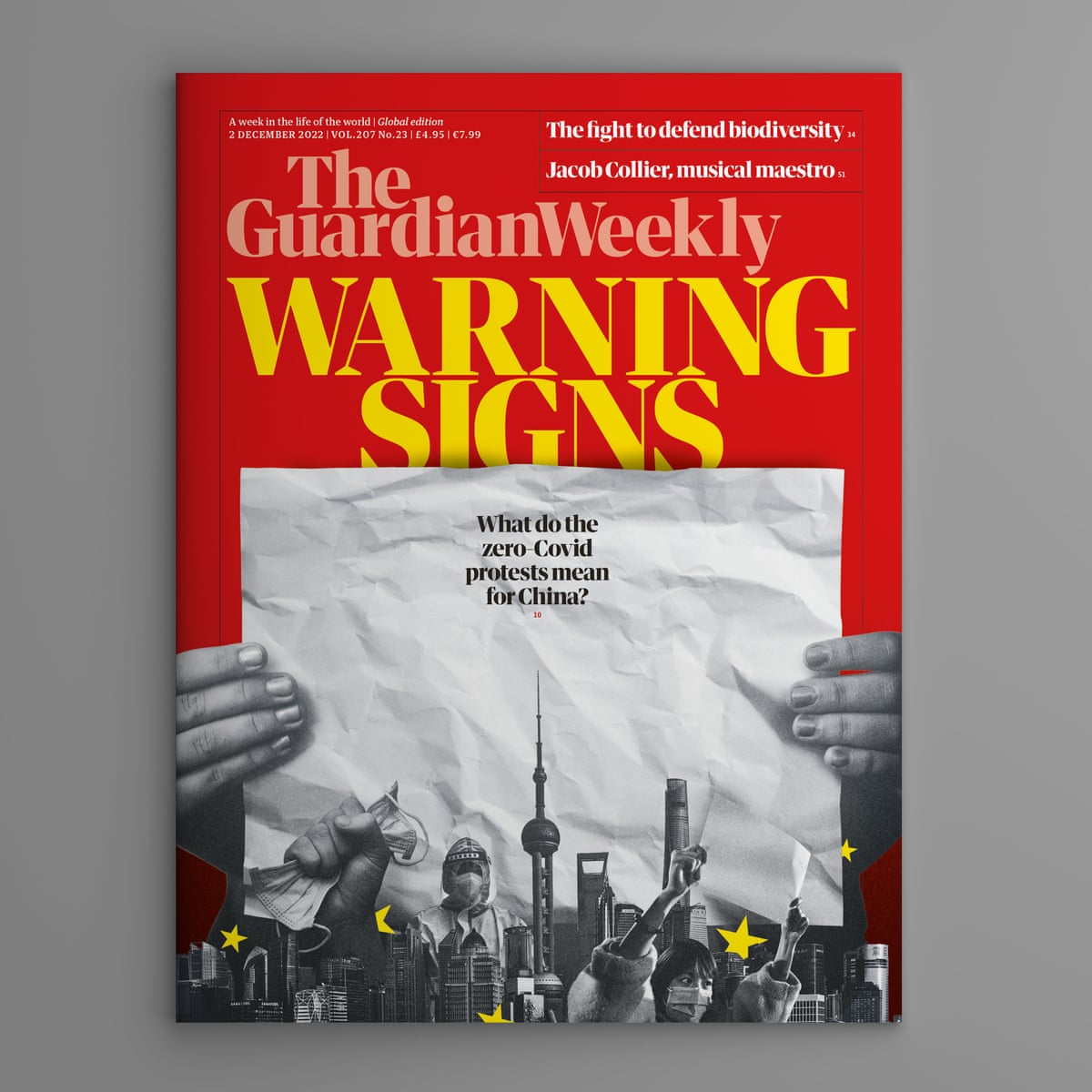
Warning signs: inside the 2 December Guardian Weekly | China | The Guardian

Warning signs: inside the 2 December Guardian Weekly | China | The Guardian

Discontent over China’s zero-Covid suppression policy came to a head last weekend in a series of unprecedented protests across the country. The civil disobedience – remarkable just for the fact it was happening at all in a state where such behaviour is rarely tolerated – seemed to have been smothered by police by the start of the week. Even so it revealed to the world signs of a hitherto unseen fracture in China’s totalitarian political system.

From one Cop to another: hot on the heels of the recent climate conference comes this month’s global summit on biodiversity, which is being held in Montreal. To set the scene, biodiversity reporter Phoebe Weston explains how the damage done to the natural world is a tale of decline spanning thousands of years. Can delegates at Cop15 seize their chance to change the narrative?

With five Grammy awards off the back of four albums spanning everything from folk to jazz and pop, the British multi-instrumentalist Jacob Collier is a global phenomenon. But despite being feted by music royalty including Stormzy, Chris Martin and Herbie Hancock, the 28-year-old has kept a relatively low profile. Global music critic Ammar Kalia takes a trip into Collier’s colourful, polyharmonic world of quarter-tones and non-standardised pitch.

Previews: The Guardian Weekly, November 25, 2022

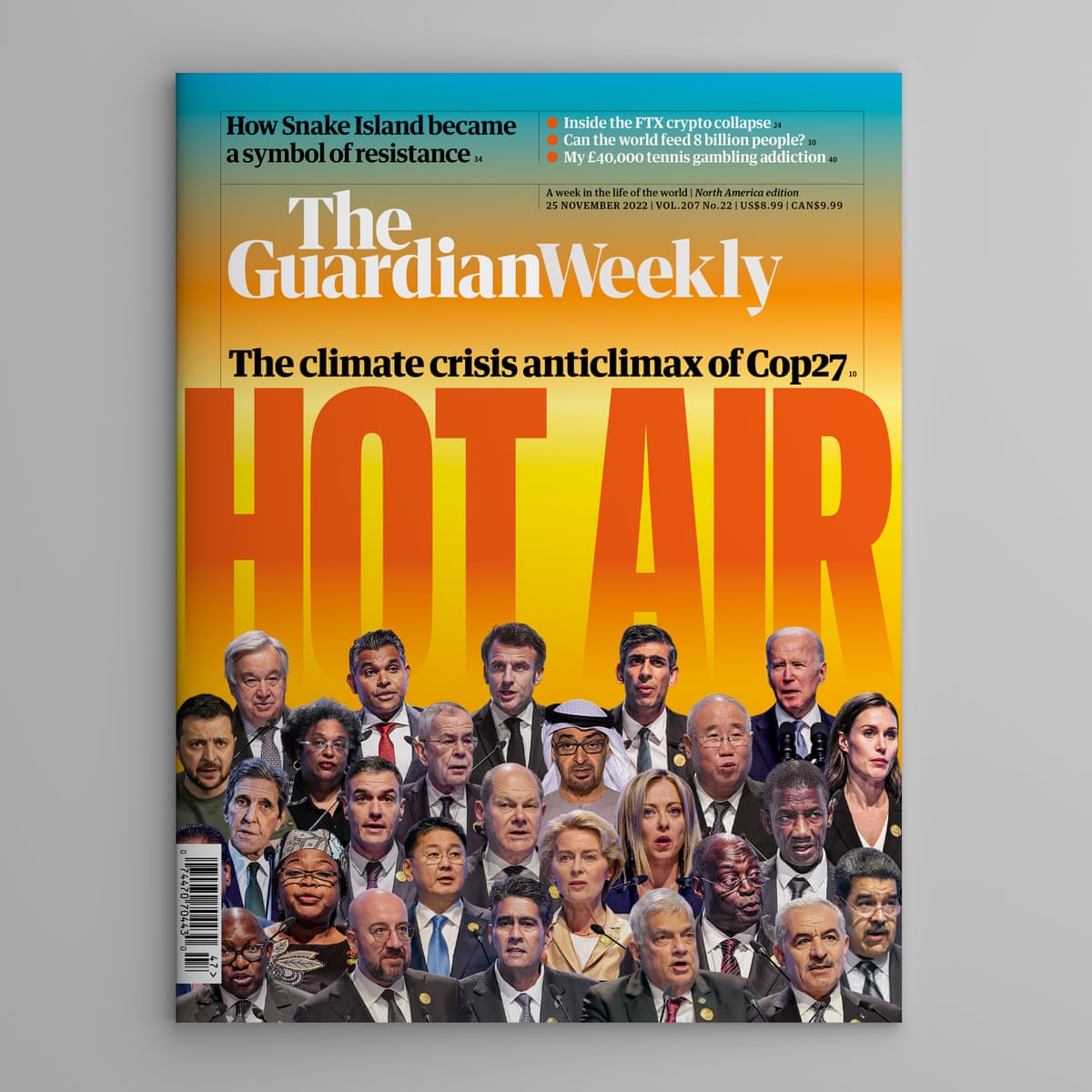
Cop27's climate anticlimax: inside the 25 November Guardian Weekly | Cop27  | The Guardian

Cop27’s climate anticlimax: inside the 25 November Guardian Weekly | Cop27 | The Guardian

Cop27 ended in a now-traditional blur of last-minute horse-trading, resulting in the welcome agreement of a finance deal for developing countries affected by global heating. But progress on eliminating fossil fuel usage – the key to slowing climate change – again seemed beyond the international community.

As winter descends on Ukraine, we focus on some of the war’s ripples around Europe. Jennifer Rankin reports from Antwerp, where the continued trade in Russian diamonds shines a light on loopholes in EU sanctions on Moscow. And Emma Graham-Harrison is in eastern Poland, where people’s proximity to the war is helping people to put aside past differences.

Then, in features, Luke Harding speaks to the Ukrainian defenders of Snake Island – who famously sent an expletive-laden rebuttal to a Russian warship at the start of the conflict – and finds out what happened next.