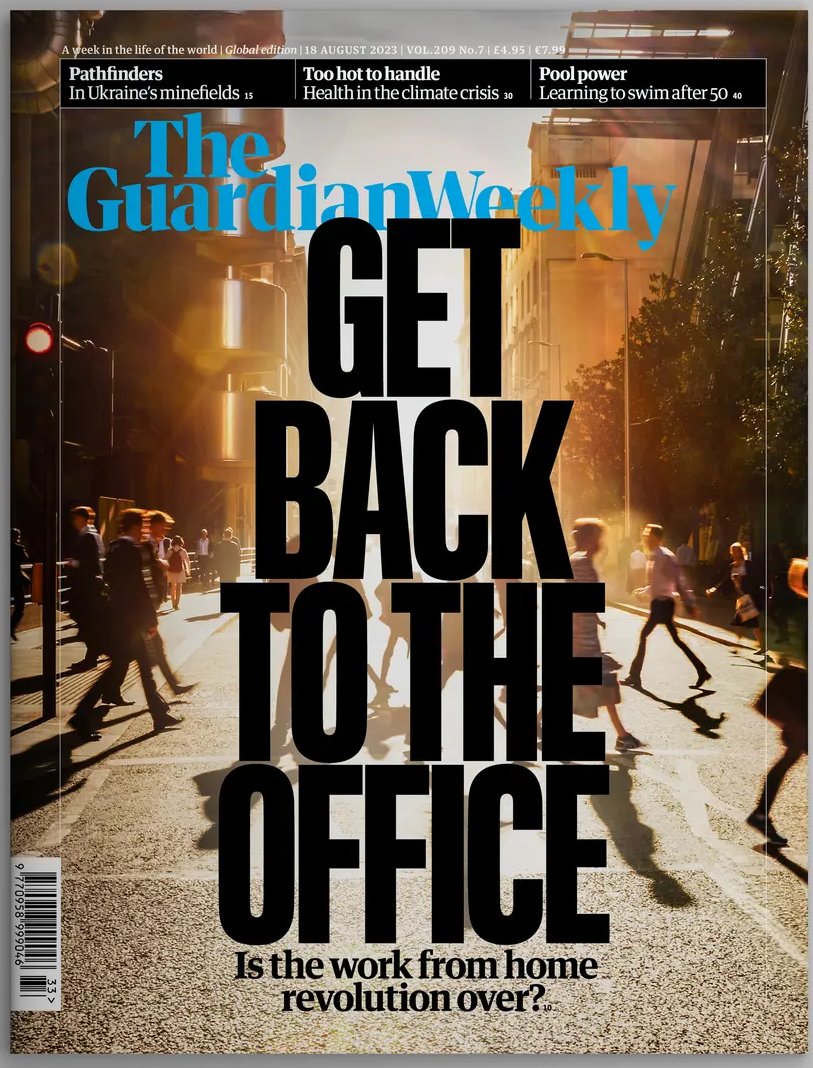
The Guardian Weekly (August 18, 2023) – This issue features ‘Back to the office: Is the work from home revolution over?’; Bangladesh’s ‘lost children’; AI does architecture; Pathfinders – In Ukraine minefields and more…
With even the big internet firms warning staff they need to show up more often, is working from home over? Or have the attitudes and expectations of employees changed for ever?
For years, Bibi Hasenaar felt rejected because she was adopted aged four. Then she saw a photo that described her as missing – and began to uncover an astonishing dark history
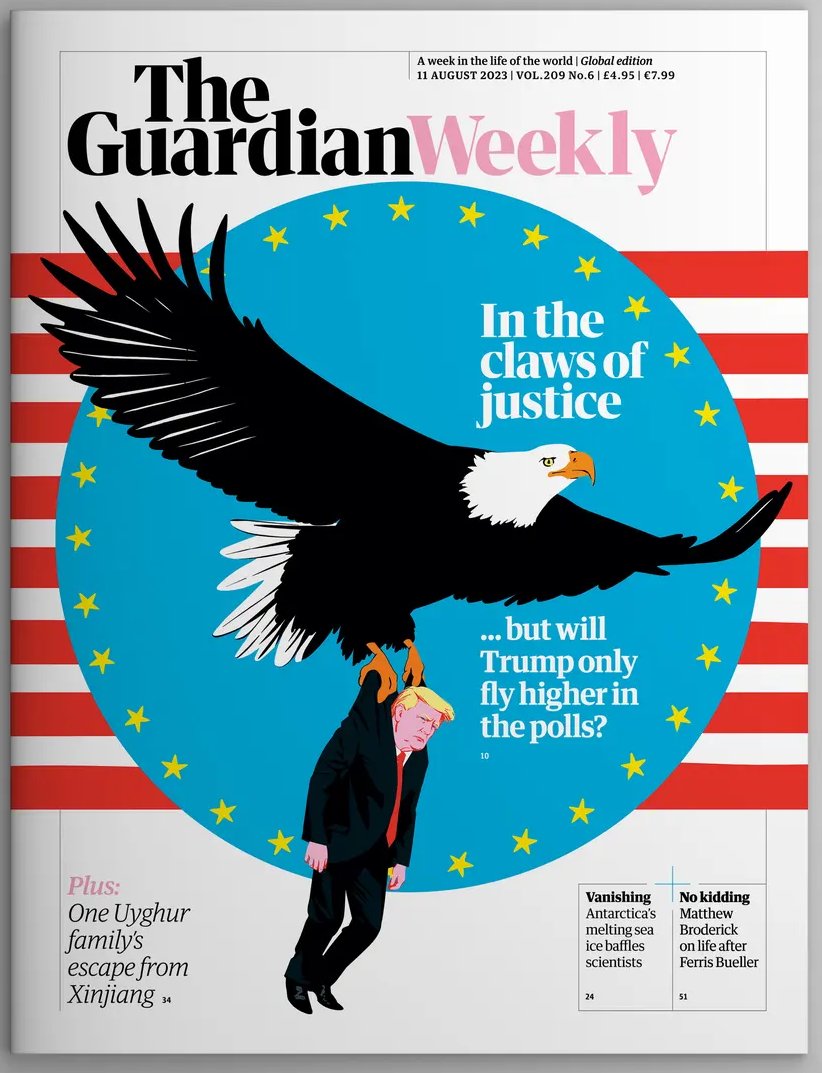
The Guardian Weekly (August 11, 2023)– The issue features Trump playing the victim, escape from Xinjiang, a day off with Matthew Broderick and more…
Donald Trump’s appearance in court in Washington last week to plead not guilty to his third indictment on criminal charges showed how the 45th president of the United States continues to defy every law of political physics.Washington bureau chief David Smith explores how playing the political martyr only firms up support for Trump to be the Republican candidate in the 2024 presidential race and silences critics within his party as well as among Democrats. We profile Trump’s new nemesis, prosecutor Jack Smith, while reporter Chris McGreal takes the temperature among voters in Iowa where the first Republican caucus will take place in January next year.
There have been few authoritative accounts of China’s persecution of the Uyghur people and the repression of their culture in Xinjiang province.Our main feature is an extract from poet Tahir Hamut Izgil’s memoir that details how, seeing the crackdown intensify and friends arrested, he planned to escape knowing that he dare not even say goodbye to his parents.
As the Hollywood industrial action continues, actors and directors have withdrawn from promoting their work, but luckily for Culture Xan Brooks caught up with Matthew Broderick just before the strike was called.He talks about his role as Richard Sackler in the new Netflix drama about the OxyContin scandal, playing opposite his wife, Sarah Jessica Parker, on stage and why escaping his legacy as Ferris Bueller is not an option.
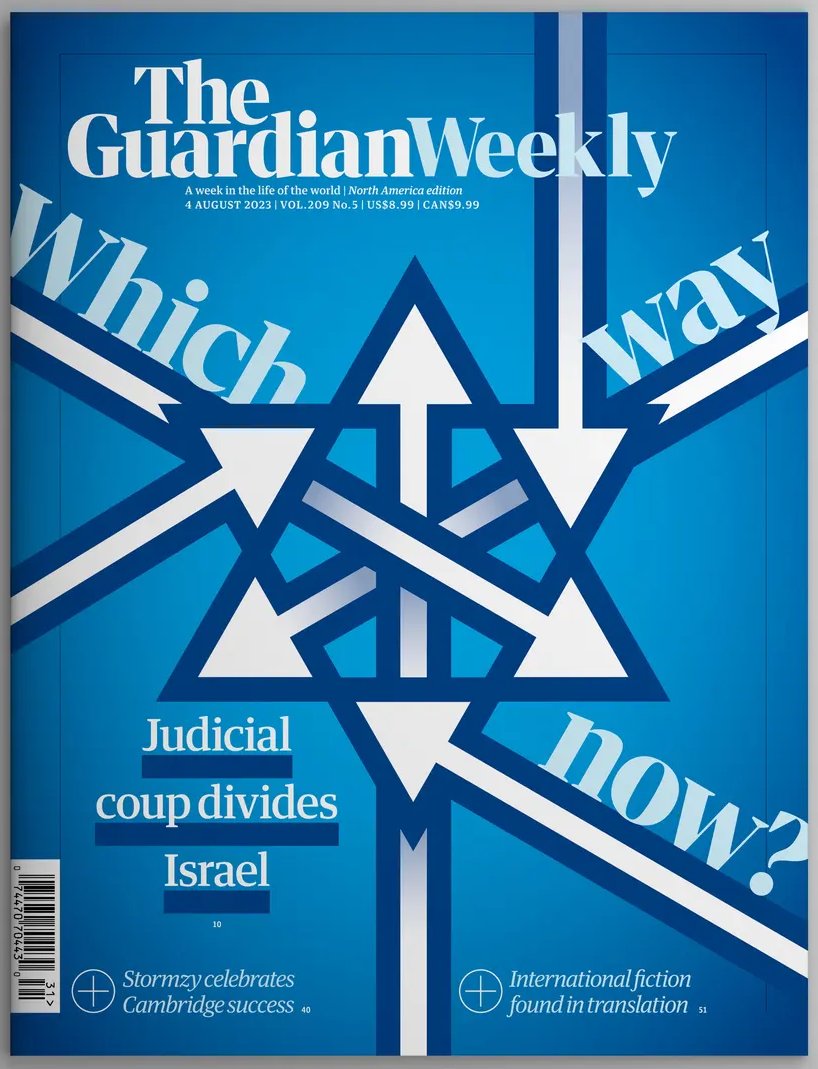
The Guardian Weekly (August 4, 2023)– Israel in turmoil: Netanyahu’s judicial coup; Stormzy’s scholarship graduates; International fiction found in translation, and more…
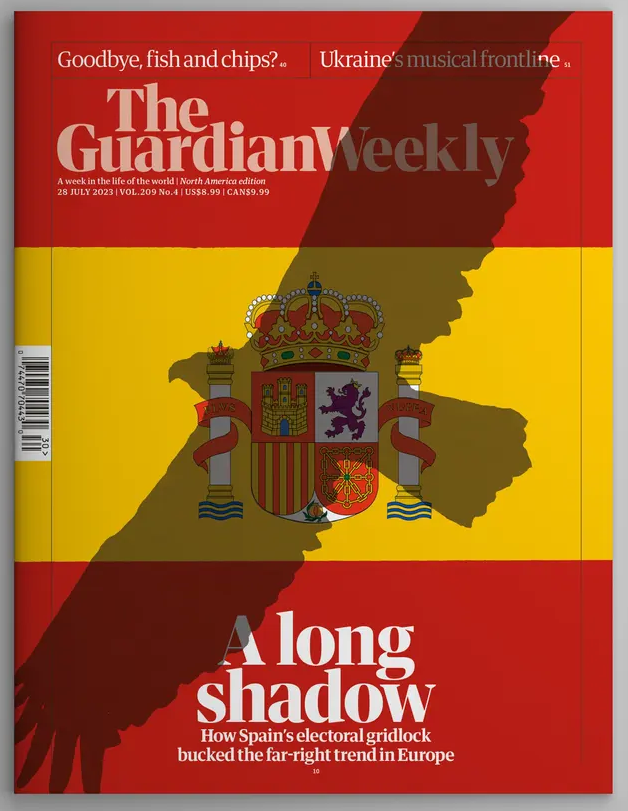
Socialist leader assures party ‘democracy can find a formula for government’ as left and right blocs try to form viable coalitions
The Spanish Socialist leader, Pedro Sánchez, has ruled out a return to the polls following Sunday’s inconclusive snap general election, insisting a new government can be formed after his ruling coalition was narrowly beaten by the opposition conservative People’s party (PP).
Plenty of people will tell you the East Neuk of Fife in Scotland is the best place in the world to eat fish and chips. So what happens when its chippies – and chippies across the UK – start to close?
When the result of the Hollywood actors’ strike ballot was announced last Thursday, the big-name stars of Oppenheimer left the film’s London premiere.
This show of solidarity by Matt Damon, Emily Blunt, Cillian Murphy and Florence Pugh was a demonstration of the far-reaching effects of creatives taking to the picket lines. For our big story, arts reporter Vanessa Thorpe looks at what the historic joint walkout by writers and actors means for all of us as movie-goers and TV viewers as well as the stars, lesser-known actors and technicians struggling to make a living.
And we look at what lies behind the dispute with our film editors Catherine Shoard and Andrew Pulver while Los Angeles reporter Lois Beckett hears from actors finding it ever harder to make a living in the age of streaming and the use of AI in the entertainment industry.
More than a week has passed since the collapse of the Kakhovka dam in Ukraine. Only as the flood waters begin to recede is the long-term scale of the disaster becoming apparent.
With suspicion (though not yet, according to western capitals, conclusive proof) falling on Moscow, Dan Sabbagh, Artem Mazhulin and Julian Borger report on a human and environmental catastrophe, and what it might mean for Ukraine’s counteroffensive plans against Russia.
And amid reports of disunity among Moscow’s ruling elite, Shaun Walker went along to a gathering of exiled influential Russians who are once again daring to dream of an end to Vladimir Putin’s rule.
The Guardian Weekly (June 9, 2023)– A year ago, the Indigenous expert Bruno Pereira and Guardian contributor Dom Phillips were murdered in a remote area of the Brazilian Amazon. They had travelled there to meet with Indigenous activists who patrol the Javari valley to protect it from illegal fishing and mining gangs.
Their deaths laid bare the environmental devastation inflicted under Brazil’s former president, Jair Bolsonaro, as well as the extreme threat to those who dare to disrupt the activities of exploitative industries in the region. That’s why, in collaboration with an international journalists’ consortium, the Guardian has published the Bruno and Dom project: a series that seeks to honour their work and continue it. You’ll find a selection of pieces in this week’s Guardian Weekly and the rest are available online.
The Guardian Weekly (May 26, 2023)– Volodymyr Zelenskiy’s surprise turn at last weekend’s G7 meeting in Hiroshima was the climax of a round of shuttle diplomacy in which the Ukrainian president secured yet more funds and equipment from western nations.
Patrick Wintour ponders the complex wider issues at stake for western leaders who realise that more constructive relations with the global south could also be the key to containing an increasingly belligerent China.
E-cigarettes have been seen as useful and less health-damaging devices for weaning smokers off tobacco. But there are growing international fears at the rise of disposable e-cigarettes, which are fuelling a boom in vaping among children. Michael Safi looks at how different countries are responding, from sales curbs to outright bans.
The Guardian Weekly (May 19, 2023) – This week’s issue considered the end of Recep Tayyip Erdoğan’s long political career. But it soon became clear that predictions of the Turkish president’s demise had been greatly misjudged. A first-round victory over his secular opponent, Kemal Kılıçdaroğlu, did not come by a wide enough margin to prevent a runoff vote on 28 May. But, barring a remarkable swing back to Kılıçdaroğlu, the indications are that Erdoğan will further extend his 20-year authoritarian brand of rule over Turkey.
As Ukraine’s president, Volodymyr Zelenskiy, toured European capitals to drum up support this week, speculation continued over when and where Ukraine’s long-anticipated counteroffensive against Russian forces would begin – or if indeed it had already done so. From Kherson, Luke Harding hears from a frontline commander why Kyiv is happy to bide its time, while defence editor Dan Sabbagh outlines four possible scenarios in which a Ukrainian counterattack might develop.
Two environmentally slanted features bring fascinating insights into very different parts of the world. From Kenya there’s the uplifting story of the waste picker who is lobbying for his colleagues’ working rights to be enshrined in a UN treaty. Then, John Bartlett reports from Antarctica on how the climate crisis, geopolitical tensions and booming tourism are straining relations at a remote scientific research station.
The Guardian Weekly (May 12, 2023) – The name Geof frey Hinton was little known outside the tech industry until last week, when the so-called “godfather of AI” gave an interview after leaving Google in which he warned that machine learning is leading us into uncharted territory.
So is now the time to get properly frightened about the capabilities unleashed by machine learning? Technology writer John Naughton in this week’s big story says an unequivocal yes as he explores a worrying near future, and what prompted Hinton to speak out.
Britain spent last weekend watching avidly or determinedly avoiding the exuberant display of ancient ceremony around the coronation of King Charles III. Our coverage takes a fondly amused look at all the pageantry, personalities and gold braid with Rachel Cooke, while columnist Nesrine Malik unpicks the game of divide and rule, display and disguise through which the institution hangs on to popular support. We also visit Belize to find out how arguments about reparations for slavery are linked to its relationship to the British crown.
News, Views and Reviews For The Intellectually Curious