
Tag Archives: Technology

 Scientists believe they have located the ancestral home of one of humanity’s early ancestors—in northern Botswana. Tom Siebel, a Silicon Valley veteran and the founder of C3.ai, explains how digital transformation stops companies from going extinct. And, host Kenneth Cukier takes a trip to the Natural History Museum in London to learn about
Technology Podcasts: What To Consider With DNA Testing (Kiplinger)
 Kiplinger’s vice president of content Sarah Stevens joins our podcast hosts Sandy Block and Ryan Ermey to talk about the advantages, risks, obstacles and other things to consider when having your DNA tested.

Future Of Avation: “Safe Return” Emergency Autolanding In A Cirrus G2 Vision Jet (Video)
From a New Atlas online review:
An important step towards autonomous aviation was taken today, as Cirrus Aviation announced “Safe Return” functionality for its G2 Vision jet, which will find the nearest airstrip, alert authorities and land itself in an emergency.
The Vision is a small private jet capable of seating seven people, cruising at over 300 knots at 31,000 feet. Small, quick and user-friendly, it’s good for those that wish to fly themselves, as well as being flown. It’s been a successful product for Cirrus, but its new functionality could represent something bigger. CEO Zean Nielsen calls it “a product that we believe is going to change personal aviation forever.”
Safe Return Autonomous Autoland, developed in conjunction with Garmin, manifests as a button on the roof of the Vision jet that is accessible to passengers. If something happens to the pilot, a passenger can hit the button and request an autoland.
To read more: https://newatlas.com/aircraft/cirrus-vision-g2-automatic-emergency-landing/

Halloween 2019: “Galaxy Of Horrors!” Video And Posters From NASA Jet Propulsion Laboratory
Dubbed Galaxy of Horrors, the fun but informative series resulted from a collaboration of scientists and artists and was produced by NASA’s Exoplanet Exploration Program Office, located at NASA’s Jet Propulsion Laboratory in Pasadena, California. The same program is behind the popular Exoplanet Travel Bureau poster series, which imagines humans visiting some of the thousands of known worlds outside our solar system.

Transportation: Cambridge University Builds Ultra-Efficient, 560-Mile Range Electric Car
From a Dezeen.com online review:
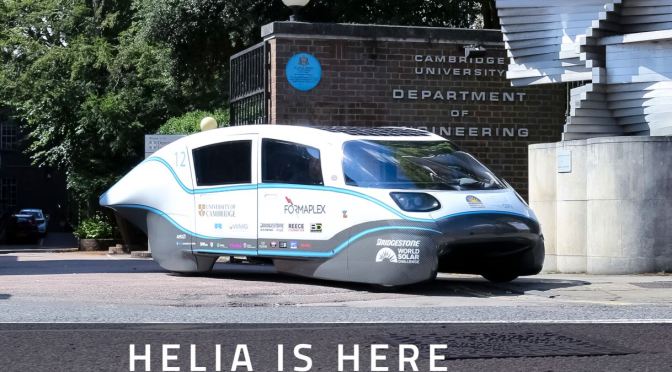
On a single charge, Helia can cover a range of 900 kilometres – the distance from London to Edinburgh. Again, compared to the Tesla 3, the Cambridge University team’s car has double the range on a battery a quarter of the size.
 The ability to cover this distance is aided by Helia’s chassis and body panels made from carbon fibre, which grant it a kerb weight of 550 kilograms.
Students from Cambridge University have built an ultra-efficient electric car that drives using only as much power as it takes to boil a kettle.
The Cambridge University Eco Racing (CUER) student society built the four-seater car, named Helia, with efficiency as the main goal.
Their achievement has been to produce a car that can travel 80 kilometres-per-hour using only 2500 watts, or as much power as it takes to boil a single kettle, which is equivalent to 31 watt-hours-per-kilometre.
Health Care Technology: Facebook Unveils Tool For “Preventative Health”
From a The Verge online article:
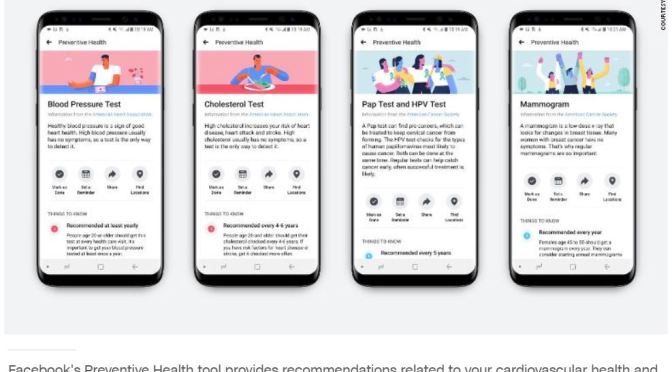
 The tool is simply called Preventive Health, and is now available to Facebook users in the United States. It takes a user’s age and sex from their Facebook profile and provides them with a list of recommended screenings based on those two data points.
“Let’s say you’re 52 years old,” Freddy Abnousi, Facebook’s head of health care research, tells The Verge. “One of the things that will come to you — based on the American Cancer Society’s recommendations — is that you should have a colorectal cancer screening.” Abnousi says that the app will then give you more information about what kinds of tests are available, from a colonoscopy to a stool test or a CT scan. Abnousi hopes that users will then take what they’ve learned and talk to their primary care physician about what would be best for them. Users can also adjust the age and sex in the tool to get different screening recommendations without having it affect anything on their profile.
To read more: https://www.theverge.com/2019/10/28/20936541/facebook-preventative-health-cancer-heart-disease-flu-tool

Dementia Care: “MapHabit” Wins Top Technology Award From National Institute On Aging
From a National Institute on Aging online release:
 First place prize awarded to MapHabit: This mobile software provides behavior prompts with customizable picture and keyword visual maps to assist memory-impaired people with accomplishing activities of daily living. The care management platform employs different interfaces depending on whether the user is a person with impaired memory, caregiver or long-term care community manager. Caregivers can monitor adherence to medication schedules or track other activities.
MapHabit, Inc., is the first place winner of the Improving Care for People with Alzheimer’s Disease and Related Dementias Using Technology (iCare-AD/ADRD) Challenge, sponsored by the National Institute on Aging (NIA). The Atlanta-based MapHabit team, led by Stuart Zola, Ph.D., will receive the $250,000 first prize for their mobile device application that helps people with dementia follow simple commands to perform daily tasks, such as taking pills and brushing teeth, and also provides feedback to caregivers. NIA is part of the National Institutes of Health.

Technology: “PrinCube” Is The World’s Smallest Mobile Color Printer
From a YankoDesign.com online review:
 The PrinCube sits on the throne of being the smallest (and the lightest) handheld color-printer. With a swift motion of your hand, the printer rapidly prints out one line at a time, measuring up to 0.56 inches in thickness. PrinCube’s multi-line feature lets you extend your prints by printing up to nearly 10 feet of content line after line. The wireless printer conveniently pairs with any device like your phone, tablet, or even laptop over a Wi-Fi connection, and each individual ink cartridge can handle approximately 415 A4 pages worth of printing before replacing. The battery on PrinCube’s pretty remarkable too, with the ability to print for 6 continuous hours before needing a recharge via the Type-C port in the PrinCube’s size.
https://www.indiegogo.com/projects/princube-the-world-s-smallest-mobile-color-printer#/
It looks like a block roughly half the size of a spray-paint can. In fact, that’s how you would hold the PrinCube too. Grab it with one hand and run it across any surface and the PrinCube performs a neat, seamless, colored inkjet-print on it. The PrinCube isn’t just small, it’s hand-held, wireless, and incredibly versatile. It can print on materials your desktop printer doesn’t even dream of. Paper, cardboard, wood, metal, cloth, working on flat, textured, and even curved surfaces. You could literally give yourself temporary tattoos too because the PrinCube even prints on the skin (it’s safe, if I may add).

Top Science Podcasts: Quantum Computing, Speediest Ants & Altering The “Deaf” Gene (Nature)
 Listen to the latest from the world of science, with Nick Howe and Shamini Bundell. This week, a milestone in quantum computing, and rethinking early mammals.
In this episode:
00:43 A quantum computing milestone
A quantum computer is reported to have achieved ‘quantum supremacy’ – performing an operation that’s essentially impossible for classical computers. Research Article: Arute et al.; News and Views: Quantum computing takes flight; Editorial: A precarious milestone for quantum computing; News: Hello quantum world! Google publishes landmark quantum supremacy claim
08:24 Research Highlights
The world’s speediest ants, and the world’s loudest birdsong. Research Highlight: A land-speed record for ants set in Saharan dunes; Research Highlight: A bird’s ear-splitting shriek smashes the record for loudest song
10:19 The mammals that lived with the dinosaurs
Paleontologists are shifting their view of Mesozoic era mammals. News Feature: How the earliest mammals thrived alongside dinosaurs
18:00 News Chat
A Russian researcher’s plans to edit human embryos, and ‘prime editing’ – a more accurate gene editing system. News: Russian ‘CRISPR-baby’ scientist has started editing genes in human eggs with goal of altering deaf gene; News: Super-precise new CRISPR tool could tackle a plethora of genetic diseases

Technology: Cowboy Electric Bike Is Lightweight, With Integrated Lights & Removable Battery
From a TechCrunch online review:
 From the outside, the Cowboy e-bike is a sleek bike. It features a seamless triangle-shaped aluminum frame, integrated lights and a low-key Cowboy logo near the saddle. The handlebar is perfectly straight like on a mountain bike. The only sign that this is an e-bike is that the frame is much larger below the saddle.
The e-bike is relatively light at 16kg (35lbs). Most of the weight is at the back of the Cowboy e-bike because of the battery. But an investor in the startup told me that it wasn’t a problem and that he was even able to attach a baby seat at the back.
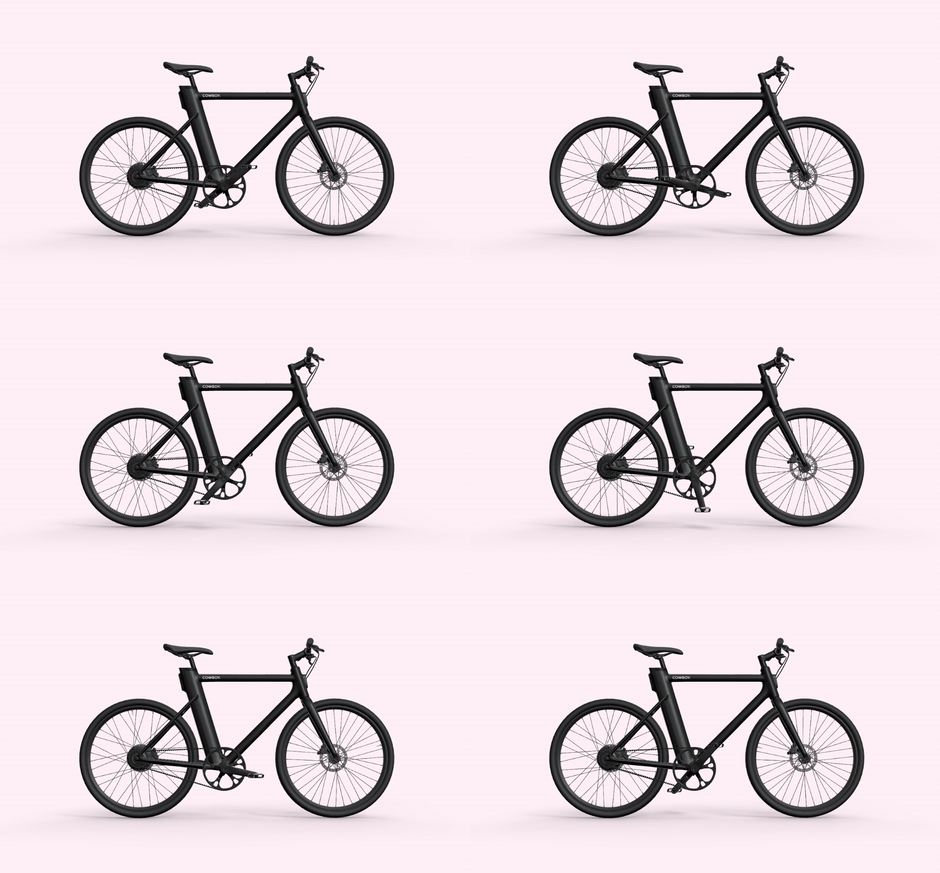
The two things you’re going to notice quite quickly is that there’s no gear and there’s a rubber and glass fiber belt. Cowboy has opted for an automatic transmission — motor assistance kicks in automatically when you need it the most, such as when you start pedaling, you accelerate or you go uphill.
To read more: https://techcrunch.com/2019/10/23/a-bike-lovers-take-on-the-cowboy-e-bike/
 Boomers Daily