
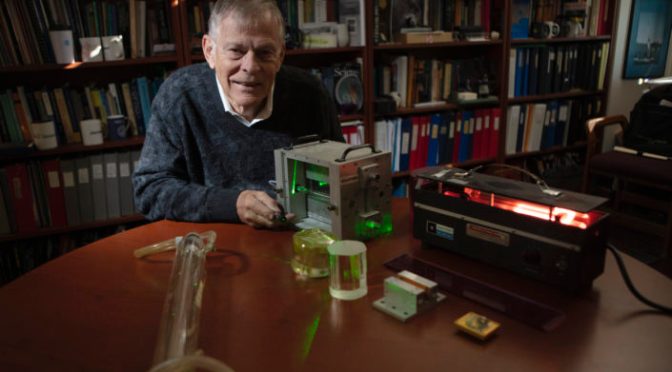
From a Stanford University News article:
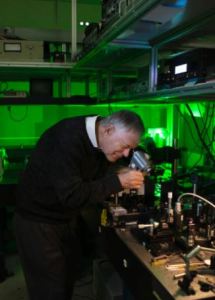 Byer also helped develop the quietest, most stable laser in the world, called the diode-pumped YAG laser. YAG lasers are today found in everything from communications satellites to green handheld laser pointers, which Byer co-developed with two of his graduate students and cites as one of his favorite inventions (he had joined Stanford in 1969). YAG lasers also form the main beams of the gravitational wave-detecting instrument, LIGO, which in 2015 achieved the most precise measurement ever made by humans when its antenna detected the tenuous spacetime fluctuations generated by two colliding black holes 1.3 billion light-years away.
Robert Byer was 22 years old when he first saw the light that changed his life.
 One summer morning in 1964, Byer drove the hour from Berkeley down to Mountain View for a job interview at a California company called Spectra Physics. He walked in to find an empty lobby but could hear clapping and cheering in the back of the building. After politely waiting for several minutes, he followed the commotion to a darkened room filled with men whose jubilant faces were illuminated by a rod of red-orange light that seemed to float above an instrument-strewn table
To read more: https://news.stanford.edu/2019/11/19/life-changing-first-glimpse-laser/

 “For patients with severe but stable heart disease who don’t want to undergo these invasive procedures, these results are very reassuring,” said
 “A simple example would be copper and fiber wires. When you’re putting wires in a new facility, it’s easier to put in many more than you need that moment because putting them in 5 years from now or 10 years from now is quite hard. Something like 85 percent of our copper wires and fiber optic cables are dark right now because we know we’re going to need them in the future.”
 There was a massive shift in Roman residents’ ancestry, the researchers found, but that ancestry came primarily from the Eastern Mediterranean and Near East, possibly because of denser populations there relative to the Roman Empire’s western reaches in Europe and Africa.
 In a
In a  Boomers Daily