Axios Today reports: Private companies are becoming more and more invested in entering the space race. That means smaller missions – with more freedom in what they can study and explore – could completely change our understanding of the universe.
Plus, democrats are changing up their voting strategy.
And, Johnson & Johnson has reached another vaccine trial milestone.
Guests: Axios’ Miriam Kramer, Alexi McCammond, and Caitlin Owens
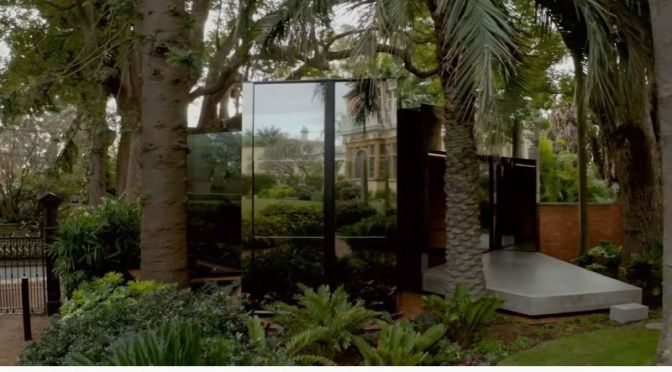
Stealth Pavilion is an architecturally designed private gym which sits suitably disguised in its landscape, concealing its presence through select materiality. Plus Minus Design carefully integrates a multifunction volume into an established heritage-listed garden setting, combining a refined and contemporary approach.
Stealth Pavilion and its location amongst significant listed trees came with its associated challenges, and through a clever approach to concealment, the result combines ingenuity and precision to the architecturally designed private gym which blends into the surrounding landscape.
The brief for the pavilion was for a structure that would house an architecturally designed private home gym and also have the capacity to be adapted to separate guest accommodation as required. After the consideration of a number of locations, the chosen siting was within the drop zone of four of the five listed trees and its surrounding landscape.
Externally, cladding of bronze mirror allows the structure of the architecturally designed private gym to reflect the surrounding foliage and landscape, and seem non-existent to the passer-by while internally the finishes reflect a robust warmth, suitable to its function.
Built by Robert Plumb Build, key to Stealth Pavilion’s integration into the existing was the carefully curated landscape by Dangar Barin Smith.
Architecture by Plus Minus Design. Build by Robert Plumb Build. Landscape by Dangar Barin Smith. Production by The Local Project. Video by Cheer Squad.
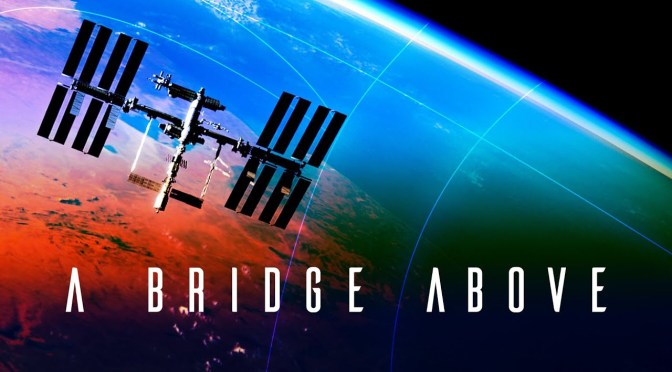
“What if we built a bridge, between and above all nations, to jointly discover the galaxy’s great unknowns?” Join us this fall as we prepare to celebrate the 20th anniversary of the the International Space Station. As a global endeavor, 240 people from 19 countries have visited the unique microgravity laboratory, which has hosted more than 2,800 research investigations from scientists in over 100 nations.
The International Space Station is a modular space station in low Earth orbit. The ISS program is a multi-national collaborative project between five participating space agencies: NASA, Roscosmos, JAXA, ESA, and CSA. It is an international collaborative effort between multiple countries.
In 2015, after a nine-and-a-half-year journey, NASA’s New Horizons spacecraft raced past Pluto, beaming images of the dwarf planet back to Earth.
Five years after the mission, researchers are poring over images of Pluto’s far-side, which was shrouded in shadow during New Horizon’s flypast. They hope that these images will help give a better understanding of how Pluto was born and even whether a hidden ocean resides beneath the world’s icy crust.
Are we alone in the Universe, or are there other life-forms ‘out there’? Recent discoveries of planets beyond the solar system (more than 4000 of them) suggest that the question is not ‘whether?’ but ‘where?’. This book enables general readers to understand current endeavours to answer this question and the related one of ‘what kind?’
Wallace Arthur is an evolutionary biologist and science writer. He is Emeritus Professor of Zoology at the National University of Ireland, Galway. His most recent book is The Biological Universe: Life in the Milky Way and Beyond, published by Cambridge University Press in 2020.
Join a virtual walkthrough of SpaceShipTwo Unity’s cabin, curated by our design team. Every detail of the design provides an unparalleled and safe experience for Future Astronauts.
Why are there so many attempts to get to Mars at the moment? The United Arab Emirate’s Hope satellite was despatched last week and now China has launched its first rover mission to the red planet. Nasa’s Perseverance Rover is scheduled to take off on 30th July. Well, summer 2020 is a popular time for missions to the red planet because of the way the planets align – but how long does it take to get there? Landing on Mars is known as the “seven minutes of terror”, and there are lots of reasons why. Here BBC Science Correspondent Laura Foster explains how long it takes to get there and why it’s so difficult. Video by Megan Fisher, Terry Saunders and Laura Foster
Researchers have assessed whether Enhanced Weathering – a technique to pull carbon dioxide out of the air – has the potential to help battle climate change. Research Article: Beerling et al.
On April 24, 2020, the Hubble Space Telescope celebrates its 30th year in orbit by premiering a never-before-seen view of two beautiful nebulas named NGC 2020 and NGC 2014.
Hubble’s senior project scientist, Dr. Jennifer Wiseman, takes us on a tour of this stunning new image, describes the telescope’s current health, and summarizes some of Hubble’s contributions to astronomy during its 30-year career.




 In 2015, after a nine-and-a-half-year journey, NASA’s New Horizons spacecraft raced past Pluto, beaming images of the dwarf planet back to Earth.


 On this week’s podcast, an ambitious Mars mission from a young space agency, and how crumbling up rocks could help fight climate change.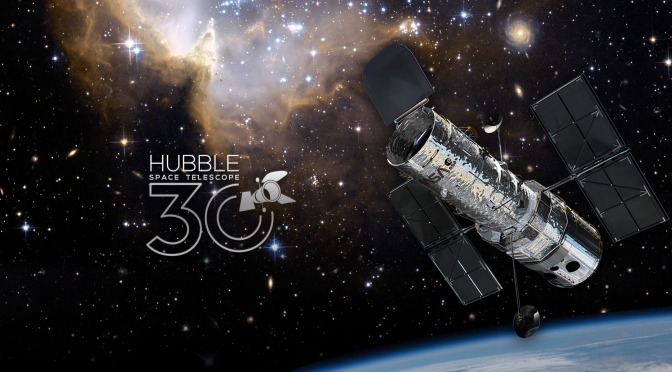
 Boomers Daily