
Smouldering fires lay dormant before bursting back into flame in spring.
In this episode:
00:56 The mysterious overwintering forest fires
Researchers have shown that fires can smoulder under snow in frozen northern forests before flaring up the following spring. Understanding how these so-called ‘zombie’ fires start and spread is vital in the fight against climate change.
Research Article: Scholten et al.
07:39 Research Highlights
Aesthetic bias means pretty plants receive the most research attention, and ancient tooth gunk reveals the evolution of the mouth microbiome.
Research Highlight: Flashy plants draw outsize share of scientists’ attention
Research Highlight: Microbes in Neanderthals’ mouths reveal their carb-laden diet
10:04 Briefing Chat
We discuss some highlights from the Nature Briefing. This time, Voyager 1 detects a faint interstellar ‘hum’, and a trove of Neanderthal bones found in an Italian cave.
Reuters: Faraway NASA probe detects the eerie hum of interstellar space
The Guardian: Remains of nine Neanderthals found in cave south of Rome
Video: Hawaii’s surprise volcanic eruption: Lessons from Kilauea 2018
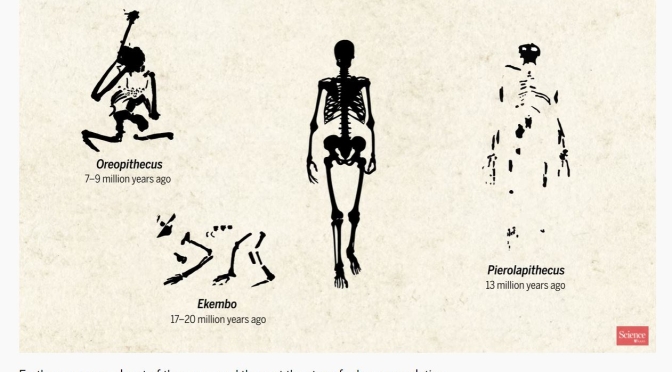
More than ten million years ago, the world was brimming with a wide variety of apes. Scientists studying the ones that are still alive today can learn a lot about human evolution—but they miss out on many clues that can only be found from the apes that went extinct. Watch to learn how fossil apes have strengthened ideas about how humans evolved, and what steps we can take to learn even more about our ancient ancestors. Read the review: https://scim.ag/3hw5PVx
The earliest evidence of deliberate human burial in Africa, and a metal-free rechargeable battery.
In this episode:
00:44 Human burial practices in Stone Age Africa
The discovery of the burial site of a young child in a Kenyan cave dated to around 78 thousand years ago sheds new light on how Stone Age populations treated their dead.
Research Article: Martinón-Torres et al.
News and Views: A child’s grave is the earliest known burial site in Africa
09:15 Research Highlights
How warming seas led to a record low in Northwestern Pacific typhoons, and the Arctic bird that maintains a circadian rhythm despite 24 hour sunlight.
Research Highlight: Warming seas brought an eerie calm to a stormy region
Research Highlight: The world’s northernmost bird is a clock-watcher
11:35 A metal-free rechargeable battery
Lithium-ion batteries have revolutionised portable electronics, but there are significant issues surrounding their recyclability and the mining of the metals within them. To address these problems, a team of researchers have developed a metal-free rechargeable battery that breaks down to its component parts on demand.
Research Article: Nguyen et al.
The next generation of computing is on the horizon, and several new machines may just smash all the records…with two nations neck and neck in a race to get there first.
The ENIAC was capable of about 400 FLOPS. FLOPS stands for floating-point operations per second, which basically tells us how many calculations the computer can do per second. This makes measuring FLOPS a way of calculating computing power. So, the ENIAC was sitting at 400 FLOPS in 1945, and in the ten years it was operational, it may have performed more calculations than all of humanity had up until that point in time—that was the kind of leap digital computing gave us. From that 400 FLOPS we upgraded to 10,000 FLOPS, and then a million, a billion, a trillion, a quadrillion FLOPS. That’s petascale computing, and that’s the level of today’s most powerful supercomputers. But what’s coming next is exascale computing. That’s zeroes. 1 quintillion operations per second. Exascale computers will be a thousand times better performing than the petascale machines we have now. Or, to put it another way, if you wanted to do the same number of calculations that an exascale computer can do in ONE second…you’d be doing math for over 31 billion years.
Contributing Correspondent Cathleen O’Grady joins host Sarah Crespi to talk about a company that stores renewable energy by hoisting large objects in massive “gravity batteries.”
Also on this week’s show, Erick Lundgren, a postdoctoral researcher at Aarhus University, talks about how water from wells dug by wild horses and feral donkeys provides a buffer to all different kinds of animals and plants during the driest times in the Sonora and Mojave deserts.
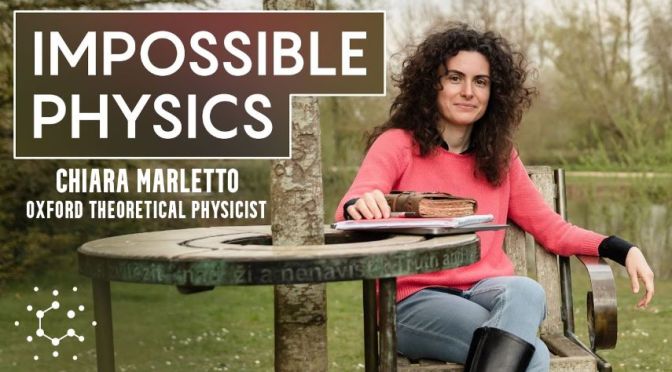
“Declaring something impossible leads to more things being possible,” writes the physicist Chiara Marletto. “Bizarre as it may seem, it is commonplace in quantum physics.”
Chiara Marletto is trying to build a master theory — a set of ideas so fundamental that all other theories would spring from it. Her first step: Invoke the impossible.
Constructor Theory is a new approach to formulating fundamental laws in physics. Instead of describing the world in terms of trajectories, initial conditions and dynamical laws, in constructor theory laws are about which physical transformations are possible and which are impossible, and why. This powerful switch has the potential to bring all sorts of interesting fields, currently regarded as inherently approximative, into fundamental physics. These include the theories of information, knowledge, thermodynamics, and life.
Read more about Marletto and David Deutsch’s constructor theory at Quanta Magazine: https://www.quantamagazine.org/how-to…






 Boomers Daily