International News Editor Martin Enserink talks with host Sarah Crespi about a moratorium on prion research after the fatal brain disease infected two lab workers in France, killing one.
Next, Abhay Goyal, a postdoctoral fellow at Georgetown University, talks with intern Claire Hogan about his Science Advances paper on figuring out how to reduce the massive carbon footprint of cement by looking at its molecular structure.
Finally, in a sponsored segment from the Science/AAAS Custom Publishing Office, Sean Sanders interviews Ansuman Satpathy, assistant professor in the department of pathology at Stanford University School of Medicine and 2018 winner of the Michelson Prize for Human Immunology and Vaccine Research, about the importance of supporting early-career research and diversity in science, technology, engineering, and math. This segment is sponsored by Michelson Philanthropies.
Discoveries of mass graves of Indigenous children in Canada have prompted new scrutiny of the residential school system – including the role physicians played in unethical experiments, says paediatrician Samir Shaheen-Hussain
Killing fossil fuels to halt global warming is the greatest challenge we face. We now have a masterplan of what we must do when – and there’s no time to delay
People think using more energy is a bad thing, says International Energy Agency chief Fatih Birol – but as long as we can make it cleanly, it needn’t be
Killing fossil fuels to halt global warming is the greatest challenge we face. We now have a masterplan of what we must do when – and there’s no time to delay
Satellite imaging has shown population increases are 10x higher in flood prone areas than previously thought, and a new way to introduce fairness into a democratic process.
In this episode:
00:47 Calculating how many people are at risk of floods.
Researchers have used satellite imagery to estimate the number of people living in flood-prone regions. They suggest that the percentage of people exposed to floods has increased 10 times more than previously thought, and with climate change that number is only set to climb.
Citizens’ assemblies are small groups of people invited to come together to help inform and affect policy decisions. But deciding who is in these groups is a mathematical challenge — the process needs to be random, but still reflect social demographics. This week, researchers describe a new algorithm that could offer a solution.
We discuss some highlights from the Nature Briefing. This time, how ships could spread a deadly coral disease, and research shows that female scientists are less likely to be cited in elite medical journals.
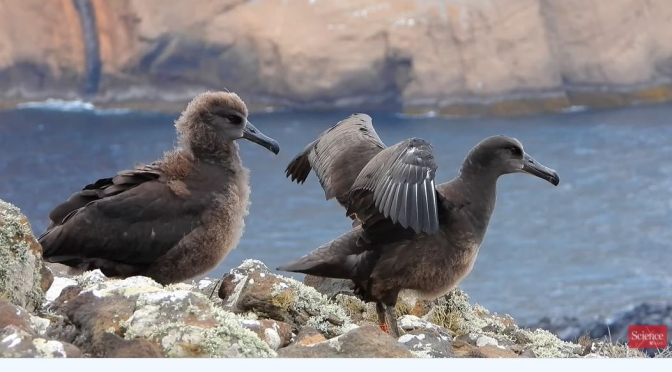
Most black-footed albatross nest on sandy beaches in Hawaii—but rising sea levels threaten their eggs and chicks. Researchers in Mexico and the United States came up with a way to save these birds: having young albatross hatch and imprint on an island 6000 kilometers away with higher ground. Watch to see the journey of these black-footed albatross. Read the story: https://www.sciencemag.org/news/2021/…
Just how does our sense of touch work? Listen to Ardem Patapoutian (@ardemp), one of the winners of the 2020 The Kavli Prize in Neuroscience, discuss how physical sensations are translated into cellular signals [Sponsored by @KavliPrize] pic.twitter.com/Q5VxRbzDQR
First this week, Staff Writer Jennifer Couzin-Frankel joins host Sarah Crespi to discuss the paradox of metabolically healthy obesity. They chat about the latest research into the relationships between markers of metabolic health—such as glucose or cholesterol levels in the blood—and obesity. They aren’t as tied as you might think.
Next, Colin Dayan, professor of clinical diabetes and metabolism at Cardiff University and senior clinical researcher at the Wellcome Centre for Human Genetics at the University of Oxford, joins Sarah to discuss his contribution to a special issue on type 1 diabetes. In his review, Colin and colleagues lay out research into how type 1 diabetes can be detected early, delayed, and maybe even one day prevented. Finally, in the first of a six-patrt series of book interviews on race and science, guest host Angela Saini talks with author and professor of history at the University of Massachusetts, Amherst, Samuel Redman, about his book Bone Rooms: From Scientific Racism to Human Prehistory in Museums. The two discuss the legacy of human bone collecting and racism in museums today.
Researchers debate whether an ancient fossil is the oldest animal yet discovered, and a new way to eavesdrop on glaciers.
In this episode:
01:04 Early sponge
This week in Nature, a researcher claims to have found a fossil sponge from 890-million-years-ago. If confirmed, this would be more than 300-million-years older than the earliest uncontested animal fossils but not all palaeontologists are convinced.
We hear about one researcher’s unorthodox attempt to listen in to the seismic-whisper at the foot of a Greenland glacier – a method that might reveal more about conditions under these enormous blocks of ice.








 Boomers Daily