
Tag Archives: Science
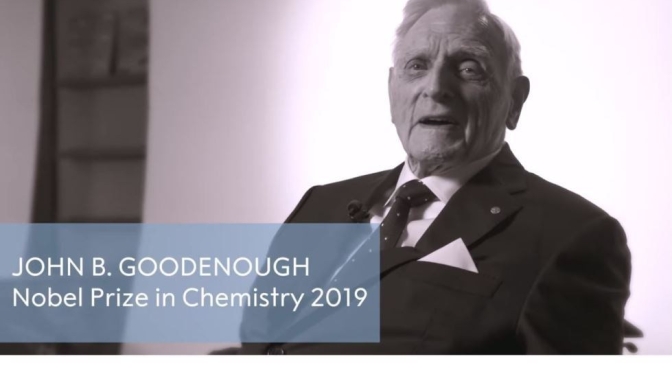
Interviews: 97-Year Old Nobel Prize Chemist John B. Goodenough On Wisdom, Love And Life
Interview with the 2019 Nobel Laureate in Chemistry John B. Goodenough, 6 December 2019
0:07 – What advice would you give to a younger version of yourself? 0:32 – How do you recognise a good teacher? 0:58 – Do you see yourself as a mentor now? 1:33 – What qualities do you think you need to be a successful scientist? 3:04 – How do you cope with failure? 3:16 – How has your dyslexia shaped you? 3:44 – How important has nature been for you? 4:40 – Has music played an important role in your life? 5:06 – How did your interest in poetry start? 6:14 – How did you meet your wife? 7:06 – What life advice can you share? 8:30 – How do you remember so much of your life? 8:47 – How does it feel to be back in Stockholm after 80 years? 9:21 – How has living through World War II influenced you? 10:03 – What is your relationship with your lab colleagues? 11:18 – What are the characteristics of a very good team? 11:55 – What is your relationship with Akira Yoshino? 12:28 – How has the scientific landscape has changed over the years? 13:42 – What environment encourage creative thinking? 14:48 – What research are you working on now? 15:39 – What are your thoughts on sustainability? 16:37 – What future do you see for sustainable batteries?
John Bannister Goodenough born July 25, 1922) is an American materials scientist, a solid-state physicist, and a Nobel laureate in chemistry. He is a professor of mechanical engineering and materials science at the University of Texas at Austin. He is widely credited with the identification and development of the lithium-ion battery, for developing the Goodenough–Kanamori rules in determining the sign of the magnetic superexchange in materials, and for seminal developments in computer random access memory.
Top New Science Podcasts: Gravity, Ancient Teeth & Containing Coronavirus
What happens if you overwater a plant? How does gravity actually work? And should we be cancelling mass events to contain the coronavirus?
It’s Q&A time on the show, and this week Phil Sansom is joined by a brainy panel of experts: plant biologist Nadia Radzman, particle physicist Chris Rogers, bioarchaeologist Emma Pomeroy, and virologist and Naked Scientist Chris Smith. Prepare to have your curiosity satisfied…
Top New Science Podcasts: Restoring Notre Dame & The Body’s “Tough Skin”
 On this week’s show, freelance writer Christa Lesté-Lasserre talks with host Sarah Crespi about the scientists working on the restoration of Notre Dame, from testing the changing weight of wet limestone, to how to remove lead contamination from four-story stained glass windows.
As the emergency phase of work winds down, scientists are also starting to use the lull in tourist activity to investigate the mysteries of the cathedral’s construction.
Also this week, Felipe Quiroz, an assistant professor in the biomedical engineering department at the Georgia Institute of Technology and Emory University, talks with Sarah about his paper on the cellular mechanism of liquid-liquid phase separation in the formation of the tough outer layer of the skin. Liquid-liquid phase separation is when two liquids “demix,” or separate, like oil and water. In cells, this process created membraneless organelles that are just now starting to be understood. In this work, Quiroz and colleagues create a sensor for phase separation in the cell that works in living tissue, and show how phase separation is tied to the formation of the outer layers of skin in mice.
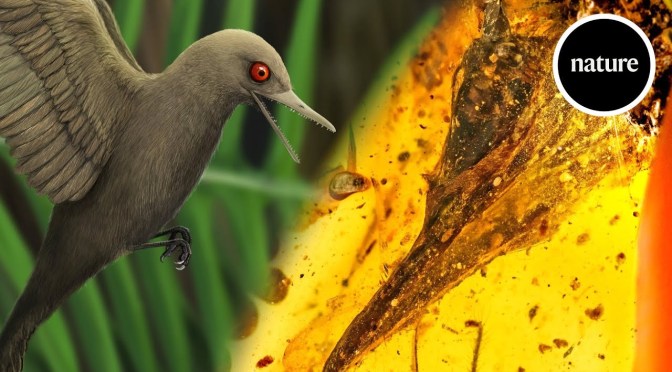
A New Species Of “Bird-Like Dinosaur” Discovered, Preserved In Amber (Video)
A tiny new species of bird-like dinosaur has been discovered, preserved in a lump of 99-million-year-old amber. The tooth-filled skull is only 7.1mm long, suggesting that this ancient creature would have been the size of a hummingbird – far smaller than other dinosaurs known from that time. Unusual features include large, side-facing eyes and a large number of sharp teeth suggesting a predatory lifestyle. The species has been named Oculudentavis khaungraae and is evidence of previously unimagined biodiversity in the Mesozoic era.
Top New Science Podcasts: 100-Million-Year-Old Bird In Amber And Viking Dental Hygiene (Nature)
 Hear the latest science news, brought to you by Shamini Bundell and Nick Howe. This week, a newly discovered bird species from the time of the dinosaurs, and microbes hundreds of metres below the ocean floor.
In this episode:
00:44 A tiny, toothy, ancient bird
Researchers have found a perfectly preserved bird fossil trapped in amber, with some rather unusual features. Research Article: Xing et al.; News and Views: Tiny bird fossil might be the world’s smallest dinosaur
08:09 Research Highlights
Dental hygiene in the time of the Vikings, and wildebeest bones feed an African ecosystem. Research Article: Bertilsson et al; Research Article: Subalusky et al.
10:21 Deep sea life
Scientists have uncovered traces of life 750m below the ocean’s surface. Research article: Li et al.
17:31 News Chat
Updates on the Coronavirus outbreak, and peer review in predatory journals. News: Coronavirus: latest news on spreading infection; News: Labs rush to study coronavirus in transgenic animals — some are in short supply; News: Hundreds of scientists have peer-reviewed for predatory journals
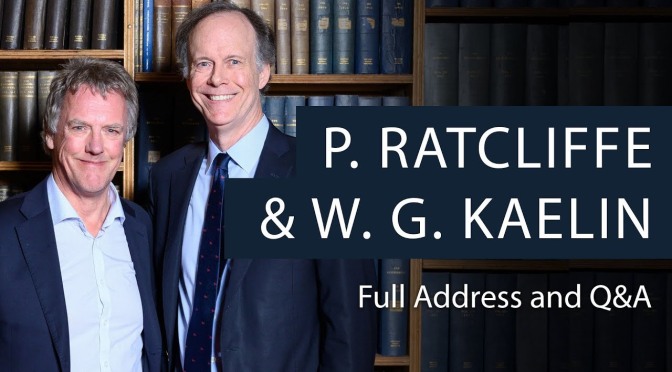
Medicine Lectures: 2019 Nobel Laureates Sir Peter Ratcliffe And Professor William Kaelin (Oxford)
Sir Peter and Prof. Kaelin were awarded the Nobel Prize in Physiology and Medicine last year by the Nobel Assembly at Karolinska Institutet, in recognition of their discoveries of how cells sense and adapt to oxygen availability, an essential adaptive process central to many significant diseases. The professors respectively work for the University of Oxford and Harvard University, and shared the Nobel Prize with Prof. Gregg Semenza, a fellow researcher.
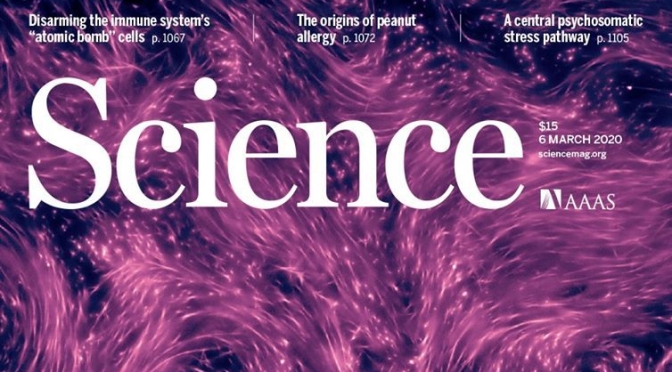
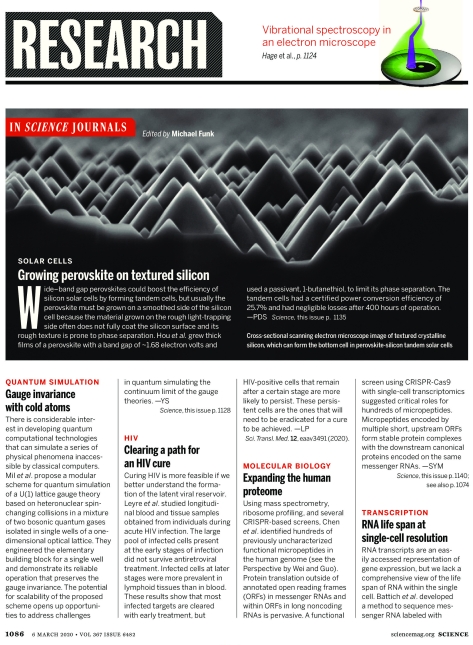
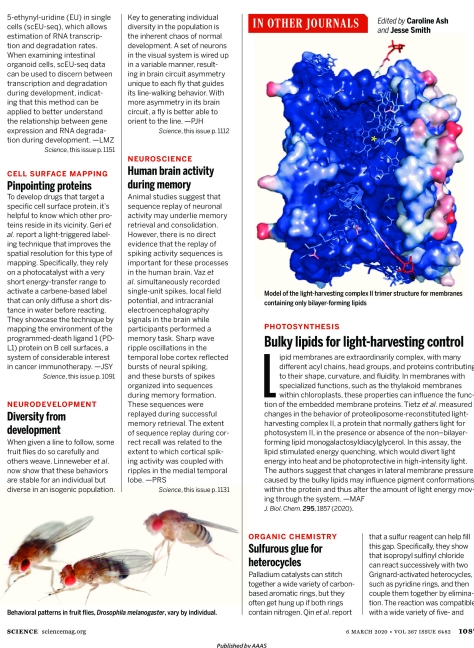
Top Journals: Research Highlights From “Science Magazine” (March 6, 2020)
New Science Podcasts: Dogs’ Cold Noses Sense Heat, Coronavirus And The Search For Alien Life
On this week’s show, Online News Editor David Grimm joins host Sarah Crespi to discuss how dogs’ cold noses may be able to sense warm bodies. Read the research. International News Editor Martin Enserink shares the latest from our reporters covering coronavirus.
And finally, from a recording made at this year’s AAAS annual meeting, host Meagan Cantwell talks with Jill Tarter, chair emeritus at the SETI Institute, about the newest technologies being used to search for alien life, what a positive signal would look like, and how to inform the public if extraterrestrial life ever were detected.
New Science Podcasts: Faster Image ID, Crafting Crystals And Coronavirus / Covid-19 Update (Nature)
 Listen to the latest from the world of science, with Benjamin Thompson and Nick Howe. This week, improving computers’ image identification, and a new method for growing crystals.
In this episode:
00:44 Upgrading computer sight
Researchers have designed a sensor that allows machines to assess images in nanoseconds. Research Article: Mennel et al.; News and Views: In-sensor computing for machine vision
06:51 Research Highlights
Calorie restriction’s effects on rat cells, and the dwindling of sandy seashores. Research Highlight: Old age’s hallmarks are delayed in dieting rats; Research Highlight: Sandy beaches are endangered worldwide as the climate changes
08:53 Crafting crystals
To understand the structure of materials, researchers often have to grow them in crystal form. A new method aims to speed up this process. Research article: Sun et al.
14:48 News Chat
Coronavirus outbreak updates, and climate change’s role in the Australian bush fires. News: Coronavirus: latest news on spreading infection; News: Climate change made Australia’s ‘unprecedented’ bushfires 30% more likely
 Boomers Daily