
Dozens of media outlets have fled to the capital of Latvia, only to encounter a distrustful public and a set of strictly enforced laws and regulations.
The Economist (March 2, 2023) – America is spending trillions of dollars in an effort to make the country stronger, greener and richer. These are the three key things you need to know about the plan and its chances of success.
Video timeline:00:00 – A new green America 00:30 – Democrats are being ambitious 01:14 – Manufacturing will move to America 01:53 – Planning could be a stumbling block
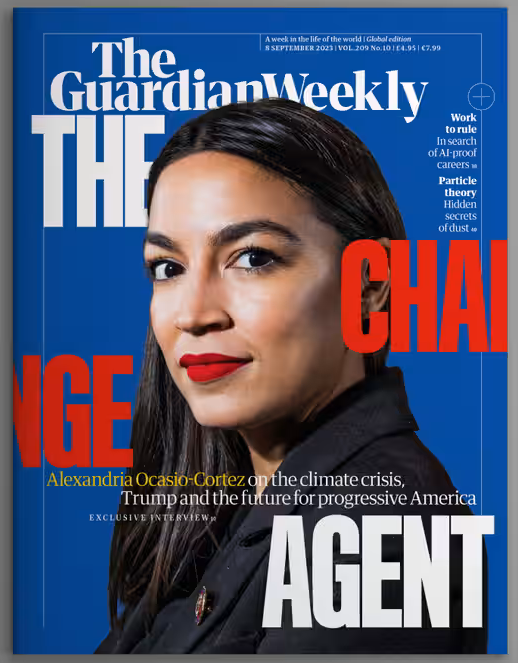
The Guardian Weekly (March 3, 2023) – A year on from the invasion of Ukraine and there seems little end in sight to a conflict that has, unquestionably, changed the world.The Guardian Weekly’s big story this week outlines five possible routes to peace (some more hopeful than others), but the main focus is a stunning collaboration from Guardian reporters detailing the fate of the port of Mariupol, the battle for which has perhaps been the bloodiest and most shocking chapter of the war to date.
It’s an extraordinary account of the devastation, partial reconstruction, and Russification of a thriving city. “You learn to only voice your opinions with those you know you can trust,” says Darya, a student opposed to the occupation. “Otherwise, you keep your thoughts to yourself.”
On Monday the UK government finally agreed a deal with the EU to end a long-running Brexit disputeover customs arrangements and legal oversight in Northern Ireland. Our Brexit correspondent Lisa O’Carroll unpicks the key points of the new agreement and what it means for the region.
In 2003, when the US army occupied Iraq after the fall of Saddam Hussein, the Guardian writer Ghaith Abdul-Ahad was aged 28 and living in Baghdad. He recounts his front-row view of the fall of the regime, the arrival of the so-called liberators and the unfolding of a sectarian war.
Through a growing focus on healthcare monitoring in recent years, Apple has positioned its wearables as essential accessories for the technophile and the casual hypochondriac alike.
Like so many other predictions of collapse, exaggerated. Methylphenidate for Miriam. Two executives showed up for a meeting dressed as Woody and Buzz Lightyear. A source of revolutionary Marxist critiques, an outright conservative, a peddler of flimsy conspiracy theories. Some days I am so filled with myself I can see nothing. I am not going to apologize for the empire, for our history. Bravissima! Stealth, he kept no socials. She had martini-glass tits. In this city every boy is an isotope. Enter among the truly civilized peoples. Cruising for difference. The body of a bear, the nose of an elephant, the paws of a tiger, the tail of an ox, and needle-like hairs. Wainscoting for an all-knowing liberalism. How can a narrow regional tabloid claim itself The World? The surrealist didn’t prescribe life-sized butter ears. Spend how you want the sixtyish years you have left of your life.
“Italian language teaching is back in Somalia!” the Italian embassy in Somalia tweeted in late September 2021, announcing a new program at the Somali National University that would reintroduce the language of the country’s former colonizer.
February 27, 2023: A selection of three essential articles read aloud from the latest issue of The Economist. This week, how to win the war in Ukraine, Joe Biden’s sensible new border policies (11:15) and Nigeria’s scorpion trade (15:30).
The Economist (February 23, 2023): The invasion of Ukraine left Russians with a stark choice: carry on as normal or make a stand against the war. But speaking out in Russia carries huge risks. How is the opposition managing to resist the regime – and at what personal cost?
Video timeline:00:00 – One year on 01:37 – The first wave of protests 05:43 – Crackdown on dissent 10:04 – Individual acts of rebellion 13:51 – Partial mobilisation 16:20 – Russia’s mass exodus 23:06 – The future of Russian rebellion
February 23, 2023: Joe Biden’s meeting with Nato’s Bucharest Nine and a look ahead to the UN’s special session on Ukraine. Plus: a special interview with Austria’s minister for foreign affairs, a flick through today’s papers, a global statistics round-up and Laura Kramer speaks to ‘Liaison’ star Vincent Cassel.
The Guardian Weekly 24 February 2022 – exactly a year since the date of this week’s Guardian Weekly magazine – Vladimir Putin unleashed his brutal offensive on Ukraine. As our senior international affairs correspondent, Emma Graham-Harrison, wrote in the following day’s Guardian newspaper: “The continent awoke to the shock of scenes it once believed it had left in the 20th century: helicopters strafing homes outside the capital, long lines of tanks ploughing ever deeper towards Ukraine’s heartland, roads choked with refugees, and civilians huddled in underground stations to escape bombardment.”
Much has been written since then about the state of the war and how it might end, but this week we focus on a key plank of the west’s response: the wide-ranging economic sanctions against Moscow that it was hoped would throttle Putin’s war effort.
How the media failed Julian Assange – Every year on the first of December, the Committee to Protect Journalists publishes its global prison census, documenting the number of journalists behind bars around the world. The 2022 edition set a grim record: 363 jailed journalists.