Tag Archives: Plato

THE ACADEMY AT CAREGGI

Marsilio Ficino and the Lost Art of Intellectual Friendship

By Michael Cummins, Editor, September 15, 2025

Earlier that day, a letter had arrived at each doorstep—written in Ficino’s careful Latin, sealed with the Medici crest. Come tonight, it read, for the stars are in accord and the soul requires company. It was invitation and summons at once. Poliziano scoffed at the astrology but tucked the note into his cloak. Pico, fresh from disputation, still had ink smudged on his fingertips when he broke the seal. Landino read it slowly, savoring the phrasing, then closed his worn Dante with a sigh. Gozzoli sharpened a charcoal stick and packed it beside a folded manuscript. Lorenzo glanced at the letter, smiled at its formality, and placed it beneath a pile of state papers, as if to remind himself that philosophy and politics were two halves of his life.

As evening drew in, the roads up to Careggi darkened. Lanterns swung from servants’ hands, lighting the cypresses along the ascent. Cloaks were drawn close, breath visible in the winter air. One by one they arrived—Poliziano striding quickly, as though words themselves propelled him; Pico lingering at the threshold, whispering a Hebrew phrase before stepping inside; Landino slow but steady, leaning on a servant’s arm; Gozzoli already sketching the turn of a staircase as he climbed; Lorenzo last, but never late, carrying the ease of a man for whom arrival was itself a ceremony.

In January 1486, at the Villa Medici in Careggi—north of Florence, in the hills of Rifredi—the villa seemed less a house than a harmony. Designed by Michelozzo di Bartolomeo, it bore the quiet precision of geometry translated into stone. Arcaded loggias opened onto citrus groves, terraces descended into the valley like measures of music, and every cornice seemed tuned to a mathematics of grace. Outside, the air was sharp with winter, the olive trees skeletal against a pale sky. But within the great hall, a fire crackled, filling the chamber with warmth. The walls, frescoed decades earlier, flickered as if alive in the candlelight. Tonight the villa was not a residence but a stage, and its occupants not merely guests but players in a drama older than Florence itself.

They gathered as friends, but each carried into the room the weight of reputation.

Poliziano, barely past thirty, was already Florence’s most brilliant poet. His Stanze per la Giostra, an unfinished hymn to Giuliano de’ Medici’s tournament, glittered with myth and memory. Quick of wit and sharper of tongue, he was both loyal to Lorenzo and ready to strike at those who questioned his genius.

Cristoforo Landino, older, stooped with age, was Florence’s commentator-in-chief. His lectures on Dante had turned the Commedia into a civic scripture, binding Florence’s destiny to its poet. If Poliziano was a flame, Landino was the lamp in which it burned steadily.

Giovanni Pico della Mirandola entered like lightning. Only twenty-three, he was preparing his audacious Oration on the Dignity of Man, a text that would dare to place human freedom on the same plane as angelic being. He had announced his intention to defend nine hundred theses, culled from Greek philosophy, Kabbalah, scholasticism, and Islamic thinkers, in a disputation that threatened to scandalize Rome. His learning was encyclopedic, his confidence dangerous, his youth incandescent.

Benozzo Gozzoli was quieter. His great achievement, the fresco cycle of the Procession of the Magi in the Medici chapel, was both sacred and political: angels mingled with courtiers, and the Holy Family arrived in Florence disguised as the Medici themselves. He preferred charcoal to disputation, sketching the turn of a head or the crease of a robe rather than wielding syllogisms. For him, philosophy was not abstract argument but the line that revealed the soul.

And then Lorenzo de’ Medici, il Magnifico, the center of the Florentine orbit. He had steered the city through the Pazzi conspiracy, outmaneuvered papal wrath, and cultivated a culture in which poets, painters, and philosophers could thrive. Half-banker, half-prince, he wrote verses of his own, presided over festivals, and wielded patronage as both weapon and blessing. His presence at Careggi made the evening not only intimate but official.

Marsilio Ficino, their host, sat at the head of the long table. Cloaked in scholar’s black, fingers resting on a lyre, he was the gravitational center of this circle. He had translated Plato, giving Florence back its philosophical ancestry, and wrote the Platonic Theology, arguing that the soul was immortal and divine. In his quieter moments, he prescribed music as medicine, believing that certain modes could cure melancholy as surely as herbs. He practiced a cautious astrology, binding celestial rhythms to bodily health.

Now, as the fire crackled, Ficino tuned his lyre and looked at his companions with quiet joy. These men—so brilliant, so flawed—were his constellation. He thought of Plato’s cave, of Plotinus’s ascent, of Florence’s restless brilliance, and wondered whether beauty could save it. Tonight, he wanted not to translate but to live a dialogue. He plucked a chord and listened not to the sound, but to the silence it left behind.

What survives when the body falls silent?

Landino spoke first, quoting Dante: L’anima nostra, che di sua natura è immortale… Death was no end but transition. His tone was measured, his gaze steady, as though Florence itself were listening.

Poliziano leaned forward, impatient. “But Plato required myth to prove it. Immortality may lie not in substance but in song. What survives is the echo, not the essence. My verses, your commentaries—those are what endure.”

Pico’s eyes burned. He leaned back slightly, his gaze still locked on Poliziano. “No, Angelo. The soul is indivisible, free, eternal. Your echoes are ash if not tethered to truth. Without immortality, justice collapses. Would you have us live as beasts, hoping only for memory?”

Gozzoli raised his parchment, showing the curve of a face. “I have painted expressions that gaze back centuries later. If souls endure, perhaps they endure through pigment and gesture. A fresco is a kind of eternity.”

Lorenzo swirled his goblet, amused. He let the silence linger before speaking. “You cling to your own crafts—reason, verse, paint. But power is remembered longer. Rome honors her emperors not for their souls but for their laws. If Florence endures, it will be for institutions, not verses.”

The fire snapped. Smoke traced its slow scroll into the rafters.

Is love a hunger, or a ladder to the divine?

Poliziano was quick, his words bright as sparks. “Love is hunger—sweet, bitter, wounding. It gnaws at the poet until words burst forth. To dress it as a ladder is to kill its fire. No poet climbs—he burns.”

Pico bristled, voice sharp. He gestured with his hand as though sketching the ladder in the air. “Plato teaches otherwise. In the Symposium, love begins in desire but ascends rung by rung until it gazes upon the divine. Hunger is only the first step. To remain in it is to remain chained.”

Landino, steady, mediated. “Love is both appetite and ascent. Dante saw it: love moves the sun and the other stars. The soul is pulled in both directions, and in that tension it lives.”

Gozzoli brushed a fleck of charcoal from his sleeve. “In art, love is light. Without it, color dies. When I painted angels, I painted not desire nor ascent, but radiance. That radiance is love.”

Lorenzo raised his goblet, amused. “If love is ascent, politics must climb as well. Yet a republic cannot live on love alone. Too little, it collapses; too much, it drowns. Love must be measured like wine—enough to warm, not enough to flood.”

The candles guttered.

Can beauty make a city just?

Landino’s answer was firm. “Yes. Beauty educates. A city shaped by harmony breeds citizens shaped by harmony. Florence’s dome, its piazzas, its frescoes—they teach order.”

Poliziano shook his head. “But beauty deceives. A poem can gild cruelty. A tyrant can mask injustice with marble. False beauty is the danger.”

Pico leaned forward, eyes alight. “Beauty is the soul recognizing itself in form. But to conscript it for politics is degradation. Beauty belongs to God.”

Gozzoli’s voice dropped. He smudged the charcoal with his thumb, as if testing his own words. “Every fresco I painted was persuasion. I gave Florence angels and saints, but I knew I was giving Lorenzo legitimacy. Was it justice or illusion? I cannot say. I only know that without beauty, citizens despair.”

Lorenzo’s smile was thin. He tapped the rim of his goblet. “Power without beauty is brutality. Beauty without power is decoration. Florence must have both, or she will falter.”

Do the stars heal, or do they bind?

Landino frowned. “Astrology is poetry mistaken for science. The stars inspire, but they do not compel.”

Poliziano smiled. “Yet I have written verses under moonlight as though cadence were whispered from above. If they bind, they bind in music.”

Pico’s voice cut sharp. “The stars compel nothing. To surrender to them is heresy. Grace alone governs man. To believe otherwise is to betray freedom.”

Gozzoli lifted his sketch of a face crowned with constellations. “The stars do not bind. They illuminate. They remind shepherds and kings alike that we are not alone in the dark.”

Lorenzo tilted his head. “The stars are politics written across the sky. Farmers plant, sailors sail, princes strike—all by their guidance. If they heal, it is belief. If they bind, it is because rulers use belief.”

Finally Ficino spoke, his tone calm but decisive. “The stars incline, but do not compel. Herbs, stones, melodies—all are instruments. They tune the body, but the soul remains free. Wisdom lies between denial and surrender—in harmony.”

The hall was quiet. Outside, olive groves bent in the winter wind. Inside, five men leaned closer, their words crossing like beams of light. It was not debate but something more fragile, more luminous: friendship turned into philosophy.

Centuries later, across the Atlantic, another landscape received that resonance. In the Hudson Valley of New York, winter light lay across the river like a mirror. At Olana, Frederic Church painted sunsets as though they were revelations, the sky itself a scripture of color. The Hudson River School sought not just landscape but transcendence: light as theology, horizon as hymn. A few miles north, at Bard College, a library with floor-to-ceiling windows overlooked the river’s bend, its glass walls holding a different kind of symposium.

Here, a circle gathered again—not princes or poets, but a painter, a philosopher, a civic activist, and a poet of the local hills. The painter spoke of light as memory, insisting every canvas was less depiction than resurrection. The philosopher invoked Spinoza, saying that God was not above but within, diffused through river, stone, and thought. The activist leaned forward, half in jest, half in earnest, and asked whether zoning laws might embody Platonic ideals. The poet, notebook open, wrote fragments, catching echoes of Careggi.

The fire was modern, a wood stove; the wine, from the Finger Lakes; the instruments, not lyres but laptops sleeping on a side table. Yet the air trembled with the same listening that had once filled Ficino’s villa. The Hudson, like the Arno, carried history but also invitation.

The true legacy of Ficino’s Academy is this: thought, when shared in friendship, becomes a kind of music.

THIS ESSAY WAS WRITTEN AND EDITED UTILIZING AI
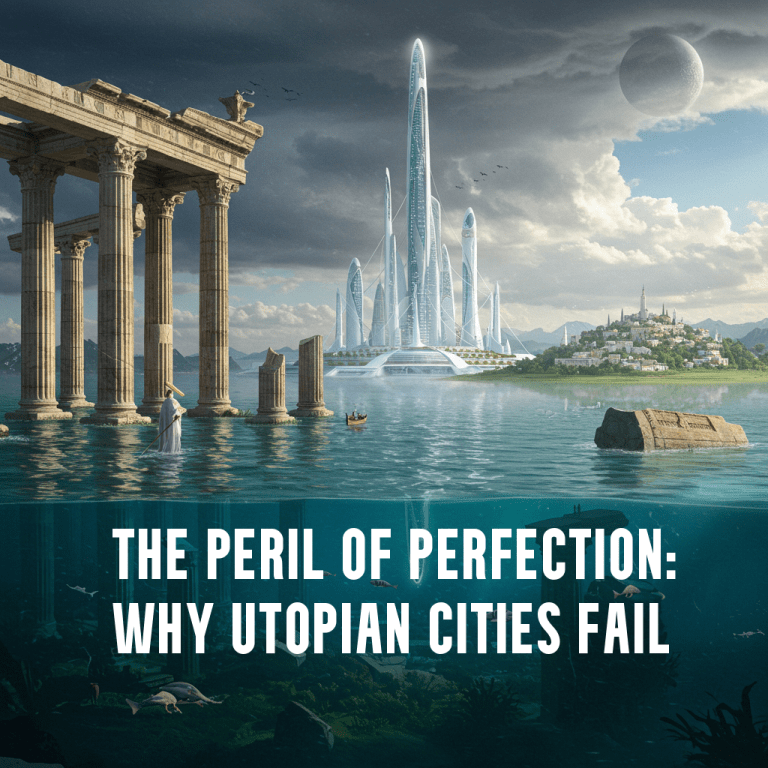
The Peril Of Perfection: Why Utopian Cities Fail

By Michael Cummins, Editor, August 7, 2025

Throughout human history, the idea of a perfect city—a harmonious, orderly, and just society—has been a powerful and enduring dream. From the philosophical blueprints of antiquity to the grand, state-sponsored projects of the modern era, the desire to create a flawless urban space has driven thinkers and leaders alike. This millennia-long aspiration, rooted in a fundamental human longing for order and a rejection of present-day flaws, finds its most recent and monumental expression in China’s Xiongan New Area, a project highlighted in an August 7, 2025, Economist article titled “Xi Jinping’s city of the future is coming to life.” Xiongan is both a marvel of technological and urban design and a testament to the persistent—and potentially perilous—quest for an idealized city.

By examining the historical precedents of utopian thought, we can understand Xiongan not merely as a contemporary infrastructure project but as the latest chapter in a timeless and often fraught human ambition to build paradise on earth. This essay will trace the evolution of the utopian ideal from ancient philosophy to modern practice, arguing that while Xiongan embodies the most technologically advanced and politically ambitious vision to date, its top-down, state-driven nature and astronomical costs raise critical questions about its long-term viability and ability to succeed where countless others have failed.

The Philosophical and Historical Roots

The earliest and most iconic examples of this utopian desire were theoretical and philosophical, serving as intellectual critiques rather than practical blueprints. Plato’s mythological city of Atlantis, described in his dialogues Timaeus and Critias, was not just a lost city but a complex philosophical thought experiment. Plato detailed a powerful, technologically advanced, and ethically pure island society, governed by a wise and noble lineage. The city itself was a masterpiece of urban planning, with concentric circles of land and water, advanced canals, and stunning architecture.

However, its perfection was ultimately undone by human greed and moral decay. As the Atlanteans became corrupted by hubris and ambition, their city was swallowed by the sea. This myth is foundational to all subsequent utopian thought, serving as a powerful and enduring cautionary tale that even the most perfect physical and social structure is fragile and susceptible to corruption from within. It suggests that a utopian society cannot simply be built; its sustainability is dependent on the moral fortitude of its citizens.

Centuries later, in 1516, Thomas More gave the concept its very name with his book Utopia. More’s work was a masterful social and political satire, a searing critique of the harsh realities of 16th-century England. He described a fictional island society where there was no private property, and all goods were shared. The citizens worked only six hours a day, with the rest of their time dedicated to education and leisure.

“For where pride is predominant, there all these good laws and policies that are designed to establish equity are wholly ineffectual, because this monster is a greater enemy to justice than avarice, anger, envy, or any other of that kind; and it is a very great one in every man, though he have never so much of a saint about him.” – Utopia by Thomas More

The society was governed by reason and justice, and there were no social classes, greed, or poverty. More’s Utopia was not about a perfect physical city, but a perfect social structure. It was an intellectual framework for political philosophy, designed to expose the flaws of a European society plagued by poverty, inequality, and the injustices of land enclosure. Like Atlantis, it existed as an ideal, a counterpoint to the flawed present, but it established a powerful cultural archetype.

The city as a reflection of societal ideals. — Intellicurean

Following this, Francis Bacon’s unfinished novel New Atlantis (1627) offered a different, more prophetic vision of perfection. His mythical island, Bensalem, was home to a society dedicated not to social or political equality, but to the pursuit of knowledge. The core of their society was “Salomon’s House,” a research institution where scientists worked together to discover and apply knowledge for the benefit of humanity. Bacon’s vision was a direct reflection of his advocacy for the scientific method and empirical reasoning.

In his view, a perfect society was one that systematically harnessed technological innovation to improve human life. Bacon’s utopia was a testament to the power of collective knowledge, a vision that, unlike More’s, would resonate profoundly with the coming age of scientific and industrial revolution. These intellectual exercises established a powerful cultural archetype: the city as a reflection of societal ideals.

From Theory to Practice: Real-World Experiments

As these ideas took root, the dream of a perfect society moved from the page to the physical world, often with mixed results. The Georgia Colony, founded in 1732 by James Oglethorpe, was conceived with powerful utopian ideals, aiming to be a fresh start for England’s “worthy poor” and debtors. Oglethorpe envisioned a society without the class divisions that plagued England, and to that end, his trustees prohibited slavery and large landholdings. The colony was meant to be a place of virtue, hard work, and abundance. Yet, the ideals were not fully realized. The prohibition on slavery hampered economic growth compared to neighboring colonies, and the trustees’ rules were eventually overturned. The colony ultimately evolved into a more typical slave-holding, plantation-based society, demonstrating how external pressures and economic realities can erode even the most virtuous of founding principles.

In the 19th century, with the rise of industrialization, several communities were established to combat the ills of the new urban landscape. The Shakers, a religious community founded in the 18th century, are one of America’s most enduring utopian experiments. They built successful communities based on communal living, pacifism, gender equality, and celibacy. Their belief in simplicity and hard work led to a reputation for craftsmanship, particularly in furniture making. At their peak in the mid-19th century, there were over a dozen Shaker communities, and their economic success demonstrated the viability of communal living. However, their practice of celibacy meant they relied on converts and orphans to sustain their numbers, a demographic fragility that ultimately led to their decline. The Shaker experience proved that a society’s success depends not only on its economic and social structure but also on its ability to sustain itself demographically.

These real-world attempts demonstrate the immense difficulty of sustaining a perfect society against the realities of human nature and economic pressures. — Intellicurean

The Transcendentalist experiment at Brook Farm (1841-1847) attempted to blend intellectual and manual labor, blurring the lines between thinkers and workers. Its members, who included prominent figures like Nathaniel Hawthorne, believed that a more wholesome and simple life could be achieved in a cooperative community. However, the community struggled from the beginning with financial mismanagement and the impracticality of their ideals. The final blow was a disastrous fire that destroyed a major building, and the community was dissolved. Brook Farm’s failure illustrates a central truth of many utopian experiments: idealism can falter in the face of economic pressures and simple bad luck.

A more enduring but equally radical experiment, the Oneida Community (1848-1881), achieved economic success through manufacturing, particularly silverware, under the leadership of John Humphrey Noyes. Based on his concept of “Bible Communism,” they practiced communal living and a system of “complex marriage.” Despite its radical social structure, the community thrived economically, but internal disputes and external pressures ultimately led to its dissolution. These real-world attempts demonstrate the immense difficulty of sustaining a perfect society against the realities of human nature and economic pressures.

Xiongan: The Modern Utopia?

Xiongan is the natural, and perhaps ultimate, successor to these modern visions. It represents a confluence of historical utopian ideals with a uniquely contemporary, state-driven model of urban development. Touted as a “city of the future,” Xiongan promises short, park-filled commutes and a high-tech, digitally-integrated existence. It seeks to be a model of ecological civilization, where 70% of the city is dedicated to green space and water, an explicit rejection of the “urban maladies” of pollution and congestion that plague other major Chinese cities.

Its design principles are an homage to the urban planners of the past, with a “15-minute lifecycle” for residents, ensuring all essential amenities are within a short walk. The city’s digital infrastructure is also a modern marvel, with digital roads equipped with smart lampposts and a supercomputing center designed to manage the city’s traffic and services. In this sense, Xiongan is a direct heir to Francis Bacon’s vision of a society built on scientific and technological progress.

Unlike the organic, market-driven growth of a city like Shenzhen, Xiongan is an authoritarian experiment in building a perfect city from scratch. — The Economist

This vision, however, is a top-down creation. As a “personal initiative” of President Xi, its success is a matter of political will, with the central government pouring billions into its construction. The project is a key part of the “Jing-Jin-Ji” (Beijing-Tianjin-Hebei) coordinated development plan, meant to relieve the pressure on the capital. Unlike the organic, market-driven growth of a city like Shenzhen, Xiongan is an authoritarian experiment in building a perfect city from scratch. Shenzhen, for example, was an SEZ (Special Economic Zone) that grew from the bottom up, driven by market forces and a flexible policy environment. It was a chaotic, rapid, and often unplanned explosion of economic activity. Xiongan, in stark contrast, is a meticulously planned project from its very inception, with a precise ideological purpose to showcase a new kind of “socialist” urbanism.

This centralized approach, while capable of achieving rapid and impressive infrastructure development, runs the risk of failing to create the one thing a true city needs: a vibrant, organic, and self-sustaining culture. The criticisms of Xiongan echo the failures of past utopian ventures; despite the massive investment, the city’s streets remain “largely empty,” and it has struggled to attract the talent and businesses needed to become a bustling metropolis. The absence of a natural community and the reliance on forced relocations have created a city that is technically perfect but socially barren.

The Peril of Perfection

The juxtaposition of Xiongan with its utopian predecessors highlights the central tension of the modern planned city. The ancient dream of Atlantis was a philosophical ideal, a perfect society whose downfall served as a moral warning against hubris. The real-world communities of the 19th century demonstrated that idealism could falter in the face of economic and social pressures, proving that a perfect society is not a fixed state but a dynamic, and often fragile, process. The modern reality of Xiongan is a physical, political, and economic gamble—a concrete manifestation of a leader’s will to solve a nation’s problems through grand design. It is a bold attempt to correct the mistakes of the past and a testament to the immense power of a centralized state. Yet, the question remains whether it can escape the fate of its predecessors.

The ultimate verdict on Xiongan will not be about the beauty of its architecture or the efficiency of its smart infrastructure alone, but whether it can successfully transcend its origins as a state project. — The Economist

The ultimate verdict on Xiongan will not be about the beauty of its architecture or the efficiency of its smart infrastructure alone, but whether it can successfully transcend its origins as a state project to become a truly livable, desirable, and thriving city. Only then can it stand as a true heir to the timeless dream of a perfect urban space, rather than just another cautionary tale. Whether a perfect city can be engineered from the top down, or if it must be a messy, organic creation, is the fundamental question that Xiongan, and by extension, the modern world, is attempting to answer.

THIS ESSAY WAS WRITTEN AND EDITED UTILIZING AI
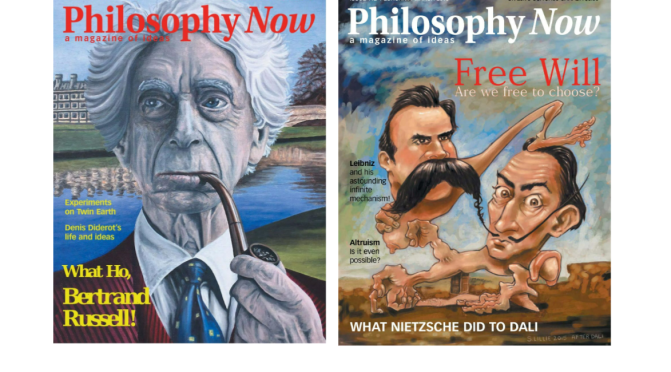
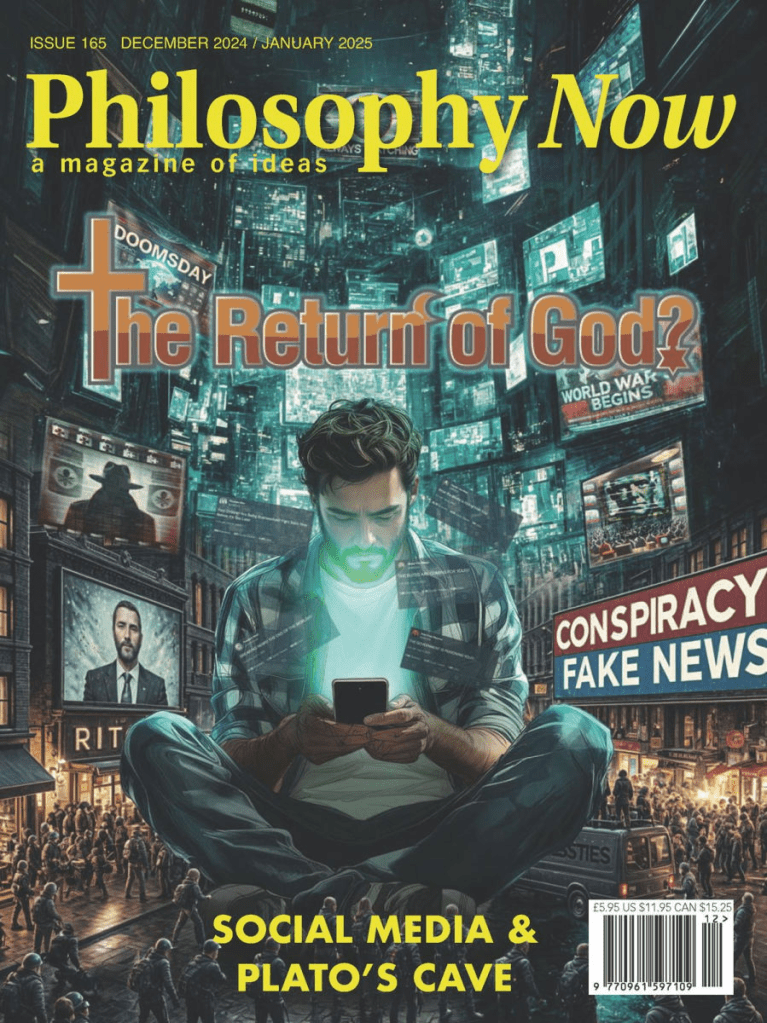
Preview: Philosophy Now Magazine January 2025

Philosophy Now Magazine (December 11,2024)The new issue features ‘The Return of God?’ and Social Media & Plato’s Cave…

Return to God?

by Rick Lewis

NEWS

News: December 2024 / January 2025

Lost Hegel lecture notes now being digitized • Professor Ted Honderich dead at 91 — News reports by Anja Steinbauer

SOCIAL MEDIA

Plato’s Cave & Social Media

Seán Radcliffe asks, has Plato’s Allegory of the Cave been warning us of social media for 2,400 years?

Trolls, Skeptics & Philosophers

Rosemary Twomey questions our online epistemology.

THE RETURN OF GOD?

Exploring Atheism

Amrit Pathak gives us a run-down of the foundations of modern atheism.

A Critique of Pure Atheism

Andrew Likoudis questions the basis of some popular atheist arguments.

Evil & An Omnipotent, Benevolent God

Zdeněk Petráček looks at the biggest problem facing monotheism.

A God of Limited Power

Philip Goff grasps hold of the problem of evil and comes up with a novel solution.

The Best Possible World, But Not For Us

Mohsen Moghri gives a Godless but principled response to the problem of evil.

Medieval Islam & the Nature of God

Musa Mumtaz meditates on two maverick medieval Muslim metaphysicians.

ARTICLES

Metaphors & Creativity

Ignacio Gonzalez-Martinez has a flash of inspiration about the role metaphors play in creative thought.

Seeing & Knowing

Shashwat Mishra explores the limits of perception via the Molyneux problem.

Perpetuating the Santa Deception

Jimmy Alfonso Licon wonders whether pretending there’s a Santa is naughty or nice.

Volney (1757-1820)

John P. Irish travels the path of a revolutionary mind.

How Can We Make A Computer Conscious?

Each answer below receives a random book. Apologies to the entrants not included.

INTERVIEWS

Robert Stern

Robert Stern talks with AmirAli Maleki about philosophy in general, and Kant and Hegel in particular.

LETTERS

Letters

Thoughts on Thoughts on Thoughts • Get Smarter • Decoding A Decoding • A Swift Rebuttal • Basic Arithmetic • A Message on Meaning

COLUMNS

Xenophanes (c.570-c.478 BCE)

by Terence Green

Philosophers on Dance

by Matt Qvortrup

“I refute it thus”

Raymond Tallis kicks immaterialism into touch.

Seneca On Anger

Massimo Pigliucci tells us how to avoid becoming irate.

REVIEWS

Too Late To Awaken by Slavoj Žižek

T.W.J Moxham reads Slavoj Žižek’s little book of Hegelian horrors.

Barriers to Entailment by Gillian Russell

Christopher John Searle recommends a study of which moves are allowed in logical arguments.

It’s A Wonderful Life

Becky Lee Meadows considers questions of guilt, innocence, and despair in this classic Christmas movie.

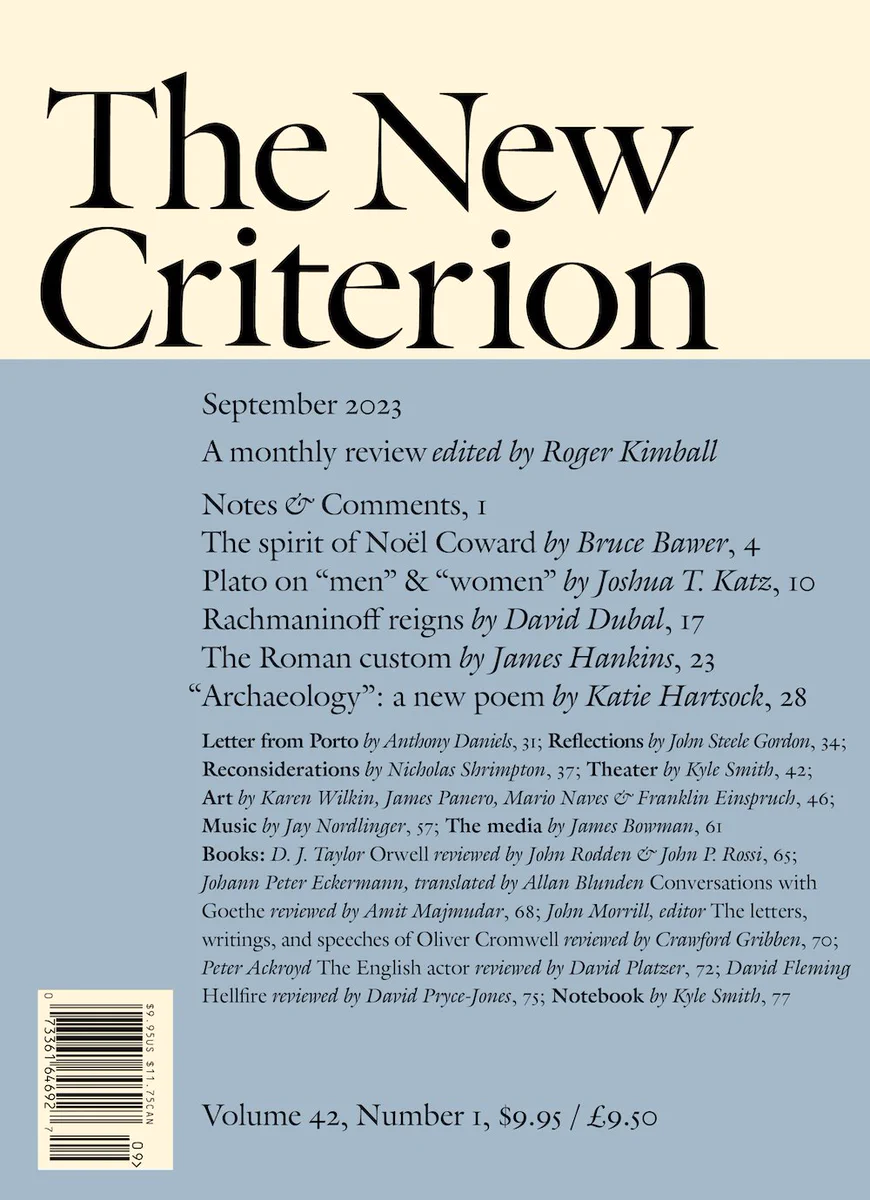
Arts & Culture: The New Criterion — SEPT 2023

Image

The New Criterion – September 2023 issue:

The spirit of Noël Coward  by Bruce Bawer
Plato on “men” & “women”  by Joshua T. Katz
Rachmaninoff reigns  by David Dubal
The Roman custom  by James Hankins


“Archaeology”: a new poem  by Katie Hartsock