
Tag Archives: Parrots

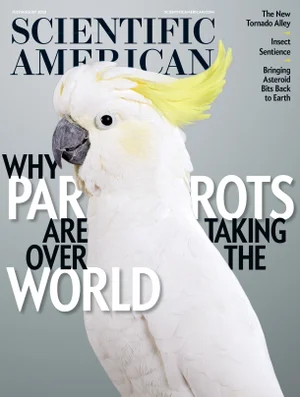
Science Review: Scientific American – July 2023 Issue

Image

Scientific American – July 2023 Issue: Smart, adaptable and loud, parrots are thriving in cities far outside their native ranges.

Parrots Are Taking Over the World
Parrots Are Taking Over the World

By Ryan F. Mandelbaum

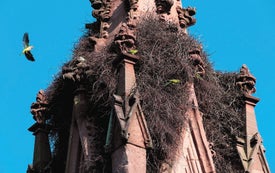
At Brooklyn’s Green-Wood Cemetery the living get as much attention as the dead. Groundskeepers maintain the 478-acre historic landmark as an arboretum and habitat for more than 200 breeding and migratory bird species. But many visiting wildlife lovers aren’t interested in those native birds. They’re at the entryway, their binoculars trained on the spire atop its Gothic Revival arches. They’ve come to see the parrots.

Extreme Heat Is Deadlier Than Hurricanes, Floods and Tornadoes Combined

Extreme Heat Is Deadlier Than Hurricanes, Floods and Tornadoes Combined

When dangerous heat waves hit cities, better risk communication could save lives

By Terri Adams-Fuller

Exposure to extreme heat can damage the central nervous system, the brain and other vital organs, and the effects can set in with terrifying speed, resulting in heat exhaustion, heat cramps or heatstroke. It also exacerbates existing medical conditions such as hypertension and heart disease and is especially perilous for people who suffer from chronic diseases. The older population is at high risk, and children, who may not be able to regulate their body temperatures as effectively as adults in extreme conditions, are also vulnerable.

Brain Waves Synchronize when People Interact

Brain Waves Synchronize when People Interact

The minds of social species are strikingly resonant


By Lydia Denworth

Wildlife: Keas – The Alpine Parrots Of New Zealand

Keas are remarkable birds: playful, belligerent and smart. So smart in fact that some scientists believe they have the intelligence of a 4-year old human.

The kea is a species of large parrot in the family Nestoridae found in the forested and alpine regions of the South Island of New Zealand. About 48 cm long, it is mostly olive-green with a brilliant orange under its wings and has a large, narrow, curved, grey-brown upper beak. 

Journal Views: Science Magazine – July 23, 2021

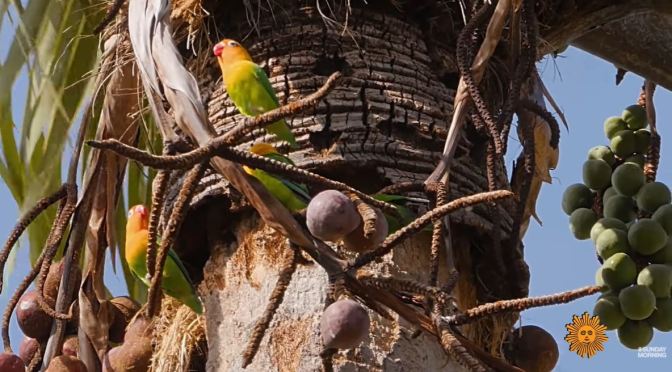
Views: ‘Fischer’s Lovebirds’ At Lake Eyasi, Northern Tanzania In Africa (Video)

“Sunday Morning” takes us to the far-away shores of Lake Eyasi in northern Tanzania, home to the aptly-named Fischer’s Lovebirds. Videographer: Lee McEachern.

Fischer’s lovebird is a small parrot species of the genus Agapornis. They were originally discovered in the late 19th century, and were first bred in the United States in 1926. They are named after German explorer Gustav Fischer.

Lake Eyasi is a seasonal shallow endorheic salt lake on the floor of the Great Rift Valley at the base of the Serengeti Plateau, just south of the Serengeti National Park and immediately southwest of the Ngorongoro Crater in the Crater Highlands of Tanzania.

Top Science Podcasts: Orbiting A Black Hole, Parrots And Online Media Consumption (Nature)

Nature PodcastsListen to the latest from the world of science, brought to you by Benjamin Thompson and Nick Howe. This week, observations of objects orbiting a black hole, and rethinking how we measure screen-time.

In this episode:

00:45 Observing the centre of the galaxy

Researchers have uncovered a population of dust-enshrouded objects orbiting the supermassive black hole at the centre of the galaxy. Research Article: Ciurlo et al.

06:34 Research Highlights

A London landmark’s height lends itself to a physics experiment, and generous behaviour in parrots. Research Highlight: An iconic structure in London moonlights as a scientific toolResearch Highlight: Parrots give each other gifts without promise of reward

09:00 The human ‘screenome’ project

To understand the effects of online media consumption, researchers argue that the way it’s measured needs to change. Comment: Time for the Human Screenome Project

17:26 News Chat

A decline in human body temperature, and a new report on research culture. News: Not so hot: US data suggests human bodies are cooling downNews: Stressful, aggressive, damaging: huge survey reveals pressures of scientists’ working lives