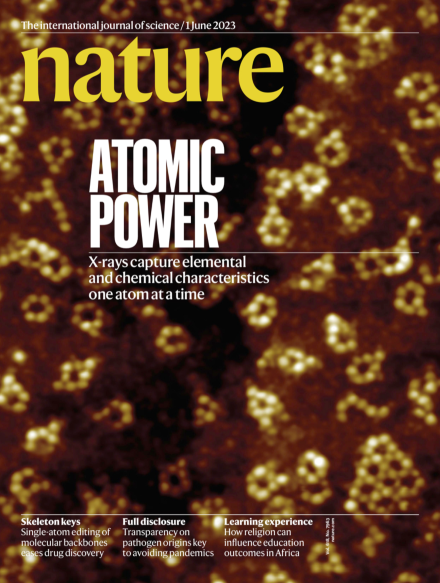
nature Magazine – June 1, 2023 issue: X-rays are widely used to characterize materials, but samples still require a reasonably high number of atoms for success. In this week’s issue, Saw-Wai Hla and his colleagues report that they have used synchrotron X-rays to characterize the elemental and chemical state of an individual atom. The team was able to detect X-ray-excited currents generated from an iron and a terbium atom in molecular hosts.
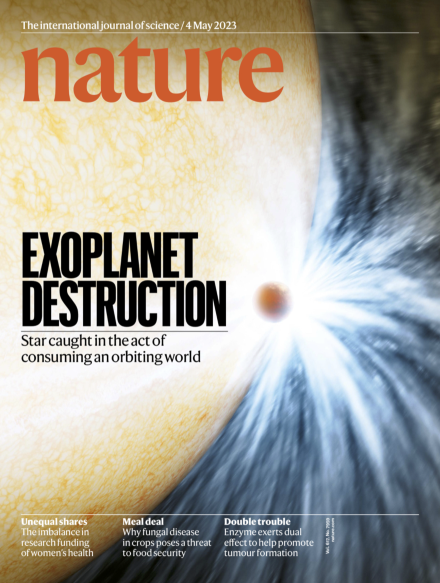
nature Magazine – May 4, 2023 issue:As stars evolve, they expand and so will engulf planets in close orbit around them. This planetary catastrophe is expected to generate powerful luminous ejections of mass from the star, although this has not been observed directly.
The current landscape of mobile mental-health apps is the result of a 70-year search to automate therapy. Now, advanced AIs pose fresh ethical questions.
Illustration by Fabio Buonocore
Since 2015, Koko, a mobile mental-health app, has tried to provide crowdsourced support for people in need. Text the app to say that you’re feeling guilty about a work issue, and an empathetic response will come through in a few minutes — clumsy perhaps, but unmistakably human — to suggest some positive coping strategies.
Facility will produce up to five billion bacteria-infected mosquitoes per year
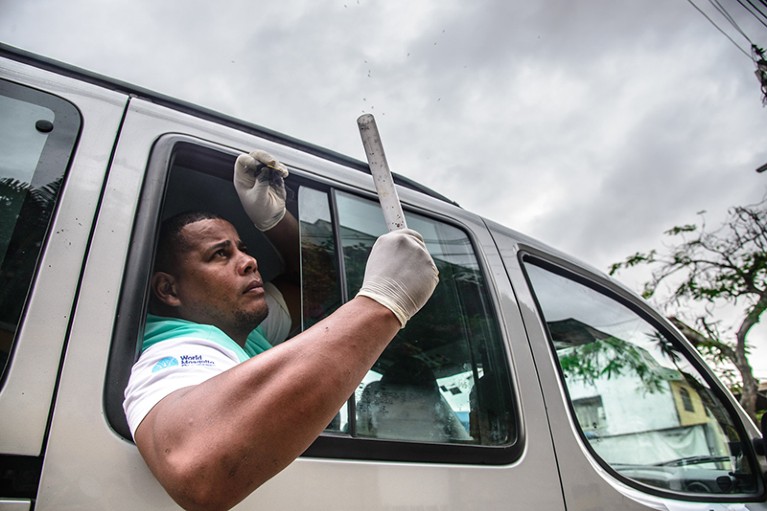
A World Mosquito Program (WMP) staff member releases Wolbachia-infected mosquitoes in Niterói, Brazil.Credit: WMP Brasil.
The non-profit World Mosquito Program (WMP) has announced that it will release modified mosquitoes in many of Brazil’s urban areas over the next 10 years, with the aim of protecting up to 70 million people from diseases such as dengue. Researchers have tested the release of this type of mosquito — which carries a Wolbachia bacterium that stops the insect from transmitting viruses — in select cities in countries such as Australia, Brazil, Colombia, Indonesia and Vietnam. But this will be the first time that the technology is dispersed nationwide.
How a move to microbial protein could affect emissions. It’s well understood that the production of meat has large impacts on the environment.
This week, a team show that replacing 20% of future meat consumption with protein derived from microbes could reduce associated emissions and halve deforestation rates.
How saltwater crocodiles’ penchant for pigs is driving population recovery in Australia, and solving the mystery of some eighteenth-century porcelain’s iridescent lustre.
10:47 The neurons that help mosquitoes distinguish smell
Female Aedes aegypti mosquitoes strongly prefer human odours to those of animals, but how they distinguish between them is not well understood. Now, researchers have shown that human odours strongly activate a specific area in the brains of these insects, a finding that could have important implications for mosquito-control strategies.
We discuss some highlights from the Nature Briefing. This time, how climate change could affect virus transmission between mammals, and how the link between a dog’s breed and its temperament may not be as close as previously thought.
The bloc seems at last to have a firm hand on inoculation and recovery—but efforts to engineer even progress among member states are not quite panning out.
In recent years Bangladesh’s government has been cosy with a puritanical Islamist group; we ask why the relationship has grown complicated. And a genetic-engineering solution to the problem of mosquito-borne disease.
The covid-19 pandemic may have derailed the world in 2020, but a far deadlier disease has shaped human history for thousands of years. Malaria defeated armies, fuelled the slave trade and jump-started the modern environmental movement. How covid-19 hinders the fight against malaria: https://econ.st/3gAsfCj
Senior Correspondent Jeffrey Mervis joins host Sarah Crespi to talk about how universities are dealing with the financial crunch brought on by the coronavirus. Jeff discusses how big research universities are balancing their budgets as federal grants continue to flow, but endowments are down and so is the promise of state funding.
Mosquito-borne infections like Zika, dengue, malaria, and chikungunya cause millions of deaths each year. Nicole Culbert and colleges write this week in Science Robotics about a new way to deal with deadly mosquitoes—using drones. The drones are designed to drop hundreds of thousands of sterile male mosquitoes in areas with high risk of mosquito-borne illness. The idea is that sterile male mosquitoes will mate with females and the females then lay infertile eggs, which causes the population to decline. They found this drone-based approach is cheaper and more efficient than other methods of releasing sterile mosquitoes and does not have the problems associated with pesticide-based eradication efforts such as resistance and off-target effects.
News, Views and Reviews For The Intellectually Curious









 Senior Correspondent Jeffrey Mervis joins host Sarah Crespi to talk about how universities are dealing with the financial crunch brought on by the coronavirus. Jeff discusses how big research universities are balancing their budgets as federal grants continue to flow, but endowments are down and so is the promise of state funding.
 Boomers Daily