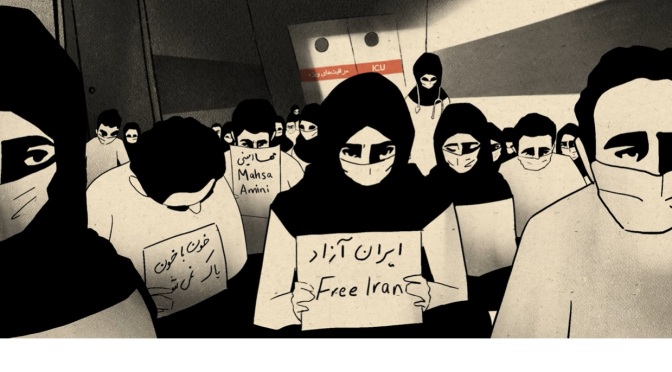
The New Yorker (April 17, 2024): In “The Smallest Power,” the filmmaker Andy Sarjahani captures the power of an individual act of resistance amid the chaos of nationwide disorder. The animated short is a product of his own circuitous journey to understand his dual identities. Sarjahani’s mother, Tammie, is a Baptist from the American South.
His father, Ali, was born a Shiite Muslim from Iran. They met in the library at the University of Alabama in Huntsville, married in 1978, and eventually settled in Russellville, Arkansas. “I grew up in the Ozarks, so I didn’t have a deep connection to my Iranian heritage,” Sarjahani told me. His family had Christmas trees and celebrated Easter but also marked Nowruz, the Persian New Year.
The Guardian Weekly (April 5, 2024) – The new issue features ‘Lone Star’ – Have the UN vote and questions about its conduct in Gaza left Israel isolated?; Liz Truss bids for political resurrection; Will IS strike again?; Nick Cave’s devilish change of direction…
Spotlight | IS affiliates could launch new wave of terror on the west
Islamic State has stalled in Iraq and Syria but officials believe it has been planning new attacks on the west for years, reports Jason Burke; while Angelique Chrisafis writes that France’s interior minister has met intelligence services to assess the terrorist threat to the country ahead of this summer’s Olympic Games
Environment | True cost of a city built from scratch
Nusantara is billed as a state-of-the-art capital city that will coexist with nature – but not all residents of Borneo’s Balikpapan Bay are happy, find. By Rebecca Ratcliffe and Richaldo Hariandja
Feature | 49 days later
Liz Truss trashed the economy as Britain’s shortest-serving prime minister. But she is back, launching a new conservative movement and spreading her ideology across the world. You just can’t keep a bad politician down, argues David Runciman
Culture | The devil in the details
In the past nine years, Nick Cave has lost two sons – an experience he explores in a deeply personal new ceramics project. He discusses mercy, forgiveness, making and meaning with Simon Hattenstone
Architecture | A Māori-built environment
A new wave of Indigenous architects are behind a series of stunning buildings embracing tribal identity in Aotearoa New Zealand, Oliver Wainwright discovers
Artificial intelligence holds huge promise in health care. But it also faces massive barriers
Better diagnoses. Personalised support for patients. Faster drug discovery. Greater efficiency. Artificial intelligence (ai) is generating excitement and hyperbole everywhere, but in the field of health care it has the potential to be transformational. In Europe analysts predict that deploying ai could save hundreds of thousands of lives each year; in America, they say, it could also save money, shaving $200bn-360bn from overall annual medical spending, now $4.5trn a year (or 17% of gdp). From smart stethoscopes and robot surgeons to the analysis of large data sets or the ability to chat to a medical ai with a human face, opportunities abound.
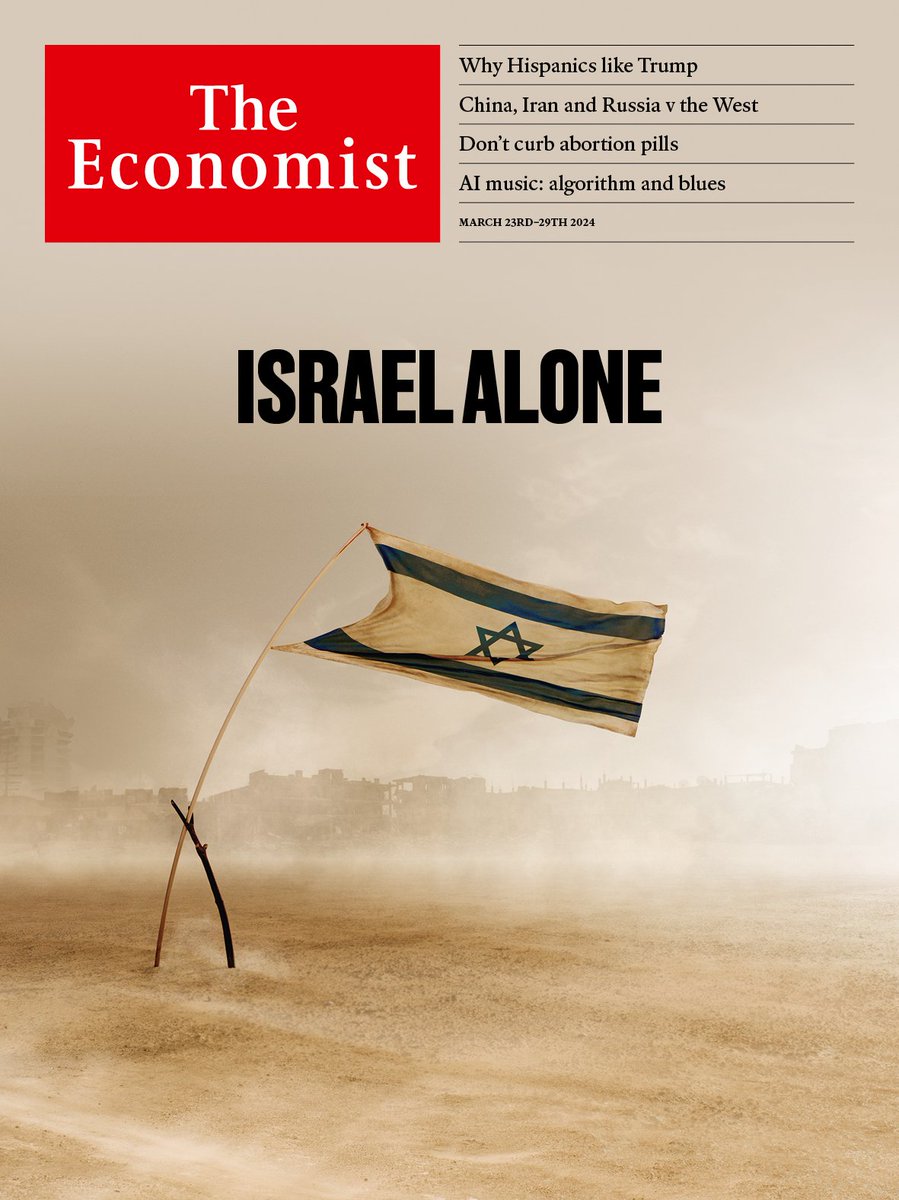
The Economist Magazine (March 21, 2024): The latest issue features ‘Israel Alone’ – At a moment of military might, Israel looks deeply; ‘How To Trade An Election’ – It is getting harder for investors to ignore politics; China, Iran and Russia versus The West – Assessing the economic threat posed by the anti-Western axis…
There is still a narrow path out of the hellscape of Gaza. A temporary ceasefire and hostage release could cause a change of Israel’s government; the rump of Hamas fighters in south Gaza could be contained or fade away; and from the rubble, talks on a two-state solution could begin, underwritten by America and its Gulf allies. It is just as likely, however, that ceasefire talks will fail. That could leave Israel locked in the bleakest trajectory of its 75-year existence, featuring endless occupation, hard-right politics and isolation. Today many Israelis are in denial about this, but a political reckoning will come eventually. It will determine not only the fate of Palestinians, but also whether Israel thrives in the next 75 years.
It is becoming harder for investors to ignore politics
Investors differ in their approach to elections. Some see politics as an edge to exploit; others as noise to block out. Even for those without a financial interest, markets offer a brutally frank perspective on the economic stakes. As elections approach in America and Britain, as well as plenty of other countries, that is especially valuable.
The Economist Magazine (March 7, 2024): The latest issue features Three big risks that might tip America’s presidential election – Third parties, the Trump trials and the candidates’ age introduce a high degree of uncertainty; Xi Jinping’s hunger for power is hurting China’s economy; How to fix the Ivy League – Its supremacy is being undermined by bad leadership…
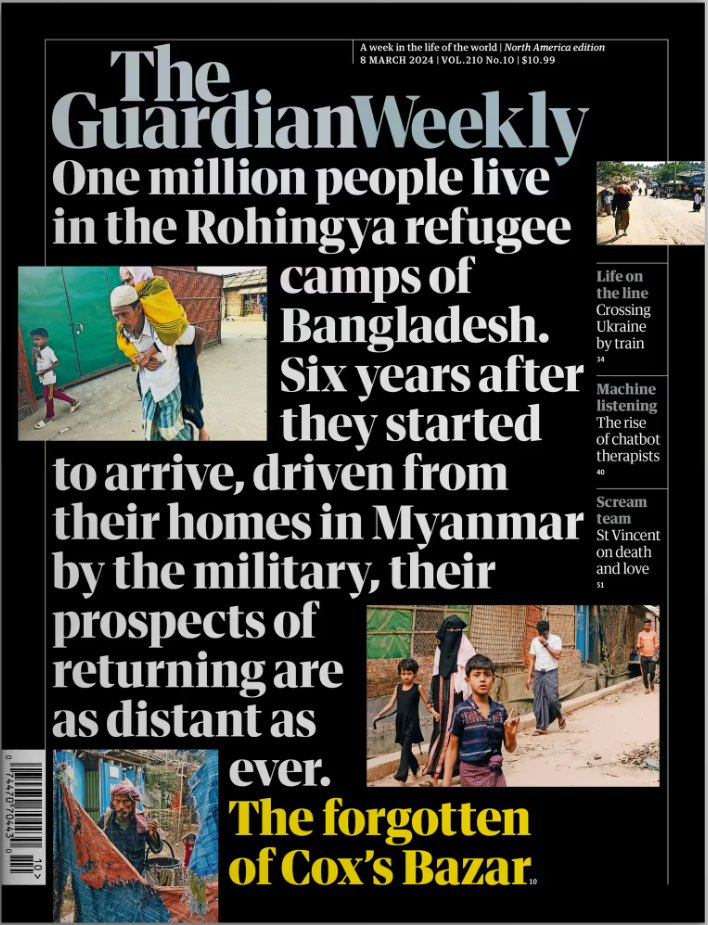
It was August 2017 when the world really started to take note of Myanmar’s Rohingya people. Descendants of Arab Muslims who speak a different language to most other people in Myanmar, the Rohingya had up to that point lived mainly in the northern Rakhine state, coexisting uneasily alongside the majority Buddhist population.
But the Rohingya were reviled by many as illegal immigrants and treated by the then government as stateless people. In 2017, when violence broke out in the north of the state, security forces supported by Buddhist militia launched a “clearance operation”that forced more than 1 million Rohingya people to flee their homes and the country, actions that many onlookers saw as ethnic cleansing. Most Rohingya were driven into vast refugee camps in the Cox’s Bazar region of Bangladesh, where they have remained ever since.
The Guardian global development reporter Kaamil Ahmed has been covering the Rohingya crisis for almost a decade, making multiple trips to the region. For this week’s Big Story, Kaamil returned to Cox’s Bazar where, in two moving reports, he details how disease and illness are widespread in the ramshackle camps, and how the desperation to escape has resulted in rich business for people traffickers.
And, with Myanmar now controlled by a military junta and introducing a deeply unpopular conscription drive (as Rebecca Ratcliffe and Aung Naing Soe report), the prospect of any Rohingya people being able to return home to Rakhine state remains as distant as it did in 2017.
News, Views and Reviews For The Intellectually Curious













 Boomers Daily