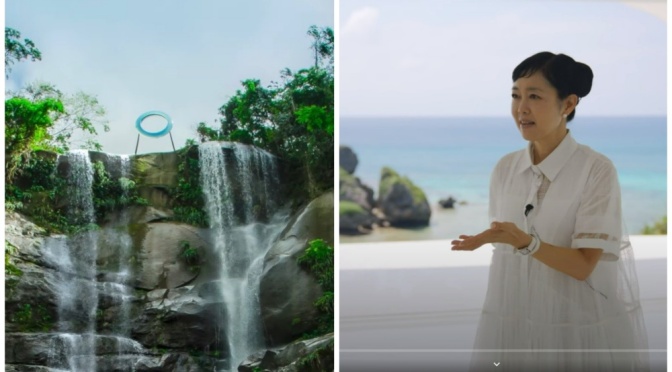
Louisiana Channel (November 7, 2023) – Japanese artist Mariko Mori shares a look into her studio and home as well as her own artistic practice. Mariko Mori was born in Tokyo, Japan, but has lived for several years in both New York and London. Her mother was an art historian, and the young Mori was introduced to art through her.
“It seems to me that a lot of our conceptual ideas are already carried out in the past. And we’re at a point to inherit those ideas to the future.”
“When I was nine years old, I was looking through her collection of postcards of all the Western art,” Mori remembers: “Somehow I found Jackson Pollock’s no. 13 painting. And I was so thrilled. I didn’t know what abstract painting was, but I really felt freedom.” Today, Mariko Mori works in various mediums, from photography and sculpture to installation and architecture. Her studio – and home – was the first architectural project she did. The house is located at Okinawa, a tropical island south of Japan.
Inspired by the surrounding nature Mori wanted “the house to be an extension of that. A part of nature.” The untraditional shape of the house is eye-catching: “Originally, I was thinking of just building an architecture building, but it became more like a sculpture or form,” she says and continues: “The shape tried to accommodate the wind coming from the north.” This explains why the building is smaller in one part and bigger in another.
Mariko Mori is a Japanese multidisciplinary artist. She is known for her photographs and videos of her hybridized future self, often presented in various guises and featuring traditional Japanese motifs. Her work often explores themes of technology, spirituality and transcendence.
“This is going to change the world as we know it.”
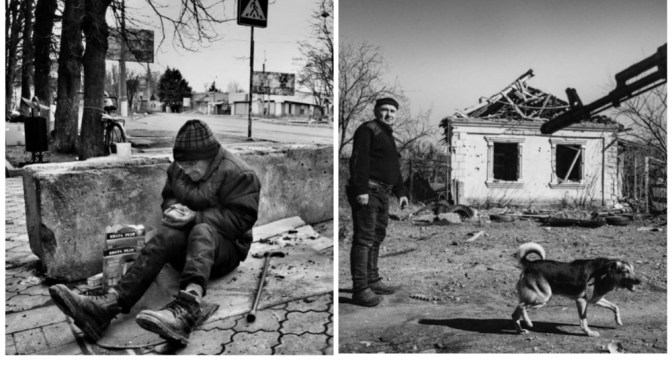
“The pictures are a documentation of the brutality within the conflict itself. It’s about civilians and civilian casualties because they are the ones hit the hardest. “
“The Russians are terrorizing the civilian population. They are hitting civilian infrastructure, may it be water, electricity, or heating. That brutality is extremely important to show. For me, it is about getting as close to these people as possible.”
Grarup is convinced that the ongoing war in Ukraine will mark the beginning of a new area that will isolate Russia from the Western World for generations to come: “I have been covering wars and conflicts for the last 35 years – just about every conflict you can imagine. In many ways, the brutality of the genocide in Rwanda in 1994 is second to none. But the war in Ukraine comes really, really close. It’s basically a country which is desiring democracy and freedom and independence – and because of that, its people are killed.”
Grarups also reflects upon his feelings covering the war, such as his general discomfort with silence as “you can be sure that something is about to happen.” On the other hand, he sees the necessity to document the war for future generations and the possible prosecution of war crimes. “What I like about black-and-white photography is its timelessness. We think in our part of the world that the world has changed, developed, and moved far away from what we have seen historically.
But the fact is: It hasn’t. It’s still the same atrocities. It’s still the same victims.” Jan Grarup was born in Denmark in 1968 and is today regarded as one of the leading and most experienced war photographers globally. Already in 1991, the year of his graduation, he won the prestigious Danish Press Photographer of the Year Award, a prize he would receive on several further occasions. In 1993, he moved to Berlin for a year, working as a freelance photographer for Danish newspapers and magazines. Afterwards, Grarup covered many wars and conflicts worldwide, including the Gulf War, the Rwandan genocide, the siege of Sarajevo and the Palestinian uprising against Israel in 2000.
His coverage of the conflict between Palestine and Israel led to two series: The Boys of Ramallah, which earned him the Pictures of the Year International World Understanding Award in 2002, followed by The Boys from Hebron. His book, Shadowland (2006), presents his work during the 12 years he spent in Kashmir, Sierra Leone, Chechnya, Rwanda, Kosovo, Slovakia, Ramallah, Hebron, Iraq, Iran, and Darfur. In the words of Foto8’s review, it is “intensely personal, deeply felt, and immaculately composed.”
His second book, Darfur: A Silent Genocide, was published in 2009. In 2017 he released the prizewinning bestseller And Then There Was Silence. He is currently working on a follow-up called While We Bleed with Danish author Adam Holm about the war in Ukraine. Jan Grarup has won numerous prizes for his dedicated work, for example eight World Press Awards, the Pictures of the Year International World Understanding Award, the UNICEF Children Photo of the Year Award, Visa d’Or, Leica Oskar Barnack Award, to mention a few of the more prestigious ones. Jan Grarup was interviewed by Marc-Christoph Wagner in Copenhagen, Denmark.
The interview took place at the Danish War Museum in March 2023 on the occasion of Grarup’s exhibition One Year With War. Camera: Jakob Solbakken Edited by: Helle Pagter Produced by: Marc-Christoph Wagner
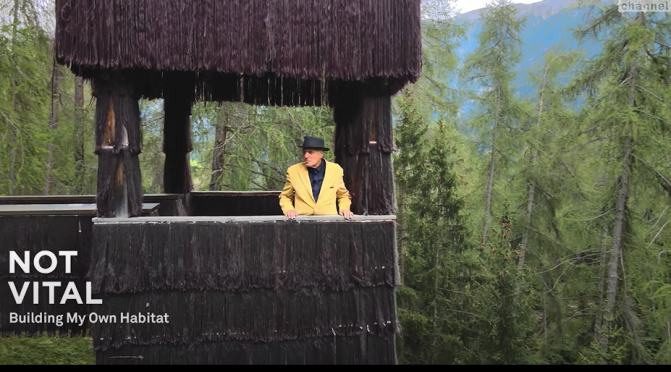
“If you’re a painter, you need a canvas. If you’re a sculptor, you need marble or plaster. And if you build a house, you need a piece of land.” Welcome to the wonderful world of Not Vital. The Swiss multi-faceted artist shows us his sculpture park, foundation, and castle in this video.
We meet Not Vital in his studio in Sent, the town in Switzerland where he grew up and one of the places where he still lives. Building places to live have been with him since childhood: “My first work was more related to trying to build a house or a habitat. The first one was when I was only three years old in 1951. There was so much snow that my brother and I built a tunnel,” he says and continues: “I think that it was the first time I realised that I like to build my own habitat.
Even though it was much more comfortable to live in the house, I spent the day in the tunnel. I remember the light, the smell of the snow. I just felt great.” Through the years, Vital has led a nomadic life, seeking and building homes in various cities around the globe: Paris, New York, Beijing, Rio de Janeiro. He has bought an island made of Marble in Patagonia, called NotOna.
In Niger, he has built a house whose only purpose is to watch the sunset. He calls these hybrids of sculpture and architecture ‘Scarch’: “It opened up a whole new world for me, which became very important. I’m calling that ‘Scarch’ because it’s a kind of sculpture and architecture. Because I’m not an architect, I didn’t want to be an architect or study architecture because I would probably have gone in a different direction.” Buying pieces of land worldwide is essential for his artistic practice.
He explains: “If you’re a painter, you need a canvas. If you’re a sculptor, you need marble or plaster. And if you build a house, you need a piece of land. That’s kind of all related.” ‘Scarch’ is not the only thing Vital makes. He also creates sculptures in silver, makes humorous wordplays with antlers and paints portraits: “I want to show the way I see. I don’t want to change anything.”
The portraits he started painting in 2008. Often they depict the people surrounding him. Other times, it is significant artists such as a young Rembrandt and Nina Simone. “When I paint, I think about a lot of Rothko. The colours. How to put two colours together. But of course, this is figurative,” Vital reflects and continues: “Actually, they have everything in it. They have eyes and noses.
And that’s great by painting that whatever you put in the canvas stays in the canvas. Even though you paint it over, it’s still there.” Not Vital does not differ between the many different artforms he works with: “Art is one. It doesn’t matter if it’s the 15th century or if it’s now. It’s all related.” Not Vital (b. 1948) is a Swiss artist who works in diverse media across installations, paintings, drawings and sculptures, typically integrating architecture. Vital divides his time between the U.S., Niger, Italy, China and Switzerland, and his art is centred on personal impressions and experiences from around the world. This somewhat anthropological approach is also reflected in how his career is structured into sections, e.g. glass blowers in Murano or paper artists in Bhutan. Vital’s work has been featured in the 49th Venice Biennale in Italy (2001), and he has held significant exhibitions at prominent venues such as the Kunsthalle Bielefeld in Germany (2005), The Arts Club of Chicago in the U.S. (2006), Ullens Center For Contemporary Art in Beijing, China (2011), the Museo d’arte di Mendrisio in Switzerland (2014-15) and Galerie Thaddaeus Ropac, London (2021).
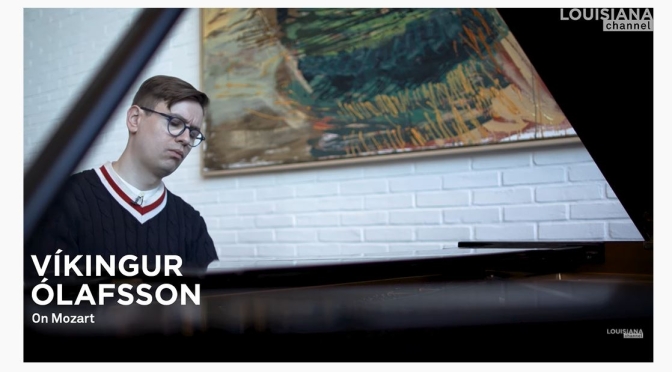
“Mozart really belonged to the 19th century”, says Icelandic star-pianist Víkingur Ólafsson about Wolfgang Amadeus Mozart “He belonged to a new area, where the artist was a free thinker. Image, if he had lived a little longer and would have had a dialogue with Ludwig van Beethoven.”
Ólafsson has no doubt that Mozart was a so-called Wunderkind. “He did have a divine gift.” But to Ólafsson another aspect of Mozart’s music is even more fascinating. According to Ólafsson Mozart wrote his best works after the age of 25, when his life was in deep crisis and the Vienna aristocracy had turned its back on him.
“The greater the music became, the less popularity he had.” To Ólafsson Mozart’s legacy must be seen in the light of the tragedy. Víkingur Ólafsson grew up in Reykjavík and started playing the piano at an early age under the tutelage of his mother, a piano teacher. He studied at the Juilliard School in New York, earning bachelor’s and master’s degrees under the supervision of Jerome Lowenthal and Robert McDonald. He also took lessons with Ann Schein.
In 2011, Ólafsson was the soloist in the opening concert of Harpa in Reykjavik, playing Edvard Grieg’s piano concerto with the Iceland Symphony Orchestra. Since he has developed into one of the most recognized and award-winning artists within classical and contemporary music.
In 2016, Víkingur signed an exclusive recording contract with the renowned label Deutsche Grammophon releasing four albums featuring the music of Philip Glass, Johann Sebastian Bach, Debussy & Rameau as well as Mozart & Contemporaries. Ólafsson has collaborated with many contemporary artists among them John Adams, Philipp Glass, Daniel Bjarnason and Icelandic singer Bjørk. He has also recorded the soundtrack of Darkest Hour, a film directed by Joe Wright, and released Bach Reworks, featuring six ‘remixed’ works by Johann Sebastian Bach from the likes of Ben Frost, Peter Gregson, Valgeir Sigurdsson as well as Ólafsson himself.
Víkingur Ólafsson was interviewed by Marc-Christoph Wagner at the Louisiana Museum of Modern Art in November 2021. Camera: Jarl Therkelsen Kaldan Edited by: Jarl Therkelsen Kaldan Produced by Marc-Christoph Wagner Copyright: Louisiana Museum of Modern Art, 2021 Louisiana Channel is supported by Den A.P. Møllerske Støttefond, Ny Carlsbergfondet and C.L. Davids Fond og Samling
News, Views and Reviews For The Intellectually Curious


 Boomers Daily