Tag Archives: Literature

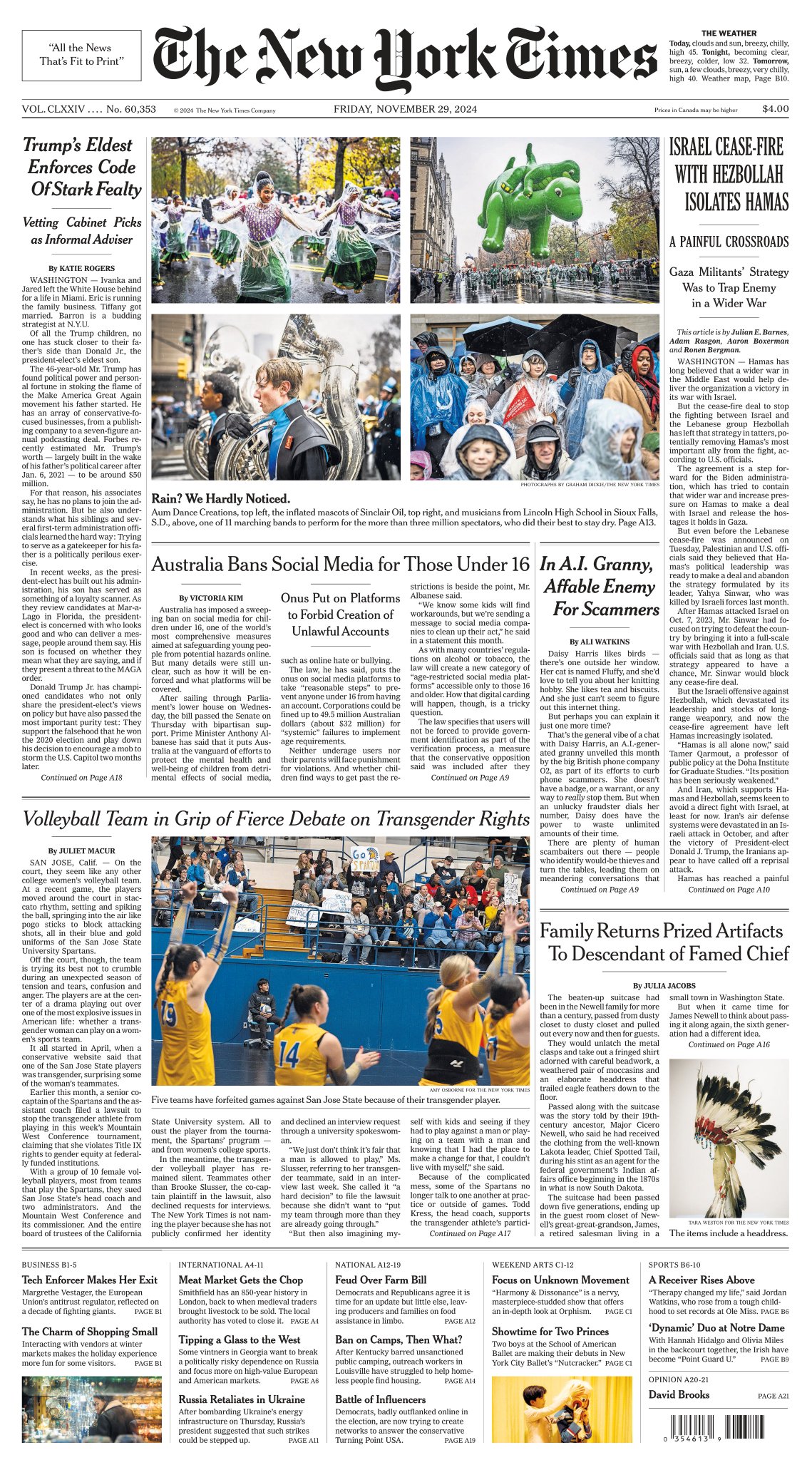
The New York Times Magazine – Feb 19, 2024

THE NEW YORK TIMES MAGAZINE (February 17, 2024): The new issue features ‘Actors in the Wild’ – The best performers of the year, when they’re not on film….

Actors in the Wild

The best performers of the year — when they’re not on film.

James Nachtwey, an eminent photojournalist known for his intimate depictions of the front lines in places like Iraq, Afghanistan and Ukraine, had never photographed a movie star before. So for this year’s Great Performers issue, we asked him to capture a dozen of the world’s best actors away from the red carpets and awards ceremonies that often define how we see them. “My work has focused almost exclusively on conflicts and critical social issues, the polar opposite of what might be thought of as celebrity photography,” Nachtwey says. But he was intrigued by the challenge: “Art takes talent, but it’s also hard work, and exploring what actors practice in their daily lives to strengthen their art would be fascinating.”

Tubi Is Reviving a Lost Joy: Watching Really, Really Bad Movies

A photo illustration of Tubi scenes.

Their films have gone viral for their awful production values. But their success says fascinating things about what comes after prestige TV.

By Niela Orr

There’s a 2008 movie that offers an odd preview of today’s entertainment. In Michel Gondry’s “Be Kind Rewind,” a bizarre accident demagnetizes the entire inventory of a video rental store, so a clerk and his eccentric friend decide to remake all the films themselves, from “The Lion King” to “Driving Miss Daisy” to “2001: A Space Odyssey.” Their versions are 20 minutes long (at most), shot on an old hand-held video camera and produced in a delightfully quirky, ad hoc way: handcrafted props and sets, buddies working as extras, costumes from the local dry cleaner.

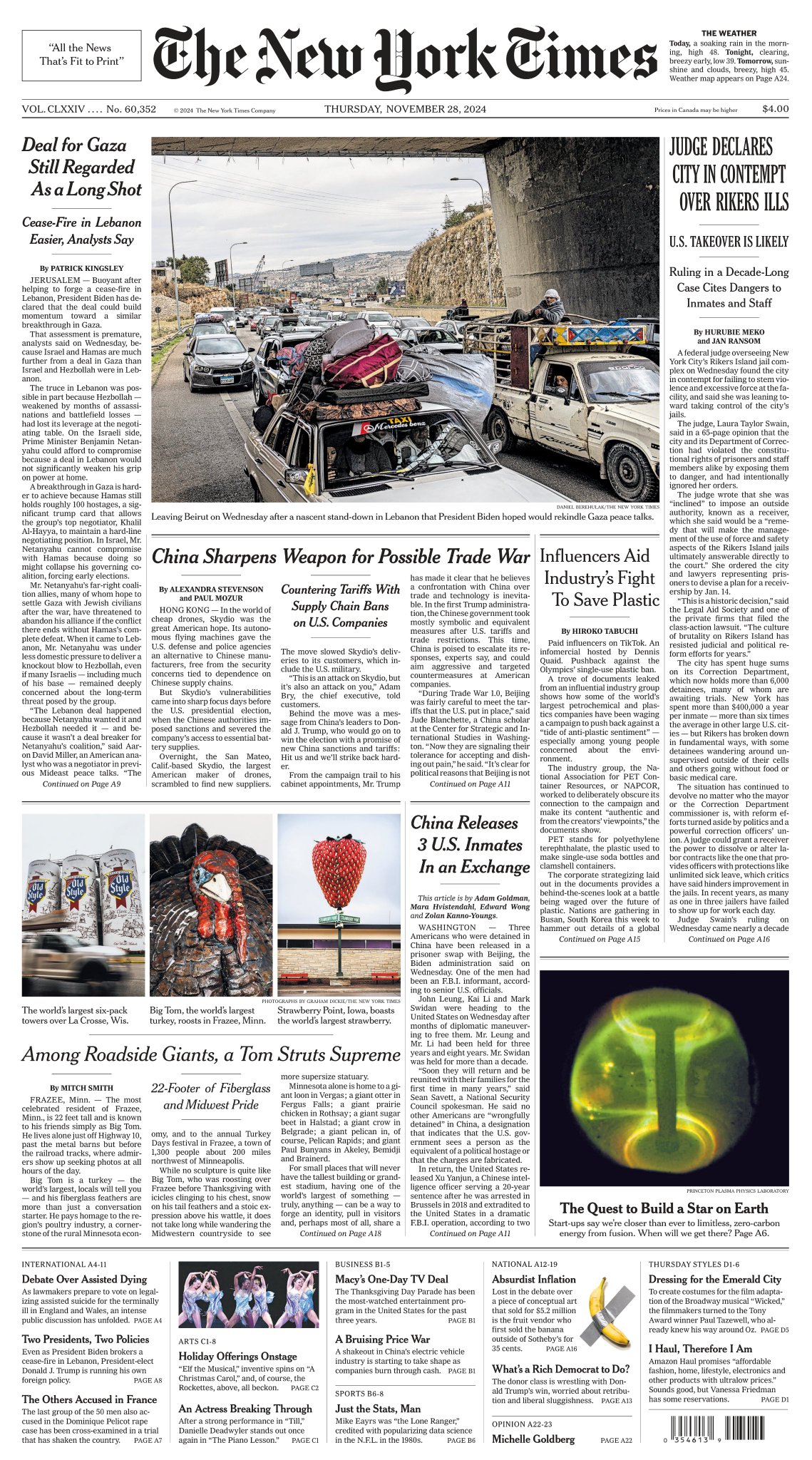
The New York Times Magazine – Feb 11, 2024

Image

THE NEW YORK TIMES MAGAZINE (February 9, 2024): The new issue features ‘The Untold Story Of How Trump’s Former Chief Of Staff Rose From Cash-Strapped Roots To Washington Prominence, Before Becoming Embroiled In The Prosecutions That May Determine The 2024 Election….

How Mark Meadows Became the Least Trusted Man in Washington

The untold story of the rise and fall of Trump’s former chief of staff — and his role in the prosecutions that may determine the 2024 election.

How Oct. 7 Drove a Wedge Into the Democratic Party

Members of Congress, and candidates for their seats, have been drawn into bitter political clashes over the Israeli-Palestinian conflict.

When George Santos, the indicted fabulist, was expelled from Congress in December, Nassau County Republicans scrambled to hunt up a new nominee. Santos was a catastrophe, but he had also flipped a New York Democratic stronghold, and party leaders wanted the best of him — the charisma, the conservatism and the history-making potential — with none of the debilitating drawbacks.

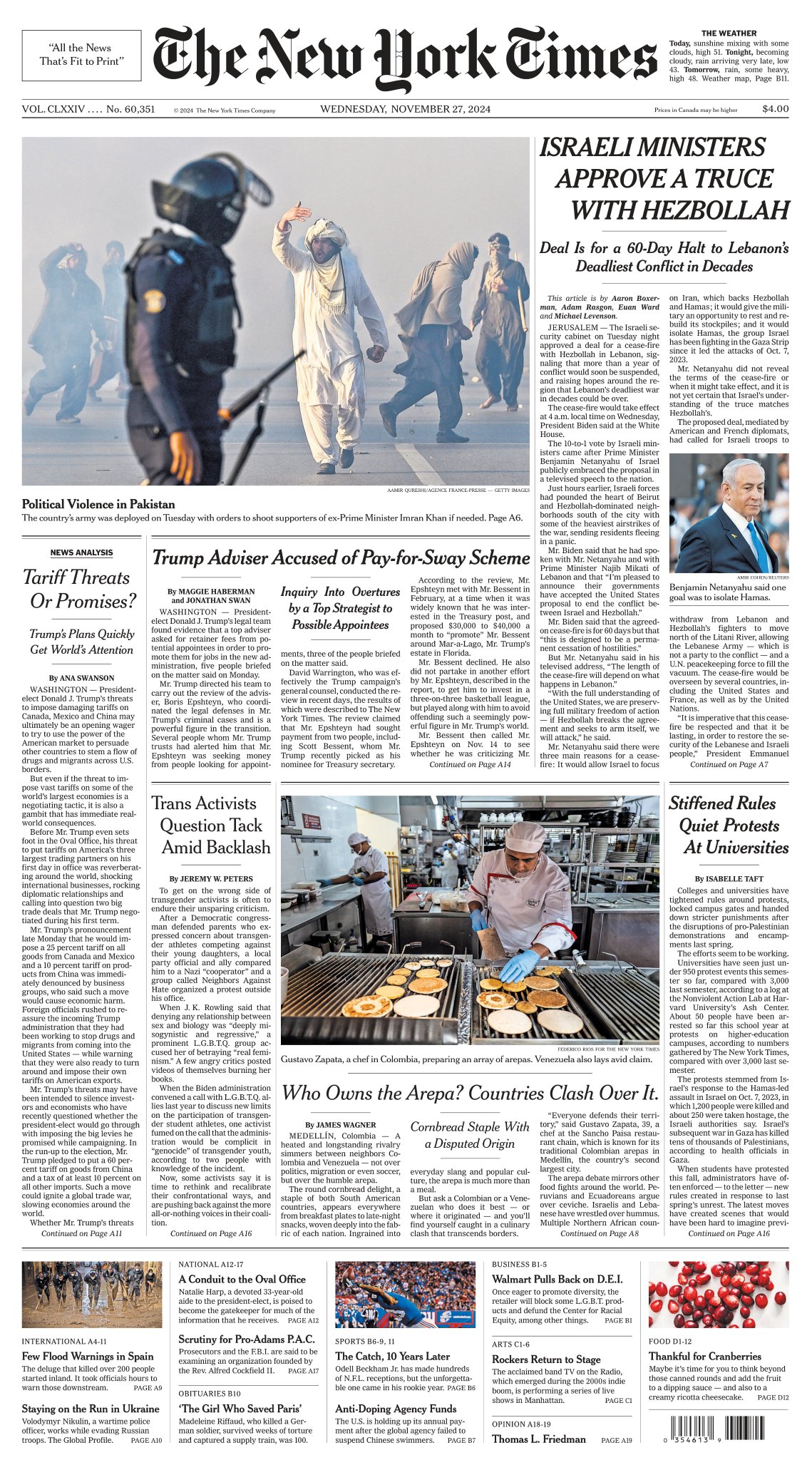
The New York Times Magazine-February 4, 2024

Image

THE NEW YORK TIMES MAGAZINE (February 2, 2024): The new issue features ‘The Long Shadow of 1948’ – How the decisions that led to the founding of Israel left the region in a state of eternal conflict…

The Road to 1948

How the decisions that led to the founding of Israel left the region in a state of eternal conflict.

A discussion moderated by Emily Bazelon

One year matters more than any other for understanding the Israeli-Palestinian conflict. In 1948, Jews realized their wildly improbable dream of a state, and Palestinians experienced the mass flight and expulsion called the Nakba, or catastrophe. The events are burned into the collective memories of these two peoples — often in diametrically opposed ways — and continue to shape their trajectories.

John Malkovich on (Really) Being John Malkovich

An illustration of John Malkovich.

By David Marchese 

There’s a scene in that modern classic of screwball existentialism, “Being John Malkovich,” from 1999, in which John Malkovich, playing a version of himself, enters a portal that others have been using to climb inside his mind. Suddenly, Malkovich is in a world populated solely by variations on himself: Malkovich as a flirtatious sexpot, a genteel waiter, a jazz chanteuse, a bemused child, everyone speaking only the word “Malkovich.” In a way, that scene is a microcosm of the actor’s decades-long, always-interesting career. 

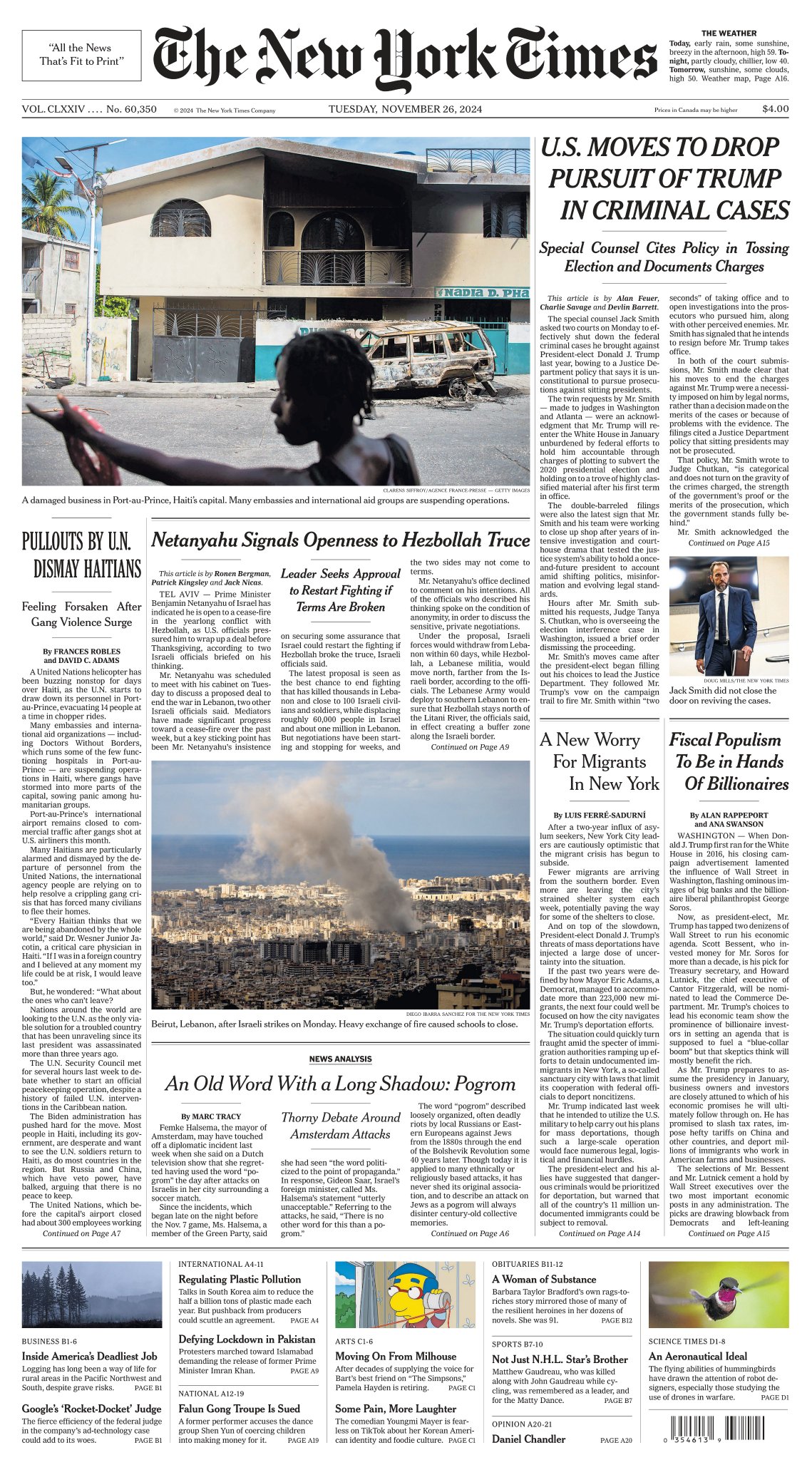
The New York Times Magazine- January 28, 2024

THE NEW YORK TIMES MAGAZINE (January 26, 2024): The new issue features ‘America’s 21st-Century E-Commerce Economy Has Stoked A 19th-Century Form of Crime: The Train Robbery’….

The Great Freight-Train Heists of the 21st Century

A photo illustration composed of an old black-and-white photograph of train robbers stealing amazon packages in color.

The explosion of the e-commerce economy has created an opportunity for thieves — and a conundrum for the railways.

College Is All About Curiosity. And That Requires Free Speech.

An illustration of a professor in front of a class that is shouting and picketing from the rafters.

True learning can only happen on campuses where academic freedom is paramount — within and outside the classroom.

Current Affairs: Prospect Magazine – March 2024

Image

Prospect Magazine (March 2024) The latest issue features ‘How The Government Captured The BBC’ – A faceless fixer – and a broadcaster in a state of ‘permanent cringe’…

To whom do we owe shelter?

We do not choose where we are born. That creates rights—and obligations—that we should all seek to honour

Conflict, human rights abuses and climate change have led to a doubling of the global refugee population in the last seven years, and yet the response of many wealthy countries has become increasingly insular and myopic. Constant demands to slash international aid, along with punitive immigration policies and hateful rhetoric, mark a shift away from humanitarian values. The UK’s Rwanda scheme epitomises this trend: it would normalise the mass deportation of asylum seekers and undermine prohibitions on returning refugees to dangerous countries. At the same time, citizens of wealthy countries appear increasingly indifferent to the plight of those who perish in the Mediterranean or along other perilous routes.

How the government captured the BBC

© Photography by Sara Morris, post-production by the Retouching Shed

Ukraine’s fate, Europe’s choice

Friendly fire? Ukraine’s chief commander, Valeriy Zaluzhny, is said to have a frosty relationship with Zelensky © Ukraine President’s Office / Alamy

The New York Times Magazine- January 21, 2024

Image

THE NEW YORK TIMES MAGAZINE (January 19, 2024): The new issue features ‘The Whale Who Went AWOL’ – How do you solve a problem like Hvaldmir?; How Group Chats Rule the World – They quietly became the de facto spaces to share dumb jokes, grief or even plans for an insurrection…

The Whale Who Went AWOL

Hvaldimir escaped captivity and became a global celebrity. Now, no one can agree about what to do with him.

By Ferris Jabr

On April 26, 2019, a beluga whale appeared near Tufjord, a village in northern Norway, immediately alarming fishermen in the area. Belugas in that part of the world typically inhabit the remote Arctic and are rarely spotted as far south as the Norwegian mainland. Although they occasionally travel solo, they tend to live and move in groups. This particular whale was entirely alone and unusually comfortable around humans, trailing boats and opening his mouth as though expecting to be fed. And he seemed to be tangled in rope.

How Group Chats Rule the World

An illustration of people falling into chat bubbles.

They quietly became the de facto spaces to share dumb jokes, grief or even plans for an insurrection.

By Sophie Haigney

I am texting all the time. I am, at the very least, receiving texts all the time, a party to conversations in which I am alternately an eavesdropper and an active participant. This is because I am in a lot of group chats — constant, interlinked, text-message-based conversations among multiple friends that happen all day long. I dip into and out of these conversations, on my phone and on my computer. Sometimes I will put both away for two hours and return to find 279 new messages waiting.

The New York Times Magazine- January 14, 2024

Image

THE NEW YORK TIMES MAGAZINE (January 12, 2024): The new issue features ‘Why Are American Drivers So Deadly’ – After decades of declining fatality, dangerous driving has surged again….

Why Are American Drivers So Deadly?

A photo illustration of a skeleton in a suit driving a car.

After decades of declining fatality rates, dangerous driving has surged again.

By Matthew Shaer

In the summer of 1999, a few years after graduating from medical school, Deborah Kuhls moved from New York to Maryland, where she had been accepted as a surgical fellow at the R Adams Cowley Shock Trauma Center in Baltimore. Founded by a pioneer in emergency medicine, Shock Trauma is one of the busiest critical-care facilities in the country — in an average year, doctors there see approximately 8,000 patients, many of them close to death.

The All-Time-Great Coach Who Makes Football Fun

Andy Reid with Mahomes and other Chiefs players.

Andy Reid’s diligence and sense of mischief have made him one of the game’s best-ever coaches. Can he get his struggling Chiefs back to the Super Bowl?

By Michael Sokolove

Andy Reid, the coach of the Kansas City Chiefs, has won more than 250 games in his career, fourth all-time, which puts him high on any list of the N.F.L.’s greatest coaches. Most of the others in that pantheon are men who personify the sport’s militaristic soul — Vince Lombardi, for example, the fabled coach of the 1960s-era Green Bay Packers, or Reid’s contemporary, the grim Bill Belichick of the New England Patriots. But Reid is no Lombardi or Belichick; he’s Steve Jobs. He’s a designer, a tinkerer, a product engineer who imbues his football with creativity and even an occasional touch of whimsy.

Arts & Literature: Kenyon Review – Winter 2024

Image

Kenyon Review – Winter 2024: The Winter 2024 issue of The Kenyon Review includes an essay by Carrie Cogan, the winner of the 2023 Kenyon Review Nonfiction Contest, selected by Leslie Jamison; work by the 2021 Kenyon Review Developmental Editing Fellows, Allison AlbinoEmily Stoddard, and Jane Walton; poetry by Sara Abou Rashed, Sarah Ghazal Ali, David Joez Villaverde, and Kim Garcia; fiction by K-Ming ChangMelissa Yancy, and Brian Ma; nonfiction by Oz Johnson and Sarah Minor; and much more. The cover art is by DARNstudio, which consists of Ron Norsworthy and David Anthone.

Lowest of the Low on a High Red Hill

By Carrie Cogan

I rode west with a childhood friend who was driving to a job in California. We passed through Tennessee, Arkansas, Oklahoma, and still there was no sign of the Commander. My friend placed a bag of chocolate-covered espresso beans on the console between us, jumble of rich dark gems, glittering like they were wet. I crunched them in my teeth without thinking. Sometimes I drove and let her sleep. When clouds clotted the sun her hair still glowed, some mix of orange and yellow and pink. Toast, or the honey for it, or the cinnamon.  

After we spent a day and a night in a certain desert town, I told my friend to go on without me. I’d stay. The town was bordered by empty hills and endless sky: room to disappear. I found an unopened pack of Juicy Fruit gum on the sidewalk, which I took for a sign. 

The New York Times Magazine – January 7, 2024

THE NEW YORK TIMES MAGAZINE (January 5, 2024): The new issue features “Letting Naomi Die” – Treatment wasn’t helping her anorexia, so doctors allowed her to stop, no matter the consequences. But is a ‘palliative’ approach to mental illness really ethical?

Should Patients Be Allowed to Die From Anorexia?

A portrait of Naomi.

Treatment wasn’t helping her anorexia, so doctors allowed her to stop — no matter the consequences. But is a “palliative” approach to mental illness really ethical?

By Katie Engelhart

The doctors told Naomi that she could not leave the hospital. She was lying in a narrow bed at Denver Health Medical Center. Someone said something about a judge and a court order. Someone used the phrase “gravely disabled.” Naomi did not think she was gravely disabled. Still, she decided not to fight it. She could deny that she was mentally incompetent — but this would probably just be taken as proof of her mental incompetence. Of her lack of insight. She would, instead, “succumb to it.”

What If People Don’t Need to Care About Climate Change to Fix It?

A photo illustration of Hannah Ritchie.

By David Marchese 

“It seems like we’ve been battling climate change for decades and made no progress,” Dr. Hannah Ritchie says. “I want to push back on that.” Ritchie, a senior researcher in the Program on Global Development at the University of Oxford and deputy editor at the online publication Our World in Data, is the author of the upcoming book, “Not the End of the World.” In it, she argues that the flood of doom-laden stats and stories about climate change is obscuring our ability to imagine solutions to the crisis and envision a sustainable, livable future.

Interviews: Novelist Joyce Carol Oates ‘Storytelling’

Louisiana Channel (January 4, 2024) – When writing, Joyce Carol Oates writes about people, often about a family, because “the family unit to me is like the nexus of all emotion, and people derive their meaning from the position in families,” she says.

Video timeline: 0:00 On preferred subjects for writing 3:20 On Karen Blixen /Isak Dinesen 4:24 On families 6:54 On the mother figure 9:00 On the novel ‘Babysitter’ 17:27 On the novel ‘Night. Sleep. Death. And the Stars’ 22:48 How traveling resembles writing 28:47 On Donald Trump

“What is so exciting about the novel is that it mimics life and that you end up doing something you never thought you would do,” says Joyce Carol Oates, one of America’s greatest living novelists, when looking back on a life of writing.

It might be a violent event or something politically relevant, or it could be a racist experience that sets off a novel. In her storytelling, Oates finds it interesting to focus on girls at the beginning of puberty: “There’s a kind of wonderful neutrality of childhood that gets conditioned out when girls get to be 12 – 14 years old. And then, from that point on, when they’re so shaped by what we call the male gaze and the expectations of others that they grow into being someone who is this female image.”

But today, the family is very different and there are all kinds of families: “There are families of same-sex couples who got married and they may adopt a child or they may have a child of their own, but then there may be families that are like communes where people are living, sharing a house, but they are a family and they may have dogs and cats who know who they are. […] The so-called nuclear family – which is just a father, mother, and children – still exists, of course, but it’s not the only example of any longer, which is wonderful. It all begins with the emancipation of women”, Joyce Carol Oates concludes.

Oates feels attracted to writing because writing is storytelling and “what’s interesting about storytelling is that you have to have revelations. That you start off with a situation, and a little bit of a mystery evolves, and then you have to follow the tendrils and the roots of that mystery, like an investigator. And then there has to be a revelation.” This means that Oates focuses a lot in her writing on the pacing and the suspense and the movement, like “how long is a paragraph, how short is the dialogue, and how much dialogue is there in proportion to the exposition, and the craftsman side of writing is actually where many people write.“