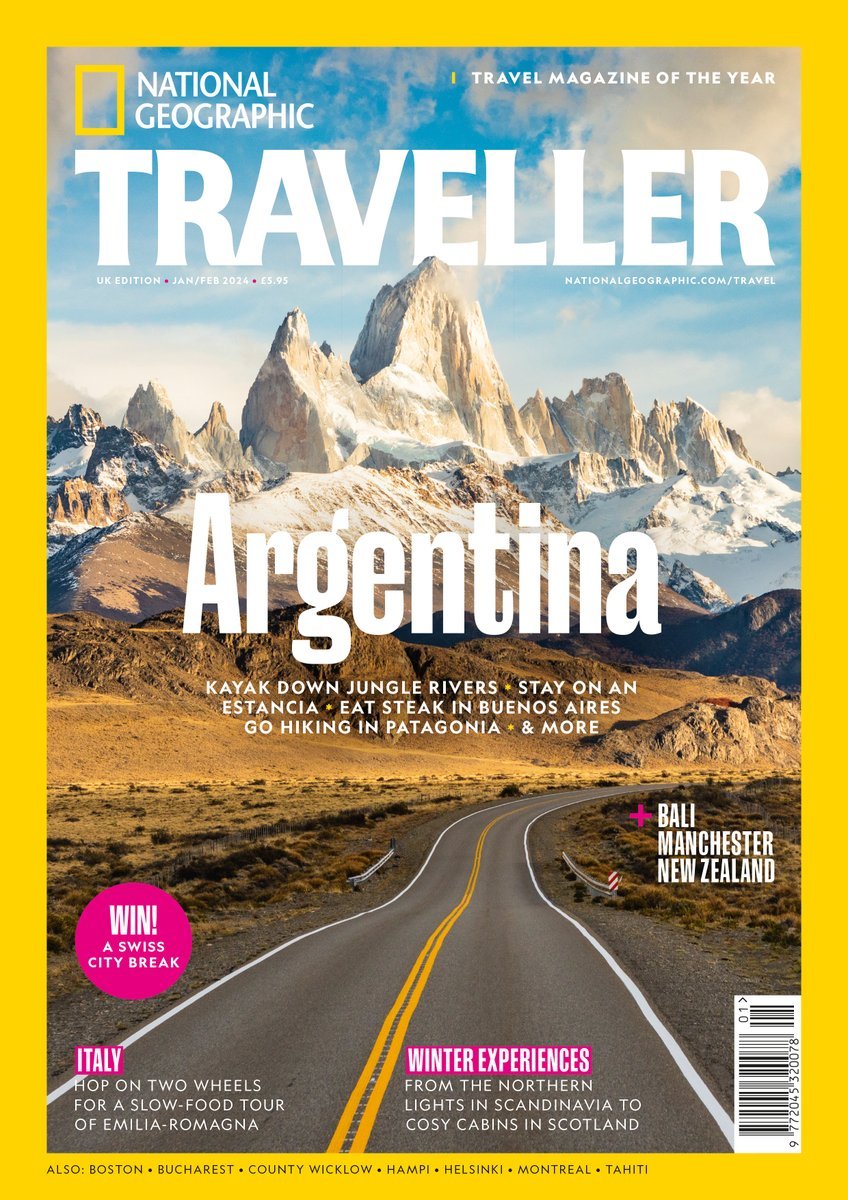
National Geographic Traveller Magazine (January 2024): The latest issue features adventures in Argentina, exploring Tahiti’s most remote corners, cycling through one of Italy’s iconic food regions and finding out how to plan a Great Walk in New Zealand…
Also inside this issue:
Emilia-Romagna: Cycle through Italy’s ‘food valley’ for a taste of the country’s iconic produce Tahiti: The French Polynesian island’s southeast offers coastal hiking and surfing fit for champions Hampi: Long in ruins, the capital of the ancient Hindu kingdom beckons pilgrims to this day New Zealand: For outdoor lovers, completing one of the country’s Great Walks is the feat of a lifetime Manchester: Creativity and craftsmanship infuse all areas of life in this northwestern hub Montreal: Canada’s second city merges European flair with North American innovation County Wicklow: Foraging, fine arts and forest paths in an outdoorsy getaway to the ‘Garden of Ireland’ Bali: Local recipes and passionate chefs are the backbone of Indonesia’s food-loving island Boston: In Massachusetts’ capital city, the best hotels are within easy reach of the culinary and cultural action
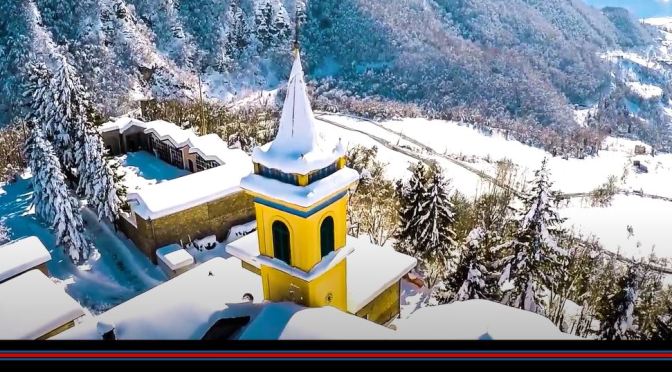
Emilia Romagna Tourism (March 13, 2023) – Walking along the Via di Linari, an ancient pilgrimage route towards Rome (alternative to the Via Francigena) which connects Fidenza to the Linari Abbey, a religious settlement that once stood on the mountain ridge between Tuscany and Emilia-Romagna.
It was established as a safer route to Tuscany compared to the Via Francigena, and it soon became an important road both for pilgrims on their way to Rome and as a trade route for the city of Parma. Like the St Vicinio Way, the Linari Way was dotted with parish churches and hospitalia, places where travellers could find shelter from the elements and bandits.
Modena and the surrounding area is extremely rich in historic and cultural treasures like these. In their unparalleled beauty, within each castle’s walls lies a special story.
The castles of the Modena area date to a range of historical periods but together make up an invaluable legacy. They remain today—just as they were when they were built—important cultural landmarks for local community residents.
First stop – Palazzo Pio Carpi – Palazzo Pio in Carpi is an imposing and complex structure that comprises fortifications, towers, courtyards, and buildings constructed between the fourteenth and seventeenth centuries. The Palazzo looks out onto Piazza dei Martiri, one of Italy’s most beautiful piazzas, to breathtaking effect. Starting in 1300 and for most of the following two centuries, Palazzo Pio was the residence of the Pio family. The Pio Prince Alberto III, nephew of the famous Pico della Mirandola, transformed the fortress into a splendid Renaissance palace whose rooms were decorated with frescoes by court painters.Today, the town of Carpi has adapted the palazzo for use as a world-class cultural center that houses the Palazzo Pio Museum; the Municipal Museum; the Castello dei Ragazzi, a children’s art and recreation center; and the fascinating Museum and Monument to Political and Racial Deportees.
Second stop – Calcagnini Fortress Formigine – The ravishing Rocca Calcagnini Fortress stands in the heart ofFormigine, a symbol of the local community and a center for collective historical memories. Built in 1201 by the city of Modena as a defense against attacks by the rival city of Reggio Emilia and to secure its control of the territory, beginning in 1300 the Rocca Calcagnini Fortress was passed among various local noble families until it became property of the Pio family of Carpi, the Estes, and finally the Calcagninis.Around 1400, when the fortress was under the control of the Pios, it was turned into a castle-residence that appears today much as it did then, with a marquis’s palazzo and grounds encircled by a wall with four corner towers and a guardhouse.During the Second World War, the fortress was irreparably damaged in a ferocious bombardment in which virtually the entire Calcagnini family was lost. In 1946, it became the property of the town government and was rebuilt and transformed for use as the city hall.Today the castle houses municipal offices on its ground floor (the city council chambers and a venue for wedding ceremonies) with reception halls located in the northeast tower.To make your visit to the Rocca Calcagnini Fortress extra special, don’t miss the Multimedia Museum of Archaeology. Beautiful and innovative multimedia displays tell the story of the fortress and of the Calcagnini nobility.The Calcagnini Fortress is Formigine’s sparkling “living room.” In addition to housing a restaurant and a wine cellar, each year the castle hosts events of all kinds—music, theater, and much more.
Third stop – Spezzano Castle Fiorano Modenese – The origins of Spezzano Castle date to the Middle Ages. The castle was transformed into a noble family residence by the Pios of Savoia in 1529.Today, Spezzano Castle is an elegant country residence surrounded by grounds landscaped in the 19th-century—a lovely place to relax or perhaps have lunch in one of the designated picnic areas.The splendid porticoed courtyard dates to the Renaissance, and the Sala delle Vedute, with its splendid frescoes of towns, towers, and castles of Sassuolo’s feudal period, is especially striking.Its pentagonal tower, at one time a prison, today houses the Municipal Vinegar Cellar and the Fiorano Museum of Ceramics, dedicated to the local history of ceramics, one of the area’s most admired products.
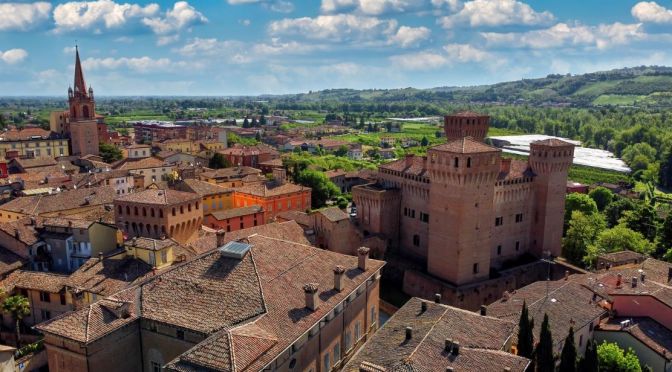
Fourth stop – Vignola Fortress Vignola – The VignolaFortress has also become a symbol—in this case, of Italy’s cherry capital. Its towers, drawbridge, and moat provide one of the most fascinating examples of defensive architecture in the entire Emilia-Romagna Region.The Vignola Fortress was built in the eighth century by the abbot of Nonantola to defend the abbey’s lands. After passing through the hands of several noble families, in 1401 it was ceded by the Este family of Ferrara to Uguccione Contrari who transformed it into a sumptuous noble home and filled the residence with frescoes and precious objets d’art.Vignola’s picturesque city center provides the perfect setting for the imposing and well-preserved Vignola Fortress. The four-sided structure contains five floors and has three square towers. The internal courtyard is magnificent and, on the left side, the “Rocchetta” (the “little fortress”) and the Contrari and Grassoni halls are located. One of the most beautiful structures is the frescoed chapel, a rare gem of “International Gothic” style.
Fifth stop – Montecuccoli Castle in Pavullo Pavullo nel – FrignanoMontecuccoli Castle is perched on a spur of rock that overlooks the Scoltenna-Panaro River Valley, three kilometers from the center of Pavullo in the heart of the Frignano area.After briefly being governed by Modena, the surrounding area was ruled by the Montecuccoli family, the powerful lords of Frignano, until the arrival of the House of Este in the mid-fourteenth century. In these ancient times, the Montecuccoli Castle was the residence and military center of the Montecuccoli family, who built dozens of attached towers and fortresses to keep watch over the roads to Tuscany. At the highest point of this point of rock is the original castle keep, which is surrounded by other structures and three rings of walls, constructed over time.Below the castle and through a Gothic portal lies a beautiful medieval village, where the Palazzo del Podestà and the fifteenth-century Church of San Lorenzo are especially noteworthy.Starting in the 1960s, the castle became the property of the town, which restored it and built the Montecuccoli Museum Complex. The Complex contains the Frignano Botanical Museum; Raffaele Biolchini’s “Donazione,” a sculpture gallery featuring works in marble, wood, terracotta, and other materials by one of Modena’s preeminent modern sculptors; and Gino Covili’s “Paese Ritrovato,” a cycle of paintings and drawings dedicated to the work, lives, and history of the people of Frignagno.
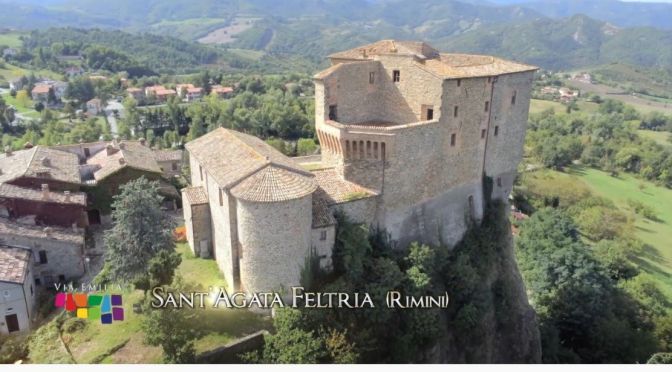
The province of Rimini (Italian: provincia di Rimini) is a province in the Emilia-Romagna region of Italy. The provincial capital is the city Rimini. The province borders the independent state of the Republic of San Marino. As of 2015, the province has a population of 335,199 inhabitants over an area of 864.88 square kilometres (333.93 sq mi), giving it a population density of 387.57 inhabitants per square kilometre. The city Rimini has a population of 147,578 inhabitants, and the provincial president is Andrea Gnassi. There are 26 comuni (singular: comune) in the province, see comuni of the Province of Rimini.
Cesena, town, Emilia-Romagnaregione, northern Italy, on the Savio River at the northern foot of the Apennines, south of Ravenna. It originated as the ancient Caesena, a station on the Via Aemilia and a fortress in the wars of the Ostrogoths and the Byzantines. An episcopal city and an independent commune in the 11th–13th century, it was heroically defended in 1357 by Cia, wife of the lord of Forlì, against papal troops under the Spanish cardinal Gil Álvarez Carrillo de Albornoz. In 1377 it was destroyed by Cardinal Robert of Geneva (later the antipope Clement VII), after which it was held by the Malatesta family of Rimini until 1465, when it passed under papal domination. Popes Pius VI and Pius VII were born at Cesena in 1717 and 1740, respectively.
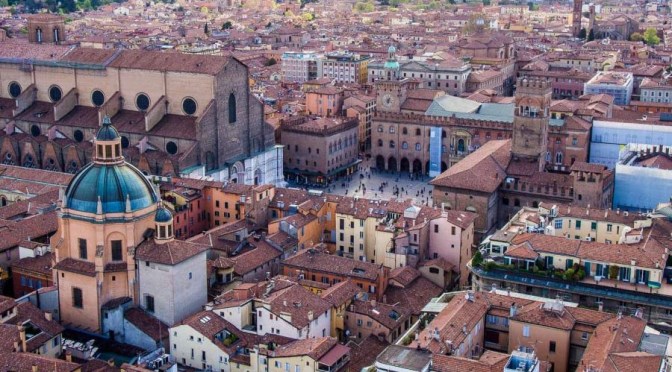
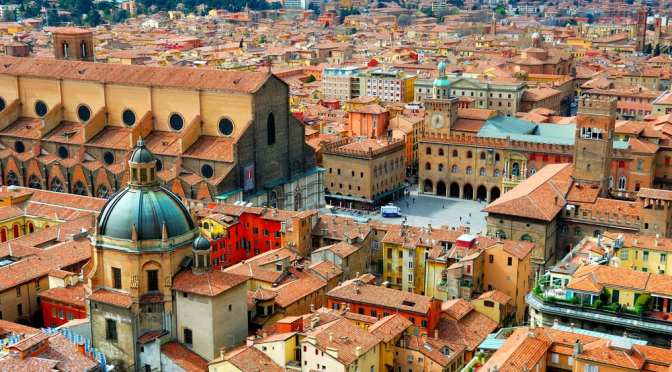
Bologna is the capital and largest city of the Emilia-Romagna region in Northern Italy. It is the seventh most populous city in Italy with about 400,000 inhabitants and 150 different nationalities. Its metropolitan area is home to more than 1,000,000 people. It is known as the Fat, Red, and the Learn’d City due to its rich cuisine, red Spanish tiled rooftops, and being home to the oldest university in the western world.
Originally Etruscan, the city has been one of the most important urban centres for centuries, first under the Etruscans (who called it Felsina), then under the Celts as Bona, later under the Romans (Bonōnia), then again in the Middle Ages, as a free municipality and signoria, when it was among the largest European cities by population. Famous for its towers, churches and lengthy porticoes, Bologna has a well-preserved historical centre, thanks to a careful restoration and conservation policy which began at the end of the 1970s. Home to the oldest university in the Western world, the University of Bologna, established in AD 1088, the city has a large student population that gives it a cosmopolitan character. In 2000 it was declared European capital of culture and in 2006, a UNESCO “City of Music” and became part of the Creative Cities Network.[14] In 2021 UNESCO recognized the lengthy porticoes of the city as a World Heritage Site.
“Emilia-Romagna is a land of bell towers, symbol of a region that has its roots in the earth, but try to rush towards the sky, to see what’s there.”
Emilia-Romagna is a region in northern Italy, extending from the Apennine Mountains to the Po River in the north. It’s known for its medieval cities, rich gastronomy and seaside resorts. The capital, Bologna, is a vibrant city with an 11th-century university and arched porticos lining the streets and squares of its medieval core. Ravenna, near the Adriatic coast, is famed for its brightly colored Byzantine mosaics.
The Summer 2021 edition of Bellissimo, our quarterly digital magazine, focuses on the central Italian region of Emilia-Romagna, famous for its culture, cars, and cuisine. https://t.co/xpxH1mRAhCpic.twitter.com/U2j65dOtCG
We share more than 100 pages of insider info so you can plan your next visit (or simply indulge in some armchair travel) from sights to see and dishes to try to little-known gems to seek out and discover.
Learn about the region’s premium epicurean delights, including Parmigiano Reggiano, Prosciutto di Parma, balsamic vinegar, and Lambrusco wine. Explore the top automobile museums marking the birthplaces of iconic brands like Ferrari and Maserati. Head to the hills along hiking trails through the rolling countryside past medieval villages and quiet vineyards. Bask in the resurging art scene in the resort town of Rimini, birthplace of Fellini.
Bellissimo comes out four times a year, so be sure to check out former issues for a deep dive into other captivating regions we’ve explored over time.
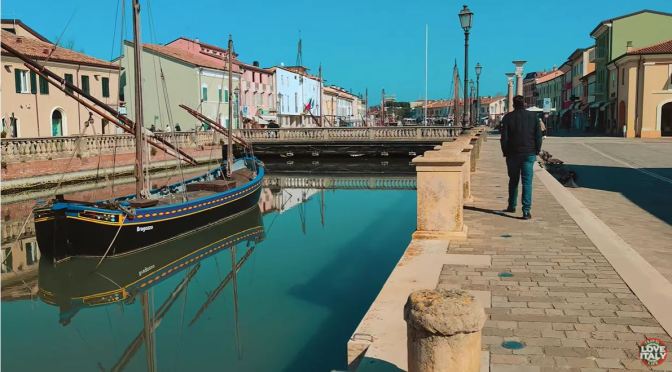
Cesenatico is a port town with about 26,000 inhabitants on the Adriatic coast of Italy. It is located in the province of Forlì-Cesena in the region of Emilia-Romagna, about 30 kilometres south of Ravenna.
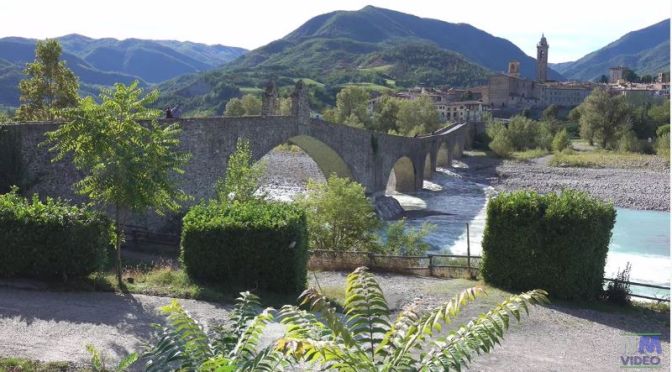
Bobbio is a small town and commune in the province of Piacenza in Emilia-Romagna, northern Italy. It is located in the Trebbia River valley southwest of the town Piacenza. There is also an abbey and a diocese of the same name. Bobbio is the administrative center of the Unione Montana Valli Trebbia e Luretta.
News, Views and Reviews For The Intellectually Curious


 Boomers Daily