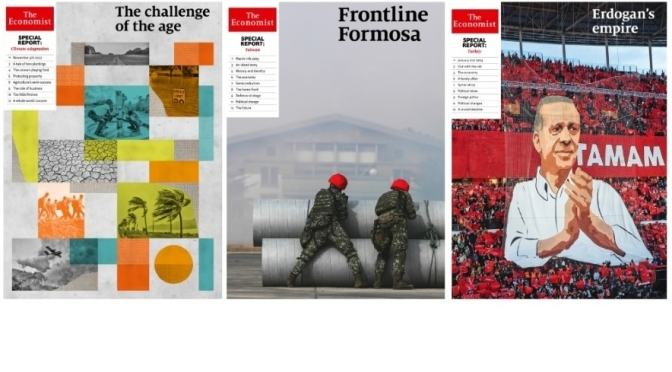

THE ECONOMIST SPECIAL REPORT: Governments going broke – In many of the world’s big economies, public finances are heading for a crisis. Henry Curr argues the consequences will be profound

THE ECONOMIST SPECIAL REPORT: Governments going broke – In many of the world’s big economies, public finances are heading for a crisis. Henry Curr argues the consequences will be profound
0:15 AI robot zaps weeds while saving crops – It’s called Concentrated Light Autonomous Weeding and Scouting or CLAWS for short. CLAWS uses AI-powered image processing to identify the crops, then targets weeds around the crop with blasts of concentrated light. This gets rid of unwanted intruders without damaging either crops or soil.
1:52 5 ways bioeconomy affects daily living – The bioeconomy uses renewable resources from land or sea to produce food, energy, and other resources. It focuses on leveraging nature’s processes and products to create sustainable economic outputs. The bioeconomy is already a part of our daily lives, influencing various sectors and industries.
6:08 Iceland sees benefit of a 4-day work week – The Nordic nation of 380,000 is rolling out a new way of working. Between 2020 and 2022, 51% of Iceland’s workers accepted an offer of shorter hours, such as a 4-day week for no loss of pay. The shift has had a positive impact on work-life balance and personal stress, new research shows.
8:17 Restored Amazon ecosystems beat logging – Amazon Sacred Headwaters Alliance is fighting to safeguard 35 million hectares of rainforest through a collaboration between 30 Indigenous nations of the Amazon basin. There’s an economic case for protecting the Amazon, says Atossa Soltani, Director of Global Strategy, Amazon Sacred Headwaters Alliance.
0:15 Finfluencer financial advice revolution – A finfluencer is a content creator on social media who shares information on budgeting, saving and financial investments, among other topics. Finfluencers use blogs, podcasts or videos to get their message out. They help widen financial access to groups who didn’t have it before.
3:49 These vegetables grow in-store without soil – Instead of soil, they use plugs of rockwool, irrigated with nutrient-rich water in a method called hydroponics. They come in different sizes producing from 2,000 to 15,000 plants monthly. These farms have a tiny environmental footprint. The largest models can grow as much as a 3-hectare farm.
5:44 Telehealth platform empowers millions – Altibbi offers 24/7 access to online doctors along with accessible, up-to-date medical information. It offers a cheaper, more accessible alternative to in-person consultations but it also aims to ‘change the narrative’ around the patient-doctor relationship.
8:43 ‘Underwater tractors’ replant seagrass – They were created by Reefgen, an UpLink Top Innovator. The robot scoots over the seabed, steadily and carefully restoring the ecosystem. Reefgen’s technology aims to aid conservation efforts by augmenting the efforts of human restorers.
0:15 What’s next for urgent climate action? – At the Sustainable Development Impact Meetings in New York, leaders discussed how to curb carbon emissions while building an inclusive economy. Regulations can be a lever for systemic change but local innovation is crucial, too.
3:09 Solar stoves reduce air pollution deaths – It cooks food while emitting hardly any smoke. It uses a hybrid system, powered by energy from solar panels and from fuel such as small sticks or crop waste. The ACE One was created by African Clean Energy which is a part of the World Economic Forum’s Equitable Transition Initiative.
5:08 Chief economists’ outlook for the rest of 2024 – Many chief economists polled by the World Economic Forum are optimistic about 2025. In the United States, nearly nine in ten chief economists anticipate moderate or strong growth in the coming year. Similarly, in South Asia, 71% predict strong or very strong growth.
9:33 Earth exceeds 6 of 9 planetary boundaries – In 2009, a team of scientists identified the 9 natural processes that regulate Earth’s biosphere and keep it stable. These include climate change, biodiversity, ocean acidification and freshwater. The team also defined the safe planetary boundary for each process. A safe and sustainable future for humanity lies within these boundaries.
0:15 How investment advice is changing – ‘The film is a rollercoaster ride into the last few years of how technology is changing our relationship to money’, says Chris Temple, director of This Is Not Financial Advice, a documentary that follows four online investors, including one who made – and lost – millions in crypto.
5:56 New tech reveals the impacts of climate change – Using AI, we can process Earth Observation (EO) data faster. Helping us monitor disaster impact in hours, not days. AI is also improving climate and weather forecast models. Through AR and VR, engineers are transforming these complex datasets into interactive, intuitive experiences that can help leaders make climate decisions.
7:39 This debt plan can save coral reefs – The deal reduces Indonesia’s debt repayments to the US by $35 million over the next 9 years and redirects those payments towards reef conservation instead. Indonesia is home to 16% of the world’s coral reefs and around 60% of the world’s coral species. Its reefs generate around $1.6 billion in value every year through fisheries, coastline protection and tourism. But Indonesia’s reefs face a range of threats.
9:21 Ray Dalio on funding climate action – By 2050, climate damage could cost between $1.7 trillion and $3.1 trillion per year. However, the costs of inaction could be even greater, says Ray Dalio, the founder of the world’s largest hedge fund, Bridgewater Associates. Right now, climate action is hugely under-financed.
0:15 Mini-factories in space – Space Forge says its technology could revolutionize manufacturing. The satellites contain miniature manufacturing systems. They take advantage of the conditions in low-Earth orbit such as microgravity, extreme temperatures and a contaminant-free environment to forge materials that would be impossible to manufacture here on Earth.
1:53 Biodiversity credits explained – Nature is under unprecedented threat. Around 2 million plant and animal species could go extinct in the next few decades as climate change and habitat loss push ecosystems towards irreversible tipping points. To fight this crisis, experts are coming up with new ways to protect life on Earth by assigning value to the ecosystems around us. These innovations include biodiversity credits.
6:58 Nairobi switches to electric buses – Private minibuses called matatus are the main mode of public transport in Nairobi. Most matatus are old, diesel-powered and inefficient and 60% of the city’s population rely on them to get around. Electric mobility start-up BasiGo has built an all-electric alternative. The first bus rolled off its Nairobi production line in early 2024. Nairobi bus operators have already ordered 500 more. More than 90% of Kenya’s electricity is generated renewably, which means BasiGo’s buses are virtually emission-free.
8:40 How to build healthier cities – This architect designs buildings that bring communities together – Sumayya Vally grew up in post-Apartheid Pretoria, South Africa in what had been an Indian-only township and saw how division kept communities apart. Vally founded the Johannesburg-based architecture practice Counterspace to fight the built legacies of colonization and highlight the peaceful coexistence between communities.
0:15 Banking uplifts women in Pakistan – Pakistan has a large gender gap in financial inclusion. 47% of men have at least one registered financial account but just 13% of women. Even for those with an account, banking can be prohibitively time-consuming, especially for women who are running a business alongside a household. Now a new kind of digital banking service is helping to close this gap.
2:23 World’s busiest airports revealed – The world’s busiest airports in 2023 were dominated by the United States, with five airports cracking the top 10. Overall, global airports saw a significant rebound in 2023, handling a total of 8.5 billion trips.
4:39 WMO: Asia hardest hit by climate – In 2023, Asia saw a wave of extreme weather events from floods to cyclones. World Economic Forum Head of Climate Adaptation Eric White explains why climate change is making extreme weather more likely.
7:07 Saving Earth with space science – Simonetta Di Pippo says that space is already helping tackle the greatest challenges on Earth. Satellite connectivity is improving our management of disasters and powering digital transformation. Which is revolutionizing sectors from healthcare to education, retail and communication.
0:15 Kiel is Germany’s first zero-waste city –Kiel has put 107 waste-reducing measures in place. They include practical changes, such as ‘pay-to-throw’, a scheme in which households pay a fee for the amount of landfill waste they generate. Other measures include recycling collection ‘islands’ around the city, discounts for shoppers who bring their own containers and banning disposable products at all city events.
1:33 Gender balanced companies outperform others – According to a BlackRock study of 1,250 of the world’s biggest companies. Over the past decade, the companies with the most equal gender balance achieved a 7.7% average annual return on assets (RoA). Those with the highest share of men delivered a 5.6% RoA, while those with the highest share of women returned a 6.1% RoA. The study concluded it was ‘diversity that counts’ rather than the dominance of a single gender.
3:08 US wants to convert empty offices into homes – The government will offer funding and technical support to help cities turn unused workspaces into affordable apartments. US office vacancy rates have hit a 30-year peak as more staff clock in to work remotely. Meanwhile, rents in the country remain at historic highs after a surge during the pandemic converting offices to apartments can be challenging.
4:48 Rwanda and Kenya open borders to other Africans – Rwanda and Kenya have made significant strides in promoting African unity by opening their borders to other Africans, enabling visa-free travel for all citizens of the continent. This move positions Rwanda as the fourth African nation to remove such restrictions, following Benin, The Gambia, and Seychelles. Kenya is set to join them on December 31, 2023.
_____________________________________________
The World Economic Forum is the International Organization for Public-Private Cooperation. The Forum engages the foremost political, business, cultural and other leaders of society to shape global, regional and industry agendas. We believe that progress happens by bringing together people from all walks of life who have the drive and the influence to make positive change.
0:15 AI can predict your risk of Parkinson’s – RETFound was trained using 1.6 million retinal images which gave it a picture of a healthy retina. Then its creators added images of eyes from people with certain conditions. Our eyes are a window to our health. They’re the only place where doctors can directly observe capillaries, our smallest blood vessels, enabling detection of cardiovascular illnesses such as hypertension. Eyes are also linked to the central nervous system, giving an insight into neural tissue, too. The RETFound tool was best at picking up eye diseases such as diabetic retinopathy. On Parkinson’s, stroke and heart disease, it performed not quite as well but still beat other AI models.
2:08 These are the most detailed heat maps of our planet – They use imagery from a satellite called HotSat-1 which can detect heat and cold at a resolution of 3.5 metres. The satellite can precisely map the fronts of forest fires, detect and monitor heat islands in cities and measure the thermal efficiency of buildings. This information can drive more effective decision-making.
3:51 AI designed this robot in 26 seconds – Researchers from Northwestern University gave an AI a simple prompt. ‘Design a robot that can walk across a flat surface’. By the 9th iteration, the AI had successfully met its brief. The robot could walk half its own body length per second. The entire iteration process took just 26 seconds and it ran on a laptop.
6:26 Norway completed it’s largest rewilding project – It’s centred around Sveagruva, a 100-year-old mining town on the Arctic island of Svalbard. Norway decided to close the town and its mining operations in 2017 and return the area to its natural state, restoring biodiversity and the local ecosystem.
_____________________________________________
The World Economic Forum is the International Organization for Public-Private Cooperation. The Forum engages the foremost political, business, cultural and other leaders of society to shape global, regional and industry agendas. We believe that progress happens by bringing together people from all walks of life who have the drive and the influence to make positive change.
0:15 Why engagement in the news is in decline – A massive media survey looked at trust and engagement in the news and found both are in steady decline. Just 48% of people say they are very or extremely interested in the news in 2023 down from 63% in 2017. Trust in the news has fallen 2 percentage points in a year. Now, only 40% say they trust the news most of the time and 36% say they actively avoid the news sometimes or often.
1:53 This robot can help people with disabilities dress – The robot was designed by a team at Carnegie Mellon University (CMU). They used a simulation to teach it how to perform its task. The team used an AI-driven approach called ‘reinforcement learning’. The robot was rewarded each time it correctly placed a shirt further along an arm.
3:25 Company captures and stores CO2 with limestone – Heirloom takes crushed limestone and heats it in a kiln powered by renewable energy. The reaction generates two products. These are CO2, which can be permanently stored underground or in materials like concrete and a powder, which is hydrated with water to make calcium hydroxide. When the calcium hydroxide is spread onto trays, it absorbs CO2 from the air to become limestone and the whole process can begin again.
5:24 How to use ChatGPT more safely – ChatGPT is an AI tool that gives detailed, natural language answers to prompts based on a database of 300 billion words drawn from books and articles. The AI learns from its interactions with you, so here are 5 ways to ensure you’re using it safely.
_____________________________________________
The World Economic Forum is the International Organization for Public-Private Cooperation. The Forum engages the foremost political, business, cultural and other leaders of society to shape global, regional and industry agendas. We believe that progress happens by bringing together people from all walks of life who have the drive and the influence to make positive change.

 Boomers Daily