
Tag Archives: DNA Sequence

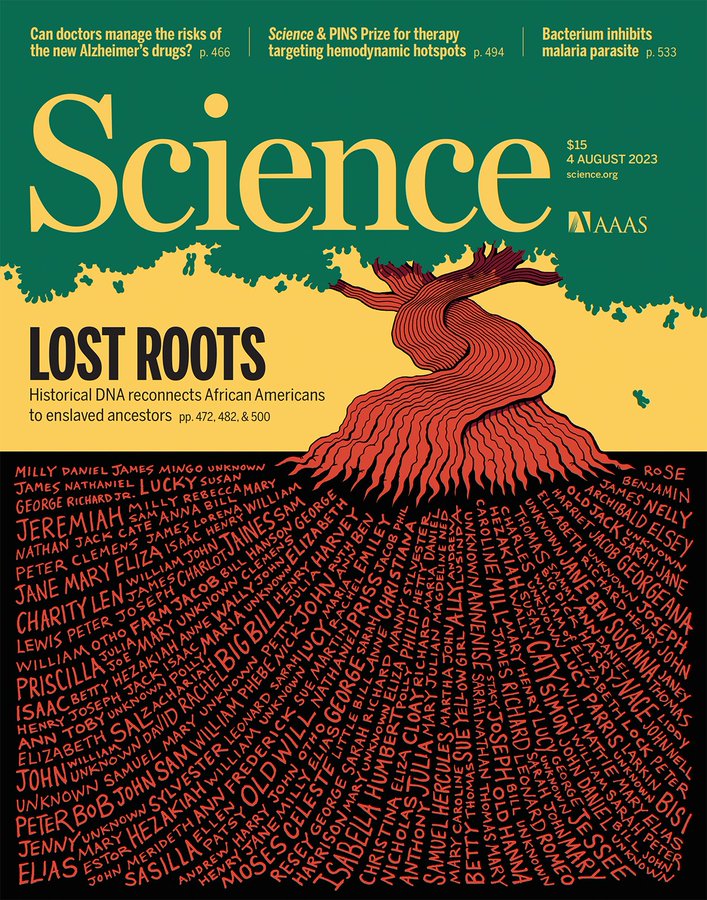
Research Preview: Science Magazine – August 4, 2023

Image

Science Magazine – August 4, 2023 issue: DNA was sequenced from 27 African Americans buried at Catoctin Furnace, Maryland, where enslaved people labored between 1774 and 1850. The tree trunk forms a double helix comprising 27 segments representing each sequenced individual.

‘We’re changing the clouds.’ An unforeseen test of geoengineering is fueling record ocean warmth

Pollution cuts have diminished “ship track” clouds, adding to global warming

Tropical trees deter similar neighbors

Tropical forests host an unusually high diversity of tree species. Strong interactions between individuals are hypothesized to create these patterns. A tree is more likely to survive when surrounded by different tree species with different resource needs, diseases, and herbivores. Kalyuzhny et al. found patterns consistent with this mechanism in a long-term forest plot in Panama. Adult trees in this site are more distant from members of their own species than from other species and more distant than would be expected by chance or by the limits of seed dispersal. This study shows that distances between conspecifics are maintained in adult trees, helping to explain the high diversity of tropical forests.
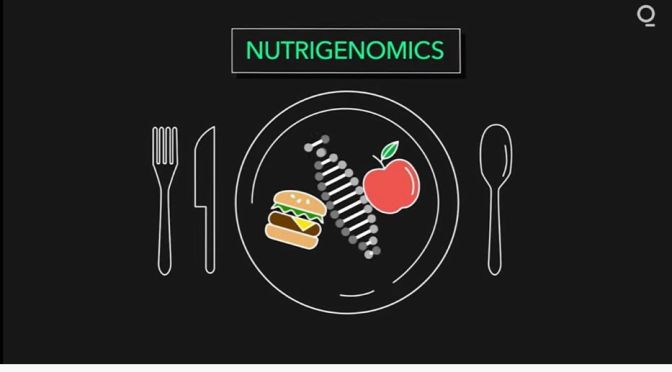
Nutrigenomics: How Diet Can Reprogram Our DNA

The burgeoning field of “nutrigenomics” claims that the food we eat can alter our genetics. Dietitians, scientists and lifestyle companies have all hopped on the bandwagon.

Nutrigenomics (also known as nutritional genomics) is broadly defined as the relationship between nutrients, diet, and gene expression. The launch of the Human Genome Project in the 1990s and the subsequent mapping of human DNA sequencing ushered in the ‘era of big science’, jump-starting the field of nutrigenomics that we know today.

Science: What Is CRISPR And How Does It Work?

This revolutionary gene-editing system has taken science by storm. CRISPR is the basis of a revolutionary gene editing system. One day, it could make it possible to do everything from resurrect extinct species to develop cures for chronic disease.

CRISPR is a family of DNA sequences found in the genomes of prokaryotic organisms such as bacteria and archaea. These sequences are derived from DNA fragments of bacteriophages that had previously infected the prokaryote. They are used to detect and destroy DNA from similar bacteriophages during subsequent infections. 

Science Podcast: Million-Year-Old Mammoth DNA, Art In Science & Jupiter

Researchers sequence the oldest DNA ever recovered, and the people bringing art and science together.

In this episode:

00:46 Million-year-old mammoth DNA

This week, researchers have smashed a long-standing record by sequencing a genome that’s over a million years old. They achieved this feat by extracting DNA from permafrost-preserved mammoth teeth, using it to build-up a more detailed family tree for these ancient animals.

Research Article: van der Valk et al.

News: Million-year-old mammoth genomes shatter record for oldest ancient DNA

News and Views: Million-year-old DNA provides a glimpse of mammoth evolution

10:00 Research Highlights

A spacecraft catches a rare glimpse of a rock smashing into Jupiter, and the perilous state of sawfish populations.

Research Highlight: Robotic eyes spy the flash of a meteor on Jupiter

Research Highlight: Humans push a hulking fish with a chainsaw nose towards oblivion

12:18 Putting art into science (and science into art)

Art and science are sometimes considered disparate, but when brought together the results can be greater than the sum of their parts. This week we hear from an artist and a scientist on the benefits they found when crossing the divide.

Career Feature: How to shape a productive scientist–artist collaboration

Career Feature: How the arts can help you to craft a successful research career

Where I work: ‘All my art is curiosity-driven’: the garden studio where art and physics collide

21:43 Briefing Chat

We discuss some highlights from the Nature Briefing. This time, a neanderthal gene makes brain-like organoids bumpy, and uncovering the original location of Stonehenge’s stone circle.