Tag Archives: Conservation

Research Preview: Nature Magazine Dec 14, 2023

Volume 624 Issue 7991

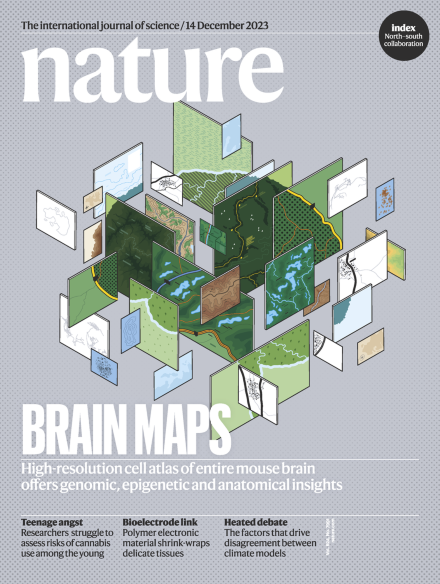
Nature Magazine – December 13, 2023: The latest issue cover features the BRAIN Initiative Cell Census Network (BICCN), which presented nine papers that map the entire mouse brain in unprecedented detail.

BICCN: The first complete cell census and atlas of a mammalian brain

Generating a complete multimodal cell census and atlas of the mouse brain through collaborative data collection, tool development and analysis.

How immense mountains create one of the rainiest places on Earth

The western coast of Colombia can get more than 26 metres of rain a year, thanks to the influence of air jets hitting the Andes range.

This bird escaped extinction — but its genes hint at an ominous future

The extravagantly feathered Seychelles paradise flycatcher lacks genetic diversity, which might hamper its resilience to climate change and other threats.
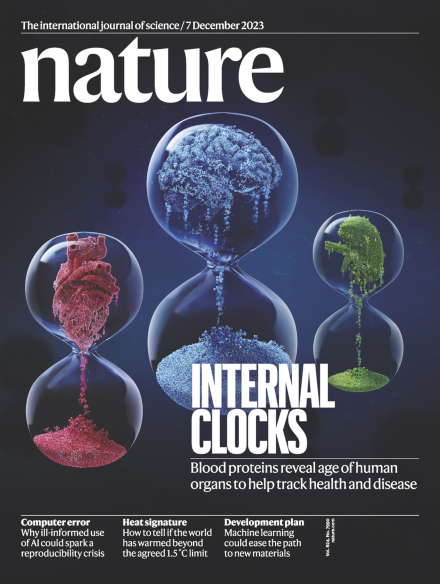
Research Preview: Nature Magazine Dec 7, 2023

Volume 624 Issue 7990

Nature Magazine – December 6, 2023: The latest issue cover features Internal Clocks – Blood proteins reveal age of human organs to help track health and disease…

A 27,000-year-old pyramid? Controversy hits an extraordinary archaeological claim

The massive buried structures at Gunung Padang in Indonesia would be much older than Egypt’s great pyramids — if they’re even human constructions at all.

Humanity’s oldest art is flaking away. Can scientists save it?

Ancient humans painted scenes in Indonesian caves more than 45,000 years ago, but their art is disappearing rapidly. Researchers are trying to discover what’s causing the damage and how to stop it — before the murals are gone forever.

Tinkering with immune cells gives cancer treatment a boost

Tumours respond more readily to radiation and other therapies in mice without a specific protein in their dendritic cells.

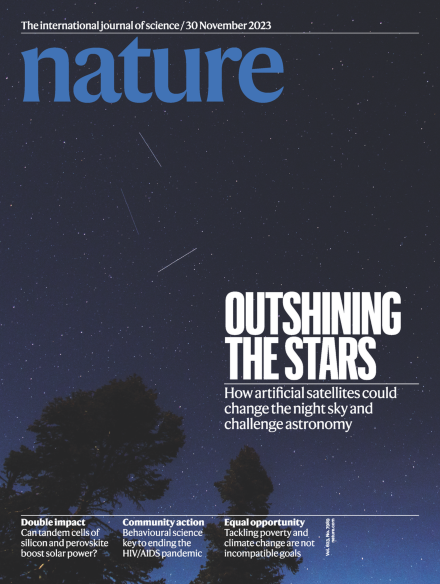
Research Preview: Nature Magazine – Nov 30, 2023

Volume 623 Issue 7989

Nature Magazine – November 29, 2023: The latest issue cover features trails left by satellites, including BlueWalker 3, a prototype communications satellite, as they pass across the sky.

‘Early dark energy’ fails to solve mystery of cosmic expansion

The extra ingredient would explain why the Universe is expanding so fast now — but conflicts with data from ancient quasars.

Huge California wildfires seeded cirrus clouds half a world away

Smoke from record-breaking fires in 2020 travelled all the way to Cyprus, where it helped to trigger cloud formation.

These falcons excel at problem-solving — and outdo some of the world’s smartest birds

A bird of prey called the striated caracara can figure out puzzles that are a struggle for Goffin’s cockatoos, which are known for their intelligence.

Research Preview: Nature Magazine – Nov 23, 2023

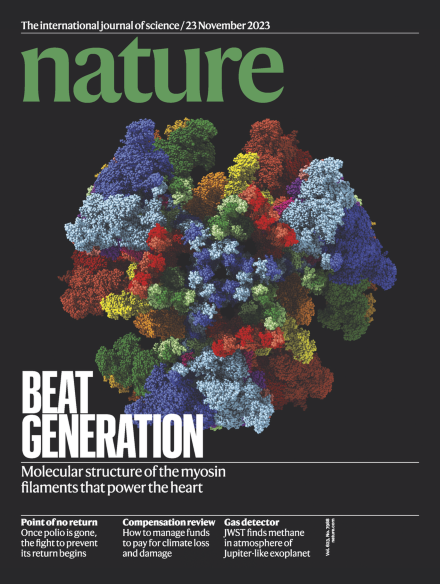
B 8G4L/ChimeraX

Volume 623 Issue 7988

Nature Magazine – November 23, 2023: The latest issue cover features how cryo-electron microscopy can reveal the structure of motor protein myosin filaments, which power the heart via muscle contraction.

Earth just had its hottest year on record — climate change is to blame

Around 7.3 billion people faced temperatures strongly influenced by global warming over the past year.

UK first to approve CRISPR treatment for diseases: what you need to know

The landmark decision could transform the treatment of sickle-cell disease and β-thalassaemia — but the technology is expensive.

How AI is expanding art history

From identifying disputed artworks to reconstructing lost masterpieces, artificial intelligence is enriching how we interpret our cultural heritage.

Research Preview: Nature Magazine – Nov 16, 2023

Volume 623 Issue 7987

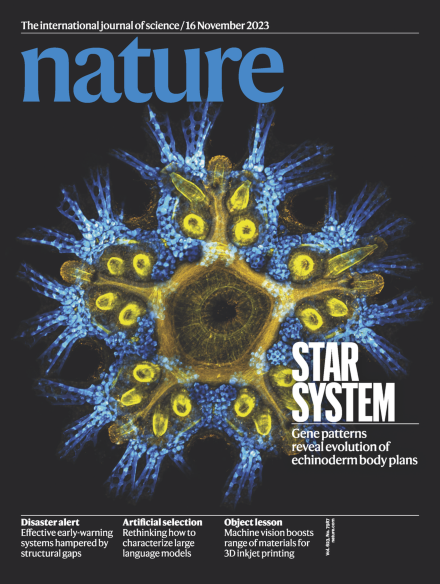
Nature Magazine – November 16, 2023: The latest issue cover features how echinoderms such as starfish and sea urchins have evolved five-fold symmetry, with five limbs radiating from a central mouth.

One brain area helps you to enjoy a joke — but another helps you to get it

Seinfeld episodes help scientists to distinguish between the brain regions involved in understanding and appreciating humour.

Spinal implant helps man with advanced Parkinson’s to walk without falling

Electrical stimulation improved his mobility, although researchers say that a larger study is needed to assess the device.

Manatees and conservation: how I protect these massive, vulnerable animals

Nataly Castelblanco Martínez works to raise awareness of the perils faced by the much-loved marine mammals.

Conservation: Protecting Grey Seals At Blakeney Nature Reserve, England

National Trust (April 10, 2023) – In this episode of The Wild Life, a new series of nature films from the National Trust, presenter Gemma Hunt discovers how the charity’s rangers are doing all they can to protect wildlife at Blakeney National Nature Reserve in Norfolk.

With an introduction from Julia Bradbury, this film will transport you to the four-mile-long shingle spit of Blakeney Point, cared for by the National Trust. The spit provides protection for Blakeney Harbour and the surrounding salt marshes are home to a vast array of wildlife. Blakeney Point is also home to England’s largest grey seal colony, over-wintering wildfowl and summer-breeding terns.

Join Gemma as she meets the National Trust rangers who work around the clock to care for this stretch of coastline, which is loved by walkers, sightseers and wildlife enthusiasts. You’ll meet ranger Duncan Halpin who spends seven months of the year living in a remote lifeboat house. During this time, he monitors the seal pups and makes sure endangered birds such as little terns have safe places to nest.

UK Riverlands: The Beavers Of The Holnicote Estate

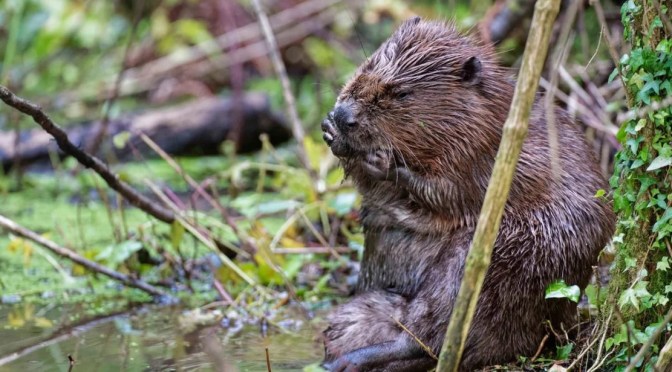
National Trust (April 2, 2023) – In this episode of The Wild Life, a new series of nature films from the National Trust, presenter Rob Bell meets the family of busy beavers at the Holnicote Estate in Somerset.

Rob takes part in some important conservation work and finds out how the beavers have been shaping the wetland habitat since they were brought to their enclosure in 2020. With an introduction from Julia Bradbury, this video also sheds light on wider work the National Trust is doing to reconnect rivers and streams to the surrounding landscape with its innovative Stage 0 project which is underway.

Rob learns how river restoration helps to ease challenges brought by climate change, including flooding and drought. The beavers also play a key role as ecosystem engineers and the dams they build hold water in dry periods and help to prevent flash flooding downstream.

English Wetlands: Wicked Fen Nature Reserve Tour

National Trust (March 27, 2023) – In this episode of The Wild Life, a new series of nature films from the National Trust, Paralympic medallist and TV presenter, Ade Adepitan explores Wicken Fen National Nature Reserve – one of Europe’s most important wetlands.

The Fen, which has been under the care of the National Trust since 1899, supports more than 9,000 species, including a wide variety of plants, birds and dragonflies. The raised boardwalk allows easy access to a landscape of flowering meadows, sedge and reed beds, home to water voles and rare birds, including hen harrier and bittern. Introduced by presenter Julia Bradbury, this film sheds light on how climate change is affecting Wicken Fen and the biodiversity it supports.

You’ll also find out about the work being done to protect wildlife habitats and ensure the peat here continues to store carbon. Ade discovers how Wicken Fen connects people to nature and learns more about future plans to extend the site. He also meets the Konik ponies and Highland cattle, which help to support this fragile landscape through conservation grazing.

Views: Celtic Rainforests In Eryri, Snowdonia, Wales

National Trust (March 20, 2023) – In this episode of The Wild Life, a new series of nature films from the National Trust, presenter Jules Hudson heads to Eryri (Snowdonia) to learn about a tree planting project that will help to protect the landscape for the next hundred years and beyond.

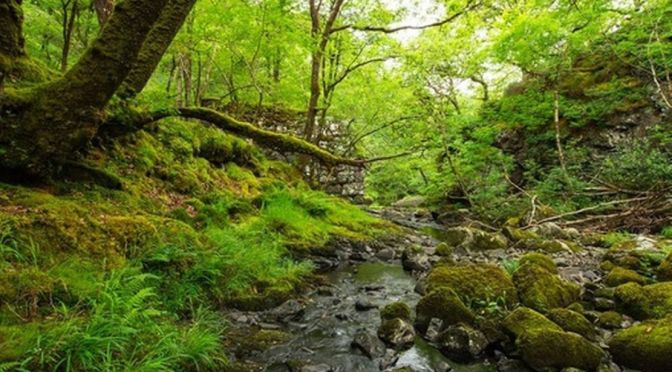
Join Jules on his visit to Hafod Garregog – a Celtic rainforest and reclaimed seabed along Afon Glaslyn (River Glaslyn). National Trust rangers have planted native saplings here to store carbon, slow the flow of water and provide a boost for nature and wildlife. Jules discovers that local tree species such as willow, aspen and hornbeam are less susceptible to diseases and can adapt better to the climate.

These trees will also create homes for warblers, moths, bats and nearby otters, as well as encourage a diverse variety of plants to grow. You’ll also discover how the National Trust works with volunteers to plant trees and find out more about the charity’s wider ambition to plant and establish 20 million trees by 2030.

Ecology: Planting Trees To Cool Scotland’s Rivers

The Woodland Trust – River woodland is key to tackling

the twin climate and biodiversity crises – reducing flooding, improving river health and restoring the ecosystem. We’re working in England, Scotland, Wales and Northern Ireland to plant and restore river woodland for people and wildlife.

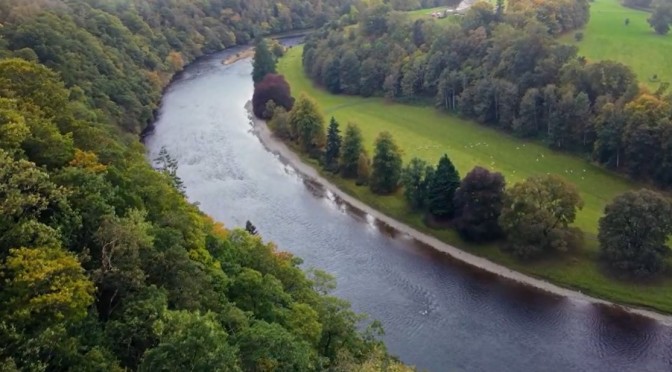
In Scotland, this particularly means fish. Salmon, to be exact. Whole upland river catchments devoid of trees are seeing Scotland’s rivers warm to a point that could see salmon disappear in just 20 years. These fish need clean, cold water to thrive, and river woodland is the way to return it to them. The Woodland Trust is working across river catchments to expand native woodland alongside rivers and burns.

Trees provide shade and cover for young salmon and trout, stabilize riverbanks, slow the flow of water downstream and create wildlife corridors. A key part of this work involves working with landowners to plant and restore river woodland on their land, advising on the initial planting and empowering them to monitor their river woods into the future.