Tag Archives: CNBC

AI Technology: Are Tesla Robotaxis Ready To Roll?

CNBC (October 2, 2024): For a decade, Elon Musk has championed the idea that one day Tesla cars will drive themselves as robotaxis. On October 10, the company plans to reveal a “dedicated robotaxi” design at an invitation-only event in Los Angeles.

Chapters: 3:18 Ch 1 – Tesla’s vision for autonomy 6:33 Ch 2 – Full self-driving 10:13 Ch 3 – Realizing the robotaxi 15:34 Ch 4 – Sizing up the robotaxi competition

Despite years of bold predictions and missed deadlines, fans of the company are holding out hope that Musk will finally deliver. Regardless of what the company showcases at its robotaxi day, experts are skeptical of the company’s strategy, citing its Auotpilot and Full Self-Driving technology as a barometer for Tesla’s progress, or lack thereof.

While Tesla has been developing its autonomous vehicles, competitors like Google-owned Waymo and Chinese companies like Pony.ai and Baidu have already launched commercial robotaxi services. With U.S. EV sales growth slowing, there’s a lot riding on Tesla’s potential pivot to autonomy. CNBC explores whether the company is ready for robotaxis and if Musk’s vision for driverless Teslas will become a reality anytime soon.
Generative AI: Speeding Up Amazon Package Delivery

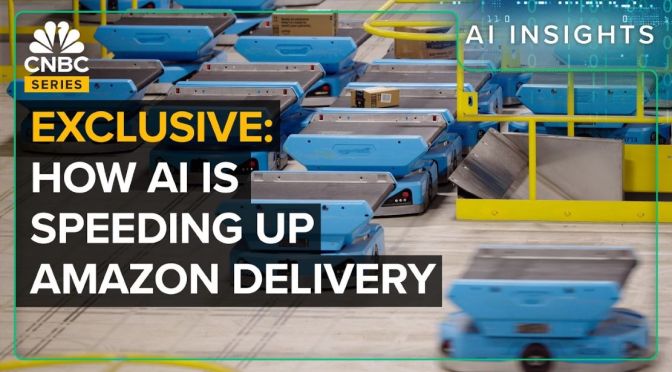
CNBC (September 17, 2024): For decades, Amazon has set the standard for fast package delivery. When Prime launched in 2005, two-day shipping was virtually unheard of. By March 2024, 60% of Prime items were delivered same or next day. Now Amazon wants to push that number even higher, using generative AI, despite concerns about energy and cost.

Chapters: 2:14 Two-day to same-day 5:51 Robot revolution 9:18 Predicting orders 12:11 Routes and personalization

CNBC got an exclusive look at Amazon’s use of generative AI to optimize delivery routes, make more intelligent warehouse robots, and better predict where to stock new items.

Fast Food & Grocery: An AI And Automation Takeover

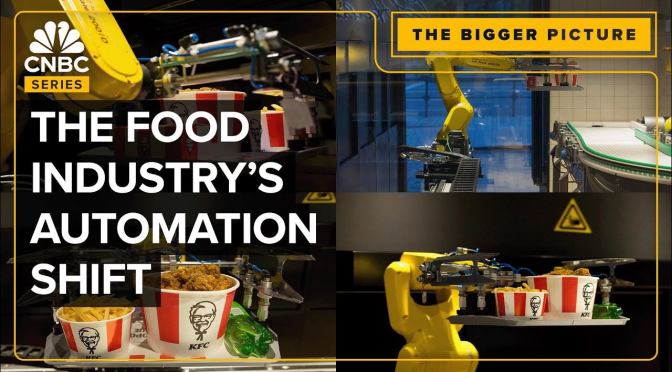
CNBC (July 15, 2024): Fully autonomous fast-food chains to smart carts lining grocery store parking lots, the way the food industry looks is changing due to massive investment in AI technology.

Chapters: 0:00 Introduction 2:34 CH 1. Digitizing food retail 5:35 CH 2. The risk and reward from robots 8:30 CH 3. What’s next?

The American consumer is starting to pull back on spending and rising food and labor costs are causing the food industry to invest more into automation to lower labor costs and improve sales, in order to stay competitive and take advantage of shifting consumer taste.

Business Analysis: Electric Vehicle Conversions Rise

CNBC (June 10, 2023) – Interest in electric vehicles is at an all time high, with sales of new EVs up 55 percent in 2022 compared to the year prior. But there are still a lot of gas cars on the road today and there will be for a long time. EV conversions are becoming a bigger trend that could help.

Chapters: 00:00 — Introduction 02:40 — EV conversions 04:12 — Conversion shops 06:45 — DIY community 11:16 — Challenges

Both the shops and aftermarket community are growing substantially to meet the new demand. CNBC explores what it takes to convert a gas-powered car to an electric vehicle and whether it could go mainstream.

Tech: Inside Samsung’s Growing Chip Business

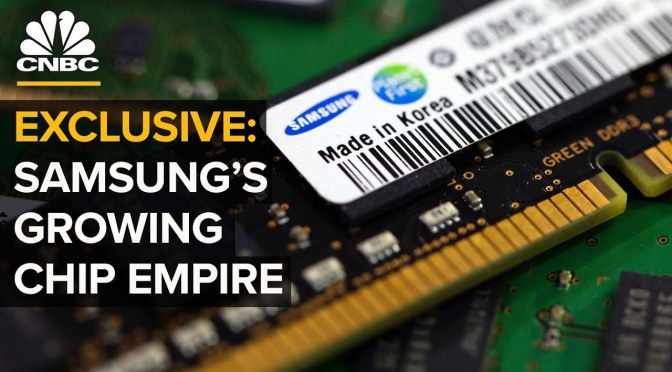
CNBC (June 8, 2023) – Samsung may be known for android phones, TVs and appliances, but it’s also been the undisputed leader in memory for more than three decades. Now, as memory prices continue to fall, it’s doubling down on manufacturing chips for outside customers, with a $17 billion new chip fab in Texas and new $228 billion cluster in South Korea.

Chapters: 00:00 – Introduction 02:31 — From fish to microchips 06:10 — Making more chips in the U.S. 11:17 — Concerns and controversy 14:40 — Ambitious road map ahead

CNBC got a rare look inside Samsung’s chip business to bring you the untold story of how it became the world’s second biggest advanced chipmaker, just as it makes plans to catch the industry leader TSMC.

Analysis: The Best Ways To Fix America’s Water Crisis

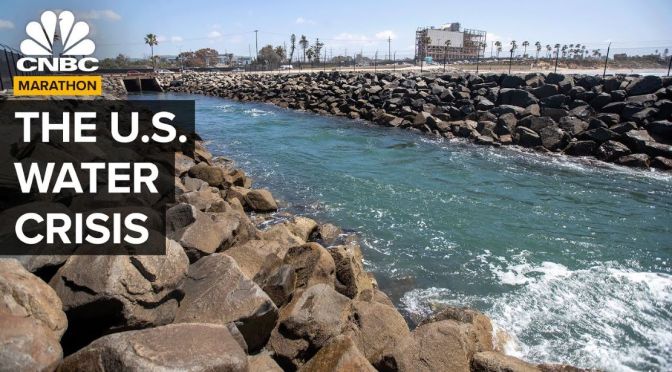
CNBC (May 30, 2023) – From floods to droughts, CNBC Marathon explores the water crisis in the U.S. Today, one out of three people don’t have access to safe drinking water. And that’s the result of many things, but one of them is that 96.5% of that water is found in our oceans. It’s saturated with salt, and undrinkable.

Chapters: 00:00 — Introduction 00:30 — Can Sea Water Desalination Save The World? (Published October 2019) 14:00 — U.S. Farms Waste A Lot Of Water — But This Tech Could Help (Published September 2022) 29:56 — How The West Coast Drought Could Cause More ‘Water Wars’ (Published July 2021) 40:07 — Why Flood Insurance Is Failing The U.S. (Published November 2020)

Most of the freshwater is locked away in glaciers or deep underground. Less than one percent of it is available to us. So why can’t we just take all that seawater, filter out the salt, and have a nearly unlimited supply of clean, drinkable water? The western U.S. is experience a megadrought so severe, it is the driest two decades in at least 1,200 years. And no sector has felt the impact more than agriculture, which takes up about 70% of the world’s freshwater.

With water resources becoming more scarce, several companies are working to improve irrigation efficiency and help sustain food production in a future where extreme climate may be more common. Water is a cornerstone of economic activity, and when it runs low, communities face tough choices. The extreme drought conditions in the U.S. West are straining water resources and providing a fertile ground for wildfires. How will the West Coast face this climate challenge? And 2020 was the busiest hurricane season on record. Flooding is one of a storm’s most devastating consequences.

FEMA estimates one inch of flood water can cause up to $25,000 in damage. The U.S. began offering national flood insurance in 1968 but the program, called the NFIP, is now over $20 billion in debt. Private companies are starting to offer flood insurance as well. However, flood insurance is more complicated than it may appear. Watch the video to better understand how flood insurance works, and doesn’t work, in the U.S.

Reviews: Can California Finish Its High-Speed Rail?

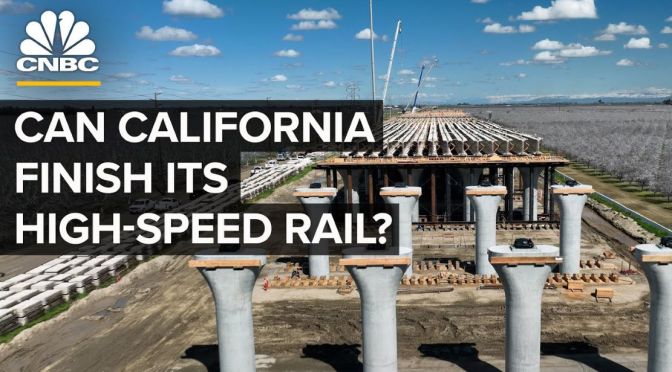
CNBC (May 16, 2023) – In 2008, California voted yes on a $9 billion bond authorization to build the nation’s first high-speed railway. The plan is to build an electric train that will connect Los Angeles with the Central Valley and then San Francisco in two hours and forty minutes.

Chapters: 1:35 Intro 1:41 The Vision 4:48 Progress 8:17 Setbacks and challenges

At the time, it was estimated the project would be complete by 2020 and cost $33 billion. But 15 years later, there is not a single mile of track laid, and there isn’t enough money to finish the project. The latest estimates show it will cost $88 billion to $128 billion to complete the entire system from LA to San Francisco. Inflation and higher construction costs have contributed to the high price tag. Despite the funding challenges, progress has been made on the project.

119 miles are under construction in California’s Central Valley. The project recently celebrated its 10,000th worker on the job. The infrastructure design work is complete, and 422 out of 500 miles have been environmentally cleared. CNBC visited California’s Central Valley, where construction is underway, to find out what it will take to complete what would be the nation’s largest infrastructure project.

Business: Inside LVMH Moët Hennessy Louis Vuitton

CNBC (May 15, 2023) – The luxury conglomerate LVMH Moët Hennessy Louis Vuitton controls 75 Maisons, or brands, including Tiffany & Co., Sephora, Dior, Givenchy and TAG Heuer. At the helm of the luxury empire is the richest person in the world,

Chapters: 0:00 – Introduction 2:20 The Rise Of Louis Vuitton 8:45 A Culture Company, Not Just Luxury 16:46 The Future Of Luxury

Bernard Arnault, whose five children all hold senior executive roles within the company. With a keen eye for luxury, ruthless negotiation skills and an effective business acumen, Arnault has acquired some of the biggest names in the world. Most recently, in 2021, the company bought Tiffany & Co. for $15.8 billion after a bitter dispute about price due to the Covid-19 pandemic, and to salvage the luxury sector’s biggest-ever deal.

Though most companies struggled during the pandemic, LVMH’s stock steadily rose while it continued to report record revenue year after year as wealthy consumers participated in what McKinsey & Co. called “revenge spending.” For the first quarter of 2023, LVMH reported a 17% increase in revenue from the same period a year earlier. The Asia market, which had seen the most significant drop due to Covid-19 closures, had a 14% rise in revenue after an 8% decrease in the fourth quarter of 2022. In April 2023, LVMH became the first European company to surpass $500 billion in market value.

Public Transit: NYC’s $16 Billion Subway Line Costs

CNBC (May 13, 2023) – Public transit can be extremely valuable for a city’s economy – in New York City 85% of the people who travel into the business district below 61st Street take some form of public transportation.

Chapters: 00:00 — Introduction 01:39 — Second Avenue Subway 06:45 — A national problem 08:37 — Subway costs 15:31 — Solutions

In several major cities – New York, Boston, Washington, D.C., and San Francisco – the subway and other rapid rail systems are key contributors to the prosperity of the city. In NYC for example, more than $37 billion of the Metropolitan Transportation Authority’s $54 billion budget goes to subways. But building subways in the U.S. is very expensive.

In fact, it’s the sixth most expensive country to build rail transit in the world. And even that is likely an understatement. High labor costs, overbuilt tracks and stations, and onerous regulations all jack up costs. NYC’s sheer population density makes it rather worth it – so many people ride the subway that the cost per rider is comparable to many European cities where total expenditures are substantially lower.

However, the high costs hurt the case for public transit in less dense areas of the country. Lowering those costs could go a long way toward building affordable and accessible public transit for smaller cities around the country and reducing traffic congestion, pollution and traffic accidents.

Business: How ‘Junk Fees’ Invaded The U.S. Economy

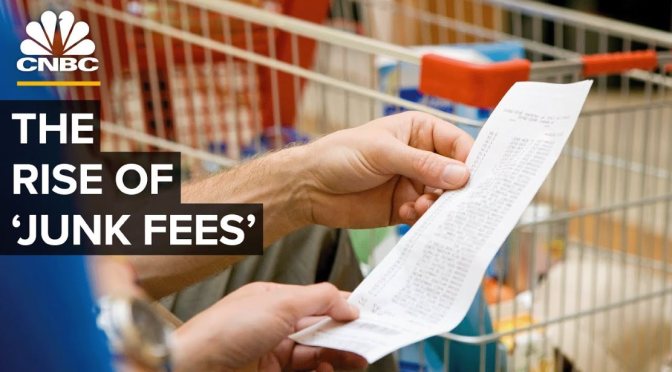
CNBC (April 25, 2023) – Americans are collectively spending nearly $65 billion on sneaky fees, according to the White House. “It really seems like companies have become addicted to junk fees,” Lina Khan, chair of the Federal Trade Commission, told CNBC.

Junk fees are making companies billions of dollars richer. Watch the video above to learn more about where junk fees hide, details of proposed changes, where policy may fall short and whether increased regulatory oversight may be enough to squash junk fees once and for all. Chapters: 0:00 Introduction 1:26 Defining ‘junk’ fees 5:34 Squashing fees 7:52 Policy problems 10:02 The future of fees