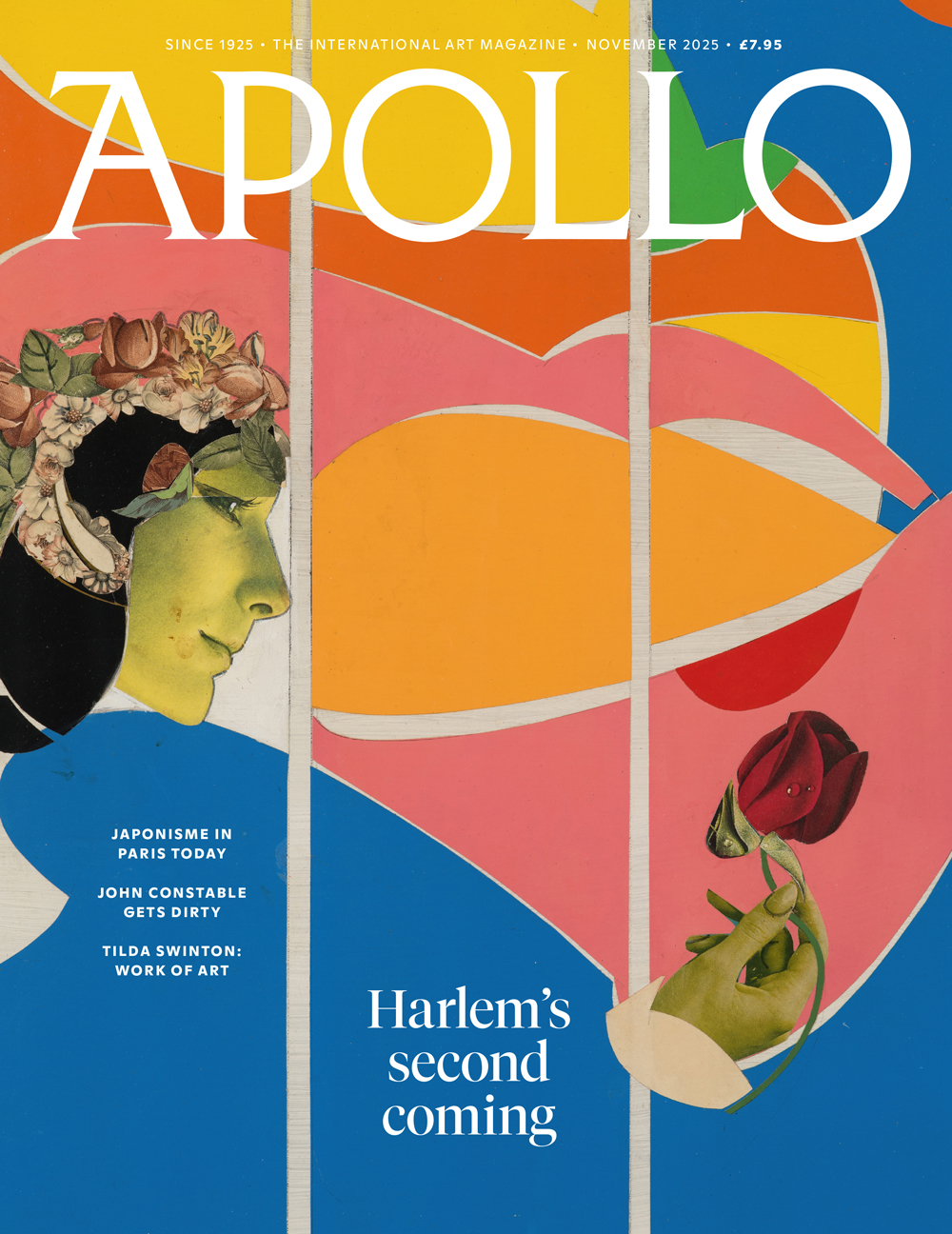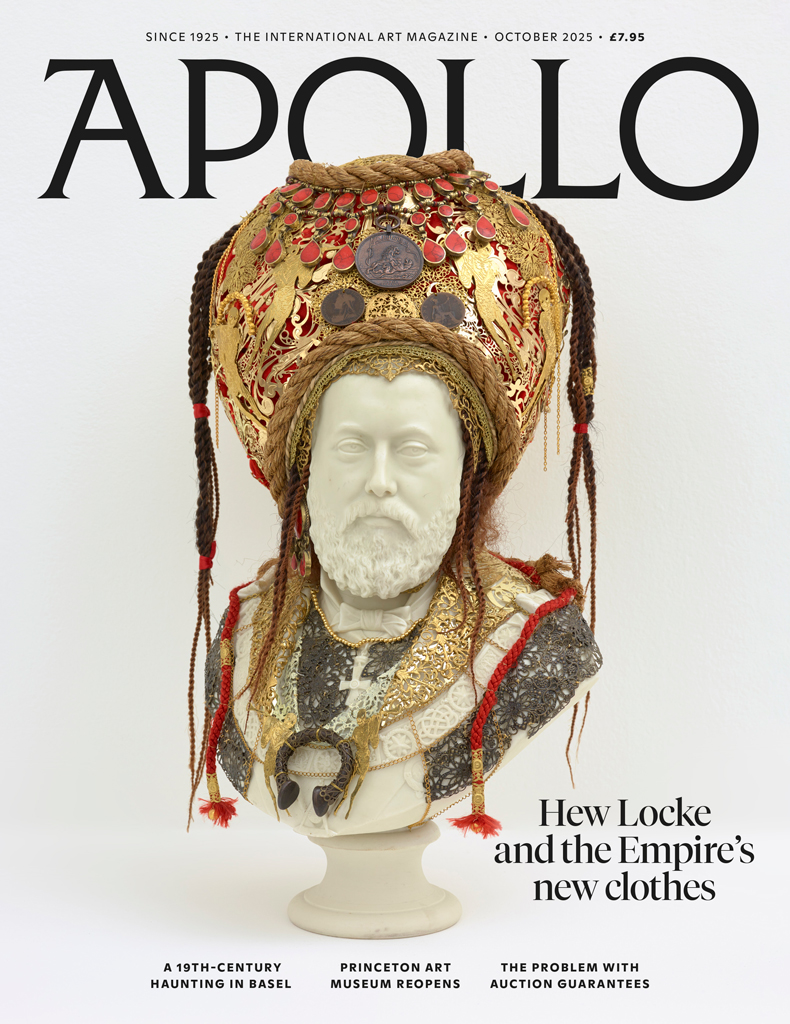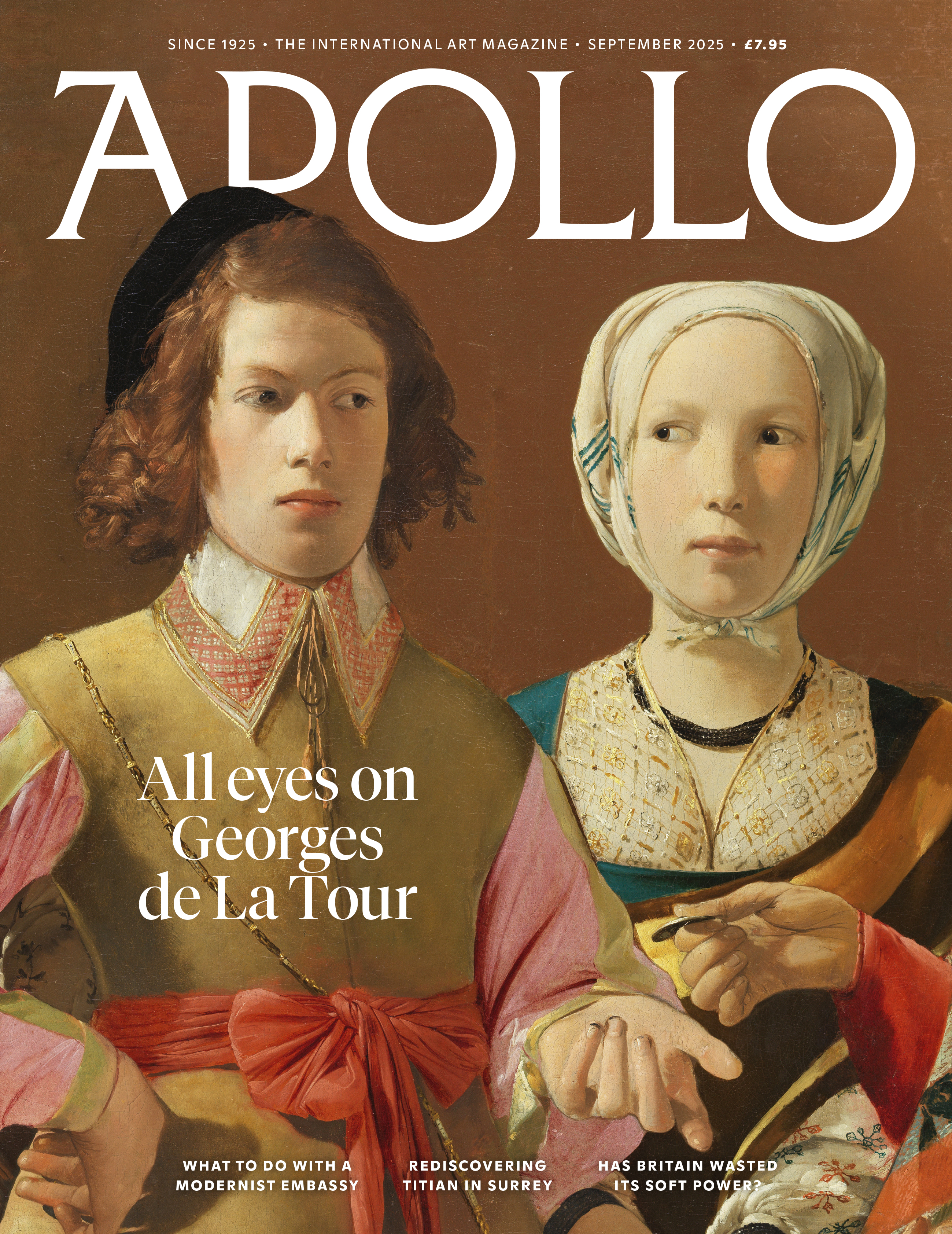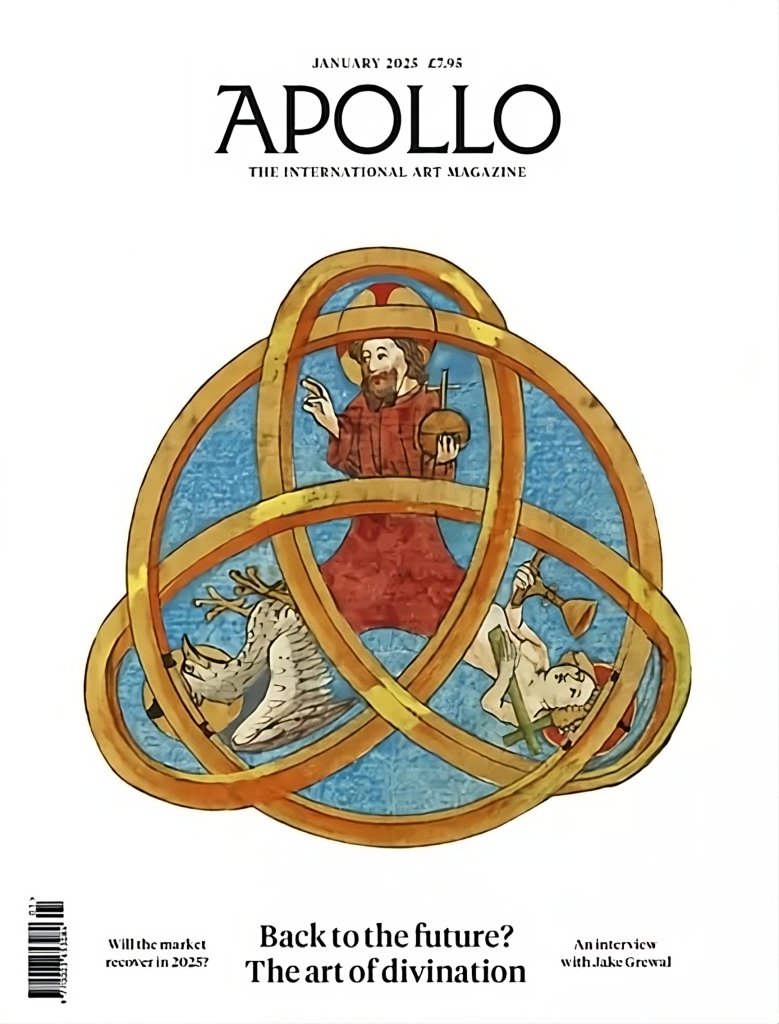
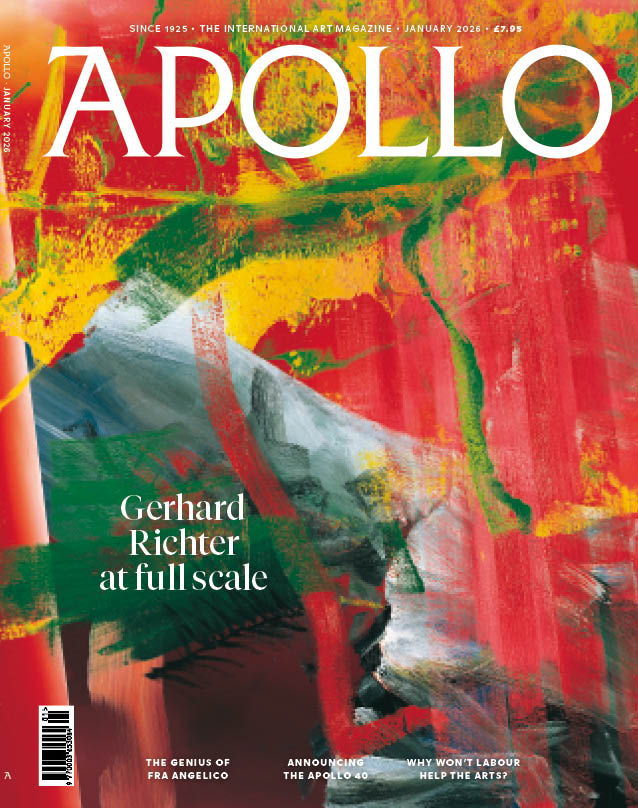
APOLLO MAGAZINE: The latest issue features Hew Locke and the Empire’s new clothes | Princeton University Art Museum reopens | William Hogarth’s bedside manner | the many faces of Nigerian modernism
Plus: Cinecittà in focus, Wangechi Mutu at the Galleria Borghese, the light touch of Antoine Watteau, Egypt’s new home for antiquities, how polenta caused a stir in Venice, the Aspen art scene continues to snowball, and the revival of London’s art market; in reviews: Amy Sherald’s portraits, King James VI and I’s cultural legacy, and what is a Jewish country house?
Plus: the artists who have bared all, the Michael C. Rockefeller Wing at the Met, Gertrude Stein’s museum of modern art, Elizabeth I’s favourite kitchen utensil, how Jenny Saville turns paint into flesh, and a preview of Treasure House Fair; in reviews: Hiroshige in London, Frida Kahlo and Mary Reynolds in Chicago, and art versus AI
THE WEEK IN ART (March 14, 2025): After a challenging year in which international galleries, auction houses and museums have been forced to scale back their operations and make redundancies on an alarming scale, a slower, more considered approach to business seems to be emerging.
So are we into an era of longer, more in-depth exhibitions and bespoke events concerned more with authentic connection than flashy spectacle? Ben Luke talks to Anny Shaw, a contributing editor at The Art Newspaper. In the Netherlands, just as in the US, cuts by far-right politicians to international development seem likely to have a huge impact on arts projects. As Tefaf, the major international art fair opens in the Dutch city of Maastricht, we talk to Senay Boztas, our correspondent based in Amsterdam, about fears of a funding crisis. And this episode’s Work of the Week is one of the greatest paintings ever made: The Hunters in the Snow (1565) by Pieter Bruegel the Elder. It is part of an exhibition called Arcimboldo – Bassano – Bruegel: Nature’s Time, which opened this week at the Kunsthistorisches Museum in Vienna. The museum’s director, Jonathan Fine, tells us more.
Arcimboldo–Bassano–Bruegel: Nature’s Time, Kunsthistorisches Museum, Vienna, until 29 June
Gagosian Quarterly (Fall 2024) – The new issue features Jessica Beck discussing Andy Warhol’s Mao series, contextualizing Warhol’s return to painting in the early 1970s and his attraction to subjects of notoriety. We dig into the archives to honor the inimitable Richard Serra, who had over forty exhibitions at Gagosian since his first in 1983. Elsewhere in the issue, Salomé Gómez-Upegui examines the work of artists confronting the climate crisis, and Péjú Oshin speaks with Jayden Ali about his expansive view of architecture.
Andy Warhol’s Insiders at the Gagosian Shop in London’s historic Burlington Arcade is a group exhibition and shop takeover that feature works by Warhol and portraits of the artist by friends and collaborators including photographers Ronnie Cutrone, Michael Halsband, Christopher Makos, and Billy Name. To celebrate the occasion, Makos met with Gagosian director Jessica Beck to speak about his friendship with Warhol and the joy of the unexpected.
Against the backdrop of the 2020 US presidential election, historian Hal Wert takes us through the artistic and political evolution of American campaign posters, from their origin in 1844 to the present. In an interview with Quarterly editor Gillian Jakab, Wert highlights an array of landmark posters and the artists who made them.
HURVIN ANDERSON’S “BARBERSHOP” series belongs to a long tradition of painterly fascination with the spaces of social interaction that reflect both the physical realities and ideological aspirations of society at large. Anderson’s exhibition “Salon Paintings” at England’s Hastings Contemporary, organized in collaboration with the Hepworth Wakefield, also in England, and Kistefos Museum in Jevnaker, Norway, brings together a body of work he produced between 2006 and 2023 that portrays, albeit in the loosest sense of the word, men’s hair salons.
View of “Time Travel: Italian Masters Through a Contemporary Lens,” 2023–24. From left: Ross Bleckner, Day and Night, Hour by Hour, 2023; Josephine Halvorson, Smiley Face, 2023. Photo: Jason Mandella.
“Time Travel: Italian Masters Through a Contemporary Lens,” a group exhibition that featured a selection of Renaissance paintings alongside works created by present-day artists, was a type of paragone, except that the debate was not whether painting or sculpture is the superior art form, but whether these historical pieces—executed at a time when grand themes and exquisite craft, among other criteria, determined their value—are better or worse than objects made by artists now, when such antiquated metrics seem well beside the point.
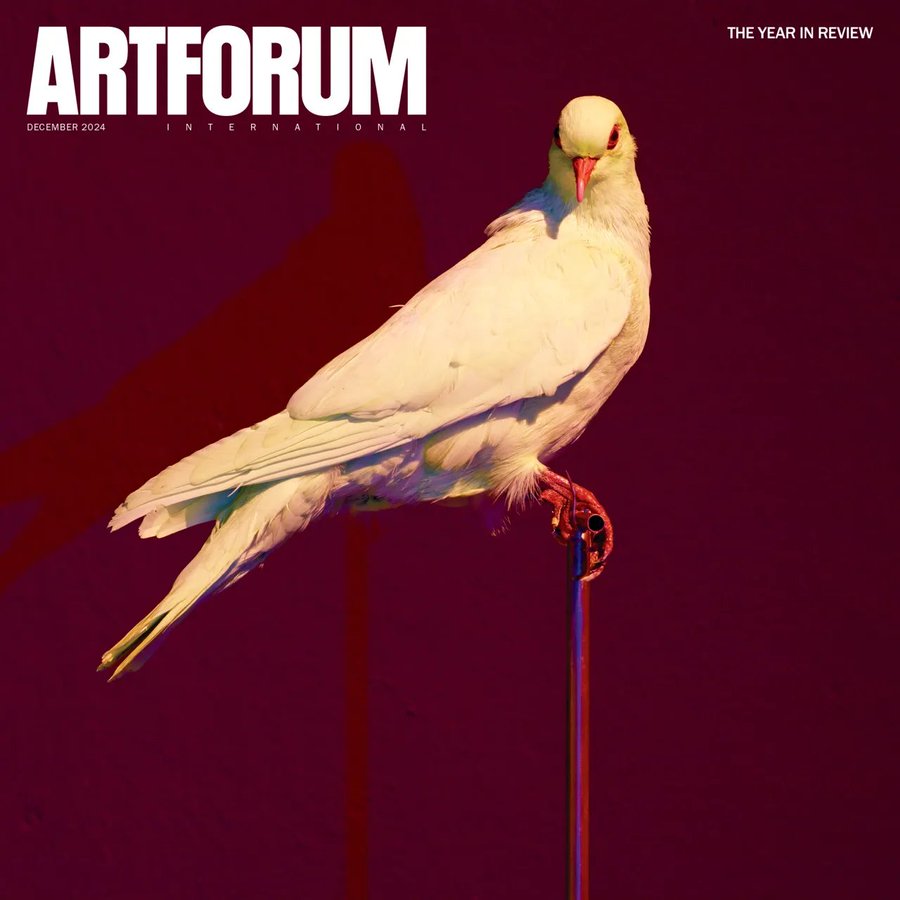
Artforum Magazine (December 5, 2023) – The latest issue features Fifteen Artists reflect on 2023, “Manet/Degas” at the Metropolitan Museum of Art in NYC, The Top Museum Exhibitions of 2023, The top ten art exhibitions of 2023, and more…
“MANET/DEGAS,” the fall blockbuster at the Metropolitan Museum of Art, New York, begins with an unabashed, double-barreled bang: Édouard Manet’s last great self-portrait, paired up alongside one of Edgar Degas’s first. The juxtaposition provides a thrilling object lesson in the stolid compare-and-contrast curatorial methodology that defines the exhibition, but if it’s meant to show the two artists on an equal footing, it doesn’t stage a fair fight. Forty-six years old when he executed Portrait of the Artist (Manet with a Palette), ca. 1878–79, Manet is at the height of his painterly power, looking backward and forward at once.
Lauren Halsey, the eastside of south central los angeles hieroglyph prototype architecture (I), 2022, glass-fiber reinforced concrete. Installation view, Metropolitan Museum of Art, New York, 2023. Photo: Hyla Skopitz.
To take stock of the past year, Artforum asked an international group of artists to select a single exhibition or event that most memorably caught their attention in 2023.
KENTURAH DAVIS Lauren Halsey (Metropolitan Museum of Art, New York) Emerging onto the Met’s rooftop, I’m greeted by sphinxes with faces carved in the likeness of the artist’s loved ones. These figures surround and protect a large architectural monument, its surfaces engraved with coded inscriptions that pay homage to the people and energy of South Central Los Angeles. The structure forgoes the exuberant color I’ve come to expect in Halsey’s work, making me think about the ways Egyptian art and architecture have changed over time—once colorfully embellished, and now animated purely by shadows. In this way, Halsey’s sanctuary suggests that it’s been standing there for millennia, transformed by the sun and communing with the cosmos.
Annette Frick, Ein Augenblick im Niemandsland (A Moment in No Man’s Land), 2010, twenty-one gelatin silver prints, each 15 3⁄4 × 11 3⁄4″.
VAGINAL DAVIS Annette Frick (MARTa Herford, Germany) You can easily get royally preggers if you stand too close to the hairy eyeball of Annette Frick. For more than forty years, the Berlin-based photographer-filmmaker and consummate artiste has been known mainly for her captivating chronicles of underground queer scenes. At her retrospectacle “A Moment in No Man’s Land,” was enchanted by her sensual large-format self-portraits and stunning nude cycle “Aus dem Wasser” (Out of the Water), 2007–2008, referring to mythological figures such as Ondine and Lilith. I had never seen her architecture-portrait hybrids and was mesmerized, wondering just what else she has hidden in her voluptuous archive.
Saâdane Afif, The King Coal Laments, 2023, coal sculptures by miners, UV prints on aluminum, wood, aluminum trusses. Installation view, Wilhelm Hallen, Berlin. Photo: Andrea Rossetti.
ANRI SALA Saâdane Afif (Wilhelm Hallen, Berlin) It’s difficult to express the poetry and poignancy of Saâdane Afif’s exhibition “The Coalman,” part of the artist’s larger endeavor to give form to a heptahedron. Here, the artist installs his personal collection of coal sculptures handcrafted by miners in their spare time alongside Is it possible that you have no coal left?, 2023, a facsimile of a letter from French composer Claude Debussy to his coal merchant, penned during the particularly severe winter of 1916–17. The repurposed missive serves as a coda to the exhibition as a whole, posing a question that resonates in manifold ways in the present (perhaps even applying to a shortage of new forms).
Ken Kiff, Man and Blue Mask, ca. 1975, oil on panel, 31 7⁄8 × 24″.
News, Views and Reviews For The Intellectually Curious