Tag Archives: Andes

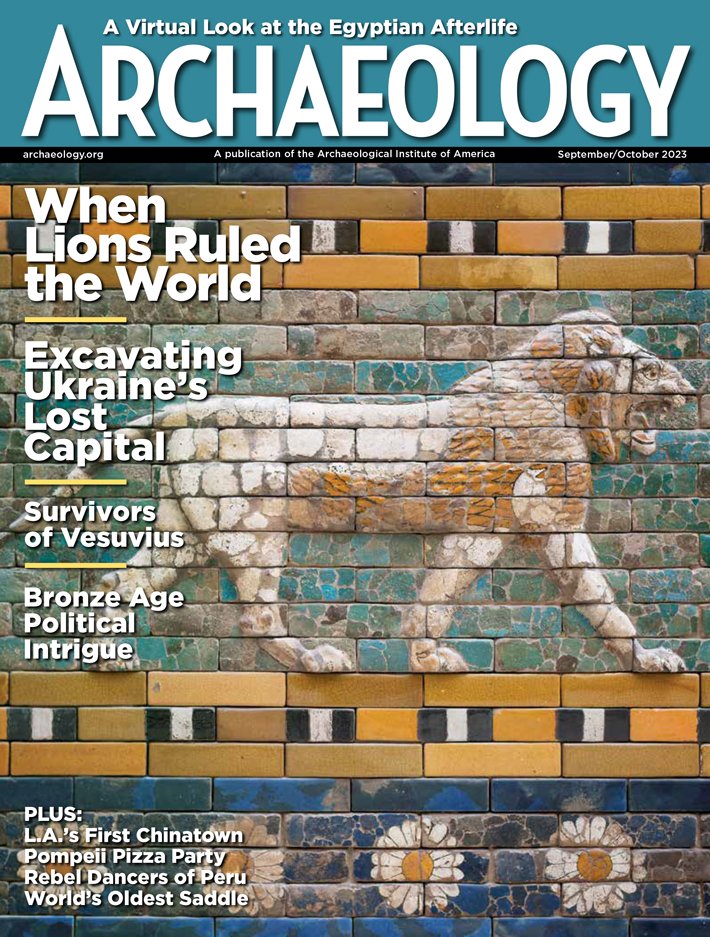
Preview: Archaeology Magazine – Sept/Oct 2023

Image

Archaeology Magazine (September/October 2023):

Ukraine’s Lost Capital
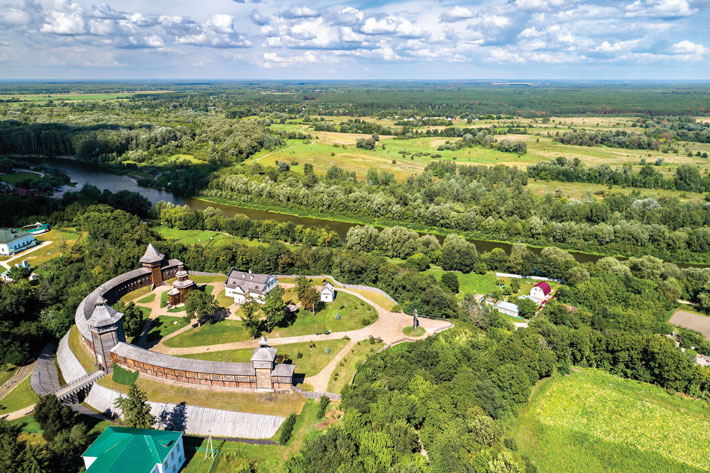
Ukraine Batyrn Cossack Citadel
Archaeologists have spent decades excavating the remnants of the Cossack capital of Baturyn in north-central Ukraine. Based on the excavation’s findings, the Ukrainian government has reconstructed the town’s citadel—including the wooden Church of the Resurrection, defensive walls, rampart, and moat—which was destroyed by Russian soldiers in 1708.

In 1708, Peter the Great destroyed Baturyn, a bastion of Cossack independence and culture

By DANIEL WEISS

On November 2, 1708,  thousands of Russian troops acting on the orders of Czar Peter I, known as Peter the Great, stormed Baturyn, the Cossack capital in north-central Ukraine. The Cossack leader, or hetman, Ivan Mazepa—who had been a loyal vassal of the czar until not long before—had departed with much of his army several days earlier to join forces with the Swedish king Charles XII, Peter’s opponent in the Great Northern War (1700–1721). The fortified core of Baturyn consisted of a citadel on a high promontory overlooking the Seim River and a larger adjoining fortress densely packed with buildings, above which soared the brick Cathedral of the Holy Trinity. The citadel and fortress were each surrounded by defensive walls, earthen ramparts, and moats whose sides were lined with logs. Although they sustained heavy losses, the Russian forces managed to seize Baturyn, which proved to be a key victory.

When Lions Were King

Across the ancient world, people adopted the big cats as sacred symbols of power and protection

Secrets of Egypt’s Golden Boy

CT scans offer researchers a virtual look deep inside a mummy’s coffin

Rites of Rebellion

Archaeologists unearth evidence of a 500-year-old resistance movement high in the Andes

Bronze Age Power Players

How Hittite kings forged diplomatic ties with a shadowy Greek city-state

Short Films: ‘The Legend of Ñaymlap’ – An Andean Origin Story Of Peru (2022)

In the Denver Art Museum’s Art of the Ancient Americas galleries, we worked with Mexico City-based animators Hola Combo to create animations to help tell the origin stories that explain the relationship between ancient American communities and the their environment. For the Andes, we chose a story that loosely relates to the works on display. “The Legend of Ñaymlap” is an ancient story from Peru’s northern coastal communities and supposedly records the origins of the Sicán or Lambayeque dynasty (about 750–1375 CE). Within this origin story, there is a moral about the relationship between the deities and the land. As the ruler turns away from the deities, rain and floods devastate the land, starving the community.

The Peruvian Andes: Cusco To Macho Picchu (4K)

Cusco, a city in the Peruvian Andes, was once capital of the Inca Empire, and is now known for its archaeological remains and Spanish colonial architecture. Plaza de Armas is the central square in the old city, with arcades, carved wooden balconies and Incan wall ruins. The baroque Santo Domingo Convent was built on top of the Incan Temple of the Sun (Qoricancha), and has archaeological remains of Inca stonework. 

Machu Picchu is an Incan citadel set high in the Andes Mountains in Peru, above the Urubamba River valley. Built in the 15th century and later abandoned, it’s renowned for its sophisticated dry-stone walls that fuse huge blocks without the use of mortar, intriguing buildings that play on astronomical alignments and panoramic views. Its exact former use remains a mystery.

Travel: Los Glaciares National Park, Argentina

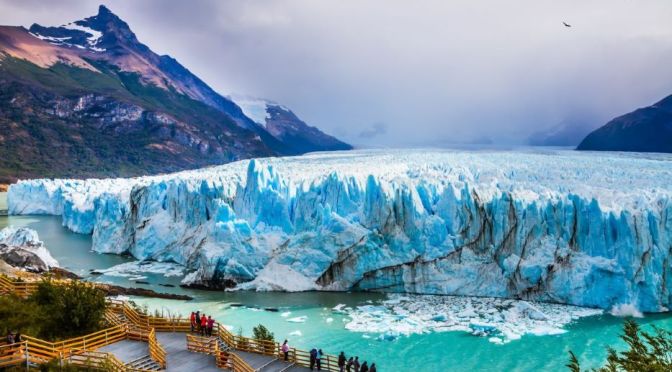
Los Glaciares National Park is in the Austral Andes of southwest Argentina, near the Chilean border. Its many glaciers include Perito Moreno, best known for the dramatic icefalls from its front wall, into Lake Argentino. In the north, Mount Fitz Roy’s jagged peak rises above the mountain town of El Chaltén and Lake Viedma. The park is home to many birds, such as condors and black-chested buzzard eagles.

Views: Ecuador’s ‘Sword-Billed Hummingbirds’

The sword-billed hummingbird has exclusive access to food that other birds simply cannot reach, but having such a long bill does have its drawbacks.

The sword-billed hummingbird is a neotropical species of hummingbird from the Andean regions of South America. It is the sole member of the genus Ensifera and is characterized by its unusually long bill; it is the only bird to have a beak longer than the rest of its body. 

Travel Tour: Top Ten Places To Visit In Chile

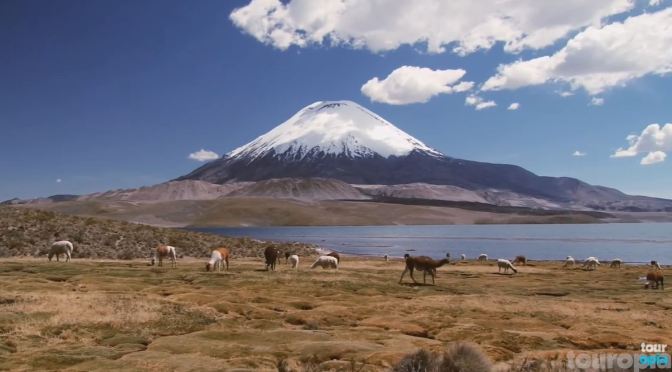
Squeezed between the Andes and the Pacific, Chile is sometimes called the longest country in the world. It is never more than 180 km wide, but its coastline extends over 4,300 km. It’s unusual long shape has given it a varied climate with one of the world’s driest desert in the north, while its southern tip is home to cold-weather creatures like penguins. Chile is also one of the closest nations, along with Argentina and New Zealand, to Antarctica. Here’s a look at the best places to visit in Chile:

Top Timelapse Videos: “Observatories – ESO” In Chile By Martin Heck

Filmed, Edited and Directed by: Martin Heck

Music: “Chasing Time” by David A. Molina

Observatories European Southern Observatory ESO in Chile timelapse video by Martin Heck 2019

Part two of a series of journeys to the big astronomical observatories of this planet. In this video: The Paranal Observatory and the Atacama Large Millimeter Array – ALMA. With some of the biggest ground-based telescopes on earth, the observatories of the European Southern Observatory in Chile are at the bleeding edge of astronomical research. These incredibly complex machines, operating synchronized and precisely in the very remote and hostile environments of the Atacama Desert and Andes, enable deep views into the universe.

All the sequences were shot in only 4 nights in total, but on two trips in 2017 and 2019.

Website: https://timestormfilms.net/