
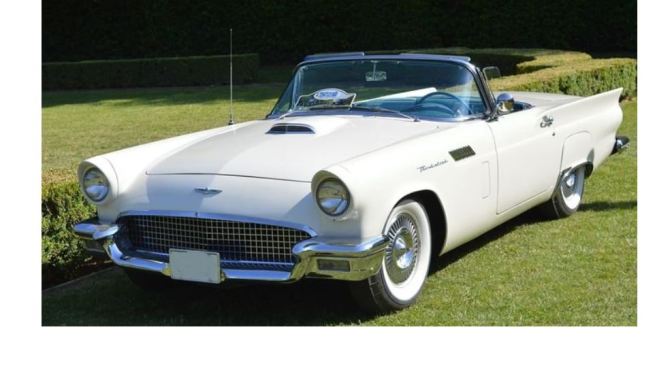
 Ford Thunderbird (colloquially called the T-Bird) is a nameplate that was used by Ford from model years 1955 to 1997 and 2002 to 2005 over eleven model generations. Introduced as a two-seat convertible, the Thunderbird was produced in a number of body configurations through its production life, including four-seat hardtop coupe, four-seat convertible, five-seat convertible and hardtop, four-door pillared hardtop sedan, six-passenger hardtop coupe, and five passenger pillared coupe, with the final generation produced as a two-seat convertible.
The Ford Thunderbird began life in February 1953 in direct response to Chevrolet’s new sports car, the Corvette, which was publicly unveiled in prototype form just a month before. Under rapid development, the Thunderbird went from idea to prototype in about a year, being unveiled to the public at the Detroit Auto Show on February 20, 1954. It was a two-seat design available with a detachable glass-fibre hard top and a folding fabric top.
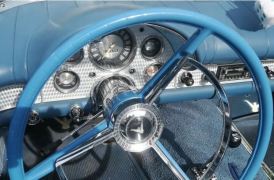
 The Thunderbird was revised for 1957 with a reshaped front bumper, a larger grille and tailfins, and larger tail lamps. The instrument panel was heavily re-styled with round gauges in a single pod, and the rear of the car was lengthened, allowing the spare tire to be positioned back in the trunk. The 312 cu in (5.1 L) V8 became the Thunderbird’s standard engine, and now produced 245 horsepower (183 kW). Other, even more powerful versions of the 312 cu in (5.1 L) V8 were available including one with two four-barrel Holley carburetors and another with a Paxton supercharger delivering 300 horsepower (220 kW). Though Ford was pleased to see sales of the Thunderbird rise to a record-breaking 21,380 units for 1957, company executives felt the car could do even better, leading to a substantial redesign of the car for 1958.
From Wikipedia
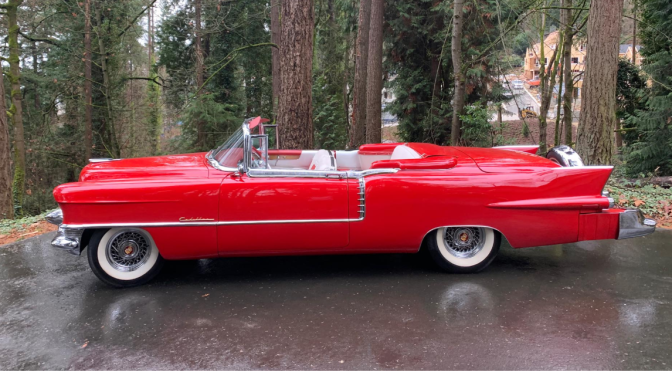
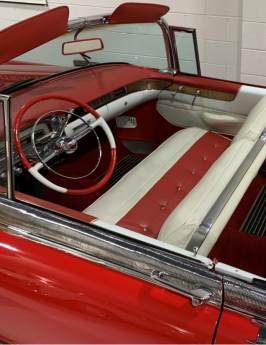 The Cadillac Eldorado is a premium luxury car that was manufactured and marketed by Cadillac from 1952 to 2002 over twelve generations. Competitors and similar vehicles included the Continental Mark series, Buick Riviera, Oldsmobile Toronado and Chrysler’s Imperial Coupe.
 For 1955, the Eldorado’s body gained its own rear end styling with high, slender, pointed tailfins. These contrasted with the rather thick, bulbous fins which were common at the time and were an example of the Eldorado once again pointing the way forward. The Eldorado sport convertible featured extras such as wide chrome body belt moldings and twin round taillights halfway up the fenders. Sales nearly doubled to 3,950.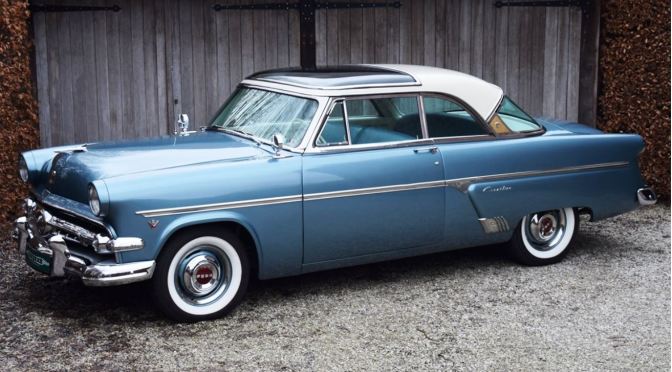
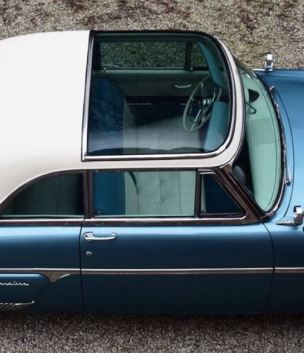 In 1954, Ford added a new niche model to the top-of-the-line Crestline series : the Skyliner. The car had a glass roof section over the front seats, made of blue-green tinted acrylic and letting a diffused yet filtered light through. Ford claimed that 60% of the sunrays were filtered out.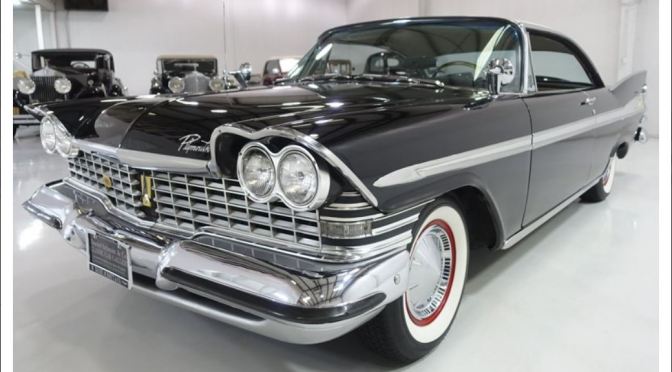
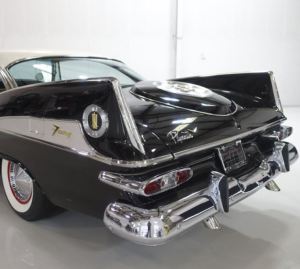 In 1959, Plymouth introduced the Sport Fury as its top model, and the Fury as its second from the top model to replace the Plymouth Belvedere at the top of the Plymouth line-up. The Fury range was now available as a four-door sedan and station wagon, as well as a two-door hardtop and sedan. The Sport Fury series had only a two-door hardtop and convertible. The Sport Fury was dropped at the end of 1959, but was reintroduced in mid-1962 and discontinued in 1971.
 The Plymouth Fury is a model of automobile which was produced by Plymouth from 1955 to 1989. It was introduced for the 1956 model year as a sub-series of the Plymouth Belvedere, becoming a separate series one level above the contemporary Belvedere for 1959. The Fury was a full-size car from 1959 to 1961, then a mid-size car from 1962 to 1964, again a full-size car from 1965 to 1974, and again a mid-size car from 1975 to 1978. From 1975 to 1977 the Fury was sold alongside the full-size Plymouth Gran Fury.
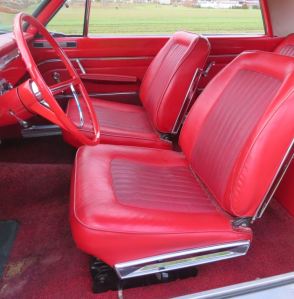 The Plymouth Valiant (first appearing in 1959 as simply the Valiant) is an
  The Valiant was totally reskinned for 1963 with a 0.5 in (13 mm) shorter wheelbase; it had a wide, flat hood and a flat square rear deck. The upper belt feature line ran from the rear body, in a gentle sweep, to the front fender tip. Here it was ‘veed’ back and down to the trailing edge of the front fender. The roofline was flatter and sharpened in profile. The grille was a variation of the inverted trapezoid shape that characterized contemporary Chryslers, with a fine mesh insert. Advances in body structure, many accessories and a new spring-staged choke were promotional highlights. The Valiant was offered as a 2-door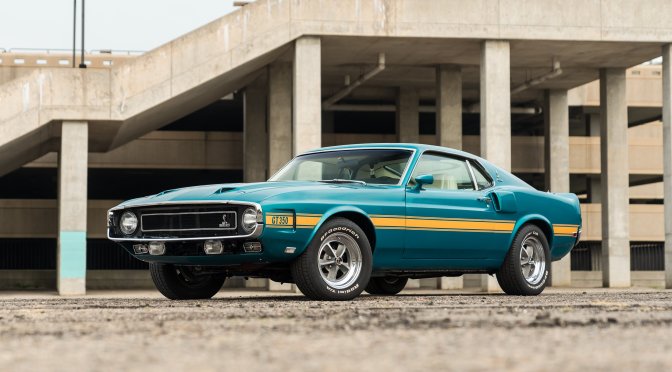
 As the Mustang line grew in size and comfort features, so too did the Shelby branded vehicles on which they are based. Never one to settle for standard, Carroll Shelby decided to take the already aggressive and bold styling of the 1969 Mustang even further. New front fenders, which included functioning brake ducts, were added which terminated in a big, full-width grill and bright chrome bumper set forward of this. Some other interesting design elements were included as well such as NACA ducts on the hood, rather than the traditional raised hood scoops.
  Boomers Daily