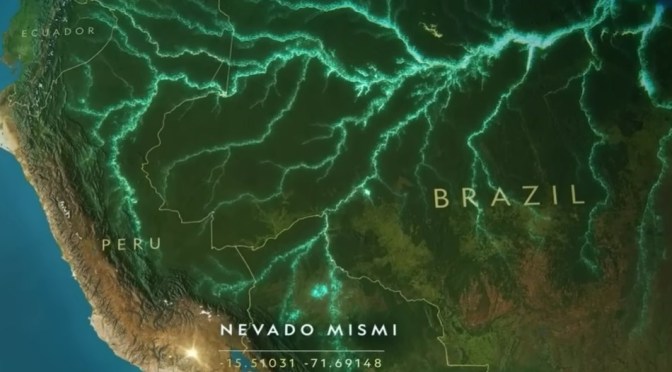
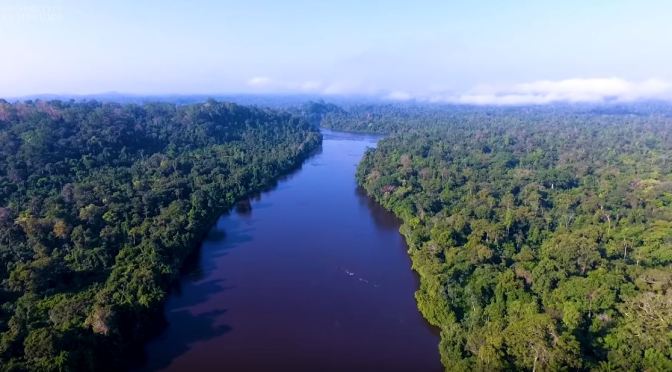
National Geographic (September 24, 2024): Presented by @ROLEX Over the course of two years, teams of Explorers on the Rolex and National Geographic Perpetual Planet Amazon Expedition have studied the Amazon River Basin from source to mouth – across six countries.
In this bonus material to National Geographic’s “Expedition Amazon” documentary, premiering on 10 October, National Geographic Explorers Thomas Peschak, Fernando Trujillo, Thiago Silva and Julia Tavares guide us from the farthest source of the river, the Nevado Mismi in Peru, to the official start of the Amazon at the Brazilian Meeting of the Waters.
Along the way we meet an adored Colombian rescue manatee named Moechi, and travel to rare Bolivian clearwaters, where gilded catfish are plentiful.
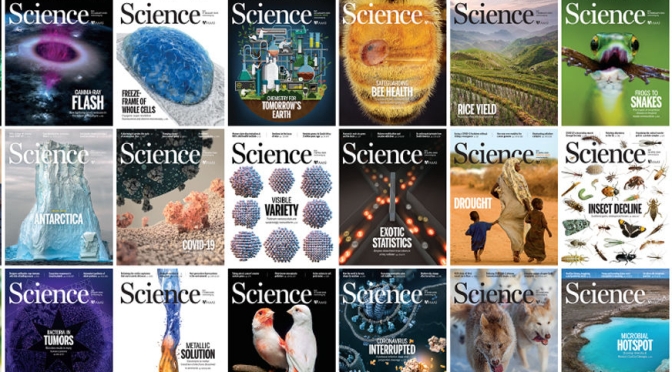
Science Magazine – February 15, 2024: The new issue features ‘A record drought in October 2023 that lowered the Amazon River near the Brazilian city of Tefé, revealing sand dunes and forcing local fishing boats to compete for spots.
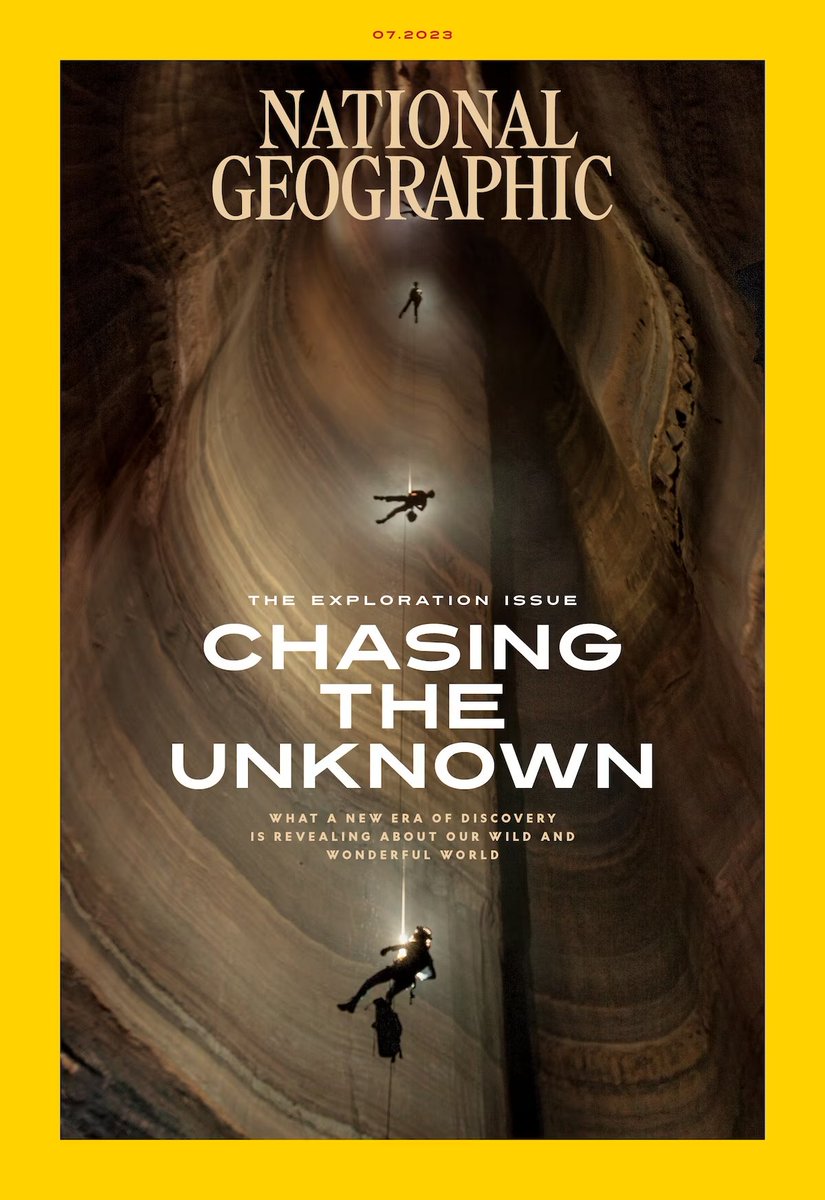
National Geographic Magazine (July 2023): The ‘Exploration Issue’ features ‘Chasing the Unknown – What a new era of discovery is revealing about our wild and wonderful world.
Why do we explore? It’s just what humans do. But how we define it is changing.
BY NINA STROCHLIC
There is only one museum along the old Oregon Trail that tells the story of America’s westward expansion through the eyes of those being expanded into. In a corner of Oregon bordered by Washington and Idaho, this wood-paneled warren of galleries and interactive exhibits celebrates the heritage of Native people and mourns what was destroyed when the pioneers arrived. Walking down a long ramp, visitors enter the brick facade of a replica “Indian training school,” where Native children were forcibly converted and assimilated. A life-size photo of the students stares back from over a century ago; their matching uniforms make them look like tiny soldiers.
In a two-year expedition, a National Geographic photographer is documenting the mighty river and the greater ecosystem from the Andes to the Atlantic.
STORY AND PHOTOGRAPHS BY THOMAS PESCHAK
Two jaguars leap into the river, lunging at pacas. These oversize rodents, with blotched and striped coats, are agile swimmers. Piranhas, attracted by the commotion, hover nearby.
I’m photographing this riveting scene, but I’m not underwater as I usually am when I’m on assignment. Instead of diving to see this aquatic life, I’ve climbed to a rocky ledge far above a rainforest. The jaguars, pacas, and piranhas are not flesh and blood; they are prehistoric artworks painted with hematite, a blood-red iron oxide, in exquisite detail. I am in awe, as if seeing the ceiling of the Sistine Chapel for the first time.
“They used to kill us with guns, now they kill us with deforestation and dams.” The Brazilian government’s failure to protect the Amazon forest is forcing the Munduruku indigenous people to take action against land grabs and illegal logging – and try to save the rain forest on their own.
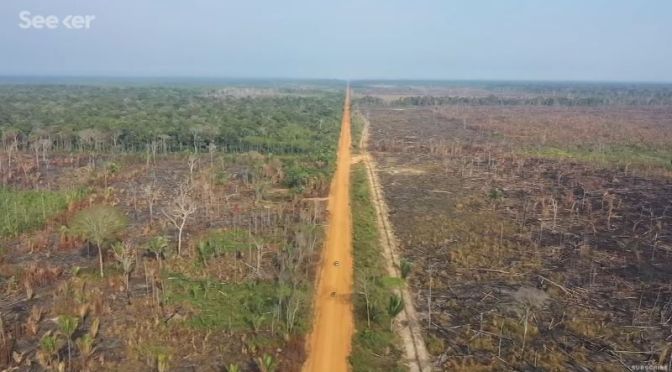
In an unprecedented movement led by Chief Juarez Saw Munduruku, for the last six years indigenous people have been fighting the theft and destruction of their forest home. Since 1970, 20% of the Brazilian Amazon has been deforested. Logging and forest fires are threatening a further 20%. Scientists say that at 40% deforestation, we will reach the point of no return. The forest will be lost forever, replaced by savannahs – and the environmental consequences will be catastrophic.
The Amazon is often known as ‘the lungs of the planet,’ producing 6% of the world’s oxygen. It is no secret that the rainforest has been losing a dramatic fight against an array of threats, encouraged by capitalism, consumerism and greed – both legal and illegal.
In today‘s Brazil, some 600,000 square kilometers of land – an area about the size of France — are farmed by farmers who don’t officially own it. The military dictatorship (1964-1985) encouraged them to settle on state-owned land, but the farmers never became legal owners. As a result, speculators now seize the areas, clear the forests, then resell the plots with forged title deeds. This land grab, known as “grilagem” in Portuguese, has led to uncontrolled forest clearing and fierce conflicts.
The documentary was shot from 2014 to 2020, under three different Brazilian governments. It provides deep insights into the drama of the illegal occupation of state land and forest areas by organized crime groups. Several indigenous peoples have united under Juarez Saw Munduruku, leader of the Munduruku people, in a last-ditch bid to save the planet’s most important forest.
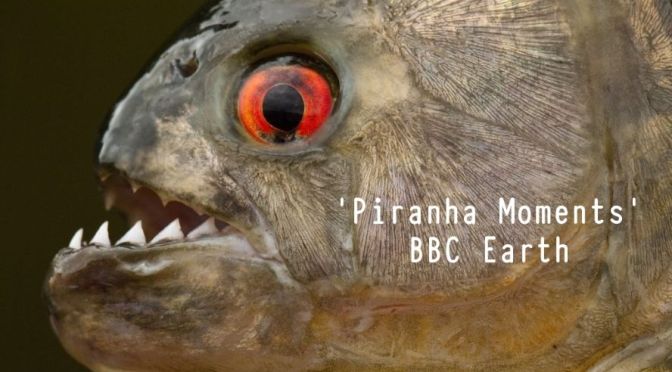
These sharp-toothed water dwellers are more than capable of stripping a carcass clean in mere moments.
A piranha or piraña, a member of family Serrasalmidae, or a member of the subfamily Serrasalminae within the tetra family, Characidae in order Characiformes, is a freshwater fish that inhabits South American rivers, floodplains, lakes and reservoirs.
New research suggests that if the current rate of deforestation continues, the Amazon rainforest could transform into a savannah within 15 years. Do we have time to stop it?
The Amazon basin spans over 6 million square kilometers, and is home to one-fifth of the world’s land species. In addition, it supports the 30 million people who live and depend on the land as a source of food, medicine, and shelter. That’s not even including the key role it plays in regulating the regional AND global climate.
Trees absorb water through their roots and transport it to their leaves, where it’s released as vapor through small pores in a process called transpiration. As the water vapor rises and condenses, it forms rain clouds over the forest canopy. Basically, the rainforest is making its own weather. For example, one large tree can release 1,000 liters of water into the atmosphere in a single day.
The rainforest recycles this water up to six times before it moves out of the region, but as more trees are cut down, those that remain may not be able to recycle enough water to survive. Less trees means more sunlight will hit the forest floor, exposing the forest to higher temperatures. Since deforestation began accelerating in the 1970’s, 800,000 square kilometers of the Amazon have been lost. And over that same period, the average temperature of the basin has risen by 1 degree Celsius.
Brazil, officially the Federative Republic of Brazil, is the largest country in both South America and Latin America. At 8.5 million square kilometers and with over 211 million people, Brazil is the world’s fifth-largest country by area and the sixth most populous.
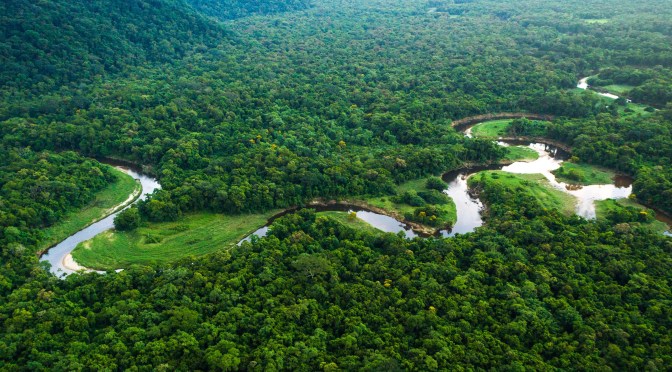
The Amazon rainforest, covering much of northwestern Brazil and extending into Colombia, Peru and other South American countries, is the world’s largest tropical rainforest, famed for its biodiversity. It’s crisscrossed by thousands of rivers, including the powerful Amazon. River towns, with 19th-century architecture from rubber-boom days, include Brazil’s Manaus and Belém and Peru’s Iquitos and Puerto Maldonado.
Research has discovered the tallest known tree in the Amazon, towering above the previous record holder at a whopping 88.5 metres. This giant could store as much carbon as an entire hectare of rainforest elsewhere in the Amazon. Toby Jackson, a plant scientist in the University of Cambridge, took part in an expedition to find the tree in a remote region of northern Brazil, and validate its height the old-fashioned way – by climbing it.






 Boomers Daily