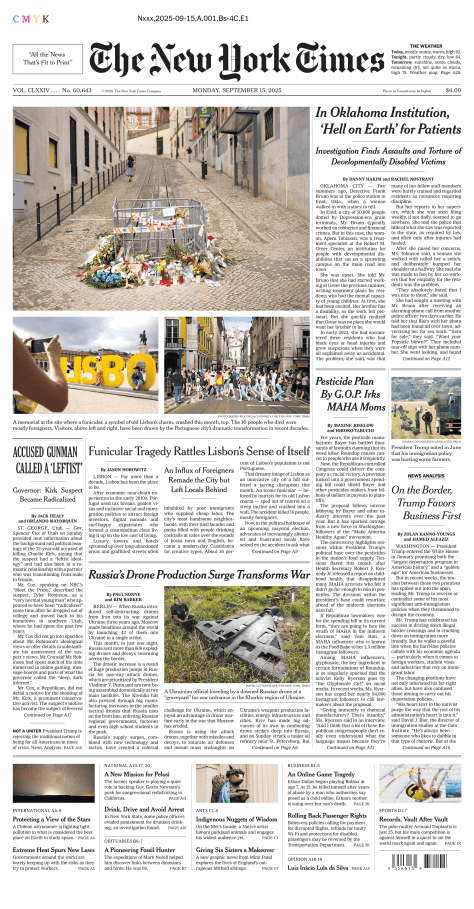
THE NEW YORK TIMES – MONDAY, JULY 14, 2025

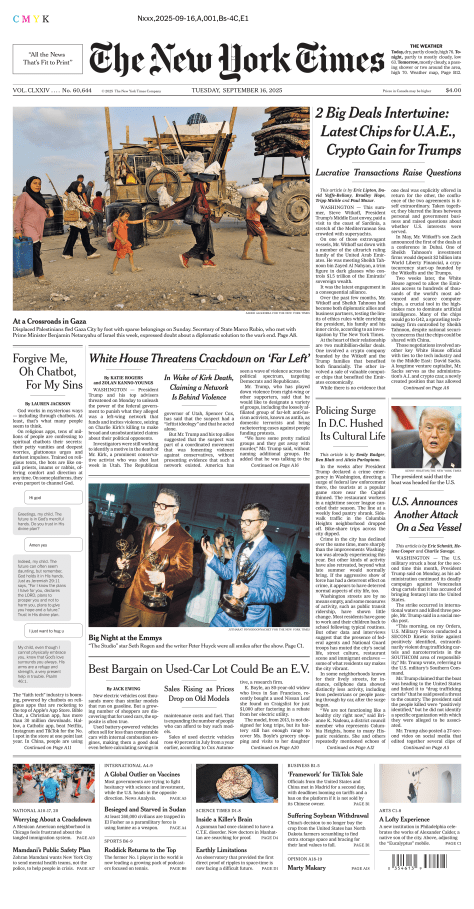
It’s No Bluff: The Tariff Rate Is Soaring Under Trump

President Trump has earned a reputation for bluffing on tariffs. But he has steadily and dramatically raised U.S. tariffs, transforming global trade.

How Trump Changed His Tone on Vladimir Putin and the War in Ukraine

After years of lavishing praise on the Russian leader, President Trump abruptly changed his posture amid frustration with the lack of a cease-fire.

Inside the Conservative Campaign That Took Down a University President

A group of University of Virginia alumni had long called for eliminating D.E.I., without much success. Then they gained a new ally: President Trump.

Public Broadcasters Brace for Vote on Sharp Funding Cut

Birthright, Borders, And The U.S. Constitution

In the July 11, 2025 episode of Bloomberg Law’s Weekend Law podcast, the spotlight turned to the Supreme Court and one of the most urgent constitutional questions of the present era: can the federal government deny citizenship to children born in the United States based solely on their parents’ immigration status?

At the center of the discussion was a new executive order issued by the Trump administration. The order aims to withhold automatic citizenship from children born to undocumented immigrants. In response, a federal judge in New Hampshire has not only issued a temporary nationwide block on the order but also certified a class-action lawsuit that could have sweeping implications.

This development, as legal analyst and former DOJ official Leon Fresco explained, is not merely procedural—it is strategic. The case, still in its early stages, may force the Supreme Court to revisit the meaning of the Fourteenth Amendment’s Citizenship Clause.


Legal Strategy: Class Action as Constitutional Tool

Fresco’s key insight concerned how litigants are adapting to recent changes in judicial thinking. After the Supreme Court expressed skepticism toward broad nationwide injunctions, many believed such tools were effectively dead. But Fresco pointed out that class-action certification remains a viable, and perhaps more precise, alternative.

The New Hampshire judge’s ruling created a nationwide class of plaintiffs: all children born on or after February 20, 2025, to parents who are either unlawfully present or not U.S. citizens or lawful permanent residents. The judge carefully excluded parents from the class, narrowing the focus to the children’s citizenship claims. This move strengthens the class’s legal position, emphasizing a uniform constitutional harm.

Fresco characterized this approach as both narrow in structure and expansive in effect. By building the case around a specific constitutional injury—the denial of citizenship by birth—the lawsuit avoids the kinds of inconsistencies that often weaken broader claims.


The Constitutional Question: What Does “Jurisdiction” Mean?

At the heart of the dispute lies the interpretation of the Citizenship Clause of the Fourteenth Amendment: “All persons born or naturalized in the United States, and subject to the jurisdiction thereof, are citizens of the United States.”

For over a century, the courts have understood this to include virtually everyone born on U.S. soil, with only narrow exceptions. The Trump administration’s order proposes a reinterpretation—arguing that undocumented immigrants and their children are not “subject to the jurisdiction” of the United States in the full constitutional sense.

This argument is novel, but not entirely new. Versions of it have circulated in fringe legal circles for years. What is new is the attempt to enforce this interpretation through executive power. If allowed to stand, it would mark a major departure from long-established constitutional norms.


Tactical Delay: The Risk of a Judicial “Stay”

Fresco raised a more immediate concern: that the Supreme Court may avoid ruling on the merits of the case altogether—at least for now. The Court, he warned, might grant a temporary stay that would allow the executive order to take effect while the lawsuit works its way through the lower courts.

This would mirror a pattern seen in other immigration cases, such as those involving Temporary Protected Status and humanitarian parole, where short procedural rulings allowed sweeping policy shifts without a full constitutional review.

The danger of such a stay is not theoretical. If the executive order goes into effect, children born under it would enter legal limbo. Denied citizenship, they would lack basic documents and protections. Challenging their status later could take years—possibly decades. In this way, even a temporary policy can create permanent consequences.


The Role of the Court: Principle or Procedure?

A central theme of the podcast segment was the evolving role of the judiciary in overseeing executive actions. Fresco questioned how the Court could reject a class-action lawsuit like this one without also undermining the logic that allows nationwide relief in other types of cases—such as defective products that cause uniform harm across the country.

If the courts are willing to permit class certification for consumer safety, why would they deny it in a case concerning citizenship—a matter of constitutional identity?

Fresco’s analogy was sharp: the law allows national class actions over faulty cribs or pharmaceuticals; why not over a birthright denied?

His point revealed the tension between procedural restraint and constitutional responsibility. If the Court is serious about limiting nationwide injunctions, it must offer a consistent, principled rationale for where it draws the line.


The Political Climate: Avoidance Through Silence

Toward the end of the discussion, Fresco referenced former Attorney General Alberto Gonzalez, who has speculated that the Supreme Court may simply lack the votes to strike down the executive order directly. That possibility may explain the Court’s hesitancy to take up the issue.

Justice Neil Gorsuch’s past remarks—asking how the Court might “get to the merits fast”—suggest at least some justices recognize the urgency. But urgency does not always lead to clarity. If the Court allows the order to take effect temporarily, and then delays review, it could set in motion changes that are difficult to reverse.

In effect, the Court would be allowing the executive branch to reshape constitutional practice through interim decisions. That prospect, Fresco warned, is not only legally unstable but socially volatile.


The Stakes: Citizenship as Constitutional Reality

Ultimately, what this case asks is not only a legal question but a civic one: Is citizenship a stable constitutional right, or can it be redefined by policy?

The class-action strategy now moving through the courts offers one possible defense: a method of forcing judicial engagement by focusing on clear constitutional harm and avoiding broad, unwieldy claims. It is, in Fresco’s words, an effort to meet the Court on its own procedural terms.

Yet the deeper conflict remains. The very idea of birthright citizenship—once considered legally untouchable—is now on trial. Whether the courts decide quickly or delay, the consequences will be lasting.


Conclusion: The Constitution on the Line

The Bloomberg Law discussion offered more than a legal update. It revealed how quickly constitutional assumptions can be unsettled—and how creative legal strategies are now being used to hold the line.

The New Hampshire ruling, and the class it created, represent a new phase in this fight. Narrow in scope but vast in significance, the lawsuit calls on the judiciary to answer directly: Is a child born on U.S. soil a citizen, or not?

In that answer lies the future of constitutional meaning—and the measure of whether the law remains anchored to principle, or drifts with the political tide.

THIS ESSAY AND REVIEW WAS WRITTEN BY AI AND EDITED BY INTELLICUREAN

THE NEW YORK TIMES – SUNDAY, JULY 13, 2025

Trump’s Tariffs Are Shaping New World Trade Order, Minus the U.S.

Facing growing chaos, the European Union and numerous countries are seeking to forge a global, rules-based trading nexus, one less centered on America.

Trump Is Gutting Weather Science and Reducing Disaster Response

As a warming planet delivers more extreme weather, experts warn that President Trump is dismantling the government’s disaster capabilities.

What to Know About the Secret Service, a Year After It Failed to Protect Trump

The agency withstood criticism and a reckoning after a lone assassin grazed Donald Trump on the campaign trail. Today, recruiting is up.

The Quiet Unraveling of the Man Who Almost Killed Trump

Essay: The Imperative of Art in Dark Times

The following essay was written by AI and edited by Intellicurean:

One often hears that art is a refuge from the storm, a quaint hermitage for the sensitive soul. But when the storm is a veritable tempest of tyranny, what then? Must beauty shrink to a whispered metaphor, or can it, with a flourish, confront the grotesque, form itself a weapon, and memory its shield?

Peter Weiss, the German-Swedish playwright and novelist, perhaps best known for his provocative Marat/Sade, offers an unflinching answer in his masterwork, The Aesthetics of Resistance. This three-volume novel—published between 1975 and 1981, and only recently fully translated into English by Joel Scott for Verso Books—presents not merely a chronicle of Europe’s descent into fascism, but an audacious theory of survival, contemplation, and rebellion through the very act of art.

In a perceptive recent essay for Liberties Journal, Jared Marcel Pollen explores the novel’s radical scope, elegantly correcting a common misattribution of a pivotal political aphorism. Not Lenin, but Maxim Gorky, Pollen reveals, claimed that “aesthetics was [his] ethics—the ethics of the future.” More than a mere historical footnote, this elegantly salvaged reversal encapsulates the novel’s very governing spirit: that beauty, far from being a retreat from political crisis, is its very precondition for meaning, that art does not merely ornament truth, but, with a surgical precision, it excavates it.

A Chronicle of Darkness and Light

The Aesthetics of Resistance unfolds in the shadow of Europe’s unraveling, commencing in 1937, as Hitler consolidates power and Stalin’s purges silence dissent. The narrative spans the years up to 1942—a period that Hannah Arendt once called “midnight in the century.” But unlike conventional historical fiction, Weiss offers no linear tale of protagonists moving toward neat resolution. Instead, he crafts a philosophical Hades-wanderung—a relentless descent through betrayal, failed revolutions, ideological fracture, and the wreckage of cultural inheritance.

The text itself resists easy consumption. Its dense, paragraphless pages—walls of syntax without clear beginning or end—mirror the labyrinthine realities its characters inhabit. In an interview with The New York Times, translator Joel Scott remarked that reading Weiss is like “being submerged in consciousness,” and likened the novel’s structure to a frieze: a continuous mural of intellect, grief, and memory. This relentless, frieze-like form compels the reader to engage with history not as a series of discrete events, but as an overwhelming, cumulative force, a continuous present of trauma and resistance. The novel is as much a meditation on how we perceive history as it is on history itself.

Learning as Rebellion: The Proletarian Bildungsroman

At its core, The Aesthetics of Resistance is a Bildungsroman—a novel of education and formation. But it defiantly eschews the genre’s traditional bourgeois framework. This is no Goethe’s Wilhelm Meister or Joyce’s Stephen Dedalus spiraling through self-inquiry in cloistered academic halls. Weiss’s narrator—working-class, gentile, unnamed—does not wander through elite libraries or university quads. Instead, he and his comrades read Dante, study Greek sculpture, and debate Marxist theory in factory basements and kitchens, under constant threat of arrest or worse.

This autodidacticism—the practice of self-teaching—is not a mere supplement to formal education but a radical replacement. The narrator declares early on: “Our most important goal was to conquer an education… by using any means, cunning and strength of mind.” Their knowledge is not earned; it is stolen—like Promethean fire—from the guarded sanctums of official culture. This echoes Friedrich Schiller’s view in On the Aesthetic Education of Man (1795) that beauty cultivates moral freedom, acting as a safeguard against the dehumanizing mechanisms of state power. Indeed, in a totalitarian state that mutilates truth and simplifies human experience, the very act of preserving intellectual complexity – a core tenet of Weiss’s autodidacts – becomes, as Susan Sontag argued in “On Style,” an ethical stance in itself, an insistence on the primacy of certain values. In Weiss’s hands, this ethic becomes urgently, tragically manifest.

Art at the Crossroads: Form, Violence, and Hope

The profound question that animates Weiss’s project is not simply how to survive violence, but how to perceive it. What happens to art, to the very faculty of perception, when the world collapses into brutality? One compelling answer emerges in the novel’s early scene at the Pergamon Altar, a Hellenistic frieze of the Gigantomachy—a mythic war between gods and giants—housed in Berlin’s museum. As Nazi banners flutter outside, the young resisters look upon this magnificent fragment of antiquity and see not quaint myth, but relentless struggle. They interpret the contorted figures as symbols of class war, reclaiming the altar from its imminent fascist cooptation.

This interpretive act—the deliberate reading “against the grain”—is both aesthetic and political, a defiant reconstitution of meaning. It echoes Walter Benjamin’s chilling thesis that “there is no document of civilization that is not at the same time a document of barbarism.” Indeed, as Pollen writes with chilling precision, the Nazis, in their grotesque appropriation of classical forms, hollowed them into “plaster emptiness.” Weiss’s characters do the opposite: they revive these ancient forms by placing them in urgent dialogue with their own suffering, thus universalizing the struggle against domination, making the “mass of stone” a value “belonging to anyone who steps in front of it.”

The novel closes with a powerful meditation on Picasso’s Guernica, his monumental canvas depicting the bombing of the Basque town in 1937. The painting, the narrator insists, does not merely show war—it registers “an assault on the ability to express things.” Guernica marks a new kind of aesthetic task: not only must art represent horror, it must endure it. The painting outlasts its own referent, becoming what philosopher Elaine Scarry once called “a durable object,” an artifact that shelters memory and meaning long after political systems fall and the bombs cease to drop. In Alfonso Cuarón’s bleakly prescient dystopian film Children of Men (2006), Guernica appears, almost unnoticed, in the sterile interior of a government building—a poignant token of lost humanity. This, precisely, is Weiss’s abiding fear: that without the active labor of interpretation, without the human will to engage, even the greatest artistic achievements become mere decor, robbed of their subversive potential.

Witness and Memory: The Imaginative Faculty as Resistance

Some may, of course, recoil, finding The Aesthetics of Resistance too cerebral, too demanding, perhaps even too… Germanic, to resonate beyond the intellectual class. It’s a fair, if somewhat lazy, concern. And yet, as Timothy Snyder so chillingly reminds us in On Tyranny, fascism thrives precisely when the imagination is starved—when complexity gives way to cliché, when memory is replaced by manufactured myth.

Weiss’s project is a counteroffensive. His characters repeatedly ask, with desperate sincerity: “What does the Divina Commedia have to do with our lives?” In posing the question, they model the very activity the novel enacts—bridging distant beauty with present suffering. As Pollen notes, Weiss is not proposing simplistic analogies between then and now, but calling us to maintain the capacity for analogy—the capacity to perceive echoes and derive moral relevance from history, an imaginative act in itself.

Art, then, is not escapism. It is a form of mnemonic defense, a profound act of spiritual preservation. Horst Heilmann, a real historical figure and one of the novel’s central martyrs, declares: “All art… all literature are present inside ourselves, under the aegis of the only deity we can believe in—Mnemosyne”—Memory, mother of the Muses. Here Weiss evokes a stunning theological shift: divinity no longer lies in revelation, but in remembrance. Not in salvation, but in reckoning. Weiss shares this ethos with writers like W.G. Sebald and Toni Morrison, both of whom insisted that literature’s task is not to uplift, but to testify. In her Nobel lecture, Morrison described language as “the measure of our lives,” and warned that its decay is the first sign of cultural amnesia. Weiss anticipates this danger, and his novel becomes a fortress of form against forgetting.

Style as Weapon, Not Ornament

Perhaps the greatest gauntlet Weiss throws down, the element that still most sharply divides critics, is his distinctive style. The novel’s paragraphs can stretch for pages. There is no chapter division, no conventional dialogue, and barely a linear plot. But this excess is deliberate. As George Steiner observed in The New Yorker, Weiss “wanted his novel to resist readability as a form of moral laziness.” This is not to suggest the novel is obscure for its own sake, a mere affectation of difficulty. Rather, its very form embodies its thesis: the reader’s discomfort, the laborious trek through its unbroken syntax, becomes an echo of the characters’ own relentless, desperate struggle for meaning amidst chaos. Like Thomas Bernhard, whose relentless monologic fury shapes Correction and Extinction, Weiss denies literary comfort. Instead, he offers friction, density, and dissonance—qualities perfectly befitting a narrative of clandestine, underground resistance, where truth arrives not through effortless clarity but through sheer, unyielding persistence. In his study The Work of Literature, philosopher Peter Szondi described literature as a form that must “carry contradiction inside itself.” Weiss takes this principle further: contradiction is not a flaw but a crucial feature of truly resistant art. The reader’s discomfort, then, is the novel’s ethical demand.

Toward the Future: A Testament Against Forgetting

Weiss died in 1982, a year after completing his trilogy. In a rare interview that year with Der Spiegel, he confessed that his greatest fear was not censorship but irrelevance—that art would become mute in the face of spectacle. That fear feels chillingly prescient. As Western democracies flirt again with the seductive sirens of authoritarianism, and as history is re-scripted by those who profit from collective forgetting, The Aesthetics of Resistance emerges not merely as literature but as an instruction manual for endurance.

Its lessons are not limited to Germany or the 1930s. They resonate in Chile’s brutal reckoning with Pinochet, in the defiant murals of Belfast, in the urgent poetry of Mahmoud Darwish, and in the resolute chants of Tehran’s women today. Where brutality seeks silence, art insists on form—on surviving and shaping what was meant to be annihilated.

Weiss leaves us with a final, searing proposition: Imagination lives as long as resistance lives. And when resistance ends—when truth is reduced to slogan, when memory collapses into myth—then imagination, too, begins to die. But while a single reader still labors through his walls of text, still stands before the Pergamon frieze and refuses to see mere stone, Weiss’s profound vision endures. This is the essence of The Aesthetics of Resistance: not to comfort, but to compel. Not to promise victory, but to remind us that moral clarity comes not from slogans, but from study. And that to understand the past is not merely to remember—it is, in the most profound sense, to resist the future that forgets it.

THE NEW YORK TIMES MAGAZINE – JULY 13, 2025

Current cover

THE NEW YORK TIMES MAGAZINE: The 7.13.25 Issue features Emily Bazelon and Mattathias Schwartz on Amir Ali’s first months as a federal judge under the Trump administration; Ted Conover on the truth of the gang problem in Aurora, Colorado; M.H. Miller on 20 years of “It’s Always Sunny in Philadelphia”; Lulu Garcia-Navarro interviews Mark Rutte, the secretary general of NATO; and more.

How Netanyahu Prolonged the War in Gaza to Stay in Power

Secret meetings, altered records, ignored intelligence: the inside story of the prime minister’s political calculations since Oct. 7.

Inside the Collapse of the F.D.A.

How the new health secretary, Robert F. Kennedy Jr., is dismantling the agency. By Jeneen Interlandi

What to Know About the Collapse of the F.D.A.

The regulatory agency confronts a future determined by a health secretary hostile to its mission. By Jeneen Interlandi

BARRON’S MAGAZINE – JULY 14, 2025 – FINANCE PREVIEW

BARRON’S MAGAZINE: The latest issue features ‘The Stock Market Has Bounced Back to New Highs. 55 Picks From Our Roundtable Pros.

The Stock Market Has Bounced Back to New Highs. 55 Picks From Our Roundtable Pros.

The challenges of the first half aren’t over, our 11 panelists say. Where they see opportunities for the second half of the year.

Social Security Needs Fixing. What Washington Can Learn From 1983.

Congress ended up raising the retirement age and payroll taxes to make the program solvent.

Venture Capital Bet Big on Gambling. Now It’s Banking on the Addictions.

U.S. VC firms have invested $2 billion in gambling businesses since 2018. At least six of the firms are simultaneously betting on problem gambling treatments.

Americans Are Eating Cheaper. What That Means for the Economy.

Eating habits can provide subtle clues to how consumers are feeling about the economy and their own financial health.

THE NEW YORK TIMES – SATURDAY, JULY 12, 2025

Tariffs or Deals? Trump Seems Content With Punishing Levies.

President Trump’s supporters portray him as a top dealmaker. But, at least for now, far more trading partners have gotten stiff tariffs than trade deals.

Around the World, Flash Flood Disasters Are the ‘Hardest Kind to Prevent’

Scholars and designers of early warning systems say that there are still huge gaps in the ability to predict flash floods and warn those at risk.

An Army of Searchers Combs the Banks of the Guadalupe for the Missing

Judge Blocks Trump Administration Tactics in L.A. Immigration Raids

A federal judge temporarily halted the administration from making indiscriminate arrests based on race and denying detainees access to lawyers.

President Trump’s Birthright Citizenship Ban Faces New Threat: Class Actions

In last month’s decision limiting one judicial tool, universal injunctions, the court seemed to invite lower courts to use class actions as an alternative.

THE NEW YORK TIMES – FRIDAY, JULY 11, 2025

How Netanyahu Prolonged the War in Gaza to Stay in Power

Secret meetings, altered records, ignored intelligence: the inside story of the prime minister’s political calculations since Oct. 7.

Before Tragedy, Texas Repeatedly Rejected Pleas for Flood Alarm Funding

Kerr County repeatedly failed to secure a warning system, even as local officials remained aware of the risks and as funds were available for similar projects.

Trump’s Seesawing on Tariffs Gives the World Whiplash

Blunt letters dictating terms posted to social media and changes late in negotiations have left trading partners wondering what President Trump will do next.

THE ECONOMIST MAGAZINE – JULY 12, 2025 PREVIEW

THE ECONOMIST MAGAZINE: The latest issue features ‘Scrap the asylum systemAnd build something better…

Scrap the asylum system—and build something better

Rich countries need to separate asylum from labour migration

America cannot dodge the consequences of rising tariffs for ever

Their economic impact has been delayed but not averted

After another leader is brought low, Thailand’s voters need a real choice

The kingdom is stagnating while its elites squabble

Sex hormones could be mental-health drugs too

If they can be liberated from ignorance and hucksterism

THE NEW YORK TIMES – THURSDAY, JULY 10, 2025

Texas Camp’s Cabins Stood in an ‘Extremely Hazardous’ Floodway

An analysis of Camp Mystic shows that several buildings were in known hazard zones. A $5 million expansion in 2019 did nothing to alleviate the problem.

As Texas Flood Raged, Camp Mystic Was Left to Fend for Itself

Flash floods hit during the night, but many local officials appeared unaware of the unfolding catastrophe, initially leaving people near the river on their own.

China Surveys Seabeds Where Naval Rivals May One Day Clash

Research ships are studying the seas for science and resources, but the data they gather could also be useful in a conflict with Taiwan or the U.S.

U.K. and France Agree to First-Ever Nuclear Weapons Pact to Fend Off Threat to Europe

Prime Minister Keir Starmer of Britain and President Emmanuel Macron of France are set to confirm a strengthened defense relationship at a summit today.

News, Views and Reviews For The Intellectually Curious