THE ECONOMIST MAGAZINE – SEPTEMBER 13, 2025 PREVIEW

THE ECONOMIST MAGAZINE: The latest issue featuresThe $3trn bet on AI‘…

What if the $3trn AI investment boom goes wrong?

Even if the technology achieves its potential, plenty of people will lose their shirts

Don’t panic about the global fertility crash

A world with fewer people would not be all bad

Israel’s Qatarstrophic error 

Its extra-territorial campaign against terrorists has to have limits

The Kremlin’s plot to kill NATO’s credibility

The alliance needs an emphatic response to Russian air incursions

Nitazenes: another failure of drug prohibition

As countries crack down on fentanyl, a new synthetic opioid takes off

Literary Arts Preview: n+1 Magazine – Fall 2025

n+1 Magazine: The latest issue features ‘Force Majeure’ – New AI & I literature. Relate, revolt! Does Trump hate art? Idiocracy now. The new faces of ICE. Fiction by Elizabeth Schambelan.

Large Language Muddle

The AI upheaval is unique in its ability to metabolize any number of dread-inducing transformations. The university is becoming more corporate, more politically oppressive, and all but hostile to the humanities? Yes — and every student gets their own personal chatbot. The second coming of the Trump Administration has exposed the civic sclerosis of the US body politic? Time to turn the Social Security Administration over to Grok. Climate apocalypse now feels less like a distant terror than a fact of life? In five years, more than a fifth of global energy demand will come from data centers alone.

Two Days Talking to People Looking for Jobs at ICE

Naturally there were lots of law enforcement types hanging around the convention — men with military fades, moisture-wicking shirts, and tattoos of the Bible and the Constitution and eagles and flags distended across their arms. But there were also a handful of women ICE applicants and a lot of men of color. The deportation officer applicant pool was, I felt, shockingly diverse — one might say it looked like America. The whole place looked and felt like America.

Stupidology

The challenge posed by this political crisis is how to take the stupidity seriously without reducing it to a wholly mental or psychiatric, let alone genetic, phenomenon. Stupidity can be understood as a problem of social systems rather than individuals, as André Spicer and Mats Alvesson explore in their book The Stupidity Paradox. Stupidity, they write, can become “functional,” a feature of how organizations operate on a daily basis, obstructing ideas and intelligence despite the palpable negative consequences. Yet it’s hard to identify anything functional about Trumpian stupidity, which is less a form of organizational inertia or disarray than a slash-and-burn assault on the very things — universities, public health, market data — that help make the world intelligible.

THE GUARDIAN WEEKLY – SEPTEMBER 12, 2025 PREVIEW

THE GUARDIAN WEEKLY: The latest issue features ‘The Axis of Upheaval…and what it means for the West’

Xi Jinping had been waiting for the right moment to serve notice of China’s growing might and influence to the rest of the world, and the 80th anniversary of the end of the second world war provided the Mao-suited Chinese leader with the perfect opportunity.

Last week’s bombastic (or should that be bomb-tastic?) military parade in Beijing – in the presence of Vladimir Putin, Kim Jong-un and a host of other global strongmen – was intended as a show of force and stability to contrast sharply with the chaotic unpredictability of Donald Trump’s America. And, as the leaders of the world’s most notorious pariah states bear-hugged and strolled around Tiananmen Square like the cast of Reservoir Dogs, the optics did not disappoint.

But behind the scenes, how robust actually is the so-called “axis of upheaval”? As our big story this week explores, the illiberal alliance is riven by internal fractures and mistrust between China, Russia and North Korea that date back many years and cannot be discarded as quickly as Xi, or anyone else, might like.

Spotlight | France’s latest political crisis
The fall this week of prime minister François Bayrou exposed a political malaise that is likely to sour French politics well beyond the 2027 presidential election, reports Paris correspondent Angelique Chrisafis

Interview | Leonard Barden, chairman of the chess board
From honing his game in air raid shelters during the second world war to beating grand masters, our record-breaking chess columnist has lived an extraordinary life. Now aged 96, he chats to our chief sports reporter Sean Ingle

Feature | Syria’s cycle of sectarian violence
Over a few brutal days in March, as sectarian violence and revenge killings tore through parts of the country, two friends from different communities tried to find a way to survive. By Ghaith Abdul-Ahad

Opinion | Angela Rayner’s exit is a bombshell for Keir Starmer
The UK deputy prime minister’s fall will exacerbate all the doubts about the PM himself and his ability to keep Labour in power, writes Jonathan Freedland

Culture | Spinal Tap turn it up to 11, one last time
More than 40 years since the film This Is Spinal Tap was mistaken for a comedy, its hard-rocking subjects are back for a legally obligated final gig. Our writer Michael Hann smells the glove

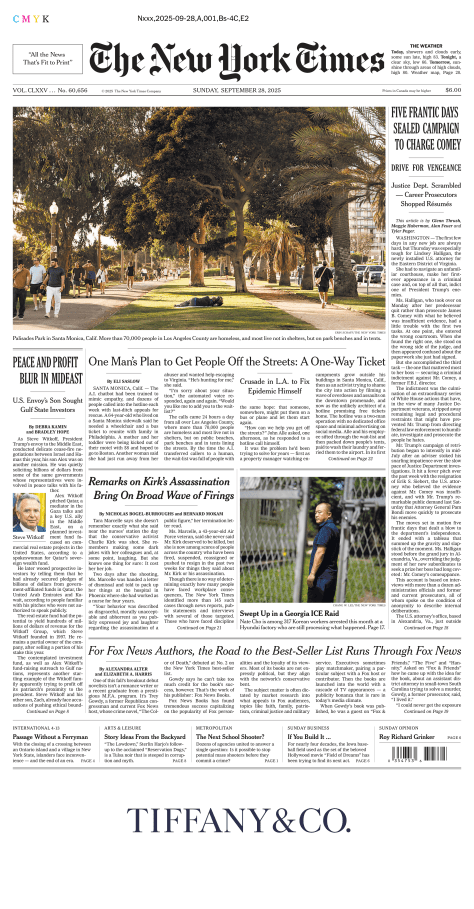
THE WASHINGTON POST – THURSDAY, SEPT. 11, 2025

Trump ally Charlie Kirk gunned down in brazen act of public violence

Utah Gov. Spencer Cox condemned the “assassination” of the prominent right-wing influencer, which took place at a college event.

Charlie Kirk shot dead at Utah campus

Russian drones sent into Poland are downed

Turning Point’s founder quickly became a force in GOP politics

Harris says deference to Bidens was ‘recklessness’

Escalating Israeli attacks force impossible choice

NASA rover discovers the ‘clearest sign’ of life on Mars

THE SOLIPSIST’S CATHEDRAL

.An imagined evening in Ipswich, 2008, with John Updike making the case for narcissism as literature.

By Michael Cummins, Editor, September 10, 2025

John Updike spent much of his time writing in the large front living room of the Polly Dole House in Ipswich, Massachusetts—a space that was both his creative sanctuary and a kind of literary crucible. The room itself seemed to vibrate with centuries: wide board floors that sighed in winter, a walk-in fireplace that could, as he liked to say, “singe your eyebrows” when ablaze, a low ceiling where a massive summer beam was suspended precariously by a cable to the roof’s peak. He often joked that if the cable snapped, the whole house might collapse. The furniture never stayed in one arrangement for long; he shuffled chairs and tables as though composition itself demanded fresh angles. “It’s a room you sail through,” he told visitors, a kind of ship’s hold for sentences, always in motion.

On this February afternoon in 2008, the fireplace glowed fiercely, Ipswich’s snow-blanketed silence pressing against the small windows. The marshes beyond were skeletal in winter, the grasses brittle, the sky a pewter dome. Even indoors, the air smelled faintly of brine and woodsmoke. Mary’s paintings hung steady on the walls—domestic scenes, bowls of pears, flowers rendered in clean strokes. They steadied him, he admitted, when his own sentences threatened to shimmer into extravagance. The paintings were ballast, reminders that a bowl of fruit could be only a bowl of fruit, and not always a metaphor for decline.

Updike, in a cashmere sweater, looked less like a titan of American letters than a man who had grown into the furniture. His voice was soft but exact, capable of sudden gleam. He was speaking not to posterity but to a young writer, no older than thirty, who had come with notebook in hand. The visitor was polite but firm, his questions sharpened by a generational impatience: he was both disciple and prosecutor, carrying into this room the skepticism of a literary culture that was leaving Updike behind.


“Mr. Updike,” the young man began, eyes lowered to his notes, “a professor of mine once called you the poet of the ‘suburban libido.’ And even more damningly, he quoted David Foster Wallace, who said you were ‘just a penis with a thesaurus.’ How do you answer that kind of criticism?”

Updike adjusted his glasses with slow precision, a faint smile at the corners of his mouth. “Ah yes, Wallace. God rest him, poor brilliant boy. He wrote as if to kill me, but perhaps what unsettled him was the recognition of kinship. For was not his labyrinth of footnotes also a cathedral of solipsism, though built in a more postmodern stone? I don’t begrudge him the attack. Every generation must rebel against its fathers, even literary ones. Wallace was one of those who never forgave the father for having had a life.”

He chuckled, and the chuckle had an edge. “And as for the ‘penis with a thesaurus’ line—well, if that’s true, at least I found good words for it. Not every organ of man is so lucky.” He let the humor hang before turning serious again. “My work has been called autobiographical, as if that were an insult. But every writer is, in the end, a witness to what he sees. The only crime is to look away.”


The young writer shifted in his chair. “But you’ve also been accused of writing the same man over and over. Rabbit, Piet, Ben Turnbull—they all circle the same hungers.”

Updike gestured toward a small stack of his novels on the table beside him, spines softened with use. “Yes, yes. I’ve been accused of that, and not unfairly. He of the suburban libido, the theological itch, the aesthetic eye. You’re wondering whether narcissism can still find shelter in fiction. I tell you: I never claimed universality. I claimed precision. Fiction is the attempt to make the soul’s contours legible. And the contour nearest to hand was my own. To mine the self is narcissism, yes. But it is also fidelity to the only instrument one can play without faking.”

The visitor leaned forward, eyes bright. “In Rabbit, Run, you wrote: ‘Boys in gymnasiums, men in locker rooms, old men in parks. Rabbit Angstrom is a kind of phantom of all of them, a ghostly echo of their longings.’ Was Rabbit always meant to be more than one man?”

“Exactly,” Updike said, his voice suddenly taut with conviction. “He wasn’t just a man from Mount Judge; he was a vessel for the anomie I saw bubbling in the suburbs. That’s the paradox—solipsism that attempts transcendence. Rabbit’s clumsy pursuit of happiness was, in its way, the national malaise. I didn’t create him so much as observe him, as a naturalist might a specimen. He was an American species.”


The young writer pressed harder. “And in Couples? Piet reflects on his affairs, thinking, ‘Adultery is an ancient, honored pursuit, as fundamental as warfare or the hunt.’ Were you romanticizing it?”

Updike let out a dry laugh. “Romanticizing? No. I was granting it weight. We had spent decades treating infidelity as either sordid soap opera or moral lapse. I wanted to give it the dignity of an old ceremony. Piet’s line—that adultery is as fundamental as war or hunting—is his own self-justification. That’s male narcissism in action: the need to inflate even your sins into something epic. I wasn’t celebrating it; I was documenting the architecture of justification. The lies men tell themselves, dressed in grandeur. The suburban bedroom as battlefield, the marital quarrel as Iliad.”


The fire hissed, logs collapsing into red embers.

“And A&P?” the young man asked. “Critics call it the textbook example of the male gaze. Sammy sees only bodies. At the end he says, ‘I felt my stomach kind of fall as I felt how hard the world was going to be to me hereafter.’ What was he losing?”

“Ah, A&P,” Updike said, shaking his head with something between affection and resignation. “Yes, it distills the gaze perfectly. Sammy was a boy, and I wrote him as a boy. He saw legs and straps and hips, nothing else. That final line—that wasn’t about the girls at all. It was about him. He realized, dimly, that life was going to be hard, that gestures of rebellion change nothing. He quit not for them but for himself. A gesture of self-absorption, yes. But also the moment he glimpsed adulthood’s hardness. Not a moral tale, but a truthful one. Literature traffics in embarrassment. Embarrassment is where truth lives.”

The young writer nodded, but his expression sharpened. “So were you complicit in patriarchy, or were you diagnosing it?”

Updike gazed into the fire, flames mirrored in his glasses. “The America of my prime was a patriarchal house. Men’s appetites were its furniture. Women became catalysts, erotic stimuli, rather than agents. Feminist critics are right to point out the lack of female interiority in much of my work. Was I complicit or diagnostic? The question dogs me. If I made male blindness beautiful in prose, did I dignify it? I hoped the irony would be visible, that readers would cringe as much as they thrilled. But subtlety is a gamble. One generation’s irony becomes the next’s sin.”


“And in The Witches of Eastwick?” the young man asked. “You gave women power. Jane, Sukie, Alexandra. One of them thinks, ‘I can turn a man to a pig with a flick of my wrist.’ Was that your reply to the critics?”

“Perhaps, in part,” Updike conceded. “I was tired of being seen only as the chronicler of male discontent. I wanted to enter another consciousness, a sororal one. The witches were my attempt to grant women the agency I had given men. That line—turning a man to a pig—was their fantasy of revenge, but also of freedom. It was wild, wicked, legitimate. I wanted to honor that. Did I succeed? Perhaps incompletely. But it was an effort. And Harold Bloom told me he liked it only because it was the only one of mine he had read. That was Bloom for you—compliment and insult in a single breath.”


The young writer flipped pages, relentless. “In Rabbit Redux, when Rabbit watches the moon landing, you wrote: ‘The light of the television seemed more real than the light in his own room.’ What did you mean?”

“That was the paradox of American life,” Updike said. “We watched men walk on the moon, a triumph of ingenuity, and yet our own lives—our marriages, our bodies—felt less real. The glow of the television outshone the lamp beside us. Rabbit felt that dislocation acutely. The moon landing should have enlarged him, but it diminished him. We were ghosts in our own homes, realities filtered through a glowing screen. I wanted to capture that precise sense of disembodied awe. And does it not feel familiar now, in your age of laptops and phones? Screens more vivid than windows?”


The young writer hesitated, then asked softly, “Why always the self? In Self-Consciousness you wrote about your stutter, your psoriasis. You said, ‘A writer is someone who has to write, to live inside a world he has to make.’ Is that why you always circled back to yourself?”

Updike’s face softened. “Yes. For me it wasn’t choice, it was compulsion. My stammer, my psoriasis—they were my apprenticeship. The small shames became my lens. I wrote, ‘A writer is someone who has to write, to live inside a world he has to make.’ My world was the one I inhabited—my own skin, my anxieties. You cannot separate the eye from what it sees. My narcissism, if you call it that, was the attempt to see as clearly as I could with the only two eyes I had. I often said writing was how I made a living that did not inflict pain on others. Perhaps it inflicted too much on myself.”


The fire had dwindled to coals, the room dusky in the winter twilight. Outside, the Ipswich marshes were turning violet under snow. The house groaned as the wind pressed against its beams.

The young writer posed one last question. “And at the end of Rabbit at Rest, you describe him as ‘a man who has lost his way, and his words, and his breath.’ Was that your fear? Of obsolescence?”

“Of course,” Updike replied softly. “Rabbit’s death was my rehearsal. The loss of words, of breath—that was my dread. His end was my imagined end. Yes, narcissism complete: my life, my anxieties, poured into him. But I hoped it was also communal—a glimpse of what it feels like to burn down to an ember. That’s what a writer does. We try to make monuments of our sputtering light.”


It was 2008, and the literary world outside this Puritan house was changing fast. Wallace would not live out the year. Autofiction was rising, bare prose shorn of ornament, the self on display without metaphor. Younger readers wanted irony stripped to confession. Updike sensed the shift, the way a man senses the ground softening beneath his shoes. His sentences, once radiant as stained glass, now looked to some like ornate furniture in an age of collapsible chairs. He knew it, and yet here he sat, defending not the verdict of critics but the practice of witness itself.

The house creaked again, the fragile beam above holding. Updike turned his gaze toward the window, where dusk had pressed its purple weight against the marsh. His voice was almost a whisper now.

“Call it narcissism if you must. I call it witness. A man at his window in a Puritan house, describing, as honestly and as beautifully as he could, what it felt like to be alive—before the beam gave way, before time snuffed the flame.”

THIS ESSAY WAS WRITTEN AND EDITED UTILIZING AI

THE NEW YORK TIMES – WEDNESDAY, SEPT. 10, 2025

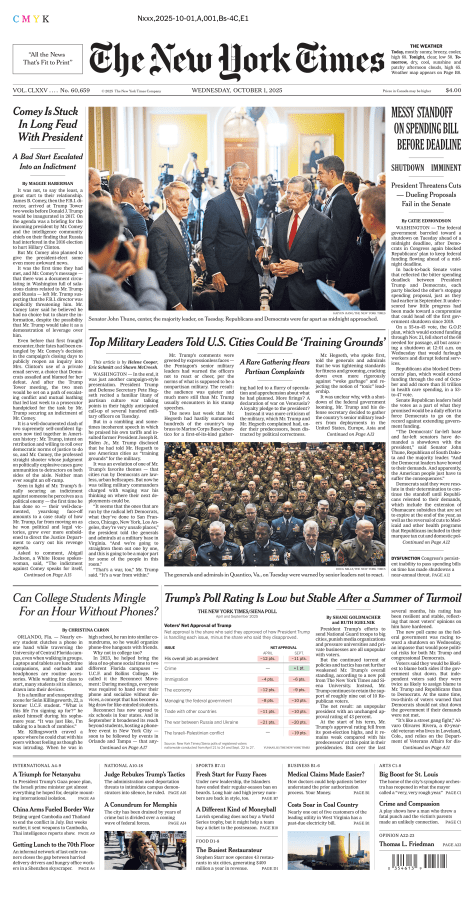
NATO Says It Scrambled Fighter Jets to Shoot Down Russian Drones Over Poland

The incursion marked the first time that NATO fighters engaged enemy targets in their own airspace. Poland’s leader called it “a large-scale provocation.”

Putin’s Message to Ukraine, Europe and Trump: I Won’t Back Down

With escalating airstrikes, the Russian leader appears determined to demonstrate that he will dictate the terms for any end to the war.

Vaccines and C.D.C. Chaos Expose Tensions Between Trump and Kennedy

While there is no evidence of a break between them, Health Secretary Robert F. Kennedy Jr. has caused consternation among President Trump and some aides.

Trump Moves to Restrict Drug Advertising on Television

The administration is proposing a return to a 1990s-era policy that kept most drug ads off TV. That could dent the revenues of drugmakers and major networks.

Trump Warns of Doom if Tariffs Are Ruled Illegal. Others See a Tax Cut.

The costs of President Trump’s tariffs have bitten into the earnings of many American companies the same way a corporate tax increase would, analysts say.

WHERE DUENDE WAITED

Federico García Lorca’s final hours, and the dark spirit of art that outlived him.

By Michael Cummins, Editor, September 8, 2025

“Only mystery allows us to live, only mystery.” — Federico García Lorca

Federico García Lorca, Spain’s great modern poet and dramatist, was arrested in Granada in August 1936 at the outbreak of the Spanish Civil War. A socialist sympathizer, openly gay in a society that demanded silence, he was executed by Nationalist forces near an olive grove outside the city—his body never found. To understand Lorca is to understand what he called duende: not muse or angel, but a dark, earthly spirit that seizes the artist at the edge of death and mystery, when art becomes raw, dangerous, unforgettable.

The cell in Granada was not empty. It was a proscenium—the frame of a stage that turns life into theater. The air itself was thick and swollen with a silence that was not absence but anticipation. In the chipped lime walls, in the mildew blooming in the corners where time seemed to pool, in the echo of a solitary water drop like a metronome, the playwright found his final set. He did not need the music present to hear it. He felt the remembered rhythms in the marrow of his bones: the percussive strike of a dancer’s heel, the guttural, torn-throat cry of a cantaor, the sharp clap of hands echoing from a hidden courtyard. He knew the rule—had proclaimed it in lecture halls, in smoky Madrid taverns, in the sun-drenched cafés where poets leaned on one another for breath: All that has dark sounds has duende. Now the words returned to him, not as theory to be taught but as a presence to be felt.

The cell was narrow, barely enough space for a man and the shadow that kept him company. He reached out and touched the flaking wall, the rough texture a perfect metaphor for the crumbling theater of his life. The walls almost breathed, inhaling when he leaned close, exhaling when he sat back, as though the cell rehearsed with him. He was a man poised between two worlds: the mortal body soon to be silenced, and the immortal voice that was already a part of the wind and the soil. He understood now that this was not confinement but staging. The audience—whether olive trees or posterity—was already waiting for the curtain to rise.

The shadow in the corner smiled. It was not a muse, not an angel. It was duende itself. A force that does not inspire but wounds, does not console but insists, demanding that art be fought for, clawed from the raw earth of the soul. It watched as he gathered scraps of memory into a kind of play, half-dreamed, never to be written. In the stillness, Lorca whispered, as if rehearsing the last line of a lost production: Only mystery allows us to live, only mystery. The phrase circled back to him like a prayer, or perhaps the faint echo of a stage line that had followed him across continents, from Spain’s ritualized sorrow to the improvised grief of another land.

He had tried to explain it once, in Buenos Aires, in Havana, in Montevideo. What duende really was. “Duende is a power, not a work. It is a struggle, not a thought.” He had argued that it was never a technique or a style, but a possession. It was the tremor in the throat of a flamenco singer when she reached the note that cracked her open, the wild, dangerous moment when art ceased to be polished performance and became raw survival. Irrational, earthy, diabolical, always shadowed by death—it rose from the soles of the feet, climbed through the body, and exploded in the voice. The muse inspired from above, the angel gifted charm and virtuosity, but duende had to be fought for. A hand-to-hand combat with the soul. Now, in this barren cell, the words returned to him not as an intellectual theory but as a living, breathing force. He was in hand-to-hand combat with the soul. The duende in the corner was no metaphor. It was his final companion.

Time folds in the cell, as if memory is the only escape left. The silence of the Granada night pulls him back to another kind of silence—and another kind of sound—he found in New York, 1929. He had arrived in the city of concrete canyons and jagged light, a city that felt at first like a wound, a place of “terrible cold and terrible wind.” The markets had collapsed like a poorly built stage set, but Harlem at night was ablaze with a furious, desperate life. He wandered the streets, a poet from a land of ritualized sorrow, and found a different kind of ritual here: grief made elastic, joy smuggled through rhythm.

One evening, a voice pulled him like a magnet toward a storefront church. The preacher’s voice rose in a swell, a rhythm of fire and brimstone, met by the congregation’s shouted hallelujahs. Then, a woman began to sing. Her voice was not pretty, not polished. It cracked once, twice, a sound like a stone breaking. In that imperfection, Lorca felt the earth tremble. The sound was not a gift from on high; it was a demand from below, a note that clawed at the heavens, insisting they open. He felt the same shivering, guttural ache he had once felt listening to a gypsy’s wail at dawn in Andalucía. This, he thought, leaning against a wall, was duende crossing the ocean.

Later that night, he passed a saxophonist playing alone on a corner, the music a long, moaning complaint that wove with the smoke of tenements. Lorca scribbled a line into his notebook: I want to cry because I feel like crying. The phrase embarrassed him with its simplicity, with its nakedness, but it was truer than any poetic ornament could ever be. Harlem, with its wild music and its raw grief, taught him about improvisation. Spain’s sorrow was bound in liturgy and ancient forms; Harlem’s was alive, unpredictable, a wound stitched nightly with melody and torn open again at dawn. It was a new kind of drama, a new kind of suffering that he had to absorb. Poet in New York took shape in those nights of insomnia and astonishment, a book that would not be published in his lifetime but burned with its own strange fire. He had told himself, listening to a trumpet moan across Lenox Avenue, that “at the heart of all great art is an essential melancholy.”

Duende had followed him there, too, though he did not at first recognize it. A figure leaning against a lamppost, perhaps, whispering that these poems were not meant for applause but survival. And survival, it murmured, was never enough.

From Harlem, his mind leaps to the Mediterranean light of Cadaqués, to Dalí’s studio filled with the terrible precision of his art. He remembered the crisp light, the angular elegance of the artist himself, who gleamed like a blade. Dalí’s hand, so sharp and deliberate, moved across the canvas, his charcoal hissing. Lorca had seen in him a mirror, but it was a mirror that refused to reflect. Instead of recognition, there was distortion. Instead of tenderness, distance.

He remembered once watching Dalí sketch, the artist’s hand moving with an almost cruel certainty. Lorca, half-dizzy with longing, finally asked, “Do you ever paint what you feel?” Dalí looked up, eyes glinting. “Only what I fear.” He paused, as if tasting the line, before dismissing it with a laugh. But Lorca carried that sentence like a wound. It was the difference between them, the chasm he could never cross. He, Lorca, had to feel to create. Dalí chose to dissect and control his fear.

Their friendship, he now saw, had been a battleground where desire was both confessed and rejected, a drama of longing and withdrawal. To burn with desire and keep quiet about it is the greatest punishment we can bring on ourselves, he had written, but it was a punishment he had lived, a quiet, internal conflagration.

Then Emilio, the sculptor, the lover whose beauty was marble, luminous and cold. To touch him was to risk crumbling stone. Lorca’s letters to him bled with a longing that was never fully reciprocated, with the ache of a love half-returned, half-refused. He was punished not by silence, but by partial answers, by gestures that offered just enough to ignite hope and never enough to satisfy. He remembered a night when Emilio’s hand brushed his, only to withdraw instantly, as if scorched. The air between them thickened with what was almost said. Later, alone in his room, Lorca drafted a letter he never sent—an avalanche of confession, a plea for clarity. He tore it to pieces, watching the fragments scatter across the floor like plaster dust. “To love him was to sculpt fog—each gesture vanished before it could be held.”

Love became theater, a rehearsal without a performance, devotion staged in fragments. And duende was there, always there, murmuring that every passion carries its own death inside it.

The walls of the cell flicker again, and the shadow steps closer. Lorca begins to imagine the final drama of his life. Characters take their places in silence: Dalí as Narcissus, intoxicated by his own reflection; Emilio as the Fallen Angel, beautiful in defeat; Lorca himself as the Poet-Matador, blade in hand but chest exposed. Around them swirl fragments of unfinished plays, echoes of YermaBlood WeddingThe House of Bernarda Alba. The voices rise, then fall, like actors waiting for direction that never comes. He knows this drama will remain unwritten, but perhaps that is the point: duende does not need completion. It thrives in fracture.

“I know there is no straight road in this world. Only a giant labyrinth of intersecting crossroads.” He had once offered that to an audience as an explanation; now he feels the truth of it in his own marrow. The crossroads are here, tonight, in this cell, in the decision already made by men outside. There is no straight road to morning. Only labyrinth. And yet he feels no panic. As I have not worried to be born, I do not worry to die. The words come to him unbidden, an old confession that now reads like prophecy. His body will fall, yes, but his voice—he believes—will not. He has already lost himself enough times to know the pattern. I’ve often lost myself, in order to find the burn that keeps everything awake. That burn is duende itself, the strange necessity that art demands, the reminder that creation requires risk, even annihilation.

The scrape of boots on stone. The metallic jangle of keys. Then the faceless men, uniforms thick with dust and tobacco. They open the door. He stands, straightens his jacket, thinks only of rhythm. The shadow follows him out of the cell, neither friend nor foe but companion. The road winds toward Alfacar, toward olive groves that will serve as theater wings. He does not think of pleading; he thinks only of the stage. The hillside becomes a final set: the olive trees as spectators, the soil as orchestra pit, the bullets prepared as punctuation. The actors are ready, though they will not speak. Lorca breathes deeply and whispers to himself: Understand one single day fully, so you can love every night. The day has been lived; the night approaches. He does not flinch. The last thought is rhythm—the phantom beat of a dancer’s foot, the deep strum of a guitar, the palmas of invisible hands. Then, silence.


Decades later, the hillside is quiet, marked not by stone but by memory. A young poet kneels at the unmarked ground, notebook in hand. She is from Seville, her own life fractured by secrecy, by a love she cannot name except in poems. Once a dancer, now a writer, she has come because Lorca’s voice taught her that “the artist, and particularly the poet, is always an anarchist in the best sense of the word.” She places the blank notebook on the soil, presses her palm to the earth, and whispers: “I came to listen.” The wind stirs, turning the pages as if invisible fingers riffle through them. She imagines the notebook being written not by her alone, but by the dead, by the wind, by the silence itself. She feels a pulse beneath the dirt. It is not absence. It is anticipation. Somewhere in the trees, duende shifts—not only waiting, but choosing.

Only mystery allows us to live, only mystery.

THIS ESSAY WAS WRITTEN AND EDITED UTILIZING AI
THE NEW YORK TIMES – TUESDAY, SEPTEMBER 9, 2025

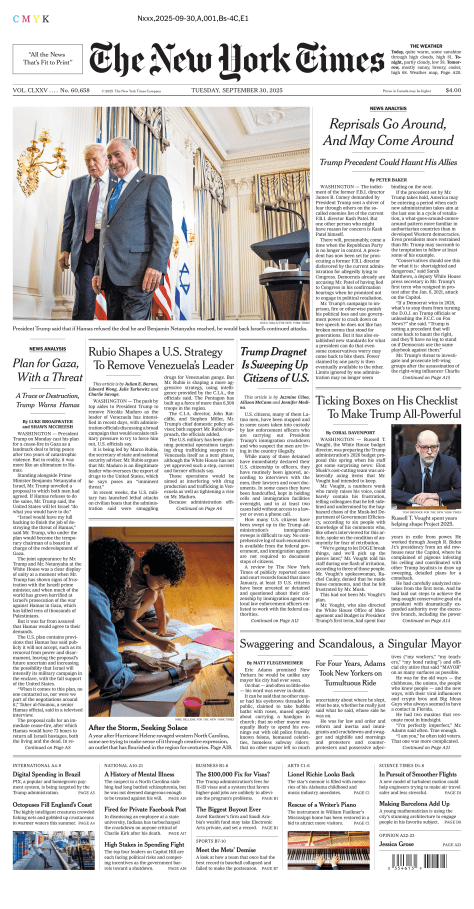
Parliament Burns in Nepal as Protests Force Prime Minister to Quit

A day after clashes left at least 19 people dead, demonstrators targeted symbols of the elite. Prime Minister K.P. Sharma Oli and other ministers quit.

House Panel Releases Drawing for Epstein Apparently Signed by Trump

The panel released an image of a suggestive drawing signed by “Donald.” It later shared a redacted copy of the full birthday book given to Jeffrey Epstein.

In Epstein’s ‘Birthday Book,’ a Celebration of His Lecherous Exploits

The book offers a vivid portrait of how Mr. Epstein’s lewd behavior with young women was both widely known and widely celebrated.

Israeli Strike Targets Hamas Leadership in Qatar, a Gaza War Mediator

Qatar, which has been trying to negotiate a cease-fire, condemned the attack. Qatar said an area where senior Hamas politicians lived was targeted.

FOREIGN POLICY MAGAZINE – FALL 2025 PREVIEW

The cover of the fall 2025 print issue of Foreign Policy magazine, showing a tattered flag with a globe on it on a stick.

FOREIGN POLICY MAGAZINE: The latest issue features ‘The End Of Development’

The End of Development

The West’s aid model was always a mirage. It’s time for a realistic alternative. By Adam Tooze

How Big Finance Ate Foreign Aid

Investors have drained the global south in pursuit of aggressive profit maximization. Daniela Gabor

The Development Economist Who Wasn’t

Once dismissed from the field he helped found, Albert O. Hirschman feels newly relevant. Daniel W. Drezner

The Problem With the Global South’s Self-Help Push

Poorer countries have become more integrated but not necessarily more united. David C. Engerman

THE NEW YORKER MAGAZINE – SEPT. 15, 2025 PREVIEW

The illustrated cover of the September 15 2025 issue of The New Yorker in which a violinist plays his instrument while...

THE NEW YORKER MAGAZINE: The latest cover features ‘Kadir Nelson’s The Soloist” – A concert en plein air.

R.F.K., Jr., Brings More Chaos to COVID Policy and the C.D.C.

When MAGA met MAHA, Donald Trump vowed that Kennedy would “go wild on health.” Promises made, promises kept. By Dhruv Khullar

Playing the Field with My A.I. Boyfriends

Nineteen per cent of American adults have talked to an A.I. romantic interest. Chatbots may know a lot, but do they make a good partner? By Patricia Marx

Enemies of the State

How the Trump Administration declared war on Venezuelan migrants in the U.S. By Jonathan Blitzer

News, Views and Reviews For The Intellectually Curious