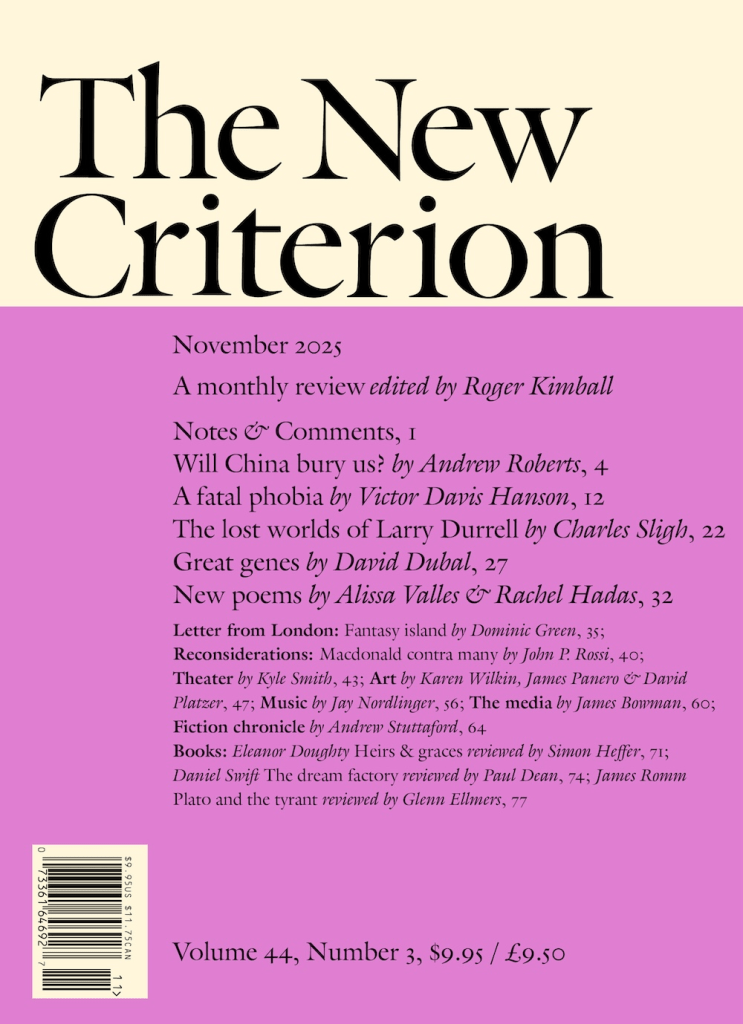
SCIENTIFIC AMERICAN MAGAZINE – SEPTEMBER 2025

Scientific American Volume 333, Issue 2 | Scientific American

SCIENTIFIC AMERICAN MAGAZINE: The latest issue features ‘The End of Food Allergies?’ – Life-changing therapies for peanut reactions are already here.

How Your Brain’s Nightly Cleanse Keeps It Healthy

Washing waste from the brain is an essential function of sleep—and it could help ward off dementia BY Lydia Denworth

Can Peanut Allergies Be Cured?

Maryn McKenna

What Happens When an Entire Generation of Scientists Changes Its Mind

Charles C. Mann

How Scientists Finally Learned That Nerves Regrow

Diana Kwon

Plastics Started as a Sustainability Solution. What Went Wrong?

Jen Schwartz

The Universe Is Static. No, Expanding! Wait, Slowing? Oh, Accelerating

Richard Panek

How RNA Unseated DNA as the Most Important Molecule in Your Body

Philip Ball

AI, Smartphones, and the Student Attention Crisis in U.S. Public Schools

By Michael Cummins, Editor, August 19, 2025

In a recent New York Times focus group, twelve public-school teachers described how phones, social media, and artificial intelligence have reshaped the classroom. Tom, a California biology teacher, captured the shift with unsettling clarity: “It’s part of their whole operating schema.” For many students, the smartphone is no longer a tool but an extension of self, fused with identity and cognition.

Rachel, a teacher in New Jersey, put it even more bluntly:

“They’re just waiting to just get back on their phone. It’s like class time is almost just a pause in between what they really want to be doing.”

What these teachers describe is not mere distraction but a transformation of human attention. The classroom, once imagined as a sanctuary for presence and intellectual encounter, has become a liminal space between dopamine hits. Students no longer “use” their phones; they inhabit them.

The Canadian media theorist Marshall McLuhan warned as early as the 1960s that every new medium extends the human body and reshapes perception. “The medium is the message,” he argued — meaning that the form of technology alters our thought more profoundly than its content. If the printed book once trained us to think linearly and analytically, the smartphone has restructured cognition into fragments: alert-driven, socially mediated, and algorithmically tuned.

The philosopher Sherry Turkle has documented this cultural drift in works such as Alone Together and Reclaiming Conversation. Phones, she argues, create a paradoxical intimacy: constant connection yet diminished presence. What the teachers describe in the Times focus group echoes Turkle’s findings — students are physically in class but psychically elsewhere.

This fracture has profound educational stakes. The reading brain that Maryanne Wolf has studied in Reader, Come Home — slow, deep, and integrative — is being supplanted by skimming, scanning, and swiping. And as psychologist Daniel Kahneman showed, our cognition is divided between “fast” intuitive processing (System 1) and “slow” deliberate reasoning (System 2). Phones tilt us heavily toward System 1, privileging speed and reaction over reflection and patience.

The teachers in the focus group thus reveal something larger than classroom management woes: they describe a civilizational shift in the ecology of human attention. To understand what’s at stake, we must see the smartphone not simply as a device but as a prosthetic self — an appendage of memory, identity, and agency. And we must ask, with urgency, whether education can still cultivate wisdom in a world of perpetual distraction.


The Collapse of Presence

The first crisis that phones introduce into the classroom is the erosion of presence. Presence is not just physical attendance but the attunement of mind and spirit to a shared moment. Teachers have always battled distraction — doodles, whispers, glances out the window — but never before has distraction been engineered with billion-dollar precision.

Platforms like TikTok and Instagram are not neutral diversions; they are laboratories of persuasion designed to hijack attention. Tristan Harris, a former Google ethicist, has described them as slot machines in our pockets, each swipe promising another dopamine jackpot. For a student seated in a fluorescent-lit classroom, the comparison is unfair: Shakespeare or stoichiometry cannot compete with an infinite feed of personalized spectacle.

McLuhan’s insight about “extensions of man” takes on new urgency here. If the book extended the eye and trained the linear mind, the phone extends the nervous system itself, embedding the individual into a perpetual flow of stimuli. Students who describe feeling “naked without their phone” are not indulging in metaphor — they are articulating the visceral truth of prosthesis.

The pandemic deepened this fracture. During remote learning, students learned to toggle between school tabs and entertainment tabs, multitasking as survival. Now, back in physical classrooms, many have not relearned how to sit with boredom, struggle, or silence. Teachers describe students panicking when asked to read even a page without their phones nearby.

Maryanne Wolf’s neuroscience offers a stark warning: when the brain is rewired for scanning and skimming, the capacity for deep reading — for inhabiting complex narratives, empathizing with characters, or grappling with ambiguity — atrophies. What is lost is not just literary skill but the very neurological substrate of reflection.

Presence is no longer the default of the classroom but a countercultural achievement.

And here Kahneman’s framework becomes crucial. Education traditionally cultivates System 2 — the slow, effortful reasoning needed for mathematics, philosophy, or moral deliberation. But phones condition System 1: reactive, fast, emotionally charged. The result is a generation fluent in intuition but impoverished in deliberation.


The Wild West of AI

If phones fragment attention, artificial intelligence complicates authorship and authenticity. For teachers, the challenge is no longer merely whether a student has done the homework but whether the “student” is even the author at all.

ChatGPT and its successors have entered the classroom like a silent revolution. Students can generate essays, lab reports, even poetry in seconds. For some, this is liberation: a way to bypass drudgery and focus on synthesis. For others, it is a temptation to outsource thinking altogether.

Sherry Turkle’s concept of “simulation” is instructive here. In Simulation and Its Discontents, she describes how scientists and engineers, once trained on physical materials, now learn through computer models — and in the process, risk confusing the model for reality. In classrooms, AI creates a similar slippage: simulated thought that masquerades as student thought.

Teachers in the Times focus group voiced this anxiety. One noted: “You don’t know if they wrote it, or if it’s ChatGPT.” Assessment becomes not only a question of accuracy but of authenticity. What does it mean to grade an essay if the essay may be an algorithmic pastiche?

The comparison with earlier technologies is tempting. Calculators once threatened arithmetic; Wikipedia once threatened memorization. But AI is categorically different. A calculator does not claim to “think”; Wikipedia does not pretend to be you. Generative AI blurs authorship itself, eroding the very link between student, process, and product.

And yet, as McLuhan would remind us, every technology contains both peril and possibility. AI could be framed not as a substitute but as a collaborator — a partner in inquiry that scaffolds learning rather than replaces it. Teachers who integrate AI transparently, asking students to annotate or critique its outputs, may yet reclaim it as a tool for System 2 reasoning.

The danger is not that students will think less but that they will mistake machine fluency for their own voice.

But the Wild West remains. Until schools articulate norms, AI risks widening the gap between performance and understanding, appearance and reality.


The Inequality of Attention

Phones and AI do not distribute their burdens equally. The third crisis teachers describe is an inequality of attention that maps onto existing social divides.

Affluent families increasingly send their children to private or charter schools that restrict or ban phones altogether. At such schools, presence becomes a protected resource, and students experience something closer to the traditional “deep time” of education. Meanwhile, underfunded public schools are often powerless to enforce bans, leaving students marooned in a sea of distraction.

This disparity mirrors what sociologist Pierre Bourdieu called cultural capital — the non-financial assets that confer advantage, from language to habits of attention. In the digital era, the ability to disconnect becomes the ultimate form of privilege. To be shielded from distraction is to be granted access to focus, patience, and the deep literacy that Wolf describes.

Teachers in lower-income districts report students who cannot imagine life without phones, who measure self-worth in likes and streaks. For them, literacy itself feels like an alien demand — why labor through a novel when affirmation is instant online?

Maryanne Wolf warns that we are drifting toward a bifurcated literacy society: one in which elites preserve the capacity for deep reading while the majority are confined to surface skimming. The consequences for democracy are chilling. A polity trained only in System 1 thinking will be perpetually vulnerable to manipulation, propaganda, and authoritarian appeals.

The inequality of attention may prove more consequential than the inequality of income.

If democracy depends on citizens capable of deliberation, empathy, and historical memory, then the erosion of deep literacy is not a classroom problem but a civic emergency. Education cannot be reduced to test scores or job readiness; it is the training ground of the democratic imagination. And when that imagination is fractured by perpetual distraction, the republic itself trembles.


Reclaiming Focus in the Classroom

What, then, is to be done? The teachers’ testimonies, amplified by McLuhan, Turkle, Wolf, and Kahneman, might lead us toward despair. Phones colonize attention; AI destabilizes authorship; inequality corrodes the very ground of democracy. But despair is itself a form of surrender, and teachers cannot afford surrender.

Hope begins with clarity. We must name the problem not as “kids these days” but as a structural transformation of attention. To expect students to resist billion-dollar platforms alone is naive; schools must become countercultural sanctuaries where presence is cultivated as deliberately as literacy.

Practical steps follow. Schools can implement phone-free policies, not as punishment but as liberation — an invitation to reclaim time. Teachers can design “slow pedagogy” moments: extended reading, unbroken dialogue, silent reflection. AI can be reframed as a tool for meta-cognition, with students asked not merely to use it but to critique it, to compare its fluency with their own evolving voice.

Above all, we must remember that education is not simply about information transfer but about formation of the self. McLuhan’s dictum reminds us that the medium reshapes the student as much as the message. If we allow the medium of the phone to dominate uncritically, we should not be surprised when students emerge fragmented, reactive, and estranged from presence.

And yet, history offers reassurance. Plato once feared that writing itself would erode memory; medieval teachers once feared the printing press would dilute authority. Each medium reshaped thought, but each also produced new forms of creativity, knowledge, and freedom. The task is not to romanticize the past but to steward the present wisely.

Hannah Arendt, reflecting on education, insisted that every generation is responsible for introducing the young to the world as it is — flawed, fragile, yet redeemable. To abdicate that responsibility is to abandon both children and the world itself. Teachers today, facing the prosthetic selves of their students, are engaged in precisely this work: holding open the possibility of presence, of deep thought, of human encounter, against the centrifugal pull of the screen.

Education is the wager that presence can be cultivated even in an age of absence.

In the end, phones may be prosthetic selves — but they need not be destiny. The prosthesis can be acknowledged, critiqued, even integrated into a richer conception of the human. What matters is that students come to see themselves not as appendages of the machine but as agents capable of reflection, relationship, and wisdom.

The future of education — and perhaps democracy itself — depends on this wager. That in classrooms across America, teachers and students together might still choose presence over distraction, depth over skimming, authenticity over simulation. It is a fragile hope, but a necessary one.

THIS ESSAY WAS WRITTEN AND EDITED UTILIZING AI

History Today Magazine – September 2025 Preview

HISTORY TODAY MAGAZINE: The latest issue features ‘The Greek World At War’….

The Ancient Greek World at War

For the ancient Greeks, the Peloponnesian War was a conflict involving the entire world. For Thucydides, it was a lesson in the realities of human nature. Robin Waterfield

Afghanistan 1919: Facing the Wasps’ Nest

Against the odds, the Third Anglo-Afghan War led to Afghanistan’s independence from the British Empire. Heather Campbell

‘The Invention of the Eastern Question’ by Ozan Ozavcı review

The Invention of the Eastern Question: Sir Robert Liston and Ottoman Diplomacy in the Age of Revolutions by Ozan Ozavcı offers the ‘sick man of Europe’ a second opinion.

THE NEW YORK TIMES – TUESDAY, AUGUST 19, 2025

Europe’s Leaders Headed Off Give-Away to Putin, but Emerged Without a Clear Path

The leaders dropped everything to travel to Washington to ensure President Trump didn’t force a bad deal on Ukraine. A road map for peace remains elusive.

It’s One Thing to Promise Ukraine Security. It’s Quite Another to Deliver.

Russia seems unlikely to agree to Western troops in Ukraine as part of any deal to end the war.

In Pursuing Trump Rival, Weaponization Czar Sidesteps Justice Dept. Norms

Edward Martin Jr. is among the top administration officials who have tried to cast the specter of criminality on President Trump’s enemies.

Trump Administration Discusses Taking 10% Stake in Intel

Federal officials are considering the move because Intel, the last leading-edge chipmaker in the United States, has been struggling.

Responsive Elegance: AI’s Fashion Revolution

Responsive Elegance: How AI Is Rewriting the Code of Luxury Fashion
From Prada’s neural silhouettes to Hermès’ algorithmic resistance, a new aesthetic regime emerges—where beauty is no longer just crafted, but computed.

By Michael Cummins, Editor, August 18, 2025

The atelier no longer glows with candlelight, nor hums with the quiet labor of hand-stitching—it pulses with data. Fashion, once the domain of intuition, ritual, and artisanal mastery, is being reshaped by artificial intelligence. Algorithms now whisper what beauty should look like, trained not on muses but on millions of images, trends, and cultural signals. The designer’s sketchbook has become a neural network; the runway, a reflection of predictive modeling—beauty, now rendered in code.

This transformation is not speculative—it’s unfolding in real time. Prada has explored AI tools to remix archival silhouettes with contemporary streetwear aesthetics. Burberry uses machine learning to forecast regional preferences and tailor collections to cultural nuance. LVMH, the world’s largest luxury conglomerate, has declared AI a strategic infrastructure, integrating it across its seventy-five maisons to optimize supply chains, personalize client experiences, and assist in creative ideation. Meanwhile, Hermès resists the wave, preserving opacity, restraint, and human discretion.

At the heart of this shift are two interlocking innovations: generative design, where AI produces visual forms based on input parameters, and predictive styling, which anticipates consumer desires through data. Together, they mark a new aesthetic regime—responsive elegance—where beauty is calibrated to cultural mood and optimized for relevance.

But what is lost in this optimization? Can algorithmic chic retain the aura of the original? Does prediction flatten surprise?

Generative Design & Predictive Styling: Fashion’s New Operating System

Generative design and predictive styling are not mere tools—they are provocations. They challenge the very foundations of fashion’s creative process, shifting the locus of authorship from the human hand to the algorithmic eye.

Generative design uses neural networks and evolutionary algorithms to produce visual outputs based on input parameters. In fashion, this means feeding the machine with data: historical collections, regional aesthetics, streetwear archives, and abstract mood descriptors. The algorithm then generates design options that reflect emergent patterns and cultural resonance.

Prada, known for its intellectual rigor, has experimented with such approaches. Analysts at Business of Fashion note that AI-driven archival remixing allows Prada to analyze past collections and filter them through contemporary preference data, producing silhouettes that feel both nostalgic and hyper-contemporary. A 1990s-inspired line recently drew on East Asian streetwear influences, creating garments that seemed to arrive from both memory and futurity at once.

Predictive styling, meanwhile, anticipates consumer desires by analyzing social media sentiment, purchasing behavior, influencer trends, and regional aesthetics. Burberry employs such tools to refine color palettes and silhouettes by geography: muted earth tones for Scandinavian markets, tailored minimalism for East Asian consumers. As Burberry’s Chief Digital Officer Rachel Waller told Vogue Business, “AI lets us listen to what customers are already telling us in ways no survey could capture.”

A McKinsey & Company 2024 report concluded:

“Generative AI is not just automation—it’s augmentation. It gives creatives the tools to experiment faster, freeing them to focus on what only humans can do.”

Yet this feedback loop—designing for what is already emerging—raises philosophical questions. Does prediction flatten originality? If fashion becomes a mirror of desire, does it lose its capacity to provoke?

Walter Benjamin, in The Work of Art in the Age of Mechanical Reproduction (1936), warned that mechanical replication erodes the ‘aura’—the singular presence of an artwork in time and space. In AI fashion, the aura is not lost—it is simulated, curated, and reassembled from data. The designer becomes less an originator than a selector of algorithmic possibility.

Still, there is poetry in this logic. Responsive elegance reflects the zeitgeist, translating cultural mood into material form. It is a mirror of collective desire, shaped by both human intuition and machine cognition. The challenge is to ensure that this beauty remains not only relevant—but resonant.

LVMH vs. Hermès: Two Philosophies of Luxury in the Algorithmic Age

The tension between responsive elegance and timeless restraint is embodied in the divergent strategies of LVMH and Hermès—two titans of luxury, each offering a distinct vision of beauty in the age of AI.

LVMH has embraced artificial intelligence as strategic infrastructure. In 2023, it announced a deep partnership with Google Cloud, creating a sophisticated platform that integrates AI across its seventy-five maisons. Louis Vuitton uses generative design to remix archival motifs with trend data. Sephora curates personalized product bundles through machine learning. Dom Pérignon experiments with immersive digital storytelling and packaging design based on cultural sentiment.

Franck Le Moal, LVMH’s Chief Information Officer, describes the conglomerate’s approach as “weaving together data and AI that connects the digital and store experiences, all while being seamless and invisible.” The goal is not automation for its own sake, but augmentation of the luxury experience—empowering client advisors, deepening emotional resonance, and enhancing agility.

As Forbes observed in 2024:

“LVMH sees the AI challenge for luxury not as a technological one, but as a human one. The brands prosper on authenticity and person-to-person connection. Irresponsible use of GenAI can threaten that.”

Hermès, by contrast, resists the algorithmic tide. Its brand strategy is built on restraint, consistency, and long-term value. Hermès avoids e-commerce for many products, limits advertising, and maintains a deliberately opaque supply chain. While it uses AI for logistics and internal operations, it does not foreground AI in client experiences. Its mystique depends on human discretion, not algorithmic prediction.

As Chaotropy’s Luxury Analysis 2025 put it:

“Hermès is not only immune to the coming tsunami of technological innovation—it may benefit from it. In an era of automation, scarcity and craftsmanship become more desirable.”

These two models reflect deeper aesthetic divides. LVMH offers responsive elegance—beauty that adapts to us. Hermès offers elusive beauty—beauty that asks us to adapt to it. One is immersive, scalable, and optimized; the other opaque, ritualistic, and human-centered.

When Machines Dream in Silk: Speculative Futures of AI Luxury

If today’s AI fashion is co-authored, tomorrow’s may be autonomous. As generative design and predictive styling evolve, we inch closer to a future where products are not just assisted by AI—but entirely designed by it.

Louis Vuitton’s “Sentiment Handbag” scrapes global sentiment to reflect the emotional climate of the world. Iridescent textures for optimism, protective silhouettes for anxiety. Fashion becomes emotional cartography.

Sephora’s “AI Skin Atlas” tailors skincare to micro-geographies and genetic lineages. Packaging, scent, and texture resonate with local rituals and biological needs.

Dom Pérignon’s “Algorithmic Vintage” blends champagne based on predictive modeling of soil, weather, and taste profiles. Terroir meets tensor flow.

TAG Heuer’s Smart-AI Timepiece adapts its face to your stress levels and calendar. A watch that doesn’t just tell time—it tells mood.

Bulgari’s AR-enhanced jewelry refracts algorithmic lightplay through centuries of tradition. Heritage collapses into spectacle.

These speculative products reflect a future where responsive elegance becomes autonomous elegance. Designers may become philosopher-curators—stewards of sensibility, shaping not just what the machine sees, but what it dares to feel.

Yet ethical concerns loom. A 2025 study by Amity University warned:

“AI-generated aesthetics challenge traditional modes of design expression and raise unresolved questions about authorship, originality, and cultural integrity.”

To address these risks, the proposed F.A.S.H.I.O.N. AI Ethics Framework suggests principles like Fair Credit, Authentic Context, and Human-Centric Design. These frameworks aim to preserve dignity in design, ensuring that beauty remains not just a product of data, but a reflection of cultural care.

The Algorithm in the Boutique: Two Journeys, Two Futures

In 2030, a woman enters the Louis Vuitton flagship on the Champs-Élysées. The store AI recognizes her walk, gestures, and biometric stress markers. Her past purchases, Instagram aesthetic, and travel itineraries have been quietly parsed. She’s shown a handbag designed for her demographic cluster—and a speculative “future bag” generated from global sentiment. Augmented reality mirrors shift its hue based on fashion chatter.

Across town, a man steps into Hermès on Rue du Faubourg Saint-Honoré. No AI overlay. No predictive styling. He waits while a human advisor retrieves three options from the back room. Scarcity is preserved. Opacity enforced. Beauty demands patience, loyalty, and reverence.

Responsive elegance personalizes. Timeless restraint universalizes. One anticipates. The other withholds.

Ethical Horizons: Data, Desire, and Dignity

As AI saturates luxury, the ethical stakes grow sharper:

Privacy or Surveillance? Luxury thrives on intimacy, but when biometric and behavioral data feed design, where is the line between service and intrusion? A handbag tailored to your mood may delight—but what if that mood was inferred from stress markers you didn’t consent to share?

Cultural Reverence or Algorithmic Appropriation? Algorithms trained on global aesthetics may inadvertently exploit indigenous or marginalized designs without context or consent. This risk echoes past critiques of fast fashion—but now at algorithmic speed, and with the veneer of personalization.

Crafted Scarcity or Generative Excess? Hermès’ commitment to craft-based scarcity stands in contrast to AI’s generative abundance. What happens to luxury when it becomes infinitely reproducible? Does the aura of exclusivity dissolve when beauty is just another output stream?

Philosopher Byung-Chul Han, in The Transparency Society (2012), warns:

“When everything is transparent, nothing is erotic.”

Han’s critique of transparency culture reminds us that the erotic—the mysterious, the withheld—is eroded by algorithmic exposure. In luxury, opacity is not inefficiency—it is seduction. The challenge for fashion is to preserve mystery in an age that demands metrics.

Fashion’s New Frontier


Fashion has always been a mirror of its time. In the age of artificial intelligence, that mirror becomes a sensor—reading cultural mood, forecasting desire, and generating beauty optimized for relevance. Generative design and predictive styling are not just innovations; they are provocations. They reconfigure creativity, decentralize authorship, and introduce a new aesthetic logic.

Yet as fashion becomes increasingly responsive, it risks losing its capacity for rupture—for the unexpected, the irrational, the sublime. When beauty is calibrated to what is already emerging, it may cease to surprise. The algorithm designs for resonance, not resistance. It reflects desire, but does it provoke it?

The contrast between LVMH and Hermès reveals two futures. One immersive, scalable, and optimized; the other opaque, ritualistic, and elusive. These are not just business strategies—they are aesthetic philosophies. They ask us to choose between relevance and reverence, between immediacy and depth.

As AI evolves, fashion must ask deeper questions. Can responsive elegance coexist with emotional gravity? Can algorithmic chic retain the aura of the original? Will future designers be curators of machine imagination—or custodians of human mystery?

Perhaps the most urgent question is not what AI can do, but what it should be allowed to shape. Should it design garments that reflect our moods, or challenge them? Should it optimize beauty for engagement, or preserve it as a site of contemplation? In a world increasingly governed by prediction, the most radical gesture may be to remain unpredictable.

The future of fashion may lie in hybrid forms—where machine cognition enhances human intuition, and where data-driven relevance coexists with poetic restraint. Designers may become philosophers of form, guiding algorithms not toward efficiency, but toward meaning.

In this new frontier, fashion is no longer just what we wear. It is how we think, how we feel, how we respond to a world in flux. And in that response—whether crafted by hand or generated by code—beauty must remain not only timely, but timeless. Not only visible, but visceral. Not only predicted, but profoundly imagined.

THIS ESSAY WAS WRITTEN AND EDITED UTILIZING AI
THE NEW YORKER MAGAZINE – AUGUST 25, 2025 PREVIEW

A child draws on a man's tattooed arm.

THE NEW YORKER MAGAZINE: The latest cover features ‘Sergio García Sánchez and Lola Moral’s “Artist in Training”

Pam Bondi’s Power Play

Donald Trump now has the Attorney General he always wanted—an ally willing to harness the law to enable his agenda. By Ruth Marcus

Trump Sends in the National Guard

Is the President’s takeover of D.C. a dry run for other cities? By Margaret Talbot

Bill Belichick Goes Back to School

Can the legendary former Patriots coach transform U.N.C. football? By Paige Williams

The Family Fallout of DNA Surprises

Through genetic testing, millions of Americans are estimated to have discovered that their parents aren’t who they thought. The news has upended relationships and created a community looking for answers. By Jennifer Wilson

THE NEW YORK TIMES – MONDAY, AUGUST 18, 2025

Putin’s Proposal for Land Deal, Made to Trump, Shifts Pressure to Zelensky

Vladimir Putin proposed that Ukraine cede a region to stop the fighting. President Trump said that would be up to Volodymyr Zelensky, whom he meets today.

Zelensky Heads Back to White House, Facing Hard Choice From Trump

Trump Says He’ll ‘Lead a Movement’ to Eliminate Mail-In Ballots

In a post on Truth Social, President Trump pledged an executive order on mail-in ballots and said he wanted to get rid of voting machines.

Texas Democrats Are Set to End Walkout, Allowing Redrawn Map to Pass

Lawmakers were expected to return after fleeing the state for two weeks, with Republicans ready to pass a congressional map called for by President Trump.

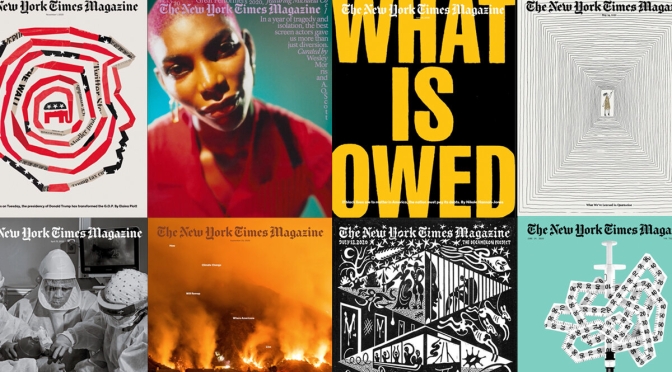
THE NEW YORK TIMES MAGAZINE – August 17, 2025

Current cover

THE NEW YORK TIMES MAGAZINE: The 8.17.25 Issue features Trevor Quirk on how Hurricane Helene disconnected his community around Asheville, North Carolina from modern communication; Ben Austen on how Trump’s war on higher education is hitting community colleges; Bruce Schoenfeld on Stu Sternberg, the owner of the Tampa Bay Rays; and more.

They Want You to Get Off Your Couch, and Go Set a World Record

When it comes to mass-participation events, would-be record setters are finding it harder than ever to draw a crowd. But it’s still fun to try.

Strawberry Picking Is Thankless Work. That’s What Makes It Worth Watching.

On TikTok Live, workers stream video of themselves doing manual labor, providing glimpses of the human effort that powers our world. By J Wortham

I Never Understood Our Data-Saturated Life Until a Hurricane Shut It Down

When Helene disconnected my part of North Carolina for weeks, my neighbors and I had to relearn old ways of knowing what was happening — and what wasn’t. By Trevor Quirk

THE NEW YORK TIMES – SUNDAY, AUGUST 17, 2025

Putin Sees Ukraine Through a Lens of Grievance Over Lost Glory

After Friday’s summit, President Vladimir Putin of Russia again implied that the war was all about his country’s diminished status since the Soviet Union’s fall.

Ukrainians Fleeing Russia’s Attacks Say the Alaska Summit Was an Insult

Evacuees at a shelter in eastern Ukraine reacted angrily to talk that land that has long been theirs could be given to Russia in exchange for peace.

Trump’s Selective Stance on Justice: Redemption for Some, Scorn for Others

President Trump, himself a felon, has shown leniency to criminals he seems to identify with — people who are white or wealthy, or who rioted on Jan. 6, 2021.

Fox News Warrior Takes on Prosecutor Role in Trump’s D.C. Crackdown

Israel Says Iranian Agents Recruited Dozens of Its Citizens

Israelis have been cajoled into acts of sabotage and even assassination plots, the authorities say, raising questions about greed, gullibility and loyalty.

THE COURAGE TO QUESTION: HOW AN EMPIRE WAS BUILT

By Michael Cummins, Editor, August 16, 2025

The memory of the Islamic Golden Age evokes powerful images: Baghdad’s legendary House of Wisdom, a beacon of scholarship for the world’s greatest minds; the astronomical observatories of Samarkand, mapping the heavens with unprecedented precision; the grand libraries of Córdoba, containing more books than all of Europe combined. For roughly five centuries, from the 8th to the 13th, the Islamic world was the undisputed global epicenter of science, philosophy, and culture. Its innovations gifted humanity algebra and algorithms, advanced surgical techniques, and the classical Greek philosophy that would later fuel the European Renaissance.

This flourishing was no accident. It was the direct result of a powerful, synergistic formula: the fusion of a voracious, institutionalized curiosity with strategic state patronage and a climate of relative tolerance. Yet, its eventual decline offers an equally crucial lesson—that such a vibrant ecosystem is fragile. Its vitality is contingent on maintaining an open spirit of inquiry, the closing of which precedes stagnation and decay. The story of the Islamic Golden Age, told through its twin centers of Baghdad and Córdoba, is therefore both an inspiring blueprint for civilizational greatness and a timeless cautionary tale of how easily it can be lost.

The Engine: A Genius for Synthesis

The foundation of the Golden Age was its genius for synthesis. It was an institutionalized curiosity that understood new knowledge is forged by actively seeking out, challenging, and combining the wisdom of others. As the scholar Dimitri Gutas argues in his seminal work, Greek Thought, Arabic Culture, this was not a random burst of energy but a deliberate, state-sponsored project driven by the “social and political imperatives of a new empire.” The Abbasid Caliphs, having established their capital in Baghdad in 762, sat at the crossroads of the Persian, Byzantine, and Indian worlds. Rather than view the intellectual traditions of these conquered or rival lands as a threat, they saw them as an invaluable resource for building a universalist imperial ideology.

This conviction gave rise to the Translation Movement, a massive, state-funded effort to translate the great works of science, medicine, and philosophy into Arabic. The nerve center of this project was Baghdad’s House of Wisdom (Bayt al-Hikmah). Far more than a library, it was a dynamic academy, a translation bureau, and a research institute where scholars from across the known world collaborated.

Their goal was never mere preservation. As the historian George Saliba demonstrates, they were active innovators who critically engaged with, corrected, and vastly expanded upon ancient texts. Ptolemy’s astronomical model in the Almagest was not just translated; it was rigorously tested in new observatories, its mathematical errors identified, and its cosmological assumptions challenged by thinkers like Ibn al-Haytham (Alhazen), whose work on optics overturned centuries of classical theory.

He did not simply import knowledge; he synthesized it into something new.

This process created a powerful intellectual alchemy. In mathematics, Muhammad ibn Musa al-Khwarizmi, a Persian scholar at the House of Wisdom, encountered the revolutionary numeral system from India, which included the concept of zero. He fused this with the geometric principles of the Greeks to create a new discipline he outlined in his landmark book, The Compendious Book on Calculation by Completion and Balancing. From the title’s key term, al-jabr (‘completion’ or ‘restoring’), the world received algebra—a tool for abstract problem-solving that would transform the world.

This same engine of synthesis, fueled by a competitive spirit, was humming thousands of miles away in Al-Andalus. In its capital, Córdoba, the physician Al-Zahrawi (Abulcasis), often called the father of modern surgery, compiled the Al-Tasrif, a thirty-volume medical encyclopedia. It was a monumental synthesis of classical medical knowledge with his own pioneering innovations, introducing the use of catgut for internal stitches and designing dozens of new surgical instruments that would define European medical practice for centuries. In philosophy, the Córdoban thinker Ibn Rushd (Averroes) produced radical commentaries on Aristotle that were so influential he became known simply as “The Commentator” in medieval Europe. He sought to demonstrate that reason and revelation were not in conflict but were two paths to the same truth, a bold intellectual project that would profoundly reshape Western scholasticism.

The Fuel: Strategic Investment in Knowledge

This intellectual engine was deliberately and lavishly fueled by rulers who saw investment in knowledge as a cornerstone of state power, prestige, and practical advantage. The immense wealth of the Abbasid Caliphate, derived from its control of global trade routes, made this grand-scale patronage possible. This power was materialized in Baghdad itself, Caliph al-Mansur’s perfectly circular “City of Peace,” an architectural marvel with the caliph’s palace and the grand mosque at its absolute center, symbolizing his position as the axis of the world. Later Abbasid palaces were sprawling complexes of exquisite gardens, cool marble halls, and courtyards filled with intricate fountains and exotic animals—dazzling stages for courtly life where poets, musicians, and scholars vied for the caliph’s favor.

It was within these opulent settings that legendary patrons like Harun al-Rashid and his son, al-Ma’mun, held court. Al-Ma’mun, a rationalist thinker himself, is said to have been inspired by a dream in which he conversed with Aristotle. He poured vast resources into the House of Wisdom, funding expeditions to Byzantium to acquire rare manuscripts and reportedly paying translators their weight in gold.

This model of state-sponsored knowledge was pursued with competitive fervor in Al-Andalus. In Córdoba, the Umayyad Caliph Abd al-Rahman III sought to build a capital that would eclipse all rivals. A few miles outside the city, he constructed a fabled palace-city, Madinat al-Zahra (“the shining city”). It was a breathtaking statement of power, built in terraces on a mountainside with thousands of imported marble columns. Its audience chambers were adorned with ivory and ebony, and at the center of the most magnificent hall lay a basin filled with shimmering quicksilver, which, when agitated, would flood the room with dazzling reflections of light.

This was a “war of culture” in which libraries were arsenals and palaces were declarations of supremacy. It was in this environment that Al-Hakam II, Abd al-Rahman’s son, amassed his legendary library of over 400,000 volumes, a beacon of knowledge designed to outshine Baghdad itself. This rivalry between distant capitals created a powerful ecosystem for genius, establishing a lasting infrastructure for discovery that attracted the best minds from every corner of the globe.

The Superpower: Pragmatic and Inclusive Tolerance

The era’s intellectual and financial investments were supercharged by a climate of relative tolerance. This was not a modern, egalitarian pluralism, but a practical and strategic inclusion that prevented intellectual monocultures and proved to be a civilizational superpower. As María Rosa Menocal writes in The Ornament of the World, this was a culture capable of a “first-rate pluralism,” where contradictions were not just tolerated but were often the source of creative energy.

The work of the Golden Age was a multi-faith and multi-ethnic endeavor. In Baghdad, the chief translator at the House of Wisdom and the most important medical scholar of his time, Hunayn ibn Ishaq, was a Nestorian Christian. A master of four languages—Syriac, Arabic, Greek, and Persian—he established a rigorous methodology, collecting multiple manuscript versions of a text to ensure the most accurate translation. For generations, Christian physicians from the Bakhtishu’ family served as personal doctors to the Abbasid caliphs.

This principle was just as potent in the West. In Córdoba, the court of Abd al-Rahman III thrived on the talents of figures like Hasdai ibn Shaprut, a Jewish physician and scholar who rose to become the caliph’s most trusted diplomat and vizier. He not only managed foreign policy but also used his position to patronize Hebrew poets and grammarians, fostering a golden age of Jewish culture that flourished in the heart of Islamic Spain. This was made possible by the dhimmi (protected peoples) system, which, while hierarchical, guaranteed non-Muslims the right to practice their faith and participate in intellectual life. In the realms of science and philosophy, merit and skill were often the ultimate currency. This diversity was the Golden Age’s secret weapon.

The Cautionary Tale: The Closing of the Mind

The Golden Age did not end simply with the hoofbeats of Mongol horses in 1258. Its decline was a prolonged grinding down of the audacious spirit of open inquiry. The Mongol sack of Baghdad was a devastating blow, but it struck a body already weakened by an internal intellectual malaise.

This cultural shift is often symbolized by the brilliant 11th-century theologian, Abu Hamid al-Ghazali. His influential critique of Hellenistic philosophy, The Incoherence of the Philosophers, was not an attack on reason itself—he was a master of it, who championed Aristotelian logic as a necessary tool for theology. Rather, it was a powerful argument against what he saw as the metaphysical overreach of philosophers on matters that he believed could only be known through divine revelation. His work, however, was a symptom of a decisive cultural turn. The intellectual energy of the elite, and the patronage that supported it, began to be re-channeled—away from speculative, open-ended philosophy (falsafa) and towards the preservation and systematization of established religious doctrine.

The central questions shifted from “What can we discover?” to “How do we defend what we know?”

This was compounded by political fragmentation. As the central authority of the Abbasid Caliphate waned, insecure local rulers, like the Seljuk Turks, increasingly sought legitimacy by patronizing conservative religious scholars. Funding flowed toward madrasas focused on theology and law rather than independent scientific academies. When a culture begins to fear certain questions, it loses its ability to generate new answers. The great North African historian Ibn Khaldun, writing in the 14th century from the ruins of this intellectual world, diagnosed the decline with stunning clarity in his Muqaddimah. He observed that when civilizations become too comfortable and focused on preserving past glories, they lose the “group solidarity” and intellectual dynamism that made them great. This growing intellectual rigidity created a civilizational brittleness, leaving it vulnerable to catastrophic external shocks.

Conclusion: A Timeless Blueprint

The legacy of the Islamic Golden Age is a double-edged one. Its rise in both the East and West provides a clear blueprint for greatness, built on relentless curiosity, wise patronage, and pragmatic inclusion. This formula demonstrates that progress is a product of openness and investment. Its decline, however, is a stark warning. The erosion of that most crucial pillar—the open, questioning mind—preceded the civilization’s fall.

The essential lesson of this epic is that culture precedes power. The wealth, military strength, and political influence of the caliphates were not the cause of the Golden Age; they were the result of a culture confident enough to be curious, strong enough to tolerate dissent, and wise enough to invest in knowledge. The engine of its greatness was not the treasury, but the House of Wisdom and the Library of Córdoba. Consequently, its decline was not merely a political or military failure, but the late-stage symptom of an intellectual culture that had begun to value orthodoxy over inquiry. When the questions stopped, the innovations stopped, and the foundations of power crumbled from within.

This narrative is not a historical artifact. It is a timeless blueprint, revealing that the most critical infrastructure any society can build is not made of stone or steel, but of the institutions and values that protect and promote the open pursuit of knowledge. In our modern world, the House of Wisdom finds its echo in publicly funded research universities, in international scientific collaborations, and in the legal frameworks that protect free speech and intellectual inquiry. The patronage of al-Ma’mun is mirrored in the grants that fund basic research—the kind of open-ended exploration that may not have an immediate commercial application but is the seedbed of future revolutions. The tolerance of Córdoba is the argument for diversity in our labs, our boardrooms, and our governments, recognizing that a multiplicity of perspectives is not a liability to be managed, but a strategic asset that fuels innovation.

The open secret of the Golden Age is therefore not a secret at all, but a choice. It is the choice to believe that greatness is born from the courage to question, to synthesize, and to explore. It is the choice to see knowledge not as a finite territory to be defended, but as an infinite ocean to be discovered. The moment a society decides it already has all the answers—the moment it values certainty over curiosity—is the moment its decline becomes inevitable.

THIS ESSAY WAS WRITTEN AND EDITED UTILIZING AI

News, Views and Reviews For The Intellectually Curious