

A multitude of multiverses
Excitingly, scientists say that alternative universes are allowed by physics. We find out about the leading multiverse theories, and establish whether they could harbour an alternate version of you.

Excitingly, scientists say that alternative universes are allowed by physics. We find out about the leading multiverse theories, and establish whether they could harbour an alternate version of you.
For many older adults, a good night’s rest is elusive. The implications of chronically poor sleep can be far-reaching and include a decline in cognitive functioning and detrimental effects on health and general well-being. Fortunately, relief may be in sight.
A new study led by investigators at the Stanford University School of Medicine shows that neurons in the lateral hypothalamus, a brain region, play a pivotal role in sleep loss in old mice. More specifically, the arousal-promoting hypocretin neurons become hyperexcitable, driving sleep interruptions.
Read the full story: https://stan.md/3JQ7z77
Luis de Lecea, PhD, is a professor of psychiatry and behavioral sciences at Stanford Medicine. He is the study’s senior author and hopes the finding could pave the way to new drug treatments for age-related sleep problems in humans.
Shi-Bin Li, PhD, is an instructor in the Psychiatry and Behavioral Sciences department at Stanford Medicine. He is also a basic life research scientist in the de Lecea lab, and is the lead author of the study.
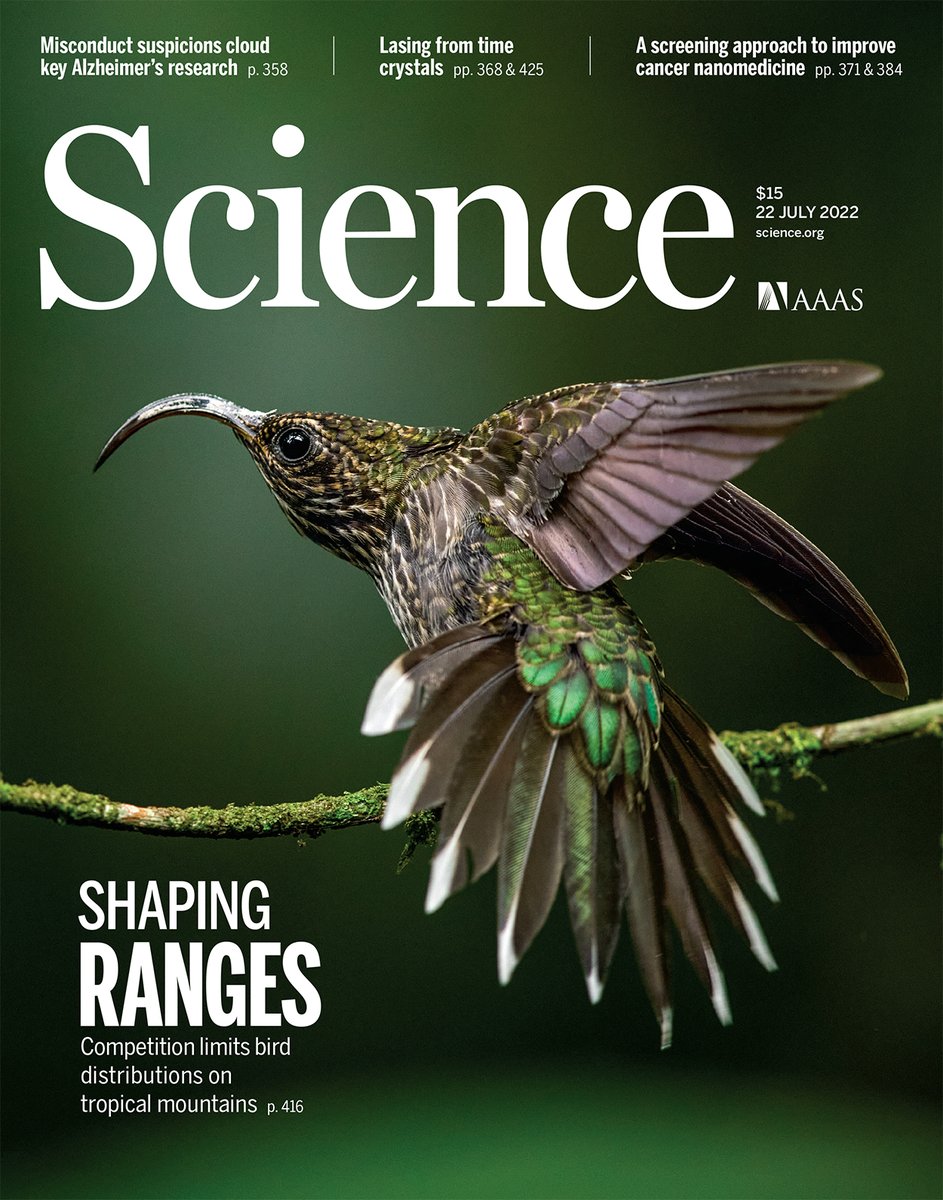
Species tend to live in narrower slices of mountainside on tropical versus temperate mountains. Stronger competition in the tropics explains this pattern for birds. For example, the habitable range of this white-tipped sicklebill (Eutoxeres aquila) is limited as a result of competition with its close relative, the buff-tailed sicklebill (Eutoxeres condamini). See page 416.
Fast-spreading subvariants are coming and going. But an entirely new variant could still emerge
Satellites capture fall in light-blocking pollution
Finding sequences that code for short proteins could add thousands of genes
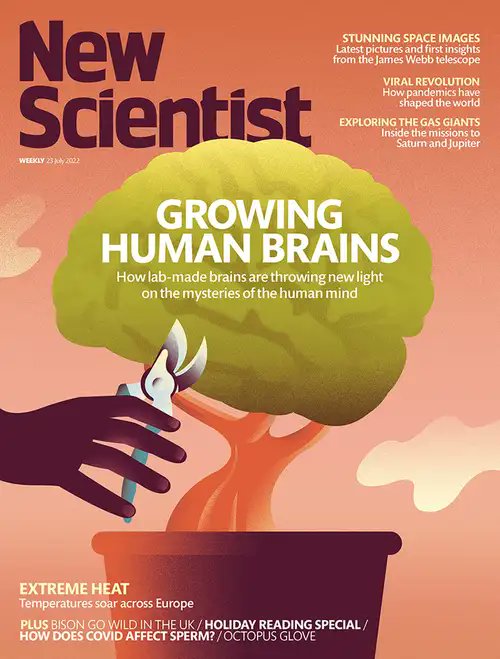
Blobs of human brain cells cultivated in the lab, known as brain organoids or “mini-brains”, are transforming our understanding of neural development and disease. Now, researchers are working to make them more like the real thing
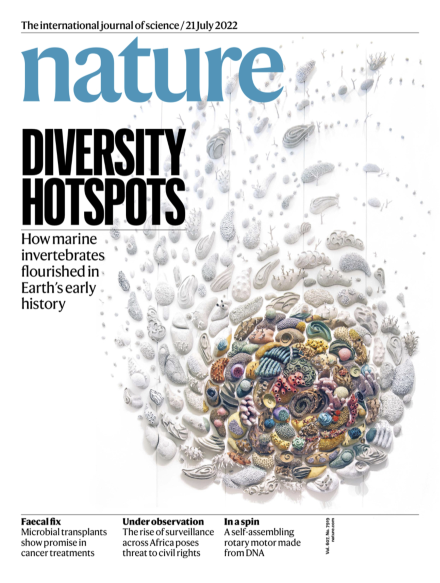
The cover shows an artistic impression of marine life in Indonesia’s coral reefs. The question of whether there are limits to biodiversity in the seas is typically addressed by examining the fossil record. In this week’s issue, Pedro Cermeño and his colleagues present a model that combines the fossil record with plate tectonics and Earth’s environmental conditions to offer insight into regional diversification of marine invertebrates. The researchers used the model to examine how biodiversity recovered after mass extinctions during the Phanerozoic eon, covering
some 500 million years of Earth’s history. They found that throughout the Phanerozoic, less than 2% of area of the globe covered by water showed signs of diversity levels reaching saturation. The team also note that as Pangaea broke up into continents, the stability of Earth’s environmental conditions allowed the development of diversity hotspots that helped to drive an increase in biodiversity in the late Mesozoic and Cenozoic eras.

COVER: Voltage pulses from the tip of a scanning probe microscope induce single-molecule chemical reactions with selectivity and reversibility. Different constitutional isomers (distinguished here in shades of red, orange, and yellow) are selected by the polarity and magnitude of the voltage pulse. The findings advance the understanding of tip-induced chemistry and reduction-oxidation reactions in general. See pages 261 and 298.
Check out what’s new this week in Science: https://fcld.ly/uc4b5kh
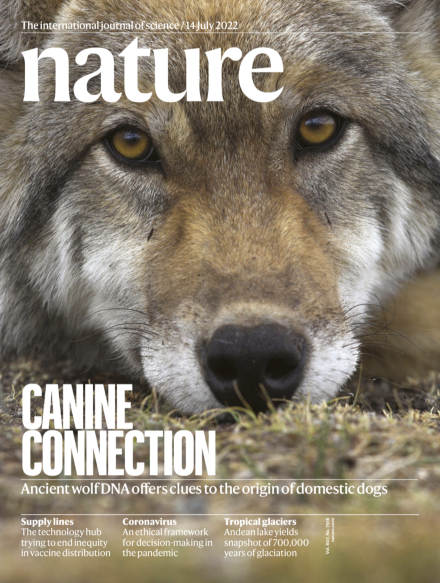
Nature Magazine – July 14, 2022 Issue
Although the domestic dog can trace its origins to the grey wolf (Canis lupus), exactly when, where and how domestication happened has remained a source of debate. In this week’s issue, Anders Bergström, Pontus Skoglund and their colleagues, take a step towards resolving this question. The researchers analysed the genomes of 72 ancient wolves from across Europe, Siberia and North America, and spanning the past 100,000 years. They found that dogs are most closely related to ancient wolves from eastern Eurasia but that dogs in the Near East and Africa derive
up to half their ancestry from a distinct population related to modern southwest Eurasian wolves. Although none of the genomes analysed was a direct match for either dog ancestry, the researchers say that it has narrowed down where next to look for the ancestors of domestic dogs.


CHILE’S VILLARRICA NATIONAL PARK—As a motley medley of mycologists climbed the basalt slopes of the Lanín volcano earlier this year, the green foliage at lower elevations gave way to autumnal golds and reds. Chile’s famed Araucaria—commonly called monkey puzzle trees—soon appeared, their spiny branches curving jauntily upward like so many cats’ tails.
Download PDF – KATIE LANGIN
For some, the ruling limits professional mobility and conference attendance
Download PDF – MITCH LESLIE
To spread, pathogens drive mice, people to make odorant
Download PDF – ROBERT F. SERVICE
In lab studies, SARS-CoV-2 finds ways to evade key drug. Some of the viral mutations are already found in people
Download PDF – ELIZABETH PENNISI
More than nutrient levels may drive toxic lake growths
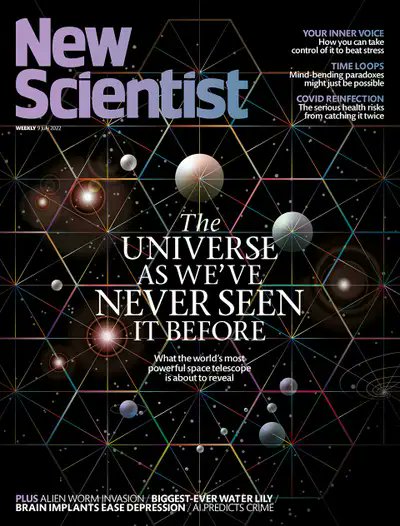
In this week’s issue: We’re about to see the first full-colour images from the James Webb Space Telescope – here’s what we can expect Available at newsstands and via our app for digital and audio editions. https://newscientist.com/issue/3394/



 Boomers Daily