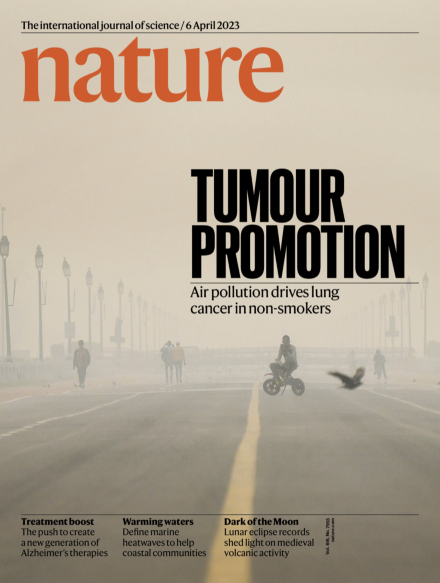
nature Magazine – April 6, 2023 issue: In 1947, Isaac Berenblum proposed that the development of cancer was a two-stage process: the first step introduces mutations into healthy cells, the second then promotes tumour growth through tissue inflammation. In this week’s issue, Charles Swanton and his colleagues investigate the role of particulate matter in prompting the development of non-small-cell lung cancers and find that cancer initiation in response to pollution conforms to Berenblum’s model.
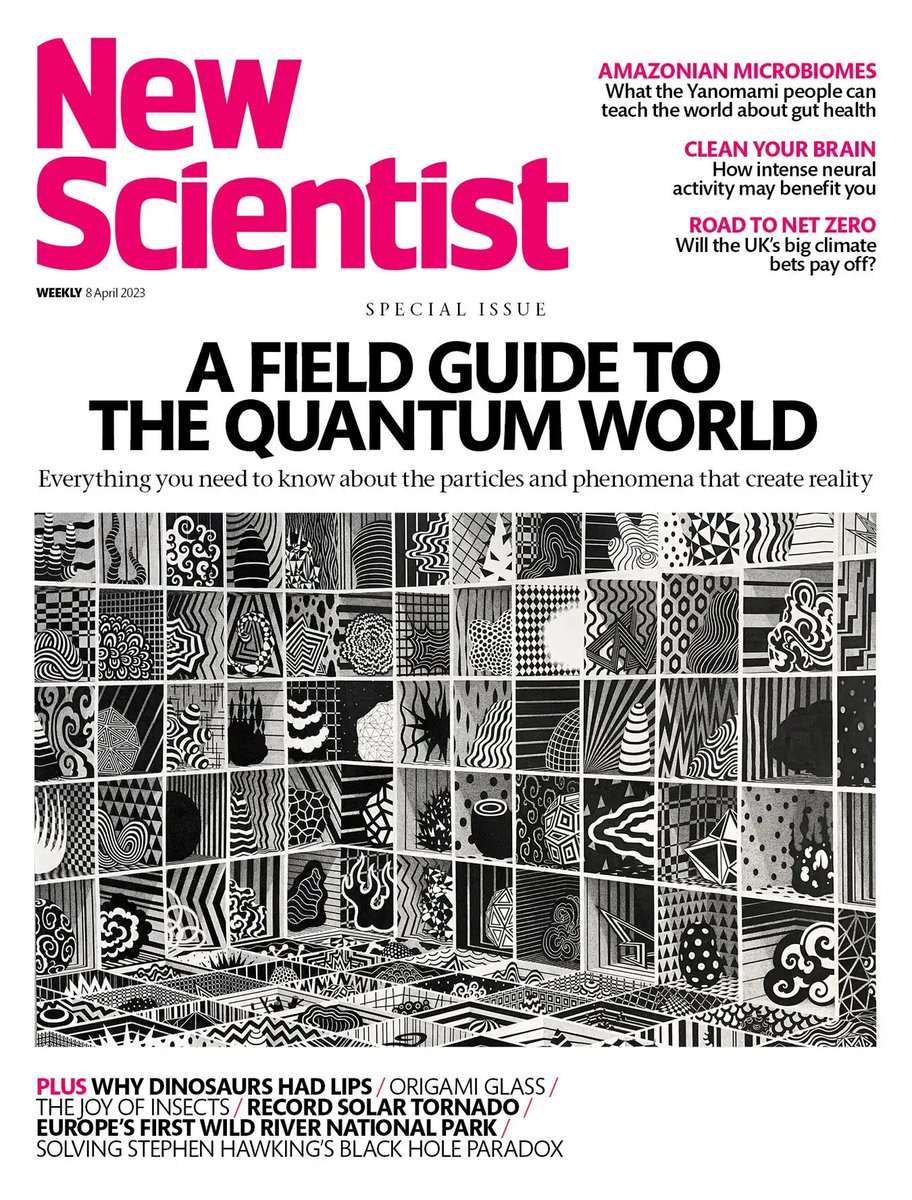
Quantum theory, and the world of subatomic particles and forces it describes, has a daunting reputation for strangeness. And yet, with the right guidance, anyone can enjoy its many wonders
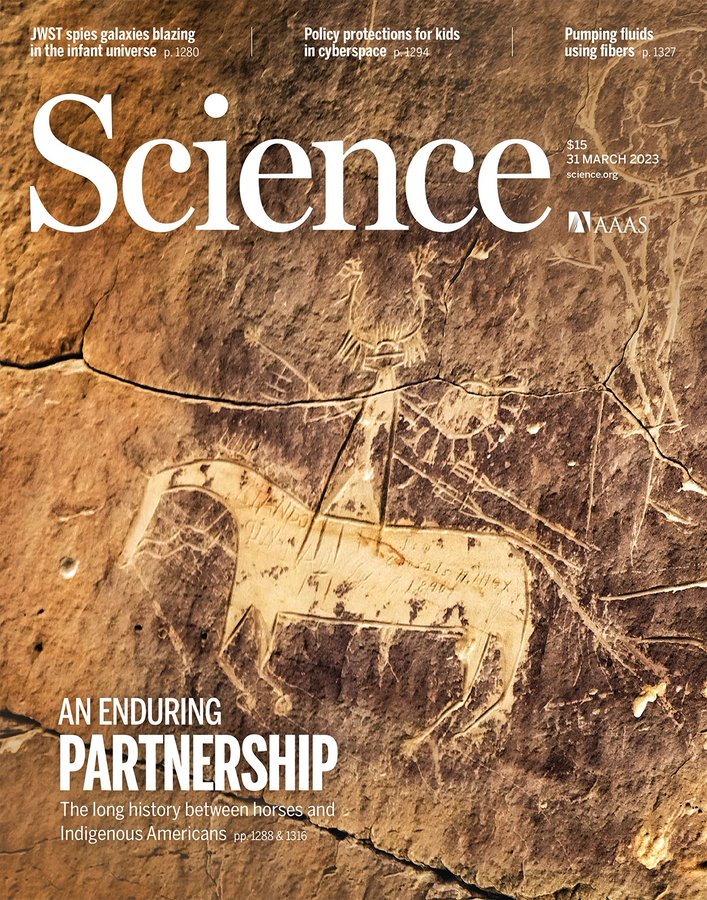
Science Magazine – March 31, 2023 issue: A new analysis shows that Great Plains tribes acquired horses much earlier than some historians had thought, consistent with Indigenous descriptions of a long and enduring partnership with the horse. This petroglyph, from the Tolar site in southern Wyoming, probably dates from soon after the modern horse became widespread in North America in the early 17th century.
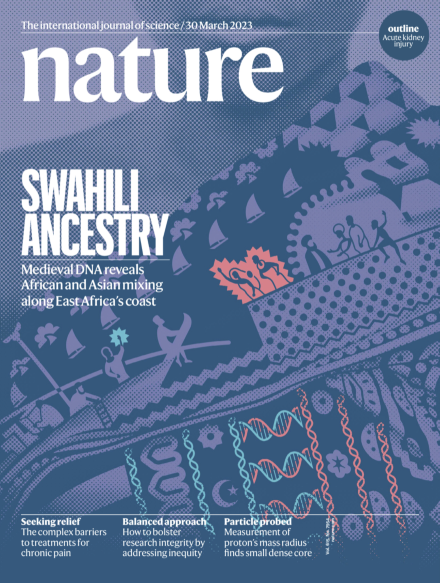
nature Magazine – March 30, 2023 issue: Medieval people on the Swahili coast of East Africa were among the first sub-Saharan people to practise Islam. David Reich, Chapurukha Kusimba and colleagues sequenced DNA from 80 individuals buried in six medieval and early modern coastal Swahili stone towns, dating between 1250 and 1800. Their analysis shows that African women and Asian men began mixing along the East African coast before the year 1000, and that the earliest Asian migrants were of largely Persian origin.
The number of people under 50 with cancer is increasing in many countries and for many different tumour types. Why this is occurring isn’t entirely clear, but it may be due to some aspects of modern life
Science Magazine – March 24, 2023 issue: This color-enhanced scanning electron microscopy image shows Ti2CCl2 MXenes grown by chemical vapor deposition. The two-dimensional layers of this material grew perpendicular to the substrate and then folded into microspherical structures. Ion intercalation between two-dimensional MXene sheets has potential for energy storage and other applications.
Workers disinfected Wuhan’s Huanan Seafood Wholesale Market in March 2020, but not before a Chinese research team collected samples there that would reveal the presence of SARS-CoV-2–susceptible mammals.
Virology database cuts off—and then reinstates—scientists who found and analyzed data collected 3 years ago by team in China
If Zhamanshin crater in Kazakhstan is 30 kilometers wide (red ring) instead of 13 kilometers (black ring), as a new study suggests, the impact that made it would have been far more fierce.
“It would be in the range of serious crap happening.”
At a basic level, humanity’s survival odds come down to one thing: the chances of a giant space rock slamming into the planet and sending us the way of the dinosaurs. One way to calibrate that hazard is to look at the size of Earth’s recent large impact craters.
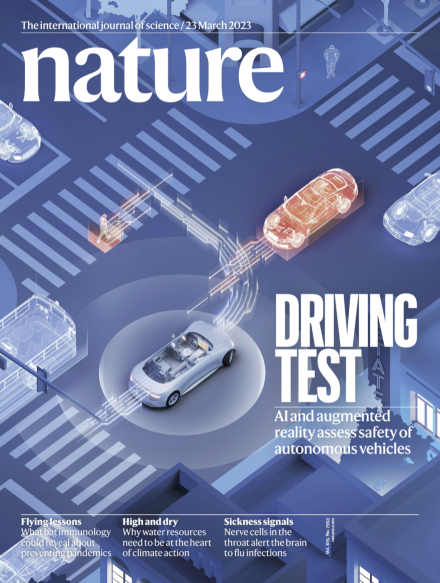
nature Magazine – March 23, 2023 issue: One of the main hurdles to putting autonomous cars on the road is how to ensure the reliability of the artificial intelligence that replaces the human driver. Evaluating the safety of an AI driver to the level of a human in a naturalistic environment would require testing across hundreds of millions of miles — something that is clearly impractical.
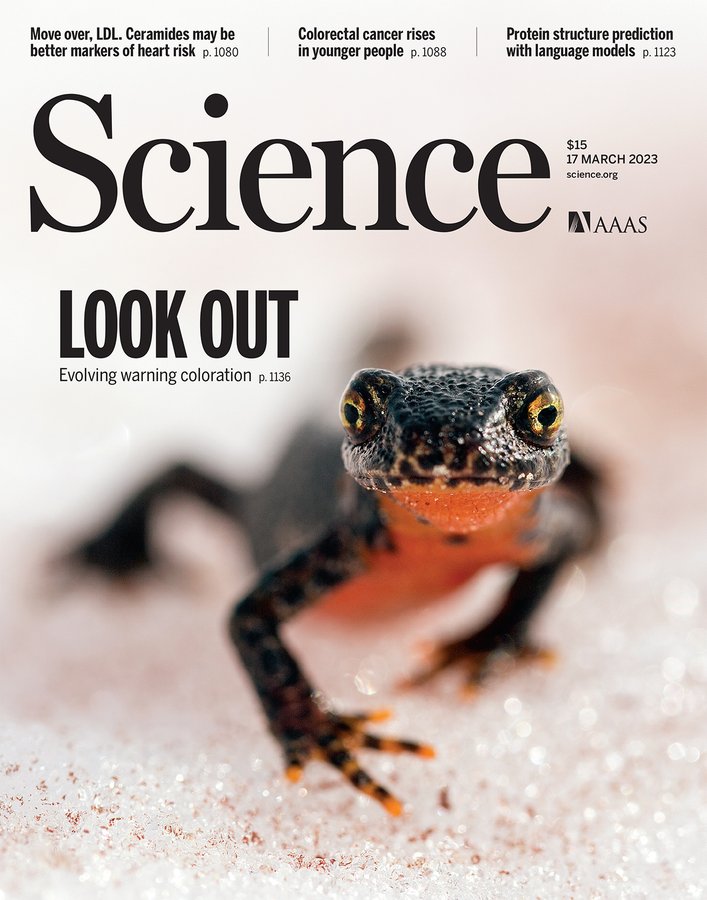
Science Magazine – March 17, 2023 issue: An alpine newt (Ichthyosaura alpestris) walks to a breeding pond in the Alps, France. Many amphibians have a cryptic upper side but a normally concealed, conspicuous underside. These hidden signals have evolved for several reasons, including as a warning display to would-be predators.
The gut microbiota is critical for human health. Understanding how beneficial bacteria colonize the gut enables medical interventions that promote gut health. Krypotou et al. discovered a mechanism that enhances the fitness of a commensal bacterium in the gut.
Palaeolithic hand stencils with missing fingers could indicate ritual mutilation or frostbite – but new research suggests they might be trying to tell us something
From mice with two fathers to cures for debilitating diseases, the transformative power of genomic technology requires some big decisions on what we want to do with it
















 Boomers Daily