
 Orthopedic surgeon Dr. Daniel Thuillier looks at the options to treat severe ankle pain from nonsteroidal anti-inflammatory drugs to surgery including ankle replacement and ankle fusion.
Series: “Mini Medical School for the Public”

Orthopedic surgeon Dr. Daniel Thuillier looks at the options to treat severe ankle pain from nonsteroidal anti-inflammatory drugs to surgery including ankle replacement and ankle fusion.
Series: “Mini Medical School for the Public”
From NPR podcast of Fresh Air with Terry Gross:
 Rieder likens his experiences trying to get off prescription pain meds to a game of hot potato. “The patient is the potato,” he says. “Everybody had a reason to send me to somebody else.”
Eventually Rieder was able to wean himself off the drugs, but not before receiving bad advice and going through intense periods of withdrawal. He shares his insights as both a patient and a bioethicist in a new book, In Pain: A Bioethicist’s Personal Struggle With Opioids.
Press play button above to hear interview.
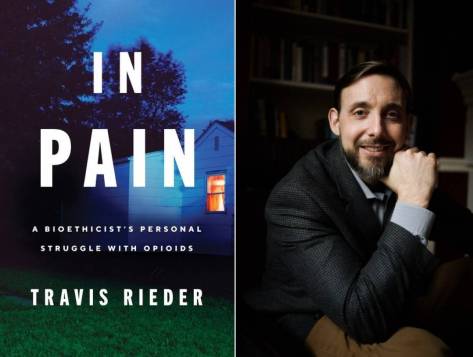
In 2015, Travis Rieder, a medical bioethicist with Johns Hopkins University’s Berman Institute of Bioethics, was involved in a motorcycle accident that crushed his left foot. In the months that followed, he underwent six different surgeries as doctors struggled first to save his foot and then to reconstruct it.
Rieder says that each surgery brought a new wave of pain, sometimes “searing and electrical,” other times “fiery and shocking.” Doctors tried to mitigate the pain by prescribing large doses of opioids, including morphine, fentanyl, Dilaudid, oxycodone and OxyContin. But when it came time to taper off the drugs, Rieder found it nearly impossible to get good advice from any of the clinicians who had treated him.
Read more
From NY Times article by Jane E. Brody:
 The learning curve was steep: “I couldn’t read; I couldn’t write. I could see the hospital signs, the elevator signs, the therapists’ cards, but I couldn’t understand them,” he wrote. The aphasia — the inability to understand or express speech — “had beaten and battered” his pride.
But he refused to give up. With age and prestroke physical conditioning on his side, he had convinced himself that “100 percent recovery was possible as long as I pushed hard enough.”
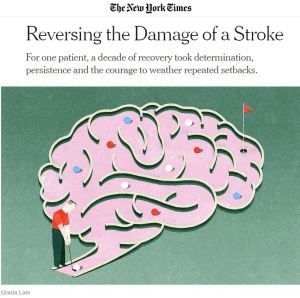
Strange as it may seem, the stroke Ted Baxter suffered in 2005 at age 41, leaving him speechless and paralyzed on his right side, was a blessing in more ways than one. Had the clot, which started in his leg, lodged in his lungs instead of his brain, the doctors told him he would have died from a pulmonary embolism.
And as difficult as it was for him to leave his high-powered professional life behind and replace it with a decade of painstaking recovery, the stroke gave his life a whole new and, in many ways, more rewarding purpose.
Read more by clicking link below:
www.nytimes.com/2019/07/01/well/live/reversing-the-damage-of-a-massive-stroke.html
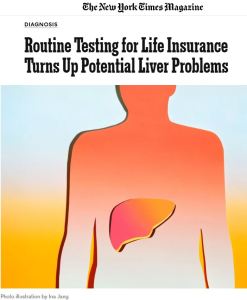 “The doctor asked whether he was sure that he had not taken anything else when he was sick? No acetaminophen? No herbs or supplements? The man was certain. Moreover, his labs were abnormal even before he took the antibiotics. The doctor hypothesized that the man’s liver had been a little inflamed from some minor injury — maybe a virus or other exposure — and the antibiotic, which is cleared through the liver, somehow added insult to injury.”
A few weeks before he got sick, he had blood tests for an application for life insurance. Days later, he heard from his doctor that his liver labs were a little off. There are enzymes in the liver that help with the organ’s work of cleansing the blood. When the liver is injured, these hardworking chemical assistants leak into the circulatory system. The levels of these enzymes, his doctor explained, were double what they should be.
Read more in the NY Times Magazine article by Lisa Sanders, M.D.:
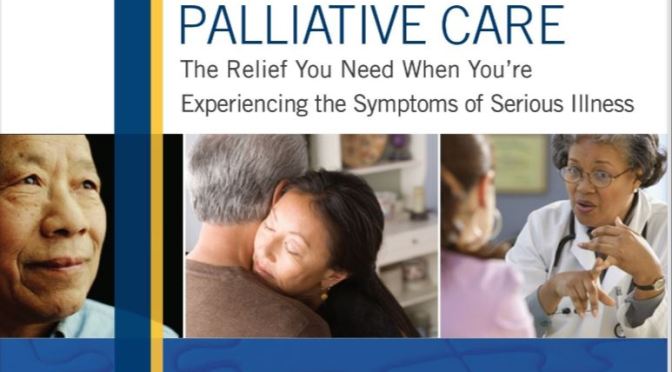
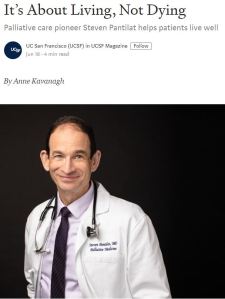 “Doctors and patients are increasingly recognizing the benefits of palliative care. People want care that helps them live as well as possible for as long as possible. Once people learn what palliative care is, they want it. So we’re training experts to meet this growing demand. We have one of the largest fellowship programs in the state, and we also train nursing students, medical students, and residents. We want all clinicians to know the basics of palliative care: how to manage pain, shortness of breath, and nausea and how to talk to patients about the things that matter most to them.”
It’s medical care focused on improving the quality of life for people with serious illnesses. If you’re facing heart failure, cancer, dementia, ALS, or another such disease, we can help you live as well as possible for as long as possible. Palliative care is not about dying but, rather, about living.
Read more at: tinyurl.com/yxslx5v4
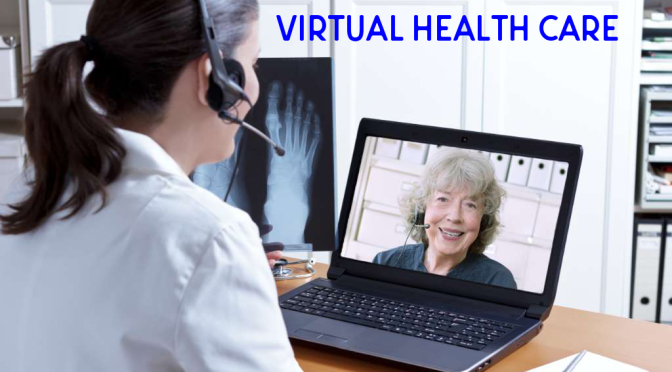
“Virtual care has great potential for the routine treatment of chronic conditions, as well as minor acute illnesses like rashes and ear infections. Digital sensors already make it possible to monitor blood glucose, heart rhythm, blood pressure, temperature, and sleep.”
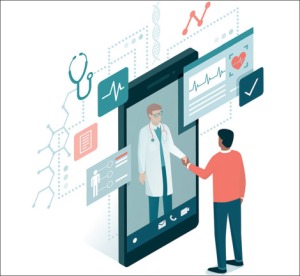 From time immemorial, an invariable feature of doctor–patient interaction has been that it takes place in person. But the status quo is changing. A large portion of patient care might eventually be delivered via telemedicine by virtualists, physicians who treat patients they may never meet.
The burden of disease has changed dramatically in the past century, shifting from acute infectious illnesses to chronic diseases. Clinic visits are poorly suited for the treatment of chronic diseases, yielding only single-point measurements of labile, continuous variables like blood pressure. Within the time constraints of an office visit, it can be difficult for the physician to make an accurate diagnosis, much less educate the patient about treatment and self-care. And after the patient leaves the doctor’s office, only limited monitoring of the condition is usually possible, without a return visit.

Fragility fractures occur in structurally weak bones due to aging and bone loss – osteoporosis. Dr. Anthony Ding explains what “fragility fractures” are, where they occur, what they mean to you, and how they are treated. Series: “Mini Medical School for the Public”.
 “Will price transparency lower health care costs? Economic theory and hospital opposition suggest it would, but the answer is not as straightforward as you might expect and could differ from market to market. Health care is a really strange economic sector, and it doesn’t always follow the usual rules.”
Click link below to read more:
https://hbr.org/2019/07/price-transparency-in-health-care-is-coming-to-the-u-s-but-will-it-matter
Discover the latest tools used to diagnose and treat back and neck pain. Series: “UCSF Osher Center for Integrative Medicine presents Mini Medical School for the Public”
0:24 – Defining the Problem – Vinil Shah, MD
10:13 – A Surgeon’s Perspective – Aaron Clark, MD, PhD
32:57 – Spine Imaging and Pain Intervention – Cynthia Chin, MD
58:24 – Precision Spine Imaging: What the Future Holds – Vinil Shah, MD
1:06:50 – Audience Questions
The role of diet and exercise in addressing prostate cancer with June Chan, UCSF. Series: “Prostate Cancer Patient Conference”.
Press “Play” Button to listen to podcast.


 Boomers Daily