THE ATLANTIC MAGAZINE (April 28, 2025): The latest issue features “I Run The Country and The World” – Donald Trump explains his victory and his plan…
1. “I run the country and the world”
Asked how his second term so far differed from his first, Trump said: “The first time, I had two things to do — run the country and survive; I had all these crooked guys.”
“And the second time, I run the country and the world,” he added.
“I’m having a lot of fun, considering what I do … You know, what I do is such serious stuff.”
2. A third term “would be a big shattering”
Of a potential 2028 run, Trump told the magazine it “would be a big shattering.”
He continued, “Well, maybe I’m just trying to shatter.” But Trump added, “It’s not something that I’m looking to do. And I think it would be a very hard thing to do.”
That follows his comments from last month, when said he is “not joking” about a third term,
Reality check: Trump launching a bid for a third term wouldn’t just shatter norms — it would violate the 22nd amendment.
Meanwhile, the Trump Organization has started selling “Trump 2028” hats.
3. The billionaire class’ “higher level of respect”
The billionaire class has largely bowed to Trump in his second term. He described the mega-rich taking a friendlier posture as “just a higher level of respect.”
“I don’t know … Maybe they didn’t know me at the beginning, and they know me now,” he continued.
HARPER’S MAGAZINE (March 19, 2025): The latest issue features ‘The Social-Skills Crisis’ – Have we forgotten how to work together?; Undercover with New York’s Guardian Angels and The End of Psychoanalysis As We Know It?…
Civilization is a product of canons. The Bible is a canon, and while the Iliad and Odyssey were not quite sacred scripture to the ancient Greeks, the Homeric epics went a long way toward establishing what it meant for a man or a city to be part of the Greek world. That world was almost a synonym for civilization itself. What was not Greek was barbarian.
Noam Chomsky has attained fame in two different areas. He is a world-renowned authority in linguistics and also a major public intellectual. But while in the former area his achievements are universally recognized, even by those who disagree with him, this is not so for his work as a public intellectual, where he is idolized by some, respected by others, tolerated by yet others, and execrated by more than a few.
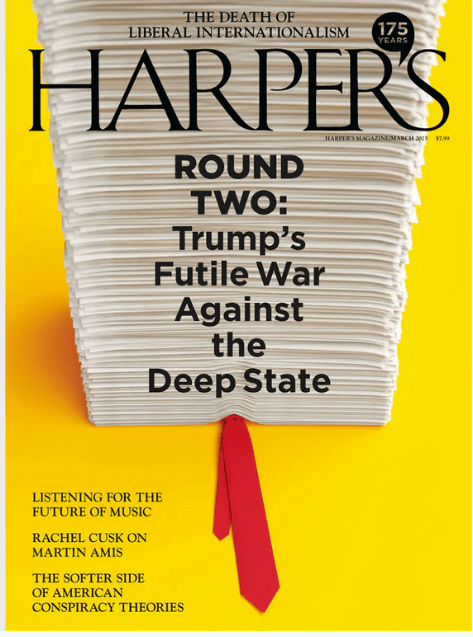
Harper’s Magazine (February 19, 2025): The latest issue features ‘Round Two – Trump’s Futile War Against The Deep State; Listening for the Future of Music; RAchel Cusk on Marin Amis and The Softer Side of American Conspiracy Theories…
FOREIGN AFFAIRS MAGAZINE (February 6, 2025): In the months since Donald Trump won the U.S. presidential election in November, policymakers in Beijing have been looking to the next four years of U.S.-Chinese relations with trepidation. Beijing has been expecting the Trump administration to pursue tough policies toward China, potentially escalating the two countries’ trade war, tech war, and confrontation over Taiwan. The prevailing wisdom is that China must prepare for storms ahead in its dealings with the United States.
Trump’s imposition of ten percent tariffs on all Chinese goods this week seemed to justify those worries. China retaliated swiftly, announcing its own tariffs on certain U.S. goods, as well as restrictions on exports of critical minerals and an antimonopoly investigation into the U.S.-based company Google. But even though Beijing has such tools at its disposal, its ability to outmaneuver Washington in a tit-for-tat exchange is limited by the United States’ relative power and large trade deficit with China. Chinese policymakers, aware of the problem, have been planning more than trade war tactics. Since Trump’s first term, they have been adapting their approach to the United States, and they have spent the past three months further developing their strategy to anticipate, counter, and minimize the damage of Trump’s volatile policymaking. As a result of that planning, a broad effort to shore up China’s domestic economy and foreign relations has been quietly underway.
FOREIGN AFFAIRS MAGAZINE (February 5, 2025): Today, about 20 percent of southeastern Ukraine is under Russian occupation, including Crimea and large parts of the Donetsk, Luhansk, Kherson, and Zaporizhzhia regions. Russian President Vladimir Putin has painted the war in Ukraine as a nationalist campaign to repel Western advances and reclaim territory that, in his view, rightfully belongs to Russia. But conquest has another motivation: economic gain. If Russia maintains military control over these regions, it may be hoping to reap that benefit. At this stage, however, it is hardly clear that they would become economic assets for Moscow; supporting the war-torn territories could just as easily become a drain on its coffers.
The human costs of this war are enormous. Russian forces are ruling occupied Ukraine with an iron fist, engaging in a ruthless campaign of torture, kidnapping, violence, and arbitrary killing. Any assessment of the war’s economic consequences should not minimize its awful depravity or the immense suffering it has inflicted. But its economic outcome will affect future judgments of Putin’s decision to invade in February 2022. If Russia benefits economically from the occupation of Ukraine, the war may be remembered as a strategic success, albeit a coldblooded one. If Russia instead suffers economically, the invasion will be seen as a self-defeating, barbaric blunder.
News, Views and Reviews For The Intellectually Curious






 Boomers Daily