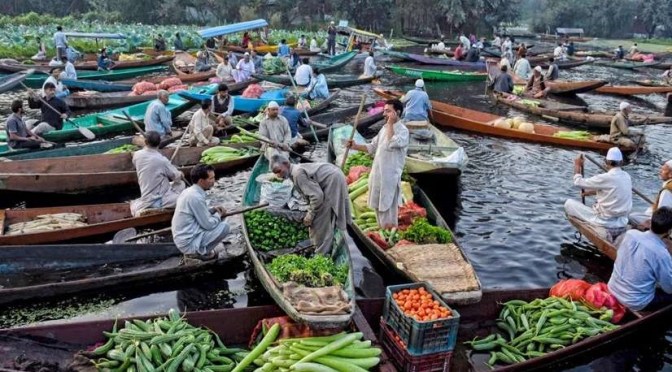
Insider Business (April 21, 2023) – For generations, farmers in Indian-administered Jammu and Kashmir have been selling their crops on the Dal Lake in a floating market. The lake is an economic hub for people living there – with many working in agriculture, fishing, and tourism. But decades of pollution have threatened their livelihoods.
The floating vegetable market on Dal Lake is in Srinagar, Kashmir, where locals trade out of their canoes. The produce sold here is grown in floating gardens.. The rich ecosystem of this wetland produces plenty of tomatoes, cucumbers, water chestnuts and the famous nadru (lotus roots, a delicacy in the Kashmir Valley).
They gather in the centre of the lake at dawn, and disappear just as sunlight hits the waters.
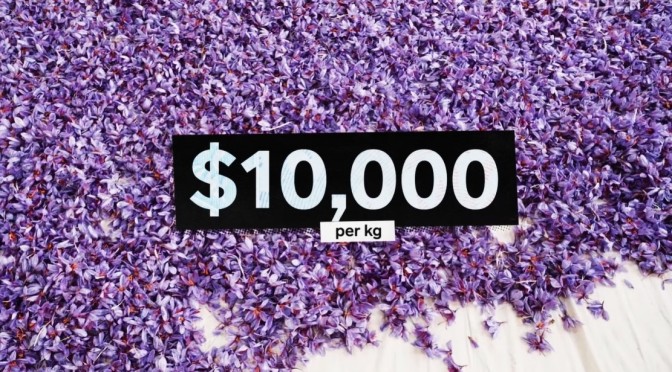
Insider Business (April 4, 2023) – Purple flowers in Kashmir produce the world’s most expensive spice — saffron. While it can sell for $10,000 per kilogram, climate change is making it even more expensive. Because of lower-than-usual rainfall over the last few years, production has dropped significantly.
And fields that once yielded this delicate spice have become sites for new housing construction. Climate change is threatening the production of all kinds of foods from cloves in India to eels in Japan and Spain. Here are 10 expensive, and vulnerable, foods and why climate change is making them so much more expensive.
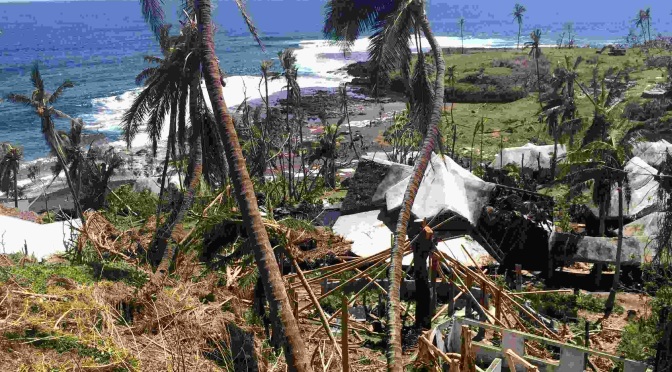
The Independent (March 28, 2023) – The tiny Pacific island state of Vanuatu was hit by two category-four cyclones and two earthquakes over three days this month, in a devastating onslaught that destroyed homes, cut power, and impacted 80 per cent of the population.
Scientists say global heating is already making major tropical cyclones like those that hit Vanuatu more frequent. Under moderate and worst-case climate scenarios, the country is expected to lose around 20-25 per cent of its GDP from natural disasters each year, according to a recent UN report. Later this month Vanuatu’s proposal for a top international court to clarify the obligations of states to tackle climate change and the consequences of not doing so under international law will be put to a vote at the United Nations.
Vanuatu is a South Pacific Ocean nation made up of roughly 80 islands that stretch 1,300 kilometers. The islands offer scuba diving at coral reefs, underwater caverns and wrecks such as the WWII-era troopship SS President Coolidge. Harborside Port Vila, the nation’s capital and economic center, is on the island of Efate. The city is home to the Vanuatu National Museum, which explores the nation’s Melanesian culture.
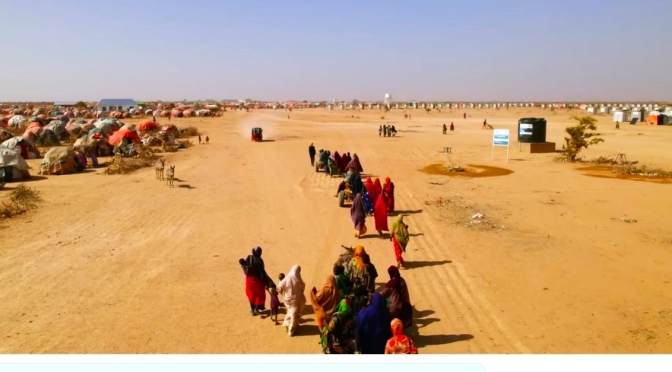
ABC News In-depth (March 23, 2023) – Somalia is one of the most dangerous places on earth. Almost two decades of conflict with the al-Qaeda backed terrorist group al-Shabaab has taken a huge toll on the country. Now Somalia is experiencing its worst drought in 40 years.
“People say that this is the worst drought in 40 years, but that’s wrong,” says Adam Abdelmoula, the UN humanitarian coordinator for Somalia. “This is the worst drought in Somalia’s history, period.”
With the world distracted by the war in Ukraine, the crisis is escalating away from the public gaze. This week on Foreign Correspondent reporter Stephanie March and producer/cinematographer Matt Davis travel to Somalia where makeshift camps have become home to more than a million hungry children and their families.
There, they meet mothers with babies who have walked for days without food and very little water. They hear incredible stories of courage and survival in a landscape that is unforgiving and unsafe. And they also face their own safety problems when their security team worries al-Shabaab has been told of their whereabouts.
As the Somali government fights back against al-Shabaab, another threat, which they have no control over, is driving the extreme weather: climate change. In the midst of this turmoil, the Foreign Correspondent team meets extraordinary people who are determined to make their story one of survival.
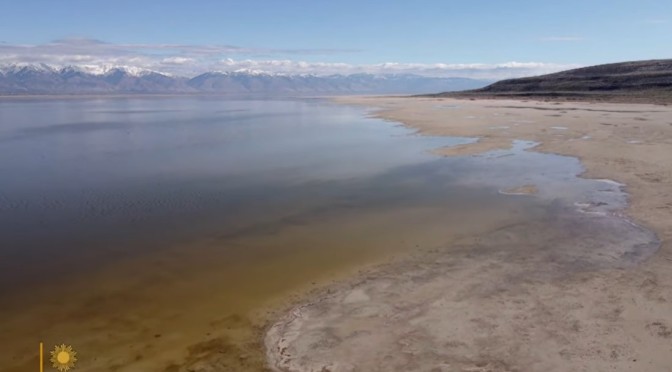
CBS Sunday Morning (February 26, 2023) – Utah’s Great Salt Lake has been in decline, owing to climate change, drought, and over-use of water resources, and is now one-third the size it was in the 1980s. A new scientific report out this month warns that, without dramatic and immediate cuts in water consumption, the lake could vanish in just five years. Correspondent Lee Cowan talks with Sen. Mitt Romney, who co-sponsored a bill studying the lake’s problems, and with experts who say aggressive action is needed.
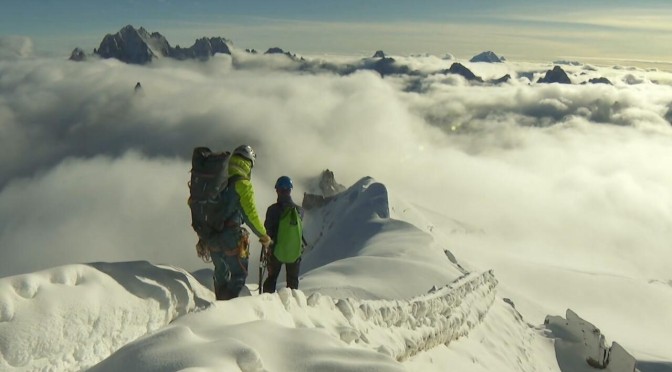
FRANCE 24 English (February 7, 2023) – Glaciers are increasingly threatened by climate change. The French Alps are home to more than 4,000 of these fascinating natural monuments, of which 80 to 90 percent are set to disappear by 2100 due to global warming.
Among the most emblematic glaciers is the Mer de Glace, or Sea of Ice, which retreats a little more each year, under the watchful eye of tourists. Meanwhile, the Bossons glacier reveals aircraft debris that was thought to be lost forever. FRANCE 24 went to meet some of the guardians of the glaciers.
The Economist (February 2, 2023) – As carbon emissions change the chemistry of the seas, ocean acidification threatens marine life and human livelihoods. How worried should you be about climate change’s so-called “evil twin”?
Video timeline: 00:00 The other carbon problem 00:50 How does the ocean’s deepest point reveal its past? 02:55 Why are baby oysters dying? 04:08 Is the ocean acidic? 05:21 What is causing ocean acidification? 06:01 Why are corals dissolving? / Will deep sea ecosystems survive? 08:35 A threat to human livelihoods 10:42 What are the ‘potato chips of the sea’? 12:04 What is the solution?
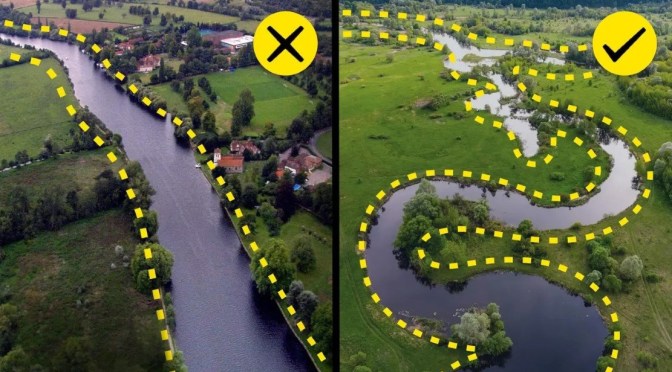
The Guardian – The quintessential image of a river you might recognize from post cards and paintings – nice and straight with a tidy riverbank – is not actually how it is supposed to look.
It’s the result of centuries of industrial and agricultural development. And it’s become a problem, exacerbating the impact of both extreme flooding and extreme drought. Josh Toussaint-Strauss looks into how so many rivers ended up this way, and how river restoration is helping to reestablish biodiversity and combat some of the effects of the climate crisis.
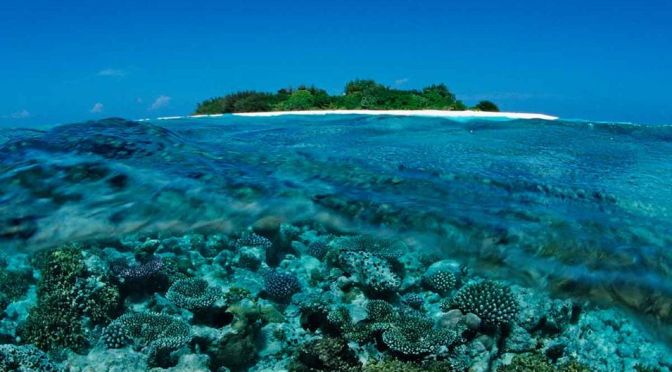
BBC Earth (January 10, 2023) – The Maldives could be underwater by 2100. Maldivians are working together to look to the very thing that defines them – the ocean – to save its future, and their island homes. Narrated by wildlife filmmaker Laura Pennafort.
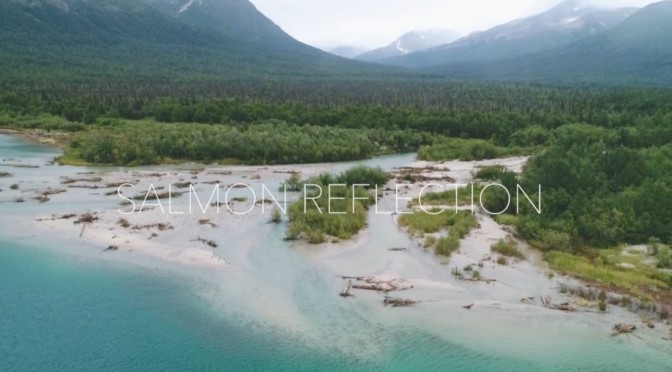
BBC Earth – A unique relationship is changing in Alaska. In her film ‘Salmon Reflection’ Norwegian and Unangax̂ filmmaker Anna Hoover explores the effects of a changing world on the communities of Bristol Bay, one of the last surviving wild salmon ecosystems.
News, Views and Reviews For The Intellectually Curious









 Boomers Daily