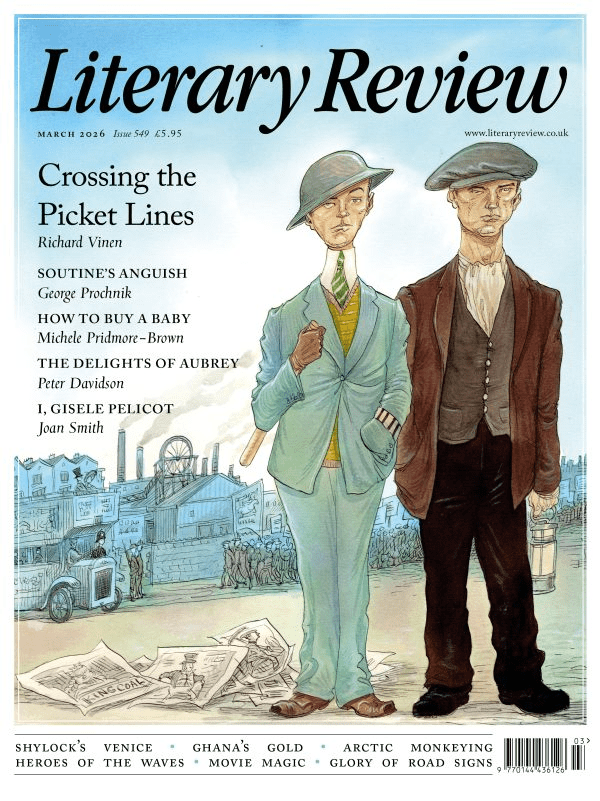
The historian A J P Taylor was at Oxford during the general strike of 1926. After it, he later recalled, relations between the minority of undergraduates, such as himself, who had gone to help the strikers and those who had signed on as special constables or volunteer strike-breakers were cordial. Only those sensible men who had stuck to their books and essays were disdained. The whole episode seemed funny in a stereotypically English way – like a Punch cartoon brought to life.
In A House for Miss Pauline, the Jamaican novelist Diana McCaulay examines her family’s shadowy history by telling the story of a woman who builds her house with the remains of the manor of a former slave plantation.
Four years after their full-scale invasion, the Russians are trying to freeze Ukraine into submission by relentlessly attacking the country’s energy grid.
What Bernie Sanders brought to the job of mayor of Burlington and what he did with it help explain what matters to him and how he fits into American political argument.
Bernie for Burlington: The Rise of the People’s Politician and the Transformation of One American Place by Dan Chiasson
‘Art arises,’ Auden writes, ‘out of our desire for both beauty and truth and our knowledge that they are not identical.’ We want things two ways, which analysis says we cannot have; but for a moment a poem lets us, in a way that discursive prose, for instance, cannot.
Alexandre Kojève described his book on Hegel as ‘very bad’, and he had a point. His take on ThePhenomenology of Spirit is not only misleading but slapdash, dogmatic, frivolous and flamboyant. The characters he filled it with, from the Master and Slave to the Sensualist and the Sage, sound rather like Mr Worldly Wiseman, Madam Bubble and Mr Sagacity in Pilgrim’s Progress.
President Trump’s reversal of a ban on sales of advanced semiconductors to China undercut the strategic logic behind years of American policy that was meant to keep the US ahead in the race to develop AI systems.
The Gilded Cage: Technology, Development, and State Capitalism in China by Ya-Wen Lei
The Thinking Machine: Jensen Huang, Nvidia, and the World’s Most Coveted Microchip by Stephen Witt
The Nvidia Way: Jensen Huang and the Making of a Tech Giant by Tae Kim
Here’s a question I often bat around with graduate students in my International Political Economy seminar: In book 12 of the Odyssey, how do the shipmates know which Ulysses to trust?
You know the story. Ulysses and his crew have been on Circe’s island for a year. They’re finally about to depart when the goddess takes Ulysses aside and warns him of the dangers that await them. The first of these is the “piercing songs” of the Sirens. “So listen,” she says, “I will give you good instructions; another god will make sure you remember.”
Circe tells Ulysses to put wax in his sailors’ ears but that he can listen to the Sirens if he wants to — as long as his shipmates bind him “hand and foot” to the mast: “So bound, you can enjoy the Sirens’ song. But if you beg your men to set you free, they have to tie you down with firmer knots.”
As their ship approaches the Sirens’ sharp rocks, the wind dies down, they pull the sails, and they begin to row. As predicted, Ulysses yells out to his men to set him free. He is still their captain. But instead of obeying his orders, Eurylochus and Perimedes stand up and “tie him down with firmer knots.” How, I ask my students, do they know to trust the first Ulysses over the second? How is it that as readers, we never question their choice?
Albert Kahn has been called “the father of industrial architecture” and “the architect of Detroit.” His firm was certainly prolific: it was responsible for the Ford Motor Company of Canada factory in Toronto, near a laneway that bears his name, and the General Motors assembly plant in Regina, along with nearly 900 buildings in Motor City alone. Kahn’s oeuvre encompassed offices, grand homes for his industrialist clients, and libraries and fraternity houses at the University of Michigan, in Ann Arbor, not to mention a post office, a synagogue, and multiple hospitals and skyscrapers. Many of Kahn’s buildings reflect a pastiche of styles that might be considered a precursor of a postmodern eclectic. Yet this prolific architect is relatively unknown today, especially outside of Michigan.
Albert Kahn Inc.: Architecture, Labor, and Industry, 1905–1961 by Claire Zimmerman
The mood on the Sea Adventurer’s bridge was grim. “She’s only making eight knots,” said our expedition leader. “We need to hit at least fourteen to keep to our itinerary.” We were four days into a two-week sailing and anchored off Ilulissat, near a UNESCO World Heritage site nestled into the crenellated western coast of Greenland.
Earlier that day, I had found myself at the helm of a Zodiac, manoeuvring the rubberized craft through thick fog, near-freezing water, and growlers. The ten high-paying passengers under my care likely had no idea that this was my first trip with the tour operator or my first time north of the Arctic Circle.
News, Views and Reviews For The Intellectually Curious






 Boomers Daily