
Previews: Country Life Magazine – July 3, 2024

Country Life Magazine (July 2, 2024): The latest issue features ‘The Call of the Coast’; Seaside treasure – the museum on the cliff; What a scoop – secrets of the ice-cream makers; A boatbuilder’s life, Barbie’s lore and best beach clubs…

Water, water, everywhere

Ben Lerwill drops anchor in the Thames to meet master boat-builder Mark Edwards, whose eclectic roll call of clients includes Elizabeth II and George Clooney

What’s your flavour?

Artisan ice cream makers have got it licked, says Madeleine Silver, as she checks out cones lovingly created using local milk and natural flavourings

You can be anything

Barbie is still in the pink at the age of 65. Susan Jenkins charts the ups and downs of Mattel’s often-controversial, yet still much-loved figurehead

Travel

Rosie Paterson reveals that Italy is still the place to go for unbeatable beach clubs, Richard MacKichan discovers the untouched isle of Formentera and Pamela Goodman carves out her own niche on a transatlantic cruise

Greg Mosse’s favourite painting

The writer chooses a ‘gorgeous panorama’ bursting with fellowship and rustic merry-making

Wrestling alligators in a mud hole

The country is all of a flutter in the build up to the General Election, but all bets are off for an exasperated Carla Carlisle

The legacy

Kate Green marvels at the Minack, Rowena Cade’s breathtaking cliffside amphitheatre

If I only had a brain

Increasing numbers of jellyfish are wobbling their way into British waters, but there’s no need to be alarmed, says Helen Scales

The good stuff

Hetty Lintell’s bold sunglasses leave everyone else in the shade   

Interiors

Well-thought-out garden buildings are an ideal way to get closer to Nature, suggests Amelia Thorpe

London Life

Rosie Paterson goes up, up and away for the capital’s Balloon Regatta, Levison Wood is in the hotseat, Holly Black takes the wraps off the new-look Royal Academy Schools and Jemima Sissons is on the comeback trail

Coasting ahead

The D-Day landings were planned from its shores, but today George Plumptre finds a haven of peace at Lepe House in Hampshire

Strawberry dreams

Tom Parker Bowles is seduced by the charms of the strawberry, that most flirtatious of fruits

Kitchen garden cook

Melanie Johnson savours the joy of sweet and floral apricots

The dog days aren’t done

All eyes are on St Swithin’s Day as Lia Leendertz examines what weather lore has in store
Books: Literary Review Magazine – July 2024

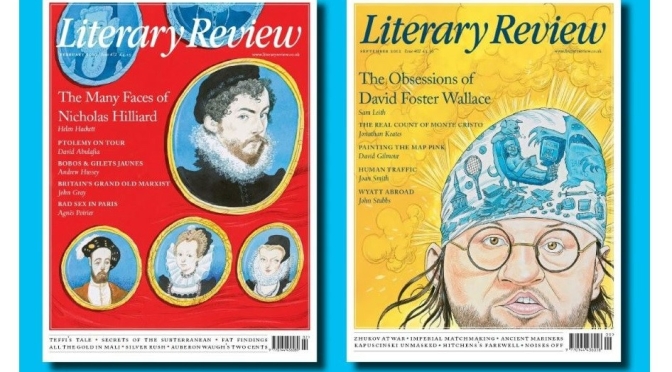
Literary Review – July 2, 2024: The latest issue features ‘A Tale of Two Fabulists’, North America Ablaze, Pascal Decoded, League of Dictators and Roffey’s Rage…

The Blood-Spattered Banner

American Civil Wars: A Continental History, 1850–1873 By Alan Taylor

A mountain of historical studies testifies to enduring interest in the American Civil War, a conflict still politically relevant in a nation riven over how to remember it. Those doubting that there is anything fresh to say about the bloodiest event in the republic’s history should read Pulitzer Prize winner Alan Taylor’s brilliant, panoramic account of the conflict. 

Ambassadors Behaving Badly

Travellers in the Golden Realm: How Mughal India Connected England to the World By Lubaaba Al-Azami

One contender for the title of centre of the civilised world in the early 17th century is the Mughal Empire. Lubaaba Al-Azami describes it as ‘a global capital and commercial hub’. The Mughal Empire reached its zenith between the reigns of Babur, the first emperor, who established the ‘golden realm’ in 1526, and his great-great-great-grandson the sixth emperor, Aurangzeb, who died in 1707. This was a time when the artists of the fabulously wealthy Mughal dynasty were building the Taj Mahal and writing and illuminating the Padshahnama

Threepenny Republic

Vertigo: The Rise and Fall of Weimar Germany 1918–1933 By Harald Jähner (Translated from German by Shaun Whiteside)

Takeover: Hitler’s Final Rise to Power By Timothy W Ryback

The Weimar Republic (so called as the parliament which drafted its constitution in 1919 sat in Weimar owing to unrest in Berlin) lasted for fourteen years and four months, two years longer than the Third Reich that succeeded it. Its history is beset with ironies. Its first president, Friedrich Ebert, a social democrat (and a former innkeeper), turned out to be the embodiment of petit-bourgeois conservatism. Having ditched the monarchy, he made a bargain with the army: they would defend the nascent republic in return for maintaining the old officer corps. This enabled the regime to survive five chaotic years marked by numerous violent attempts to overthrow it from both the Left and the Right. 

Technology Report: “Spycraft” – July 6, 2024

Technology Quarterly: Watching the watchers

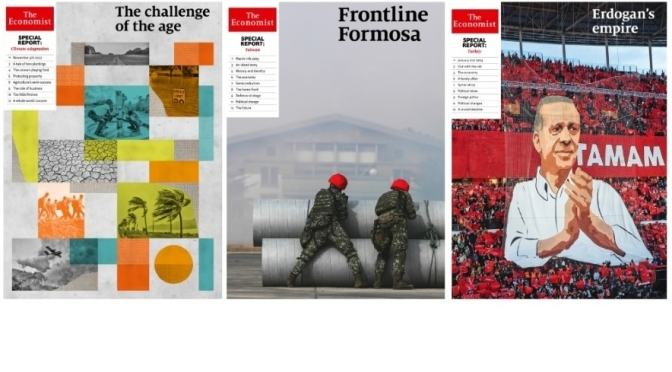
The Economist SPECIAL REPORTS (July 2, 2024): The ‘Watching The Watchers’ issue features Tools of the spy trade have changed and so has the world in which they are used, says Shashank Joshi

The tools of global spycraft have changed

Illustration of two magnifying glasses with eyes inside on a background of digital files and pointing cursors.
illustration: claire merchlinsky

And so has the world in which they are used, says Shashank Joshi

Afew years ago intelligence analysts observed that internet-connected cctv cameras in Taiwan and South Korea were inexplicably talking to vital parts of the Indian power grid. The strange connection turned out to be a deliberately circuitous route by which Chinese spies were communicating with malware they had previously buried deep inside crucial parts of the Indian grid (presumably to enable future sabotage). The analysts spotted it because they were scanning the internet to look for “command and control” (c2) nodes—such as cameras—that hackers use as stepping stones to their victims.

Ubiquitous technical surveillance has made spying more difficult

Signals intelligence has become a cyber-activity

Sometimes the old ways of espionage are the best

Artificial intelligence can speed-sort satellite photos

Private firms and open sources are giving spies a run for their money

News: Israel Frees Dozens Of Palestinian Prisoners, Gaza Humanitarian Crisis

The Globalist Podcast (July 2, 2024): We discuss the latest on the Hamas-Israel war following the release of dozens of Palestinian prisoners and the UN Security Council’s special session on the humanitarian situation in Gaza.

Meanwhile, a new European far-right alliance led by Hungary’s Viktor Orbán is announced in Vienna. Plus, a flick through the papers, South Africa’s new government and a round-up of fashion and retail news.

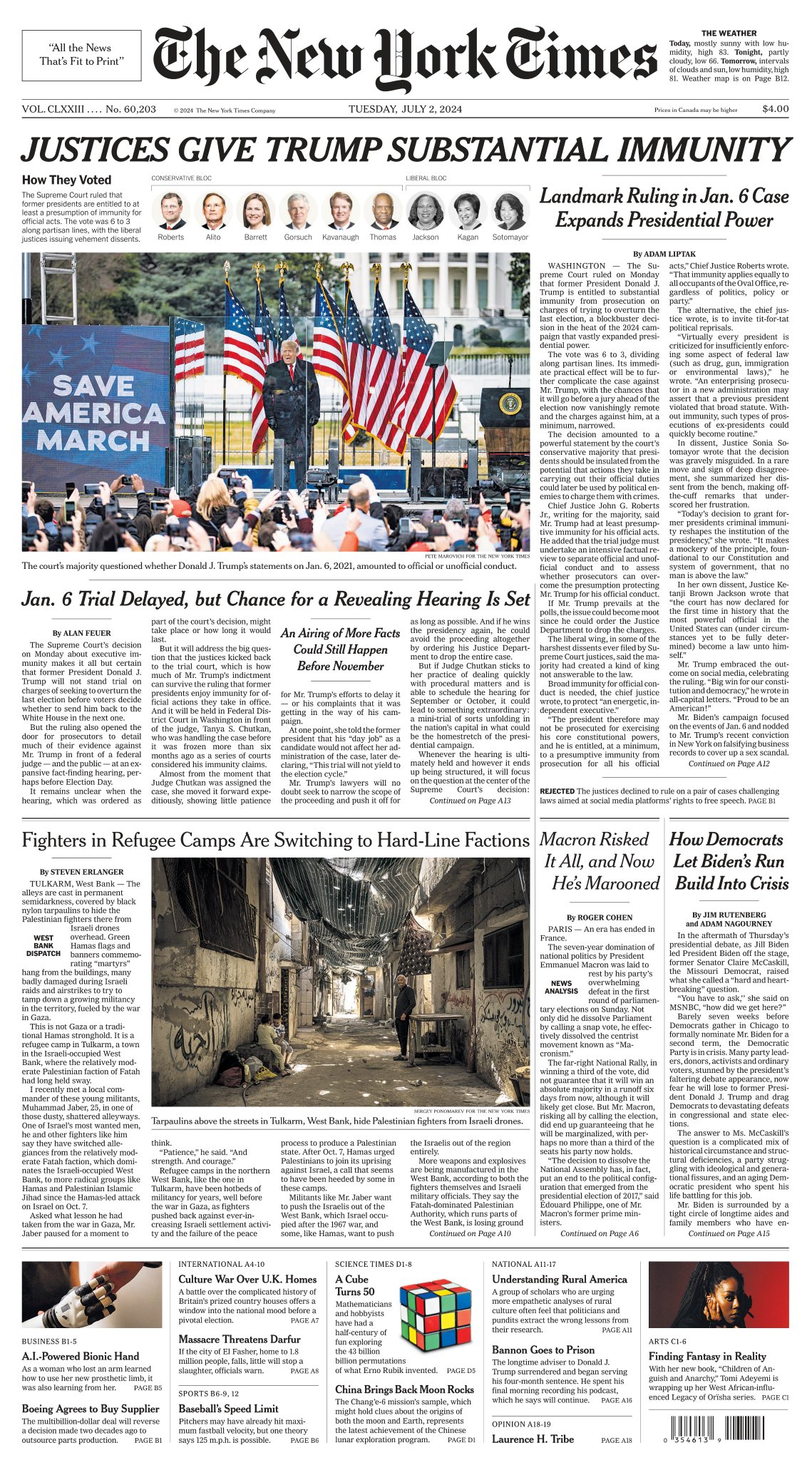
The New York Times — Tuesday, July 2, 2024

Image

Supreme Court Says Trump Has Some Immunity in Election Case

The ruling makes a distinction between official actions of a president, which have immunity, and those of a private citizen. In dissent, the court’s liberals lament a vast expansion of presidential power.

Ruling Further Slows Trump Election Case but Opens Door to Airing of Evidence

The Supreme Court’s immunity decision directed the trial court to hold hearings on what portions of the indictment can survive — a possible chance for prosecutors to set out their case in public before Election Day.

The Road to a Crisis: How Democrats Let Biden Glide to Renomination

An 81-year-old candidate and no Plan B. “How did we get here?” one leading Democrat asks. The answer is complicated.

The Center Collapses in France, Leaving Macron Marooned

Squeezed by the far-right National Rally party and the left, President Emmanuel Macron faces a country that may prove ungovernable.