1. The U.S. Supreme Court has rejected a Republican bid to invalidate the Affordable Care Act, also known as Obamacare, preserving the landmark healthcare law for the third time since its 2010 enactment.
2. Juneteenth is now a federal holiday. Joe Biden signed into law a bill making June 19 a national holiday commemorating the emancipation of enslaved Black Americans.
3. China launched three astronauts up to its unfinished space station on the Shenzhou-12 spacecraft. The astronauts will live in a module called ‘Tianhe’ for three months.
4. Israeli aircraft struck Hamas sites in Gaza on Thursday night after incendiary balloons were launched from the Palestinian enclave, for the second time this week, since a fragile ceasefire ended 11 days of deadly fighting last month.
5. Iranians voted in a presidential election likely to be won by a hardline judge subject to U.S. sanctions.
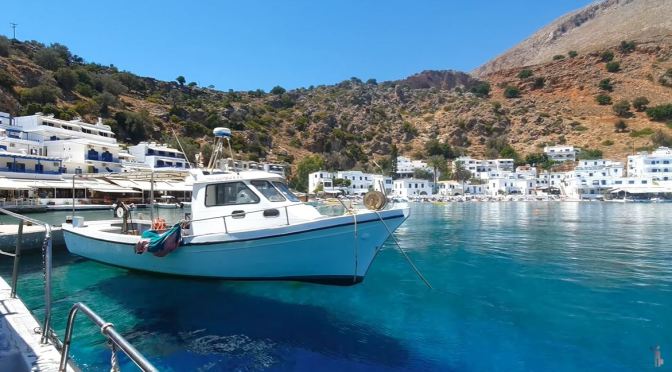
Loutro lies on the south coast of Chania regional unit in west Crete, between Chora Sfakion and Agia Roumeli, the exit to the Samaria Gorge. The whole area is known as Sfakia. The village got its name from the Greek word for “bath,” for the many ancient baths found in the area.
Loutro is such an incredibly soporific place, where there’s absolutely nothing ( … almost ) to do but eat, drink and laze – and where you fast lose any desire to do anything else. There are hundreds of people who walk down the Samaria Gorge each day in the summer. After a drink at one of the tavernas in Agia Roumeli where the gorge opens to the sea and perhaps enjoying a swim, most board the ferry taking them to Chora Sfakia (Sfakia). There, waiting for buses transport the aching crowds back to Chania. On the way, the ferry calls in at Loutro, and many vow to visit it one day – few do so! Loutro is peaceful – it is small and feels like a village even if 95% of the people here in the summer are visitors. It takes less than five minutes to amble from one side of the bay from Sifis Hotel & Maestrali Bar (Vangelis’), past Daskalogiannis Hotel, the tavernas, mini-market, the Blue House, the pebble beach, Hotel Porto Loutro, Notos, “Fat Stav’s”, a couple more tavernas and then Keramos rooms and fish taverna. This is a magic place to relax, swim, read, write your own book in western Crete, Sfakia region. Don’t forget the church, second mini-market, and a few other buildings – more rooms including perched-on-the-hillside Villa Niki – that’s it! Loutro evokes some great emotion – produced perhaps by the unique combination of the steep, harsh, rock mountainsides – audibly decorated with the clinking of goat bells – the sun visibly changing the panorama in view as its ark lights different aspects of the slopes forming the bowl – the bay that houses Loutro, the often-warm sea, the history, and the people. This magic place. No road leads here – therefore no mopeds, cars, and trucks disturb contemplation, conversation, and consumption of food or drink. A port of shelter for St Paul we hear, and one of the best shelters from a stormy workplace or busy professional life. Small, stunningly beautiful – no nightlife or discos, just a multinational, multi-everything group of visitors staying in its closely grouped buildings. During the day even when all rooms are full, Loutro can be almost empty – many have gone to sauté gently on nearby beaches, or tackle books, strolls, walks, and – let’s be serious – hikes. You are left to act as your own custodian of the semi-circular bay, with a small pebble beach, edged with the hotel, domatia, and waterside tavernas. So gaze at the ruins on the hilltop, measure the approaching ferry, decide whether to read a few pages more, walk over the hill to the taverna of Phoenix, or plot your ascent to Anopolis a thousand meters above…it’s up to you. Time passes. Loutro village was named after the baths (Loutro or Loutra) found in the area, and from which water was directed to nearby Anopoli Village. Loutro also served as the port of ancient Anopoli. Later it became the winter time port of the town of Sfakia, due to the fact that the enclosed bay and the small island at its entrance create a natural harbor where ships can be safe even in very bad weather conditions. Mountains rear straight up from the sea deep wooded gorges, ravines, and valleys, stand proud, and act as a magnet to the eye and the imagination. The Sfakia region has been the site of heroic deeds, ancient civilizations, and constant intrigue for thousands of years, and the home of brave tough people made so by their labors on the land and their experiences. Really Loutro is a place to let days flow by as they will. When you meet people who are poetic utterances appeal – converse, when striding rocky paths is the urge – proceed, when the water beckons – shout back / get in; eat and relax. You shouldn’t come here expecting entertainment – the reward is being in Loutro and listening to what your heart desires…
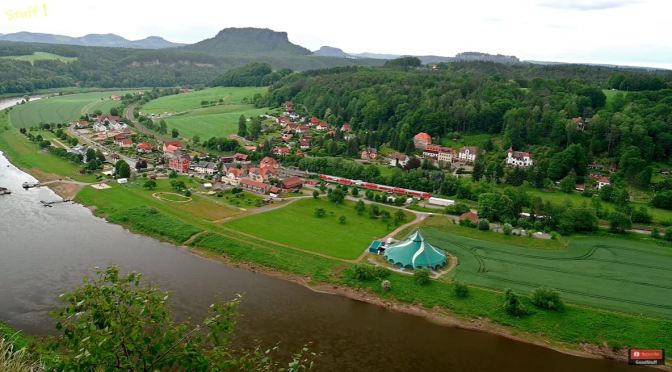
Saxon Switzerland (or in german Sächsische Schweiz) is National Park in Saxony Germany. It is famous for its wonderful landscape of Sandstone that was formed around 100 million years ago.
Saxon Switzerland National Park, is a National Park in the German Free State of Saxony, near the Saxon capital Dresden. It covers two areas of 93.5 km² in the heart of the German part of the Elbe Sandstone Mountains, which is often called Saxon Switzerland.
A look ahead to the weekend’s regional election in France, a look at the state of US foreign policy after an eventful week for president Biden, plus the renaissance of night trains in Europe.
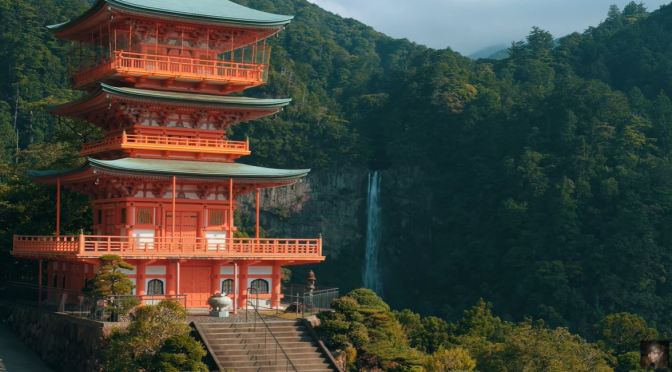
Daimonzaka is a slope located in Nachikatsuura Town, Wakayama Prefecture, and is the approach to Kumano Nachi Taisha Shrine. The course from Daimonzaka to Nachi Taisha is easy to walk and easily accessible from the station, and is popular with tourists visiting Nachikatsuura.
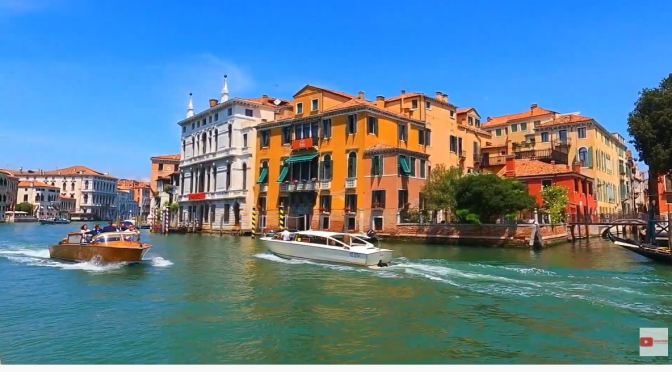
1.- The 4 Bridges Crossing the Canal Grande in Venice: Ponte de Rialto, Ponte dell’Accademia, Ponte degli Scalzi, Ponte della Costituzione. 2.- Most famouse attraction along the Grand Canal: St Mark Square, Doge Palace, Santa Maria della Salute Church, Peggy Guggenheim Colletion (Ca’ Venier dei Leoni), Palazzo Corner della Ca’ Grande, Ponte dell’Accademia and the Academy of Fine Arts, Ca’ Rezzonico, Ca’ Foscari, Rialto Bridge, Fondaco dei Tedeschi, Ca’ da Mosto, Fish Market, Ca’ d’Oro, Ca’ Pesaro, Fondamenta Turchi and the Natural History Museum, Constitution Bridge.
Video timeline: 00:00 St. Mark and Doge Palace from Grand Canal 01:50 First stop S. Marco (Line 1 vaporetto) 02:33 Punta della Dogana and Santa Maria della Salute Church 03:43 Hotel Bauer 5 stars 03:57 Palazzo Treves 04:08 Santa Maria della Salute Church 04:38 Palazzo Contarini Fasan 07:31 The Gritti Palace Hotel 5 stars 09:20 Palazzo Corner della Ca’ Granda 09:40 Casina delle Rose 10:13 Palazzi Barbaro 10:17 Palazzo Cavalli-Franchetti 10:24 Accademia bridge 13:15 Palazzo Malipiero 19:28 S. Angelo vaporetto 24:58 Rialto vaporetto stop 26:43 T Fondaco dei Tedeschi by DFS 31:15 Ca’ D’Oro vaporetto stop 34:51 Casino’ Venice 37:47 Church of san geremia 40:27 Ponte degli Scalzi 40:48 Ferrovia vaporetto stop 42:28 Traun station “Santa Lucia” 43:29 Ponte della Costituzione








 Boomers Daily