
 First up this week, Staff Writer Jennifer Couzin-Frankel talks with host Sarah Crespi about a rare inflammatory response in children that has appeared in a number of COVID-19 hot spots.
 Next, Julian Dowdeswell, director of the Scott Polar Research Institute and professor of physical geography at the University of Cambridge, talks with producer Meagan Cantwell about tracing the retreat of Antarctica’s glaciers by examining the ocean floor. Finally, Kiki Sanford interviews author Danny Dorling about his new book, Slowdown: The End of the Great Acceleration―and Why It’s Good for the Planet, the Economy, and Our Lives.
Online News Editor David Grimm talks with producer Joel Goldberg about the unique challenges of reopening labs amid the coronavirus pandemic. Though the chance to resume research may instill a sense of hope, new policies around physical distancing and access to facilities threaten to derail studies—and even careers.
Despite all the uncertainty, the crisis could result in new approaches that ultimately benefit the scientific community and the world. Also this week, Joel Podgorski, a senior scientist in the Water Resources and Drinking Water Department at the Swiss Federal Institute of Aquatic Science and Technology, joins host Sarah Crespi to discuss the global threat of arsenic in drinking water. Arsenic is basically present in all rocks in minute amounts. Under the right conditions it can leach into groundwater and poison drinking water. Without a noticeable taste or smell, arsenic contamination can go undetected for years. The paper, published in Science, estimates that more than 100 million people are at risk of drinking arsenic-contaminated water and provides a guide for the most important places to test.
 Contributing Correspondent Lizzie Wade talks with host Sarah Crespi about the role of inequality in past pandemics. Evidence from medical records and cemeteries suggests diseases like the 1918 flu, smallpox, and even the Black Death weren’t indiscriminately killing people—instead these infections caused more deaths in those with less money or status.
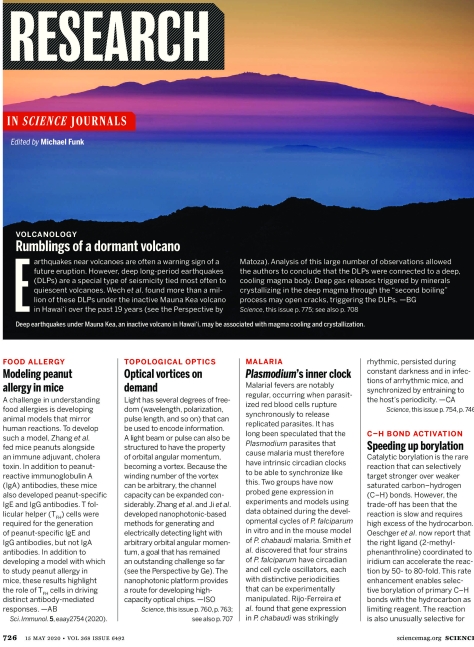
Also this week, Aaron Wech, a research geophysicist for the U.S. Geological Survey at the Alaska Volcano Observatory, joins Sarah to talk about recordings of more than 1 million earthquakes from deep under Hawaii’s Mauna Kea volcano, which hasn’t erupted in 4500 years. They discuss how these earthquakes, which have repeated every 7 to 12 minutes for at least 20 years, went undetected for so long.
Staff Writer Jon Cohen joins host Sarah Crespi to talk about using monoclonal antibodies to treat or prevent infection by SARS-CoV-2. Many companies and researchers are rushing to design and test this type of treatment, which proved effective in combating Ebola last year. See all of our News coverage of the pandemic here, and all of our Research and Editorials here. And Karen Holl, a professor of environmental studies at the University of California, Santa Cruz, joins Sarah to discuss the proper planning of tree-planting campaigns. It turns out that just putting a tree in the ground is not enough to stop climate change and reforest the planet.
Staff Writer Jocelyn Kaiser joins Sarah to talk about a recent Science paper describing the results of a large study on a blood test for multiple types of cancer. The trial’s results suggest such a blood test combined with follow-up scans may help detect cancers early, but there is a danger of too many false positives. And postdoctoral researcher Timo Reinhold of the Max Planck Institute for Solar System Research joins Sarah to talk about his paper on how the Sun is a lot less variable in its magnetic activity compared with similar stars—what does it mean that our Sun is a little bit boring?


 Boomers Daily