The triumph and tragedy of the Higgs boson
Ten years ago, physicists found what they predicted. Little new has followed
Ancient DNA reveals Black Death source
Graves in Kyrgyzstan hold early victims of plague that swept medieval Europe

Ten years ago, physicists found what they predicted. Little new has followed
Graves in Kyrgyzstan hold early victims of plague that swept medieval Europe

REPORTS BY
REPORTS BY
RESEARCH ARTICLES BY
RESEARCH ARTICLES BY
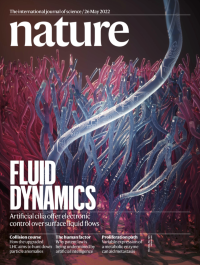
Cilia are characterized by slender, threadlike projections, which are used by biological organisms to control fluid flows at the microscale. Attempts to mimic these structures and engineer cilia-like systems to have broad applications have proved problematic. In this week’s issue, Wei Wang and colleagues present electronically controlled artificial cilia that can be used to create flow patterns in near-surface liquids. The researchers use surface-mounted platinum strips, each about 50 micrometres long, 5 micrometres wide and 10 nanometres thick, and capped on one side with titanium. Applying an oscillating potential with an amplitude of around 1 volt to the cilia drives ions on to and off of the exposed platinum surface. These ions create asymmetric forces that generate a beating pattern that can be used to pump surface liquids in various flow geometries. The cover shows an artist’s impression of the artificial cilia in action.
A survey of cell types across tissues as part of the Human Cell Atlas, mapped with single-cell transcriptomics in three papers in this issue, lays the foundation for understanding how cellular composition and gene expression vary across the human body in health, and for understanding how genes act in disease.
Download PDF – Sites compete to mark global changes of the 1950s and define new geological age
Download PDF – Agency wants to retool its surveys and decennial census to improve efficiency and generate better data
Download PDF – Critics challenge data underpinning “resolution immunology,” triggering university probes
Download PDF – As prosecutors evaluate complaints from animal rights groups, labs try to reduce surplus
Download PDF – Atmospheric analog to ocean’s acoustic channel could be used to monitor eruptions and bombs
On this week’s show: Climate change is killing critical soil organisms in arid regions, and early evidence for the Maya calendar from a site in Guatemala.
Staff Writer Elizabeth Pennisi joins host Sarah Crespi to discuss how climate change is affecting “biocrust,” a thin layer of fungi, lichens, and other microbes that sits on top of desert soil, helping retain water and create nutrients for rest of the ecosystem. Recent measurements in Utah suggest the warming climate is causing a decline in the lichen component of biocrust, which is important for adding nitrogen into soils.
Next, Sarah talks with Skidmore College anthropologist Heather Hurst, who directs Guatemala’s San Bartolo-Xultun Regional Archaeological Project, and David Stuart, a professor of art history and director of the Mesoamerica Center at the University of Texas, Austin, about their new Science Advances paper. The study used radiocarbon dating to pin down the age of one of the earliest pieces of the Maya calendar. Found in an archaeological dig in San Bartolo, Guatemala, the character known as “seven deer” (which represents a day in the Maya calendar), was dated to 300 B.C.E. That early appearance challenges what researchers know about the age and origins of the Maya dating system.
COVER – A glass structure about 4.5 mm tall with features as small as 0.25 mm is 3D printed with microscale computed axial lithography followed by high-temperature sintering. The process enables the synthesis of highly transparent and inert glass parts with fine details, which are useful for a variety of applications.
Pandemic propels international efforts to understand incidence of rare side effects
Campaign probes for earliest signs of oxygen-producing life
Efficiency jump in key component raises hopes for storing renewable energy as heat

 Boomers Daily