The Week In Art Podcast (October 27, 2023): This week: the first Kyiv Biennial since Russia’s invasion of Ukraine last year is taking place in various locations across the wartorn country as well as a host of neighbouring European states.
We talk to the co-curator, Georg Schöllhammer, about this year’s event. As refugees and displaced people continue to dominate the news, a global sound art project, Migration Sounds, aims to explore and reimagine the sounds of human migration and settlement.
We speak to Stuart Fowkes, the founder of Cities and Memory, who has conceived the project with the University of Oxford’s Centre on Migration, Policy and Society (Compas). And this episode’s Work of the Week is Rebirth of a Nation, a mural made for Brixton Underground Station in London by the Ethiopian-Italian artist Jem Perucchini, which is unveiled next week. Jessica Vaughan, the senior curator of Art on the Underground, tells us about the commission.
The Kyiv Biennial continues to unfold into 2024, visit 2023.kyivbiennial.org
Cities and Memory’s Migration Sounds project, citiesandmemory.com/migration; compas.ox.ac.uk
Jem Perucchini: Rebirth of a Nation, Brixton Underground Station, London, from 2 November.
The Week In Art Podcast (October 20, 2023): This week: it’s the second year of Paris +, the event that has taken over from Fiac as the leading French art fair. How is Art Basel’s French flagship faring amid geopolitical turmoil and economic uncertainty, and is Paris still on the rise as a cultural hub?
We speak to Georgina Adam, an editor-at-large at The Art Newspaper, and Kabir Jhala, our deputy art market editor, who are in Paris, to find out. The largest ever exhibition of the work of the Japanese photographer Hiroshi Sugimoto opened last week at the Hayward Gallery in London, before travelling to Beijing and Sydney next year. We talk to its co-curator Thomas Sutton.
And this episode’s Work of the Week is La femme-cheval or the Horse-Woman, a painting made in 1918 by the French artist Marie Laurencin. She is the subject of a major survey, called Sapphic Paris, opening this week at the Barnes Foundation in Philadelphia in the US. Cindy Kang, who co-curated the exhibition, tells us more about this landmark work in Laurencin’s life.
Paris +, 20-22 October.
Hiroshi Sugimoto: Time Machine, Hayward Gallery, London, until 7 January 2023; UCCA Center for Contemporary Art, Beijing, 23 March-23 June 2024; The Museum of Contemporary Art, Sydney, Australia, 2 August-27 October 2024.
The Week In Art Podcast (October 13, 2023): The Frieze art fair has turned 20 this week, and is only growing in its ambitions, having acquired the Armory Show fair in New York and Expo Chicago.
So what should we make of Frieze’s continuing expansion and what’s the mood at Frieze London and Frieze Masters this year? We talk to Tim Schneider, The Art Newspaper’s acting art market editor, who is over from New York for the fairs. In Reykjavik in Iceland, the artist-run Sequences Biennial opens on Friday. A former curator of the event is Hildigunnur Birgisdóttir, who will represent Iceland at the Venice Biennale in 2024. Tom Seymour went to the Icelandic capital to talk to her about Venice, Sequences and the Icelandic scene.
And this episode’s Work of the Week is Open Window, Collioure (1905) by Henri Matisse. The painting is a highlight of the exhibition Vertigo of Colour: Matisse, Derain, and the Origins of Fauvism at the Metropolitan Museum of Art in New York. We speak to Dita Amory, co-curator of the show, about this landmark painting in Matisse’s career.
Frieze London and Frieze Masters, Regent’s Park, London, until 15 October.
The Sequences Biennial, entitled Can’t See, begins on 13 October and continues until 22 October 2023.
Vertigo of Color: Matisse, Derain, and the Origins of Fauvism, Metropolitan Museum of Art, New York, 13 October-21 January 2024; Museum of Fine Arts, Houston, 25 February-27 May 2024.
The Week In Art Podcast (October 6, 2023): The looted Ethiopian icon, AI copyright debate in US, and the end of China’s museum boom.
The Art Newspaper’s London correspondent Martin Bailey tells us about the Kwer’ata Re’esu, a European painting of Christ that became a revered icon in Ethiopia before being looted by an agent for the British Museum in the 19th century. Martin’s colour photographs of the work—which has been stored in a vault in Portugal—might help us to identify its maker and prompt new calls for the icon’s return to Ethiopia. On Monday this week, campaigners in the US staged an AI Day of Action, amid mounting concerns over the exploitation of artists’ work by corporations behind powerful artificial intelligence tools.
We talk to our reporter Daniel Grant about renewed calls for the US Congress to enact a law that would ban corporations from copyrighting art made by AI. And as China’s economy struggles, some museums in the country are closing or scaling down their ambitions. We talk to our correspondent in China, Lisa Movius, about how the end of the Chinese economic miracle has hastened the end of its museum boom.
The Week In Art Podcast (September 28, 2023): This week: three big London shows, in depth. As Marina Abramović draws huge crowds to the Royal Academy of Arts in London, we interview her about the exhibition—the first ever dedicated to a woman artist in the Royal Academy’s main galleries.
At the National Gallery, meanwhile, is a remarkable survey of the paintings of the 17th-century Dutch master Frans Hals, which will tour next year to Amsterdam and Berlin. We take a tour with Bart Cornelis, curator of the National’s incarnation of the show. And this episode’s Work of the Week is Peter Paul Rubens’s Three Nymphs with a Cornucopia of around 1625 to 1628 (painted with Frans Snyders). In the collection of the Prado in Madrid, it is one of a number of major loans to the exhibition Rubens and Women at the Dulwich Picture Gallery in London. Amy Orrock, one of the curators of the exhibition, tells us more.
Marina Abramović, Royal Academy of Arts, London, until 1 January 2024. You can hear our interview with Marina during the Covid lockdown in our episode from 8 May 2020, and a conversation with Tate Modern’s Catherine Wood about Ulay, following his death in 2020, in the episode from 6 March that year.
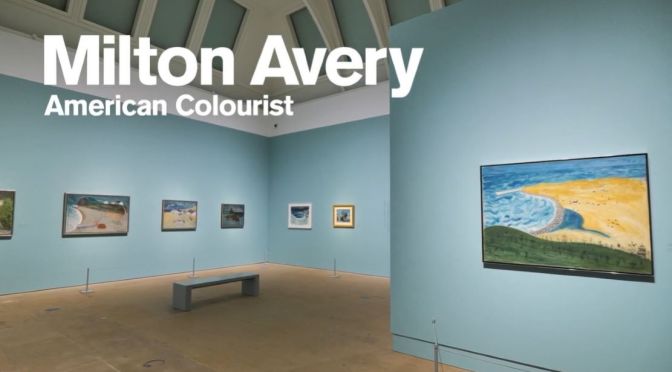
Milton Avery is considered one of North America’s greatest 20th-century painters. Milton Avery: American Colourist is the first comprehensive exhibition of the artist’s work in Europe.
It brings together a selection of around 70 of his most celebrated paintings featuring landscapes, portraits, scenes of city life and studies of the human form. Take a tour of the exhibition with curator Edith Devaney, advisor to the Milton Avery Trust Waqas Wajahat, and Avery’s grandson and artist Sean Cavanaugh.
With nearly 1,500 artworks on display, there is a lot to see at the Royal Academy of Arts (RA) Summer Exhibition 2022. If you want a taste of what’s on show then here is a quick tour. The theme chosen by the exhibition’s coordinator, Alison Wilding RA, is Climate. It begins outside, where a large-scale immersive installation by Spanish artist Cristina Iglesias brings nature and water to the courtyard. Inside, the artworks are spread over 11 rooms, including two galleries of prints selected by Grayson Perry RA.
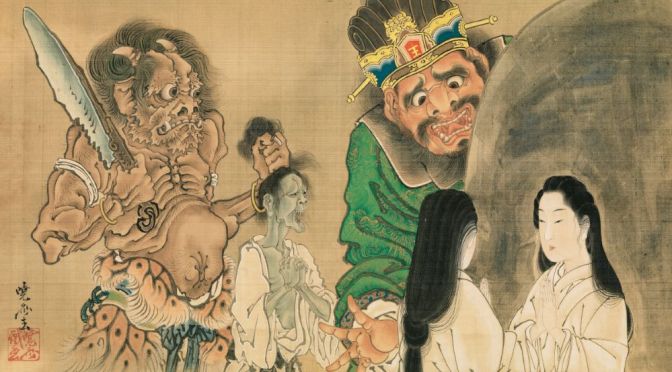
The Japanese painter Kawanabe Kyōsai (1831–1889) was one of the most innovative artists of his day. He lived during a turbulent time, experiencing the downfall of the Tokugawa shogunate (the hereditary military government) and the new imperial regime’s reforms to modernise and Westernise the country. Kyōsai’s drive to capture the world with his brush earned him the nickname ‘demon of painting’ – which he lived by.
Kyōsai, as a highly trained painter, was proficient in traditional methods and subjects. He broke with convention by blurring the established boundary between ‘serious’ and comic pictures. Traditionally, complex painting techniques were reserved for literary classics, historical and legendary figures, auspicious themes and religious images. Comic pictures were typically produced in a lighter, more fluid style.
Kyōsai often saw humour in ‘serious’ subjects and introduced comic and everyday content in highly finished, detailed paintings. The selection in this room demonstrates Kyōsai’s range and skill across diverse genres. Subjects include animals, monsters, ghosts, protective deities and Buddhist icons. Some paintings display powerful Kano-style ink techniques, others depict humorous creatures – recalling works by his first teacher, Utagawa Kuniyoshi, and referencing medieval picture scrolls. He can be seen exploring Western techniques such as perspective, shading and the study of anatomy, which attests to his insatiable curiosity and desire to push beyond tradition.
Kyōsai had a keen interest in society, and captured contemporary events in his pictures with humour and piquancy. His satirical prints from the 1860s, the period leading up to the collapse of the shogunate regime, reflect widespread anxiety about the political turmoil, economic instability and foreign presence. He channelled the febrile atmosphere into dynamic images of frog battles, monster parties and wildly dancing tengu (mischievous, semi-human creatures). Under the new Meiji government, the sudden influx of Western-style culture greatly shocked many Japanese, after over 260 years of relative isolation.
Kyōsai’s comic pictures express both the excitement of the new era, with modern technologies such as the telegraph and trains, and a certain scepticism towards those who blindly followed the new trends. The government’s policy of hiring European and American specialists to teach at new institutions in Japan brought the painter a personal benefit. The British architect Josiah Conder (1852–1920) became his pupil around 1881, and remained a student, patron and friend until Kyōsai’s death in 1889.
In nineteenth-century Japan, artists often produced works impromptu in front of an audience. The creative process was appreciated as a performance. At commercially organised calligraphy and painting parties called shogakai, attendees would pay for admission, and once inside, could ask the artists to create works for them at no extra charge. These gatherings were frequently a platform for collaboration. Multiple painters would complete a picture together or a calligrapher would inscribe a poem by the painter’s work. Kyōsai often depicted a scene of art viewing, and the artworks within the image would be painted by other artists.
Collaboration has always been an important part of the creative process in Japan, among artist friends or between teacher and pupils, sharing and marking the occasion. Event flyers, newspaper articles and anecdotes attest that Kyōsai was famous for his speedy, skilful and witty performances. The parties involved copious alcohol. Kyōsai loved saké and his brush became even more playful and expressive when intoxicated. Josiah Conder wrote in his master’s obituary: ‘under the influence of BACCHUS some of his strangest fancies, freshest conceptions and boldest touches were inspired.’
News, Views and Reviews For The Intellectually Curious


 Boomers Daily