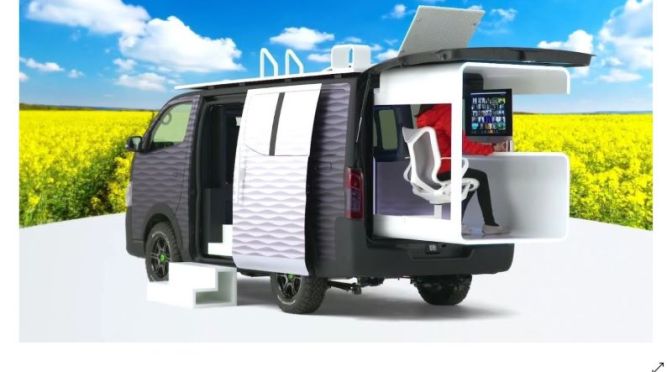
The Nissan Office Pod is more than a workstation: it’s a fully mobile van with just enough creature comforts to make a day at the office feel like a quiet vacation.
The van, a Nissan NV350 Caravan, features an office desk and chair, though it can slide in and out of the back of the van, giving workers an open-air working experience when it’s extended. It stows away inside when needed.
On top of the Office Pod is a balcony that’s accessible from the interior. Official video show off a large lounge space, a patio recliner, and a sizable umbrella. The van also features a golf ball-like exterior with a scallop-like pattern along its sides, which sits above the slightly widened fender extensions.
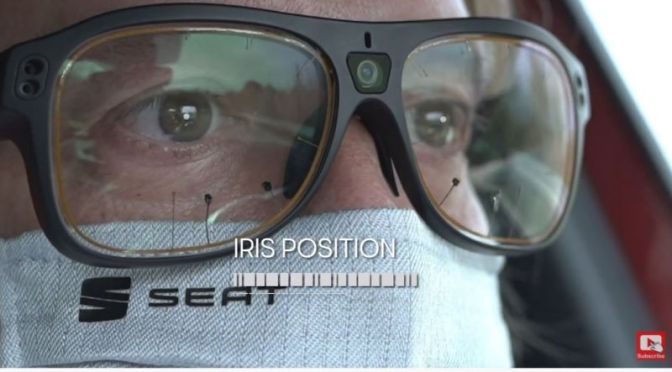
The SEAT Smart Quality team uses Eye-Tracker glasses to track the driver’s gaze through infrared sensors, cameras and algorithms. Knowing where users are looking helps to achieve a more intuitive and secure interaction with devices such as infotainment.
This technology will have applications in other areas such as the design of mobility apps. Infrared light sensors, high resolution images and a sophisticated algorithm. All this technology is used to find out exactly where people are looking.
As we drive, the road must obviously be the main focus. That’s why it’s key to safety to be able to locate everything we’re looking for on the central console of the infotainment system at a glance, from the navigation system to the air conditioning or the radio.
“We must guarantee the minimum interaction time with the screen, and to do this the information must be where users intuitively and naturally look for it” says Rubén Martínez, head of SEAT’s Smart Quality department. To accomplish this, they now have an innovative system.
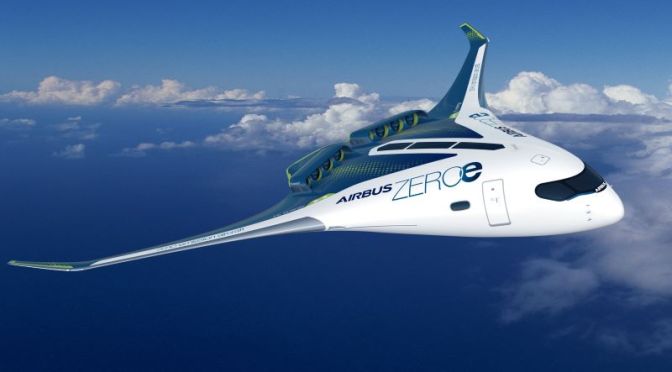
Airbus has revealed three concepts for the world’s first zero-emission commercial aircraft which could enter service by 2035. These concepts each represent a different approach to achieving zero-emission flight, exploring various technology pathways and aerodynamic configurations in order to support the company’s ambition of leading the way in the decarbonisation of the entire aviation industry.
All of these concepts rely on hydrogen as a primary power source – an option which Airbus believes holds exceptional promise as a clean aviation fuel and is likely to be a solution for aerospace and many other industries to meet their climate-neutral targets.
The three concepts – all codenamed “ZEROe” – for a first climate neutral zero-emission commercial aircraft include:
•A turbofan design (120-200 passengers) with a range of 2,000+ nautical miles, capable of operating transcontinentally and powered by a modified gas-turbine engine running on hydrogen, rather than jet fuel, through combustion. The liquid hydrogen will be stored and distributed via tanks located behind the rear pressure bulkhead.
• A turboprop design (up to 100 passengers) using a turboprop engine instead of a turbofan and also powered by hydrogen combustion in modified gas-turbine engines, which would be capable of traveling more than 1,000 nautical miles, making it a perfect option for short-haul trips.
• A “blended-wing body” design (up to 200 passengers) concept in which the wings merge with the main body of the aircraft with a range similar to that of the turbofan concept. The exceptionally wide fuselage opens up multiple options for hydrogen storage and distribution, and for cabin layout.
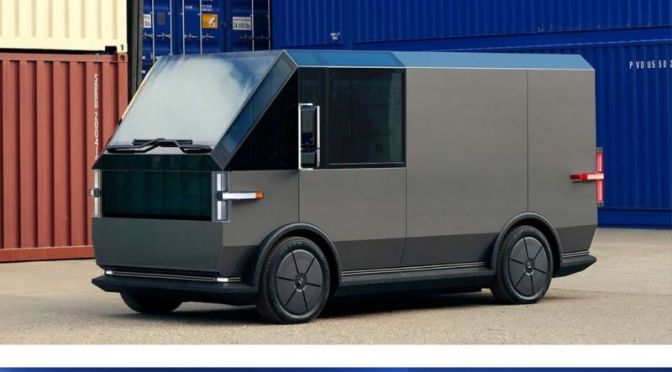
California EV startup Canoo has announced a new multipurpose electric vehicle aimed at last-mile deliveries and other small businesses, which starts at $33,000 but scales up in size and cost. It’s Canoo’s second vehicle, following the subscription-only van it debuted last year. Canoo still plans to make that EV — in fact, the new multipurpose vehicle is built on the same technological platform that Canoo developed for the van, and they share similar design features.
The new vehicle will initially be sold in two variants, though Canoo says more will eventually be offered. The smaller one (which is the one that starts at $33,000) is 14.4 feet long, 6.4 feet wide, and 6.2 feet tall, and has 230 cubic feet of cargo space. Canoo will offer three different battery pack options, too: 40kWh (with an estimated 130 miles of range), 60kWh (190 miles), and 80kWh (230 miles). The company will also make a larger version that is 17.1 feet long, 7.2 feet wide, and 8.4 feet tall, with 500 cubic feet of cargo space. The same battery pack options will be available, though the range estimates drop to 90 miles, 140 miles, and 190 miles, respectively, thanks to the extra weight.
News, Views and Reviews For The Intellectually Curious

 Boomers Daily