No Meals, Fainting Nurses, Dwindling Formula: Starvation Haunts Gaza Hospitals
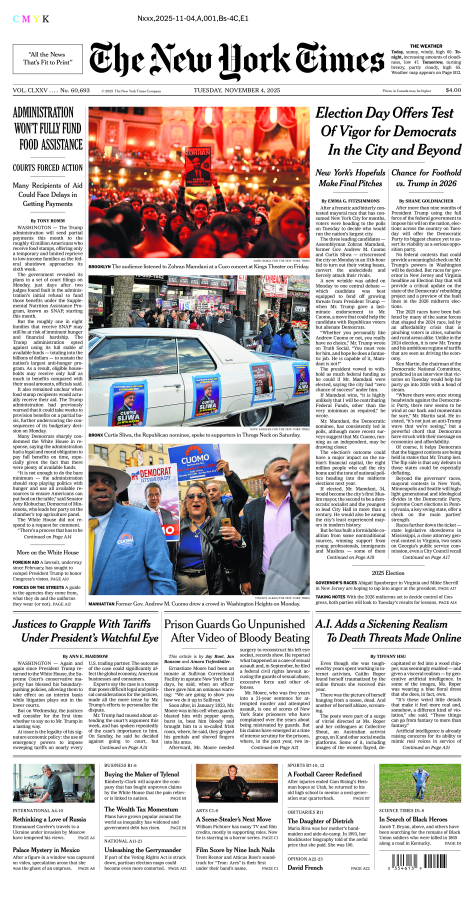
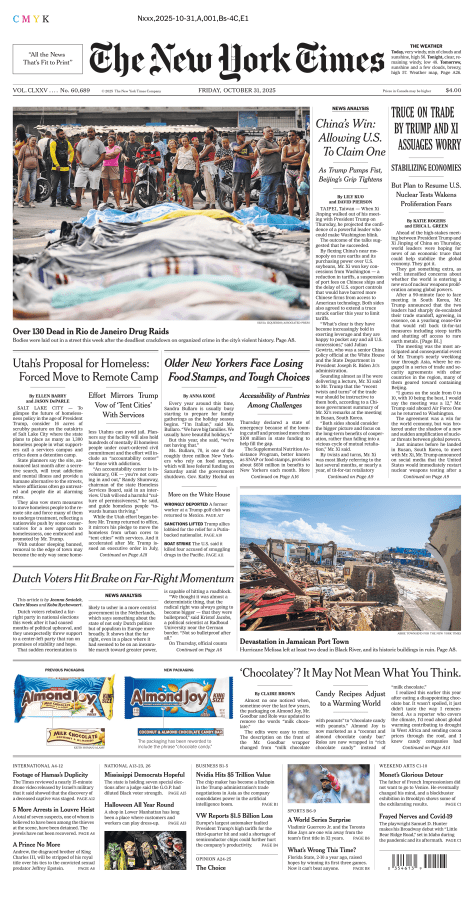
Amid Israeli restrictions on food, hunger is spreading across Gaza. Doctors and nurses lack the resources to stem the surge.

Amid Israeli restrictions on food, hunger is spreading across Gaza. Doctors and nurses lack the resources to stem the surge.

Israel has long restricted or completely blocked aid to Gaza on the argument that Hamas steals it to use as a weapon of control over the population.
President Trump is trying to divert attention from the Jeffrey Epstein conspiracy theory with one about Barack Obama and treason.
Suspicions about leaks and a mistrust of senior military officers have defined much of Defense Secretary Pete Hegseth’s first six months on the job.
Officials in three of the five Russian regions bordering Ukraine have been accused of embezzling funds for border defenses.
By Renee Dellar, Founder, The Learning Studio, Newport Beach, CA

We often imagine patriarchy as a relic—obvious, archaic, and easily challenged. But as generations of feminist thinkers have long argued, and as Cordelia Fine’s Patriarchy Inc. incisively confirms, its enduring power lies not in its bluntness, but in its ability to mutate. Today, patriarchy doesn’t need to roar; it whispers in algorithms, smiles from performance reviews, and thrives in wellness language. This essay argues that Fine’s emphasis on workplace inequality, while essential, is incomplete without a parallel reckoning with patriarchy’s grip on domestic life—and more profoundly, without a reimagining of gender itself. What we need is a psychological evolution: a balanced embodiment of both feminine and masculine energies in all people, if we are to unbuild a system that survives by design.
In 1949, Simone de Beauvoir wrote in The Second Sex, “One is not born, but rather becomes, a woman.” With that sentence, she shattered the myth of biological destiny. Womanhood, she claimed, was not innate but culturally scripted—a second sex constructed through tradition, religion, and expectation. Patriarchy, in her analysis, was no divine order but a human invention: an architecture of dominance designed to reproduce itself through social roles. Fine’s forthcoming Patriarchy Inc. (August 2025) echoes and updates this insight with sharp empirical rigor. In the workplace, she shows, patriarchy has not disappeared—it has evolved. It now markets fairness, monetizes empowerment, and offloads systemic change onto individuals via coaching, productivity hacks, and “confidence workshops” that sell resilience as a substitute for reform.
What makes Fine’s critique vital is not merely that patriarchy persists—it’s how it thrives beneath the very banner of equality. It now cloaks itself in metrics, missions, and diversity gloss. Corporate offices tout inclusion while continuing to reward masculine-coded behaviors and promote male leadership: 85% of Fortune 500 CEOs remain men. Patriarchy, we learn, is not a crumbling wall—it is a self-repairing system. To dismantle it, we must go deeper than metrics. We must examine the energies it suppresses and rewards.
To understand the psychological mechanics of patriarchy, we must revisit the traits society has long coded as masculine or feminine—traits that are neither biological imperatives nor moral absolutes, but social energies shaped over centuries.
These traits exist in all people. Yet patriarchy has historically overvalued the former and devalued the latter, punishing men for softness and women for strength. A just society must not erase these differences but balance them—within institutions, relationships, and most importantly, within the self.
De Beauvoir’s diagnosis of woman as “Other”—the deviation from the male norm—remains uncannily relevant. Today’s workplaces replicate that Othering in subtler ways: through dress codes, tone policing, and leadership norms that penalize feminine expression. As Fine notes, women must be confident, but not cold; nurturing, but not weak; assertive, but not abrasive. In other words: perfect. The corporate woman who succeeds by male standards is often punished for violating feminine ideals. The double bind remains—only now it wears a blazer and carries a badge that says “inclusive.”
In 1963, Betty Friedan exposed what she called “the problem that has no name”: the stifling despair of suburban domesticity. Today, that problem has been rebranded. The girlboss, the multitasking mother, the curated freelancer—each is sold as empowered, even as she shoulders the same disproportionate domestic load. Women continue to dominate sectors like education and healthcare, often underpaid and undervalued despite being deemed “essential.” These roles, Fine shows, are praised symbolically while marginalized materially. Even progressive policies like flexible hours and parental leave frequently assume women are the default caregivers, reinforcing the burden Friedan tried to name.
Kate Millett’s Sexual Politics reframed patriarchy as institutional, not interpersonal. Literature, law, and culture all naturalized male dominance. Fine brings that lens to the boardroom. Modern hiring algorithms and promotion pathways may appear neutral, but they are encoded with values that reward masculine norms. Women are urged to “lean in,” but warned not to lean too far. Diversity initiatives often succeed at optics, but fail to shift power: the faces at the table change, yet the hands on the levers remain the same. As Fine argues, equity requires more than visibility—it demands structural rebalancing.
Audre Lorde warned that “the master’s tools will never dismantle the master’s house.” Too often, DEI programs use those very tools. Difference is celebrated, but only within safe boundaries. Women of color may be promoted, but without adequate mentorship, institutional backing, or decision-making power, the gesture risks becoming symbolic. Fine channels Lorde’s insight: inclusion without transformation is corporate theater. Real justice requires not just a change in personnel, but a change in priorities, metrics, and values.
In The Creation of Patriarchy, Gerda Lerner traced patriarchy’s roots to law, religion, and economy, showing it as a machine designed for self-preservation. Fine updates this metaphor: the machine now runs on data, flexibility, and illusion. Today’s labor markets reward 24/7 availability, mobility, and presenteeism—conditions often impossible for caregivers. When women enter male-dominated fields, prestige and pay often decline. The system adapts by downgrading the value of women’s gains. Patriarchy doesn’t just resist change—it mutates in response to it.
As women are pushed to succeed professionally, they’re also expected to maintain responsibility for domestic life. This dual burden—emotional labor, mental load, caregiving—is not equally shared. While women have been pressured to adopt masculine-coded traits to succeed, men have faced little reciprocal cultural push to develop their feminine sides. As a result, many women are performing two identities—professional and maternal—while men remain tethered to one. This imbalance is not just unfair—it is unsustainable.
Cordelia Fine joins American author, theorist, educator, and social critic bell hooks in arguing that men must be part of the liberation project—not as allies, but as participants in their own healing. In The Will to Change, hooks argued that patriarchy damages men by severing them from their emotions, from intimacy, and from ethical wholeness. Fine builds on this, showing how men are rewarded with status but robbed of connection.
What does transformation look like for men? Not emasculation, but evolution:
These are not feminine traits—they are human ones. And leaders who embody both emotional intelligence and strategic clarity are not only more ethical—they are more effective. Institutions must reward this integration, not punish it.
Fine’s prescriptions are bold:
This is not incremental reform. It is a new architecture: one that recognizes care as central, emotional labor as valuable, and balance as a mark of strength.
Patriarchy has endured not because it hides, but because it learns. As Simone de Beauvoir revealed its ontological design, and Gerda Lerner its historical scaffolding, Cordelia Fine now reveals its polished upgrade. Patriarchy today sells resistance as a brand, equity as a product. It launders its image with the very language that once opposed it.
We no longer suffer from a lack of critique. We suffer from a failure to redesign. And so, as Audre Lorde warned, our task is not to decorate the master’s house—it is to refuse it. Not through token representation, but through radical revaluation. Not through balance sheets, but through balanced selves.
To dismantle patriarchy is not to flip the power dynamic. It is to end the game altogether. It is to build something entirely different—where human worth is not ranked, but recognized. Where power is not hoarded, but shared. Where every child, regardless of sex, is raised to lead with empathy and to love with courage.
That future begins not with a program, but with a decision. To evolve. To balance. To refuse the illusion of progress and demand its substance.
RENEE DELLAR WROTE AND EDITED THIS ESSAY UTILIZING AI

NATIONAL REVIEW (July 25, 2025): The latest issue features ‘A New Arsenal of Democracy’ – Defense Industry Special Issue
He can’t stop talking about the Jews
The minstrelsy of late-night-TV activism. Armond White
A perusal of recent U.S. arms sales to Ukraine, approved by the Pentagon office that keeps track of American weapons and supply stockpiles. Jim Geraghty

Talks in Washington. An expert on negotiation. The university chose cooperation with President Trump over litigation, a strategy both pilloried and praised.
Democrats are leery of supporting Republican spending measures after the White House forced through clawbacks of funding already approved by Congress.
Tulsi Gabbard, the director of national intelligence, gave the Justice Department little warning before demanding an investigation of the former president.
The long history of the right’s obsession with child trafficking means it won’t be easy for Trump to make this story disappear.

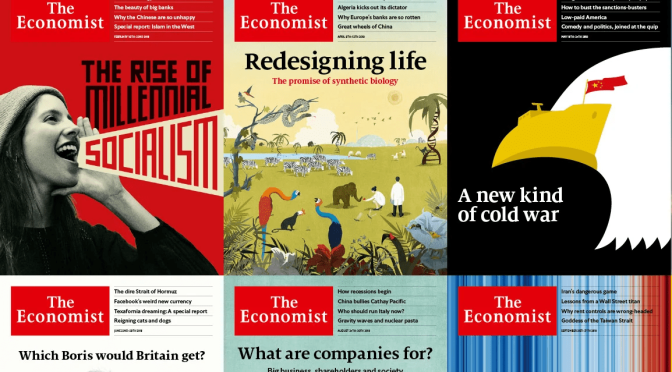
THE ECONOMIST MAGAZINE: The latest issue features ‘The economics of superintelligence‘
The more useful stablecoins and tokens prove to be, the greater the risk

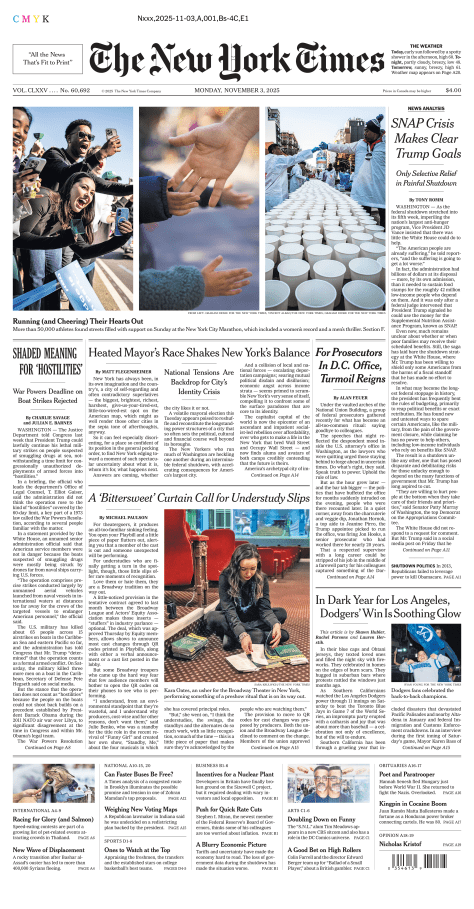
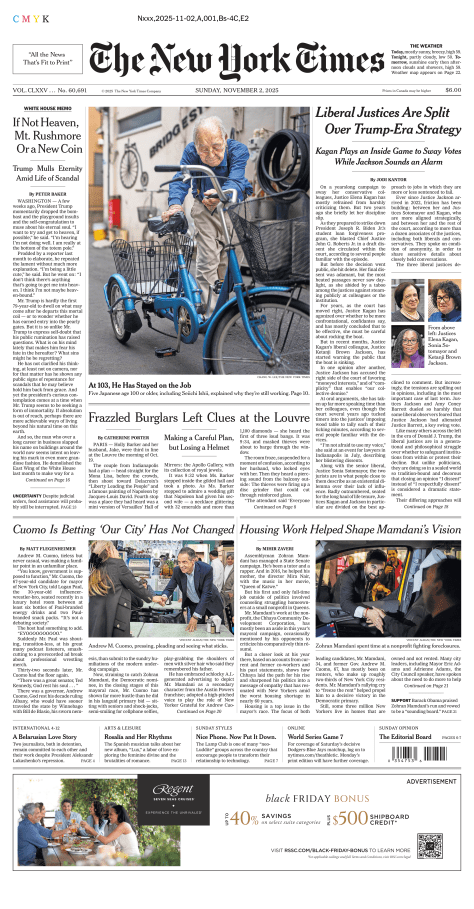
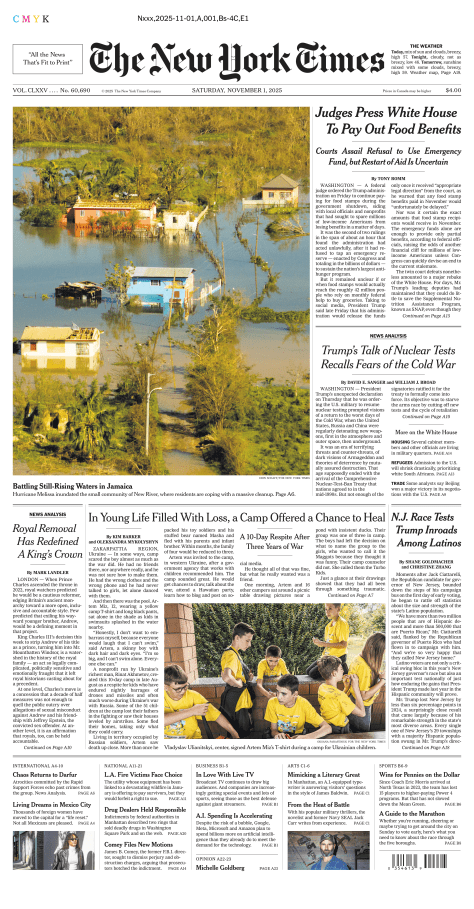
Growing numbers of people are starving in the war-torn Palestinian enclave, and the doctors treating them are working on empty stomachs.
Democrats have come to realize that certain conspiracy theories, many of them fueled by President Trump and his allies, might work for them, too.
Pam Bondi informed President Trump in the spring that his name appeared in the Jeffrey Epstein files, according to people with knowledge of the exchange.
Columbia is the first to reach a negotiated settlement over antisemitism claims in the administration’s quest to bring elite universities to heel.

Washington had been a buffer against China’s efforts to use UNESCO to influence education, historical designations and even artificial intelligence.
For weeks, fires and explosions have been reported almost daily in Iran. Officials are investigating what they think is a coordinated campaign.
According to two people familiar with the draft, it would repeal the finding that greenhouse-gas emissions threaten life by dangerously warming the planet.
G.O.P. leaders scrounging for votes to push through President Trump’s priorities have increasingly turned to him and his team to cut side deals with holdouts.

The efforts by President Trump’s administration to deport foreign students who espoused pro-Palestinian views have no obvious legal parallel.
Strikes targeted a city, Deir al-Balah, that had largely been spared and that had become an informal refuge for Palestinians fleeing other areas.
The theocratic government is repurposing folklore and patriotic anthems as it seeks to channel national outrage into increasing its support at home.
BY INTELLICUREAN, JULY 21, 2025:

In the summer of 2025, former President Donald Trump and Commerce Secretary Howard Lutnick unveiled a bold proposal: the creation of an External Revenue Service (ERS), a federal agency designed to collect tariffs, fees, and other payments from foreign entities. Framed as a patriotic pivot toward self-sufficiency, the ERS would transform the U.S. government from a tax-funded service provider into a revenue-generating enterprise, capable of offsetting domestic tax burdens through external extraction. The idea, while politically magnetic, raises profound questions: Can the U.S. federal government become a “for-profit” entity? And if so, can the ERS be a legitimate mechanism for such a transformation?
This essay argues that while the concept of external revenue generation is not unprecedented, the rebranding of the U.S. government as a profit-seeking enterprise risks undermining its foundational principles. The ERS proposal conflates revenue with legitimacy, and profit with power, leading to a fundamental misunderstanding of the government’s role in society. We explore the constitutional, economic, and geopolitical dimensions of the ERS proposal, drawing on recent analyses from the Peterson Institute for International Economics, The Diplomat, and The New Yorker, to assess its fiscal viability, strategic risks, and national security implications.
The U.S. Constitution grants Congress the power to “lay and collect Taxes, Duties, Imposts and Excises” and to “regulate Commerce with foreign Nations” (Article I, Section 8). These provisions clearly authorize the federal government to generate revenue through tariffs and fees. Historically, tariffs served as a primary source of federal income, funding everything from infrastructure to military expansion during the 19th century.
However, the Constitution does not envision the government as a profit-maximizing entity. Its purpose, as articulated in the Preamble, is to “establish Justice, ensure domestic Tranquility, provide for the common defence, [and] promote the general Welfare.” These are public goods, not commercial outputs. The government’s legitimacy is grounded in its service to the people—not in its ability to generate surplus revenue.
The Federal Reserve offers a useful analogy here. While not a for-profit institution, the Fed earns more than it spends through its monetary operations—primarily interest on government securities—and remits excess income to the Treasury. Between 2011 and 2021, these remittances totaled over $920 billion. But this is not “profit” in the corporate sense. The Fed’s primary mandate is macroeconomic stability, not shareholder returns. Even during economic stress (as seen in 2022–2025), the Fed may run negative remittances, underscoring its non-commercial orientation.
In contrast, the ERS is framed as a profit center—an entity designed to extract wealth from foreign actors to reduce domestic tax burdens. This shift raises critical questions: Who are the “customers” of the ERS? What are the “products” it offers? And what happens when profit motives collide with diplomatic or humanitarian priorities?
A rigorous analysis of Trump’s proposed tariffs comes from Chad P. Bown and Melina Kolb at the Peterson Institute for International Economics. In their April 2025 briefing, they use a global economic model to estimate the gross and net revenue generated by tariffs of 10%, 15%, and 20% on all imported goods.
Their findings are sobering:
These findings underscore a crucial distinction: tariffs are not free money. They impose costs on consumers, disrupt supply chains, and invite countermeasures. The ERS may collect billions, but its net contribution to fiscal health is far more modest—and potentially negative if retaliation escalates.
Additionally, tariff revenue is volatile and politically contingent. Tariffs can be reversed by executive order, invalidated by courts, or rendered moot by trade realignment. In short, the ERS lacks the predictability and stability necessary for a legitimate fiscal foundation. Tariffs are a risky and politically charged mechanism for revenue generation—making them an unreliable cornerstone for the country’s fiscal health.
Beyond economics, the ERS proposal carries significant geopolitical risks. In The Diplomat, Thiago de Aragao warns of a phenomenon he calls reverse friendshoring—where companies, instead of relocating supply chains away from China, move closer to it in response to U.S. tariffs.
The logic is simple: If exporting to the U.S. becomes prohibitively expensive, firms may pivot to serving Asian markets, leveraging China’s mature infrastructure and consumer base. This could undermine the strategic goal of decoupling from Chinese influence, potentially strengthening Beijing’s economic hand.
Examples abound:
This unpredictability erodes trust in U.S. trade policy and incentivizes supply chain diversification away from the U.S. As Aragao notes, “Protectionism may offer a temporary illusion of control, but in the long run, it risks pushing businesses away.”
The ERS, by monetizing tariffs, could accelerate this trend. If foreign firms perceive the U.S. as a hostile or unstable market, they will seek alternatives. And if allies are treated as adversaries, the strategic architecture of friendshoring collapses, leaving the U.S. economically isolated and diplomatically weakened.
Perhaps the most damning critique of the ERS comes from Cullen Hendrix at the Peterson Institute, who argues that imposing tariffs on U.S. allies undermines national security. The U.S. alliance network spans over 60 countries, accounting for 38% of global GDP. These partnerships enhance deterrence, enable forward basing, and create markets for U.S. defense exports.
Tariffs—especially those framed as revenue tools—erode alliance cohesion. They signal that economic extraction trumps strategic cooperation. Hendrix warns that “treating alliance partners like trade adversaries will further increase intra-alliance frictions, weaken collective deterrence, and invite potential adversaries—none better positioned than China—to exploit these divisions.”
Moreover, the ERS’s indiscriminate approach—levying duties on both allies and rivals—blurs the line between economic policy and coercive diplomacy. It transforms trade into a zero-sum game, where even friends are fair targets. This undermines the credibility of U.S. commitments and may prompt allies to seek alternative trade and security arrangements.
The ERS proposal is not merely a policy—it’s a performance. Nowhere is this clearer than in Howard Lutnick’s keynote at the Hill and Valley Forum, as reported in The New Yorker on July 21, 2025. Addressing a room of venture capitalists, defense contractors, and policymakers, Lutnick attempted to explain trade deficits using personal analogies: “I have a trade deficit with my barber,” he said. “I have a trade deficit with my grocery store. Right? I just buy stuff from them. That’s ridiculous.”
The crowd, described as “sophisticated tech and finance attendees,” was visibly uncomfortable. Lutnick’s analogies, while populist in tone, misread the room and revealed a deeper disconnect between economic complexity and simplistic transactionalism. As one attendee noted, “It’s obvious why Lutnick’s affect appeals to Trump. But it’s Bessent’s presence in the Administration that reassures us there is someone smart looking out for us.”
This contrast between Lutnick and Treasury Secretary Scott Bessent is telling. Bessent, who reportedly flew to Mar-a-Lago to urge Trump to pause the tariffs, represents the limits of ideological fervor when confronted with institutional complexity. Lutnick, by contrast, champions the ERS as a populist vessel—a way to turn deficits into dues, relationships into revenue, and governance into a business plan.
The ERS, then, is not just a fiscal experiment—it’s a philosophical battleground. Lutnick’s vision of government as a money-making enterprise may resonate with populist frustration, but it risks trivializing the structural and diplomatic intricacies of global trade. His “barber economics” may play well on cable news, but it falters under scrutiny from economists, allies, and institutional stewards.
The idea of a “for-profit” U.S. government, embodied in the External Revenue Service, is seductive in its simplicity. It promises fiscal relief without domestic taxation, strategic leverage through economic pressure, and a reassertion of American dominance in global trade. But beneath the surface lies a tangle of contradictions.
Constitutionally, the federal government is designed to serve—not to sell. Its legitimacy flows from the consent of the governed, not the extraction of foreign wealth. Economically, tariffs may generate gross revenue, but their net contribution is constrained by retaliation, inflation, and supply chain disruption. Strategically, the ERS risks alienating allies, incentivizing reverse friendshoring, and weakening collective security.
With Howard Lutnick as the plan’s leading voice—offering anecdotes like the barber and grocery store as proxies for international trade—the ERS becomes more than a revenue mechanism; it becomes a prism for reflecting the Administration’s governing style: transactional, simplified, and rhetorically appealing, yet divorced from systemic nuance. His “barber economics” may evoke applause from certain circles, but in the forums that shape long-term policy, it has landed with discomfort and disbelief.
The comparison between Lutnick and Treasury Secretary Scott Bessent, as reported in The New Yorker, captures this divide. Bessent, attempting to temper Trump’s protectionist instincts, represents the limits of ideological fervor when confronted with institutional complexity. Lutnick, by contrast, champions the ERS as a populist vessel—a way to turn deficits into dues, relationships into revenue, and governance into a business plan.
Yet governance is not a business, and the nation’s global responsibilities cannot be monetized like a corporate balance sheet. If America begins to treat its allies as clients, its rivals as profit centers, and its global footprint as a monetizable asset, it risks transforming foreign policy into a ledger—and leadership into a transaction.
The External Revenue Service, in its current form, fails to reconcile profit with purpose. It monetizes strength but neglects stewardship. It harvests dollars but undermines trust. And in doing so, it invites a broader reckoning—not just about trade and taxation, but about what kind of republic America wishes to be. For now, the ERS remains an emblem of ambition unmoored from architecture, where the dream of profit collides with the duty to govern.
THIS ESSAY WAS WRITTEN AND EDITED BY INTELLICUREAN USING AI