Tag Archives: Politics

COMMENTARY MAGAZINE – SEPTEMBER 2025 PREVIEW

Commentary Magazine – A Jewish magazine of politics, high culture, cultural  and literary criticism, American and Israeli campaigns and elections, and  world affairs.

COMMENTARY MAGAZINE: The latest issue features ‘Board Games’ – The Supreme Court has outlawed counting by race in college admissions. Here’s how universities might try to defy the ruling and keep affirmative action without admitting it.

How Israel Can Defend Itself in the Future

Can it take lessons from a policy that failed even as it succeeded? by Jonathan Schanzer

College Board Games

The Supreme Court has outlawed counting by race in college admissions. Here’s how universities might try to defy the ruling and keep affirmative action without admitting it. by Naomi Schaefer Riley

When Artificial Intelligence Goes Nuts

by James B. Meigs

Why Jeans Are Making Progressives Blue

by Christine Rosen

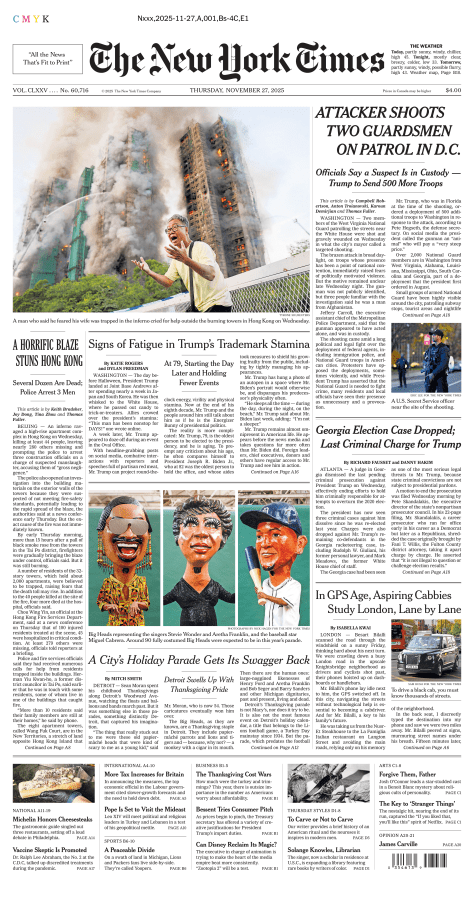
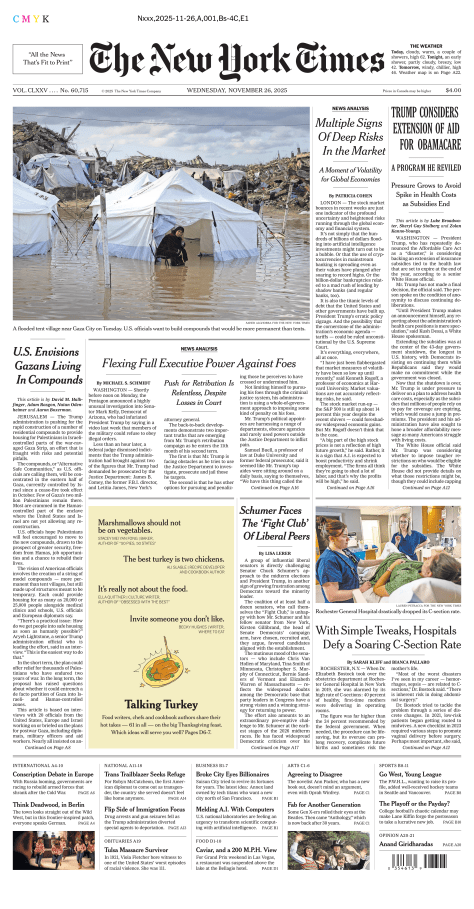
THE NEW YORK TIMES – TUESDAY, AUGUST 12, 2025

U.S. Inflation Report Shows Effects of President Trump’s Tariffs

One gauge showed prices increasing at the fastest annual pace in five months, a sign that businesses are passing along tariff-related costs to customers.

Gaming Out the Price of a Trump Trade Deal With China

President Trump again delayed higher tariffs on China. But his recent moves on chips have stoked fears he’s willing to give too much to make a deal.

Trump, Seeking Friendlier Economic Data, Names New Statistics Chief

Russia Makes a Swift Battlefield Advance, Seeking an Edge in Trump Talks

Russian forces have moved several miles into Ukrainian-held territory in the east, threatening to outflank Ukraine’s positions.

Ahead of Trump-Putin Talks, Europe Says Ukraine Must Be Part of Peace Process

See more updates ›

THE NEW YORKER MAGAZINE – AUGUST 18, 2025 PREVIEW

The illustrated cover of the August 18 2025 issue of The New Yorker in which people hike on a colorful landscape.

THE NEW YORKER MAGAZINE: The latest cover features ‘Lorenzo Mattotti’s “Summer Rays” – The art of wandering.

Can Democrats Fight Back Against Trump’s Redistricting Scheme?

Fleeing lawmakers in Texas are unlikely to stop Republicans from redrawing the state’s congressional maps, but their effort has offered a rallying cry—and a reminder of the Democratic Party’s weaknesses. By Jonathan Blitzer

How an Ultra-Rare Disease Accelerates Aging

Teen-agers with progeria have effectively aged eight or nine decades. A cure could help change millions of lives—and shed light on why we grow old. By Dhruv Khullar

How Much Is Trump Profiting Off the Presidency?

An honest accounting of our Executive-in-Chief’s runaway self-enrichment. By David D. Kirkpatrick

THE NEW YORK TIMES – MONDAY, AUGUST 11, 2025

Trump to Deploy National Guard in Washington, D.C.

The U.S. military is preparing to activate National Guard troops in the capital as part of President Trump’s campaign against crime there, an official said.

Trump Administration to Put F.B.I. Agents on Night Patrol in Washington

In Unusual Move, U.S. Government to Take Cut of Companies’ Chips Sold to China

The unorthodox agreement for Nvidia and AMD to pay the U.S. 15 percent would essentially make the federal government a partner in their business in China.

Is the Chip Deal a Tax, or a Payoff?

Higher Tariffs Loom as U.S.-China Trade Truce Nears Expiration

President Trump has yet to formally sign off on an agreement to extend an economic cease-fire with China, which expires on Tuesday.

Judiciary On Trial: States Rights vs. Federal Power

By Michael Cummins, Editor, August 10, 2025

The American system of government, with its intricate web of checks and balances, is a continuous negotiation between competing sources of authority. At the heart of this negotiation lies the judiciary, tasked with the unenviable duty of acting as the final arbiter of power. The Bloomberg podcast “Weekend Law: Texas Maps, ICE Profiling & Agency Power” offers a compelling and timely exploration of this dynamic, focusing on two seemingly disparate legal battles that are, in essence, two sides of the same coin: the struggle to define the permissible boundaries of government action.

This essay will argue that the podcast’s true essence lies in its powerful synthesis of these cases, presenting them not as isolated political events but as critical manifestations of an ongoing judicial project: to determine the limits of legislative, executive, and administrative power in the face of constitutional challenges. This judicial project, as recent scholarly works have shown, is unfolding within a broader shift in American federalism, where a newly assertive judiciary and a highly politicized executive branch are rebalancing the relationship between federal and state power in unprecedented ways.

“The judiciary’s role is not merely to interpret the law, but to act as the ultimate check on a government’s temptation to consolidate power at the expense of its people.” — Emily Berman, law professor, Texas Law Review (2025)

The Supreme Court’s role as the final arbiter of these powers is not an original constitutional given, but rather a power it asserted for itself in the landmark 1803 case Marbury v. Madison. In that foundational ruling, Chief Justice John Marshall established the principle of judicial review, asserting that “it is emphatically the province and duty of the judicial department to say what the law is.” This declaration laid the groundwork for the judiciary to act as a check on both the legislative and executive branches, a power that would be tested and expanded throughout history. The two cases explored in the “Weekend Law” podcast are the latest iterations of this long-standing judicial project, demonstrating how the courts continue to shape the contours of governance in the face of contemporary challenges.

This is particularly relevant given the argument in the Harvard Law Review note “Federalism Rebalancing and the Roberts Court: A Departure from Historical Patterns” (March 2025), which contends that the Roberts Court has consciously moved away from historical trends and is now uniquely pro-state, often altering existing federal-state relationships. This broader jurisprudential shift provides a crucial backdrop for understanding Texas’s increasingly assertive actions, as it suggests the state is operating within a legal landscape more receptive to its claims of sovereignty.

Legislative Power and the Gerrymandering Divide

The first case study, the heated Texas redistricting battle, serves as a vivid illustration of the tension between legislative power and fundamental voting rights. The podcast effectively frames the drama: Texas Democrats, in a last-ditch effort, fled the state to deny the Republican-controlled legislature a quorum, thereby attempting to block the passage of a new congressional map. The stakes of this political chess match are immense, as the proposed map, crafted following the census, could solidify the Republican party’s narrow majority in the U.S. House. The legal conflict hinges on the subtle but consequential distinction between “racial” and “political” gerrymandering, a dichotomy that the Supreme Court has repeatedly struggled to define.

While the Court has held that drawing district lines to dilute the voting power of a racial minority is unconstitutional under the Fourteenth Amendment’s Equal Protection Clause and the Voting Rights Act of 1965, it has also ruled in cases like Rucho v. Common Cause (2019) that political gerrymandering is a “political question” beyond the purview of federal courts. The Bipartisan Policy Center’s explainer, “What to Know About Redistricting and Gerrymandering” (August 2025), is particularly relevant here, as it directly references a similar 2003 case where the Supreme Court allowed a Texas mid-decade map to stand. This history of judicial deference provides the specific legal precedent that empowers Texas to pursue its current redistricting efforts with confidence, and it helps contextualize the judiciary’s reluctance to intervene.

The Texas case exploits this judicial gray area. The state legislature, while acknowledging its aim to benefit the Republican Party—a seemingly permissible “political” objective—faces accusations from Democrats and civil rights groups that the new map disproportionately dilutes the power of Black and Hispanic voters, particularly in urban areas. The podcast highlights the argument that race and political preference are often so tightly intertwined that it becomes nearly impossible to separate them. This is precisely the kind of argument the Supreme Court has had to grapple with, as seen in recent cases like Alexander v. South Carolina State Conference of the NAACP (2024). In that case, the Court’s majority, led by Justice Alito, held that challengers must provide direct, not just circumstantial, evidence that race, rather than politics, was the “predominant” factor in drawing a district. This ruling, and others like it, effectively “stack the deck” against plaintiffs, creating novel and significant roadblocks to a successful racial gerrymandering claim.

“The Supreme Court has relied upon the incoherent racial gerrymandering claim because the Court lacks the right tools to police certain political conduct that might be impermissibly racist, partisan, or both.” — Rick Hasen, election law expert

Legal experts like Rick Hasen, whose work on election law is foundational, would likely view this trend with deep concern. Hasen has long argued for a more robust defense of voting rights, noting the Constitution’s surprising lack of an affirmative right to vote and the Supreme Court’s incremental, often restrictive, interpretations of voting protections. The Texas situation, in his view, is not a bug in the system but a feature of a constitutional framework that has been slowly eroded by a Court that has become increasingly deferential to state legislatures. The podcast’s narrative here is a cautionary tale of a legislative body wielding its power to entrench itself, and of a judiciary that, by its own precedents, may be unable or unwilling to intervene effectively.

The political theater of the Democrats’ walkout, therefore, is not merely a symbolic act; it is a desperate attempt to use the legislative process itself to challenge a power grab that the judiciary has made more difficult to contest. This is further complicated by the analysis in Publius – The Journal of Federalism article “State of American Federalism 2024–2025” (July 2025), which explores the concept of “transactional federalism,” where presidents reward loyal states and punish those that are not. This framework provides a vital lens for understanding how a state like Texas, with a strong political alignment to the executive branch, might feel empowered to take such aggressive redistricting actions.

Reining in Executive Overreach: The ICE Profiling Case

On the other side of the legal spectrum, the podcast turns to the Ninth Circuit’s ruling against U.S. Immigration and Customs Enforcement (ICE) in Southern California. This case shifts the focus from legislative overreach to executive overreach, particularly the conduct of an administrative agency. The court’s decision upheld a lower court’s temporary restraining order, barring ICE agents from making warrantless arrests based on a broad “profile” that included apparent race, ethnicity, language, and location. This is a critical challenge to the authority of a federal agency, forcing it to operate within the constraints of the Fourth Amendment. The court’s ruling, as highlighted in the podcast, was predicated on a “mountain of evidence” demonstrating that ICE’s practices amounted to unconstitutional racial profiling.

“The Ninth Circuit’s decision is a critical affirmation that the Fourth Amendment does not have a carve-out for immigration enforcement. A person’s skin color is not probable cause.” — David Carden, ACLU immigration attorney (July 2025)

The legal principles at play here are equally profound. The Fourth Amendment protects “the right of the people to be secure in their persons, houses, papers, and effects, against unreasonable searches and seizures.” The Ninth Circuit’s ruling essentially states that a person’s appearance, the language they speak, or where they work is not enough to establish the “reasonable suspicion” necessary for a warrantless stop. This decision is a powerful example of the judiciary acting as a check on the executive branch, affirming that even in the context of immigration enforcement, constitutional rights apply to all individuals within the nation’s borders. The podcast emphasizes the chilling effect of these raids, which created an atmosphere of fear and terror in communities of color. The court’s decision serves as a crucial bulwark against an “authoritarian” approach to law enforcement, as noted by ACLU attorneys.

Immigration attorney Leon Fresco, who is featured in the podcast, provides a nuanced perspective on the case, discussing the complexities of agency authority. While the government argued that its agents were making stops based on a totality of factors, not just race, the court’s rejection of this argument underscores a significant judicial shift. This is not a new conflict, as highlighted in the Georgetown Law article “Sovereign Resistance To Federal Immigration Enforcement In State Courthouses” (published after November 2020), which examines the historical and legal foundation for state and individual resistance to federal immigration enforcement. The article identifies the “normative underpinnings” of this resistance and explores the constitutional claims that states and individuals use to challenge federal authorities.

This historical context is essential for understanding the sustained nature of this conflict. This judicial skepticism toward expansive agency power is further illuminated by the Columbia Law School experts’ analysis of 2025 Supreme Court rulings (July 2025), which focuses on the federalism battle over immigration law and the potential for a ruling on the federal government’s ability to condition funding on state compliance with immigration laws. This expert commentary shows that the judicial challenges to federal immigration authority, as seen in the Ninth Circuit case, are part of a broader, ongoing legal battle at the highest levels of the judiciary.

The Judicial Project: Unifying Principles of Power

The true genius of the podcast is its ability to weave these two disparate threads into a single, cohesive tapestry of legal thought. The Texas redistricting fight and the ICE profiling case, while geographically and thematically distinct, are both fundamentally about the limits of power. In Texas, we see a state legislature exercising its power to draw district lines in a way that, critics argue, subverts democratic principles. In Southern California, we see a federal agency exercising its power to enforce immigration laws in a way that, the court has ruled, violates constitutional rights. In both scenarios, the judiciary is called upon to step in and draw a line.

“It is emphatically the province and duty of the judicial department to say what the law is.” — Chief Justice John Marshall, Marbury v. Madison (1803)

The podcast’s synthesis of these cases highlights the central role of the Supreme Court in this ongoing process. The Court, through its various rulings, has crafted the very legal tools and constraints that govern these conflicts. The precedents it sets—on gerrymandering, on the Voting Rights Act, and on judicial deference to agencies—become the battleground for these legal fights. The podcast suggests that the judiciary is not merely a passive umpire but an active player whose decisions over time have shaped the very rules of the game. For example, the Court’s decisions have made it harder to sue over gerrymandering and, simultaneously, have recently made it harder for agencies to act without judicial scrutiny. This creates a fascinating and potentially contradictory legal landscape where the judiciary appears to be simultaneously retreating from one area of political contention while advancing into another.

Conclusion: A New Era of Judicial Scrutiny

Ultimately, “Weekend Law” gets to the essence of a modern American dilemma. The legislative process is increasingly characterized by partisan gridlock, forcing a reliance on executive and administrative actions to govern. At the same time, a judiciary that is more ideological and assertive than ever before is stepping in to review these actions, often with a skepticism that questions the very foundations of the administrative state.

The cases in Texas and Southern California are not just about voting maps or immigration sweeps; they are about the fundamental structure of American governance. They illustrate how the judiciary, from district courts to the Supreme Court, has become the primary battleground for defining the scope of constitutional rights and the limits of state and federal power. This is occurring within a new legal environment where, according to the Harvard Law Review, the Roberts Court is uniquely pro-state, and where the executive branch, as discussed in the Publius article, is engaging in a form of “transactional federalism.”

The podcast masterfully captures this moment, presenting a world where the most profound political questions of our time are no longer settled in the halls of Congress, but in the solemn chambers of the American courthouse. As we look ahead, we are left to ponder a series of urgent questions. Will the judiciary’s new skepticism toward administrative power lead to a more accountable government or a paralyzed one? What will be the long-term impact on voting rights if the courts continue to make it more difficult to challenge gerrymandering?

“When the map is drawn to silence the voter, the very promise of democracy is fractured. The judiciary’s silence is not neutrality; it is complicity in the decay of a fundamental right.” — Professor Sarah Levinson, University of Texas School of Law (2025)

And, in an era of intense political polarization, can the judiciary—a branch of government itself increasingly viewed through a partisan lens—truly be trusted to fulfill its historic role as a neutral arbiter of the Constitution? The essence of the podcast, then, is a sober reflection on the state of American democracy, filtered through the lens of legal analysis. It portrays a system where power is constantly tested, and the judiciary, despite its own internal divisions and evolving doctrines, remains the indispensable mechanism for mediating these tests.

“A government that justifies racial profiling on the streets is no different from one that seeks to deny justice in its courthouses. The Ninth Circuit has held a line, declaring that our Constitution protects all people, not just citizens, from the long shadow of authoritarian overreach.” — Maria Elena Lopez, civil rights attorney, ACLU of Southern California (2025)

The podcast’s narrative arc—from the political brinkmanship in Texas to the constitutional defense of individual rights in California—serves as a powerful reminder that the rule of law is a dynamic, living concept, constantly being shaped and reshaped by the cases that come before the courts and the decisions that are rendered. It is a story of power, rights, and the enduring, if often contentious, role of the American judiciary in keeping the two in balance.


THIS ESSAY WAS WRITTEN AND EDITED UTILIZING AI

THE NEW YORK TIMES – SUNDAY, AUGUST 10, 2025

In a Trump-Putin Summit, Ukraine Fears Losing Say Over Its Future

Ukrainians have worried about a peace accord being struck without them. Mr. Trump and President Vladimir Putin of Russia are set to meet this week.

After Almost Losing Trump, Putin Gets His Ideal Meeting

Behind Europe’s Anguished Words on Gaza, a Flurry of Hard Diplomacy

Images of starving children spurred Britain, France and Germany to a tougher stance. Prime Minister Benjamin Netanyahu was undeterred.

Far-Right Israeli Minister Calls for Quicker Military Moves in Gaza

THE NEW YORK TIMES – SATURDAY, AUGUST 9, 2025

Secret Compartments and Cartel Lookouts: How Fentanyl Reaches the U.S.

Times reporters documented how fentanyl was concealed by Mexico’s most powerful criminal syndicate, which is adapting amid a crackdown by two governments.

Mexico’s President Says U.S. Forces Are Unwelcome in Her Country

Zelensky Rejects Ceding Land to Russia After Trump Suggests a Land Swap

President Volodymyr Zelensky of Ukraine’s comments risk angering President Trump, who has made a peace deal one of his signature foreign policy goals.

Russia Goes After Ukraine With Distant Strikes and New Tactics

Assaults on Ukraine have intensified even as President Trump has threatened new sanctions. But Russia’s gains aren’t translating into a breakthrough, experts say.

Trump Says He Will Meet With Putin in Alaska Next Week

THE NEW YORK TIMES – FRIDAY, AUGUST 8, 2025

Netanyahu, Aiming to Capture Gaza City, Risks Ending in Familiar Deadlock

Time and again, Prime Minister Benjamin Netanyahu has pledged to defeat Hamas by force. The decision to capture Gaza City repeats a strategy that has failed in the past.

Trump Escalates a Fight Over How to Measure Merit in American Education

President Trump’s demand for college admissions data enters a debate over how grades and test scores should be weighed against less quantitative measures.

Can Russia’s Economy Withstand Trump’s Pressure?

The Russian economy was slowing even before President Trump’s latest threats. But the Kremlin has enough money to keep fighting in Ukraine.

The Peril Of Perfection: Why Utopian Cities Fail

By Michael Cummins, Editor, August 7, 2025

Throughout human history, the idea of a perfect city—a harmonious, orderly, and just society—has been a powerful and enduring dream. From the philosophical blueprints of antiquity to the grand, state-sponsored projects of the modern era, the desire to create a flawless urban space has driven thinkers and leaders alike. This millennia-long aspiration, rooted in a fundamental human longing for order and a rejection of present-day flaws, finds its most recent and monumental expression in China’s Xiongan New Area, a project highlighted in an August 7, 2025, Economist article titled “Xi Jinping’s city of the future is coming to life.” Xiongan is both a marvel of technological and urban design and a testament to the persistent—and potentially perilous—quest for an idealized city.

By examining the historical precedents of utopian thought, we can understand Xiongan not merely as a contemporary infrastructure project but as the latest chapter in a timeless and often fraught human ambition to build paradise on earth. This essay will trace the evolution of the utopian ideal from ancient philosophy to modern practice, arguing that while Xiongan embodies the most technologically advanced and politically ambitious vision to date, its top-down, state-driven nature and astronomical costs raise critical questions about its long-term viability and ability to succeed where countless others have failed.

The Philosophical and Historical Roots

The earliest and most iconic examples of this utopian desire were theoretical and philosophical, serving as intellectual critiques rather than practical blueprints. Plato’s mythological city of Atlantis, described in his dialogues Timaeus and Critias, was not just a lost city but a complex philosophical thought experiment. Plato detailed a powerful, technologically advanced, and ethically pure island society, governed by a wise and noble lineage. The city itself was a masterpiece of urban planning, with concentric circles of land and water, advanced canals, and stunning architecture.

However, its perfection was ultimately undone by human greed and moral decay. As the Atlanteans became corrupted by hubris and ambition, their city was swallowed by the sea. This myth is foundational to all subsequent utopian thought, serving as a powerful and enduring cautionary tale that even the most perfect physical and social structure is fragile and susceptible to corruption from within. It suggests that a utopian society cannot simply be built; its sustainability is dependent on the moral fortitude of its citizens.

Centuries later, in 1516, Thomas More gave the concept its very name with his book Utopia. More’s work was a masterful social and political satire, a searing critique of the harsh realities of 16th-century England. He described a fictional island society where there was no private property, and all goods were shared. The citizens worked only six hours a day, with the rest of their time dedicated to education and leisure.

“For where pride is predominant, there all these good laws and policies that are designed to establish equity are wholly ineffectual, because this monster is a greater enemy to justice than avarice, anger, envy, or any other of that kind; and it is a very great one in every man, though he have never so much of a saint about him.” – Utopia by Thomas More

The society was governed by reason and justice, and there were no social classes, greed, or poverty. More’s Utopia was not about a perfect physical city, but a perfect social structure. It was an intellectual framework for political philosophy, designed to expose the flaws of a European society plagued by poverty, inequality, and the injustices of land enclosure. Like Atlantis, it existed as an ideal, a counterpoint to the flawed present, but it established a powerful cultural archetype.

The city as a reflection of societal ideals. — Intellicurean

Following this, Francis Bacon’s unfinished novel New Atlantis (1627) offered a different, more prophetic vision of perfection. His mythical island, Bensalem, was home to a society dedicated not to social or political equality, but to the pursuit of knowledge. The core of their society was “Salomon’s House,” a research institution where scientists worked together to discover and apply knowledge for the benefit of humanity. Bacon’s vision was a direct reflection of his advocacy for the scientific method and empirical reasoning.

In his view, a perfect society was one that systematically harnessed technological innovation to improve human life. Bacon’s utopia was a testament to the power of collective knowledge, a vision that, unlike More’s, would resonate profoundly with the coming age of scientific and industrial revolution. These intellectual exercises established a powerful cultural archetype: the city as a reflection of societal ideals.

From Theory to Practice: Real-World Experiments

As these ideas took root, the dream of a perfect society moved from the page to the physical world, often with mixed results. The Georgia Colony, founded in 1732 by James Oglethorpe, was conceived with powerful utopian ideals, aiming to be a fresh start for England’s “worthy poor” and debtors. Oglethorpe envisioned a society without the class divisions that plagued England, and to that end, his trustees prohibited slavery and large landholdings. The colony was meant to be a place of virtue, hard work, and abundance. Yet, the ideals were not fully realized. The prohibition on slavery hampered economic growth compared to neighboring colonies, and the trustees’ rules were eventually overturned. The colony ultimately evolved into a more typical slave-holding, plantation-based society, demonstrating how external pressures and economic realities can erode even the most virtuous of founding principles.

In the 19th century, with the rise of industrialization, several communities were established to combat the ills of the new urban landscape. The Shakers, a religious community founded in the 18th century, are one of America’s most enduring utopian experiments. They built successful communities based on communal living, pacifism, gender equality, and celibacy. Their belief in simplicity and hard work led to a reputation for craftsmanship, particularly in furniture making. At their peak in the mid-19th century, there were over a dozen Shaker communities, and their economic success demonstrated the viability of communal living. However, their practice of celibacy meant they relied on converts and orphans to sustain their numbers, a demographic fragility that ultimately led to their decline. The Shaker experience proved that a society’s success depends not only on its economic and social structure but also on its ability to sustain itself demographically.

These real-world attempts demonstrate the immense difficulty of sustaining a perfect society against the realities of human nature and economic pressures. — Intellicurean

The Transcendentalist experiment at Brook Farm (1841-1847) attempted to blend intellectual and manual labor, blurring the lines between thinkers and workers. Its members, who included prominent figures like Nathaniel Hawthorne, believed that a more wholesome and simple life could be achieved in a cooperative community. However, the community struggled from the beginning with financial mismanagement and the impracticality of their ideals. The final blow was a disastrous fire that destroyed a major building, and the community was dissolved. Brook Farm’s failure illustrates a central truth of many utopian experiments: idealism can falter in the face of economic pressures and simple bad luck.

A more enduring but equally radical experiment, the Oneida Community (1848-1881), achieved economic success through manufacturing, particularly silverware, under the leadership of John Humphrey Noyes. Based on his concept of “Bible Communism,” they practiced communal living and a system of “complex marriage.” Despite its radical social structure, the community thrived economically, but internal disputes and external pressures ultimately led to its dissolution. These real-world attempts demonstrate the immense difficulty of sustaining a perfect society against the realities of human nature and economic pressures.

Xiongan: The Modern Utopia?

Xiongan is the natural, and perhaps ultimate, successor to these modern visions. It represents a confluence of historical utopian ideals with a uniquely contemporary, state-driven model of urban development. Touted as a “city of the future,” Xiongan promises short, park-filled commutes and a high-tech, digitally-integrated existence. It seeks to be a model of ecological civilization, where 70% of the city is dedicated to green space and water, an explicit rejection of the “urban maladies” of pollution and congestion that plague other major Chinese cities.

Its design principles are an homage to the urban planners of the past, with a “15-minute lifecycle” for residents, ensuring all essential amenities are within a short walk. The city’s digital infrastructure is also a modern marvel, with digital roads equipped with smart lampposts and a supercomputing center designed to manage the city’s traffic and services. In this sense, Xiongan is a direct heir to Francis Bacon’s vision of a society built on scientific and technological progress.

Unlike the organic, market-driven growth of a city like Shenzhen, Xiongan is an authoritarian experiment in building a perfect city from scratch. — The Economist

This vision, however, is a top-down creation. As a “personal initiative” of President Xi, its success is a matter of political will, with the central government pouring billions into its construction. The project is a key part of the “Jing-Jin-Ji” (Beijing-Tianjin-Hebei) coordinated development plan, meant to relieve the pressure on the capital. Unlike the organic, market-driven growth of a city like Shenzhen, Xiongan is an authoritarian experiment in building a perfect city from scratch. Shenzhen, for example, was an SEZ (Special Economic Zone) that grew from the bottom up, driven by market forces and a flexible policy environment. It was a chaotic, rapid, and often unplanned explosion of economic activity. Xiongan, in stark contrast, is a meticulously planned project from its very inception, with a precise ideological purpose to showcase a new kind of “socialist” urbanism.

This centralized approach, while capable of achieving rapid and impressive infrastructure development, runs the risk of failing to create the one thing a true city needs: a vibrant, organic, and self-sustaining culture. The criticisms of Xiongan echo the failures of past utopian ventures; despite the massive investment, the city’s streets remain “largely empty,” and it has struggled to attract the talent and businesses needed to become a bustling metropolis. The absence of a natural community and the reliance on forced relocations have created a city that is technically perfect but socially barren.

The Peril of Perfection

The juxtaposition of Xiongan with its utopian predecessors highlights the central tension of the modern planned city. The ancient dream of Atlantis was a philosophical ideal, a perfect society whose downfall served as a moral warning against hubris. The real-world communities of the 19th century demonstrated that idealism could falter in the face of economic and social pressures, proving that a perfect society is not a fixed state but a dynamic, and often fragile, process. The modern reality of Xiongan is a physical, political, and economic gamble—a concrete manifestation of a leader’s will to solve a nation’s problems through grand design. It is a bold attempt to correct the mistakes of the past and a testament to the immense power of a centralized state. Yet, the question remains whether it can escape the fate of its predecessors.

The ultimate verdict on Xiongan will not be about the beauty of its architecture or the efficiency of its smart infrastructure alone, but whether it can successfully transcend its origins as a state project. — The Economist

The ultimate verdict on Xiongan will not be about the beauty of its architecture or the efficiency of its smart infrastructure alone, but whether it can successfully transcend its origins as a state project to become a truly livable, desirable, and thriving city. Only then can it stand as a true heir to the timeless dream of a perfect urban space, rather than just another cautionary tale. Whether a perfect city can be engineered from the top down, or if it must be a messy, organic creation, is the fundamental question that Xiongan, and by extension, the modern world, is attempting to answer.

THIS ESSAY WAS WRITTEN AND EDITED UTILIZING AI

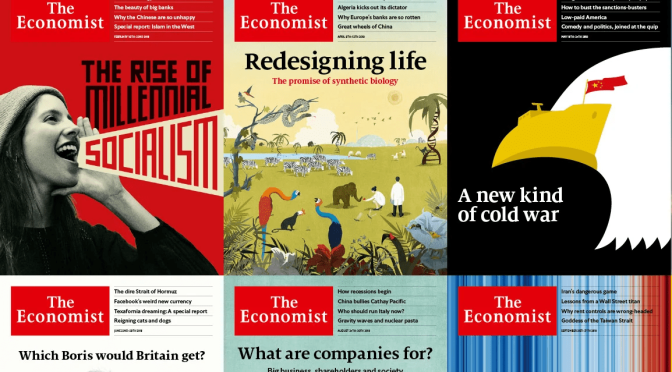
THE ECONOMIST MAGAZINE – AUGUST 9, 2025 PREVIEW

THE ECONOMIST MAGAZINE: The latest issue features Why Israel must hold itself to account

Why Israel must hold itself to account

And how it can be made to do so

Donald Trump’s awful trade policy will outlast him

He thinks America is winning. It is not

Buy now, pay later gets a bad rap. But it could be useful

Provided lenders open up