Tag Archives: Podcasts

Reviews: ‘The Week In Art’

Donatello in Florence, the Biennale of Sydney and Eduardo Navarro’s seed installation.

This week, as the Palazzo Strozzi and Museo Nazionale del Bargello in Florence present a survey of Donatello, one of the greatest of all Italian Renaissance masters, we talk to Arturo Galansino, the Strozzi’s Director General, and Paola D’Agostino, Director of the Bargello museum, about the show. The Biennale of Sydney in Australia has just opened, with the theme of rīvus, meaning stream in Latin. José Roca, the Biennale’s artistic director, and Alessandro Pelizzon, co-founder of the Global Alliance for the Rights of Nature, discuss the Biennale’s concept, bringing rivers and other “aqueous beings”, as Roca and his curatorial colleagues call them, into dialogue with artists, architects, designers, scientists, and communities. What does it mean if you grant rivers and other natural forms rights? And this episode’s Work of the Week also explores nature, ecology and the relationship between humans and natural phenomena. We speak to curator Bárbara Rodriguez Muñoz about The Photosynthetics, an installation by Eduardo Navarro in Rooted Beings, the latest exhibition at London’s Wellcome Collection.

Donatello: The Renaissance, Fondazione Palazzo Strozzi and the Museo Nazionale del Bargello in Florence, 19 March-31 July. Gemäldegalerie, Berlin, 2 September-8 January 2023. The Victoria and Albert Museum in London will stage its variation of the exhibition in 2023

The Biennale of Sydney: Rīvus continues until 13 June. And José and Alessandro will take part in a panel discussion on 10 May titled Reclaiming Rivers’ Rights. Find out more at biennaleofsydney.art

Rooted Beings, Wellcome Collection, London, 24 March-29 August
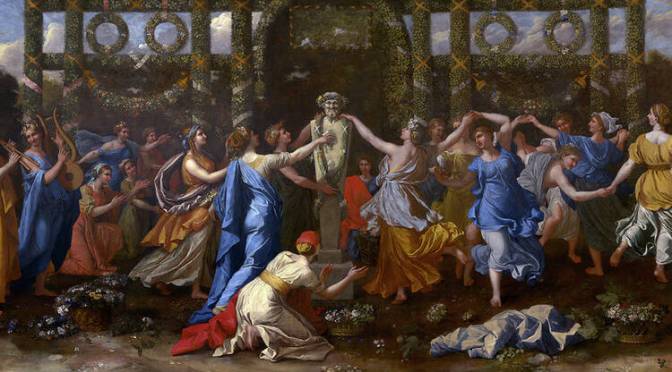
Art History: ‘Poussin And The Dance’ (The Getty)

“One of the hopes of this exhibition was really to try to enlist visitors’ bodily experience in their understanding of these works of art that can sometimes seem a little bit like they live entirely in our heads, a little bit intellectualized.”

Although Nicolas Poussin is widely regarded as the most influential painter of the 17th century—the father of French classicism—he is not as well-known as many of his contemporaries, such as Rembrandt, Rubens, and Caravaggio. This is due, in part, to Poussin’s austere painting style and erudite subject matter, which often came from Roman history or the Bible. As a result, his work can sometimes feel a bit cold or remote to today’s audiences.

But earlier in his career, Poussin was inspired by dance. His paintings of wild revelry, filled with dancing satyrs and nymphs, emerged as his signature genre from that time. Poussin and the Dance, organized by the Getty Museum and the National Gallery in London, is the first exhibition to explore the theme of dance in Poussin’s work. By supplementing his delightful dancing pictures with new dance films by Los Angeles–based choreographers—this unique exhibition invites viewers into the world of Poussin in a fresh, relatable way.

In this episode, Emily Beeny, curator in charge of European paintings at the Fine Arts Museums of San Francisco and curator of Poussin and the Dance, joins Sarah Cooper, public programs specialist at the Getty, to delve into Poussin’s process and love of dance.

The exhibition, which received generous support from the Leonetti/O’Connell Family Foundation and is sponsored by City National Bank, is on view at the Getty Center through May 8, 2022.

Political Analysis: Putin’s Repression, Commodity Chaos, China Backs Russia

A selection of three essential articles read aloud from the latest issue of The Economist. This week, why Vladimir Putin is resorting to repression at home; (10:15) how war and sanctions have caused commodities chaos; (16:35) and why Xi Jinping has placed a bet on Russia.

Morning News: Western Ukraine Bombed, Student Loan Freeze, Trump Rally

Russian missiles falling on Ukraine’s far West raise fears that a new front in the war has been opened. The Biden administration may be considering another extension of the federal student loan payment freeze. Will former President Donald Trump’s endorsements and rallies sway the outcome of GOP congressional primaries?

Science: Scanning Sewage For Covid-19, Pandemic Questions, Future Threats

First up, Contributing Correspondent Gretchen Vogel joins host Sarah Crespi to discuss what scientists have learned from scanning sewage for COVID-19 RNA. And now that so many wastewater monitoring stations are in place—what else can we do with them? 

Next, we have researcher Katia Koelle, an associate professor of biology at Emory University. She wrote a review on the evolving epidemiology of SARS-CoV-2: What have been the most important questions from epidemiologists over the course of the pandemic, and how can they help us navigate future pandemic threats?

Check out the full COVID-19 retrospective issue on lessons learned from the pandemic.

This week’s episode was produced with help from Podigy.

[Image: Stephan Schmitz/Folio Art; Music: Jeffrey Cook]

[alt: partially constructed bridge over water filled with giant SARS-CoV-2 viral particles]

Authors: Sarah Crespi; Gretchen Vogel

Episode page: https://www.science.org/doi/10.1126/science.adb1867

Science: Future Of Energy, Amazon Rainforest, CRISPR

The war in Ukraine has sparked an energy crisis, as European countries attempt to cut ties with Russia. The team discusses what this means for the future of energy production and how it may speed up our pivot to renewable energy. They also explore the growing concerns at various nuclear sites in Ukraine, as some have been seized by the Russians, while others have been damaged during the conflict.

For the first time a virgin birth has taken place in a mammal – a female mouse has given birth without any input from a male. The team explains how CRISPR gene editing has been used to create embryos from unfertilised eggs.

As the Amazon rainforest becomes less resilient to drought, there are fears it may be passing a tipping point that could turn the whole system from forest into savannah. Earth system scientist Tim Lenton of the University of Exeter explains the devastating global impact this would have.

Taking a much-needed trip off the planet, the team discusses two stories from Mars, one from NASA’s Perseverance rover and another from China’s Zhurong rover. We also present an audio space-quiz you can take part in! Thanks to NASA/JPL-Caltech/LANL/CNES/CNRS/ISAE-Supaéro for the audio clips. 

And legendary cosmologist Martin Rees shares his thoughts on the existence of extraterrestrial intelligence in the universe and the fascinating concept of ‘secular’ intelligent design.

On the pod are Rowan Hooper, Penny Sarchet, Matt Sparkes, Adam Vaughan and Richard Webb. To read about these stories and much more, subscribe at newscientist.com/podcasts.

Morning News: Ukraine Hospital Bombed, Voting System Stress, Vaccines

Russia has bombed a children’s hospital in Ukraine’s port city of Mariupol. Election professionals cite threats, stress, and political attacks on the voting system among the forces pushing them from their jobs. And how eager will parents of the youngest kids in the U.S. be to have their children vaccinated against COVID?

Morning News: Refugees From Ukraine, French Election, Russia-China

The latest from Ukraine, with an update on humanitarian corridors and the refugee situation. Plus: the official French presidential-election candidate list is released, and how does China and Russia’s relationship swing the balance of global power?