
Tag Archives: Older Adults

 It started with a phone call. In a week, a scammer would take Nina Belis’s life savings. WSJ’s Sarah Krouse explains why robocalls persist: Because sometimes they work.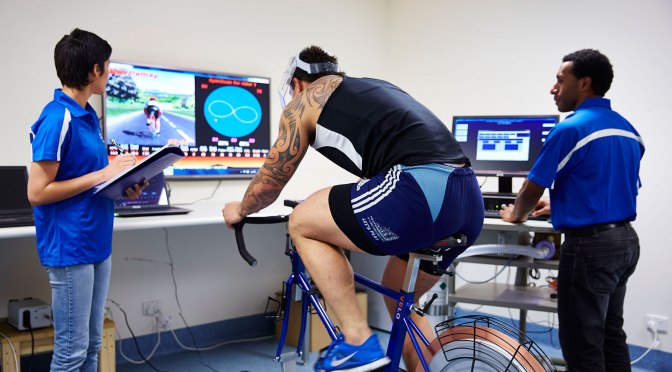
Exercise Studies: Older Adults’ “Fragmented Physical Exercise” Linked To Higher Death Rates
From a National Institute On Aging release:

Fragmented physical activity, but not total daily activity, was significantly associated with death, the researchers found. For each 10% higher degree of activity fragmentation, mortality risk was 49% greater. The duration of physical activity also mattered: Participants who frequently engaged in short bouts of activity of less than five minutes were more likely to die than those whose activity bouts lasted five minutes or longer. These associations held after adjusting for age, sex, body mass index and other factors.
Daily physical activity, which benefits health and quality of life, typically decreases in older adults. A new study shows that higher fragmentation of that activity — more transitions from activity to sedentariness — may be a better indicator of risk of death than a person’s overall level of physical activity.
Researchers from the Johns Hopkins Bloomberg School of Public Health, Baltimore, analyzed data from the NIA-supported Baltimore Longitudinal Study of Aging (BLSA), looking at a week’s worth of minute-by-minute physical activity for 548 healthy participants age 65 and older (average age, 76).
To read more: https://www.nia.nih.gov/news/fragmented-physical-activity-linked-higher-risk-death-older-adults
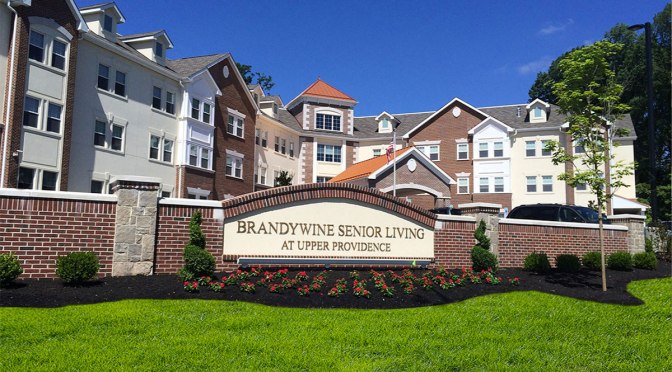
Senior Housing: Baby Boomers Choosing To Stay In Own Homes Threatens New Facilities
From a Wall Street Journal online article:
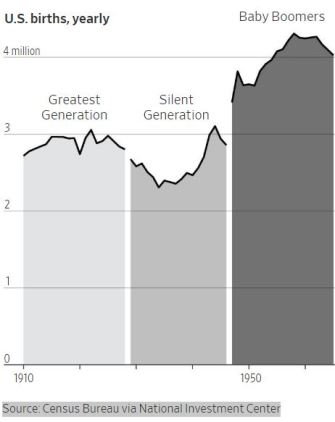 The rise of technologies that help the elderly stay in their homes threatens to upend one of commercial real estate’s biggest bets: Aging baby boomers will leave their residences in droves for senior housing.
Developers and senior-housing companies have spent billions of dollars over the past five years to build facilities that provide housing, food, medical care and assistance for the elderly.
While these properties have been filling up with people born during the Depression or World War II era, real-estate investors are eagerly eyeing the massive baby-boomer generation: 72 million people born between 1946 and 1964, or about one in five Americans. Their needs would require hundreds of thousands of new units, if previous demand patterns persist.
But this wager on elderly care is falling short of expectations, and there are concerns that it could become one of the biggest real-estate miscalculations in recent memory, some analysts suggest.
To read more: https://www.wsj.com/articles/boomers-want-to-stay-home-senior-housing-now-faces-a-budding-glut-11573554601

On Aging: A Look At Friendships “Changing” At The End Of Life (Atlantic)
From a The Atlantic online article:
 Being with people at the end of life is very intense work. You are regularly seeing a part of life that a lot of people don’t see, or see very rarely. How do you feel that affects your relationships generally and your friendship specifically?
People become frightened at the end of life. Sometimes I see them moving away from friends as they get sicker. Once people get past that fear of what’s going on, they can be friends again.
Every week, The Friendship Files features a conversation between The Atlantic’s Julie Beck and two or more friends, exploring the history and significance of their relationship.
This week, she talks with two women who met through the nontheistic religion of Ethical Culture and have spent a significant amount of time ministering to aging and dying members of their congregation. They discuss how friendship changes at the end of life, and how they work to foster connection and community for members of all ages.
To read more: https://www.theatlantic.com/family/archive/2019/11/how-friendship-changes-end-life/601204/

Retirement: Older Adults Upgrade Their Skills To Become Entrepreneurs (PBS Newshour Podcast)
 Entrepreneurs are often imagined as twenty-something recent college dropouts. But in fact, people ages 45 to 64 start businesses at higher rates than do their younger peers — and plenty of seniors are in startup mode, too. Economics correspondent Paul Solman visits a New York City center that helps older adults upgrade their technology skills and realize their entrepreneurial dreams.
Harvard’s “Housing America’s Older Adults 2019” Study Highlights Increasing Housing Cost Burdens For The 65+
From a Harvard Joint Center for Housing Studies report:
As both the number and share of older households in the United States increase to unprecedented levels, inequalities are becoming more evident. Within the 65-and-over age group, most recent income gains have gone to the highest earners, and the number of households with housing cost burdens has reached an all-time high. Ensuring that middle- and lower-income households in this age range have the means to live affordably and safely in their current homes or move to other suitable housing will be a growing challenge.
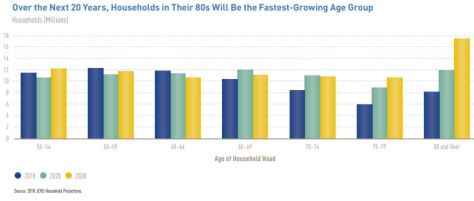
Meanwhile, many households in the 50–64 year-old age group have not recovered from the Great Recession, leaving them with lower incomes and homeownership rates than their predecessors at similar ages. For the nearly 10 million households in this age group that are cost burdened, ensuring financial and housing security in retirement will be a struggle.
https://www.jchs.harvard.edu/sites/default/files/Harvard_JCHS_Housing_Americas_Older_Adults_2019.pdf
 Boomers Daily