The Local Project (July 26, 2024): When designing an architects own home above their own workplace, Smart Design Studio thought of the industrial qualities of the surrounding precinct and how they could bring them into the design of the home of William Smart.
Video timeline:00:00 – Introduction to the Architects Own Home 01:05 – The Original 1950s Warehouse 01:54 – Creating Tranquility Through Shapes and Materials 02:49 – A Walkthrough of the Home 04:42 – Proud Moments
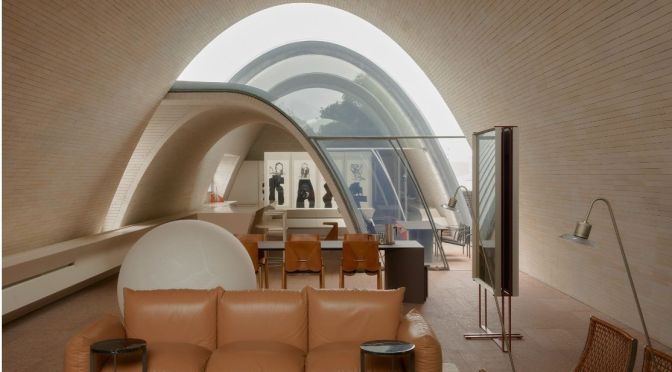
One particular element to the interior design and architecture of an architects own home are the four vaults that feature heavily throughout. Fascinated with how he could light the vaults in different ways, Smart looked into how they would allow light play to reveal the material texture and quality of the home. Originally attracted to the 1950s warehouse because of its endearing built form, the architect saw past its deteriorated exterior and knew that it could become more.
As typical with most warehouses, the front brick facade hid an office space and mezzanine that overlooked the warehouse. After demolishing the front half of the building, Smart Design Studio created a new structure that was seven metres wide for the whole 34-metre length of the building. This new structure was then designed to hold the reception, staff bathrooms, offices, meeting rooms, a boardroom and, importantly, the residence above. Moving the house tour of an architects own home upstairs, the interior design reveals a tranquil and quiet reprieve from the office below. The residence above allows its owners to come inside and feel disconnected from the city and working offices below.
The Local Project (February 16, 2024) – Cliffside by Thomas Hamel & Associates is an interior designers own home located on the South Coast of NSW, with an enchanting character and scenic setting that captures immediate attention.
Video timeline: 00:00 – Introduction to An Interior Designers Own Home 00:41 – A Magical Site 01:35 – The Evolution of the Style and Mood 02:13 – Robust Materials and Textures 03:53 – Blending the Old and New 04:33 – A New Passion for Gardening 04:52 – Favourite Aspects
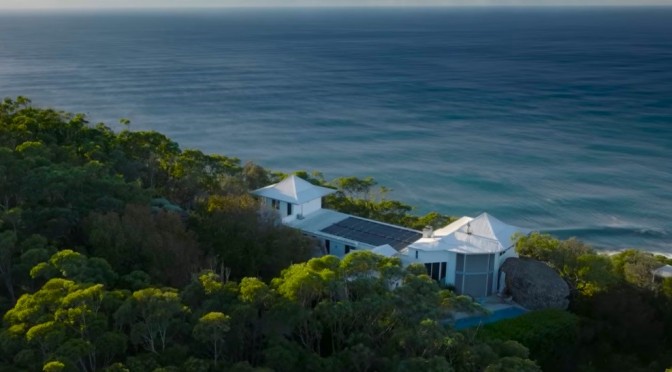
Nestled amid boulders, Cliffside emerges as a dream home that caters to every need. Located an hour south of Sydney within the Royal National Park, the home boasts a layout that closely aligns with the owners’ preferences, yet it lacked a personalised touch to truly make it their own. To address this during the design process, Thomas Hamel of Thomas Hamel & Associates – who is also the client – focused on fulfilling his and his partner’s needs and desires for a residence that would serve as their forever home.
As seen in the house tour of an interior designers own home, the style and mood of the interior have evolved organically, shaped by the owners’ cherished collections of treasures and souvenirs. Drawing inspiration from the boulders and the coastal location of the beach house, Thomas Hamel & Associates curated a palette for the interior of Cliffside that harmonised with its environment. This led to the incorporation of cohesive materials throughout the home, such as custom-designed wallpaper from Los Angeles, imparting a natural plaster texture. Complementing this, the furnishings exhibit a similar sense of harmony, featuring rough-hewn timbers reminiscent of forest elements turned into sculptural pieces.
The Local Project (March 14, 2023) – Inspired by jungle living and the whimsical idea of a spaceship crash landing into the landscape, Ground House 107R by David Fewson is a structure unlike any other. Beginning as a joint family effort, the guesthouse is complete with thoughtful design, build, furniture and artwork choices.
Video timeline:00:00 – Introduction to the Concrete Bunker Home 00:43 – The Location 01:16 – Ground House Space Station: A Vision 01:34 – A Collaboration of Friends 01:53 – The Layout 02:24 – Ground House’s Space-Inspired Bedroom 02:47 – Ground House’s Ship Lighting 03:13 – The Gift of Natural Light 03:47 – Materials Used Throughout 03:55 – Ground House Spaceship Control Panel: Kitchen 04:09 – Ground House Crash Aftermath: Landscape 04:59 – The Collaborative and Fun Process
The building is a precisely curated space in which one can find respite from urban living. With its charming jungle living experience, Ground House 107R sits on a section of undulating land surrounded by rainforest and is covered in a myriad of flora that helps it to disappear further into the land. Starting from approach, the home’s calming yet magical ambience is first seen as it emerges over the ridge.
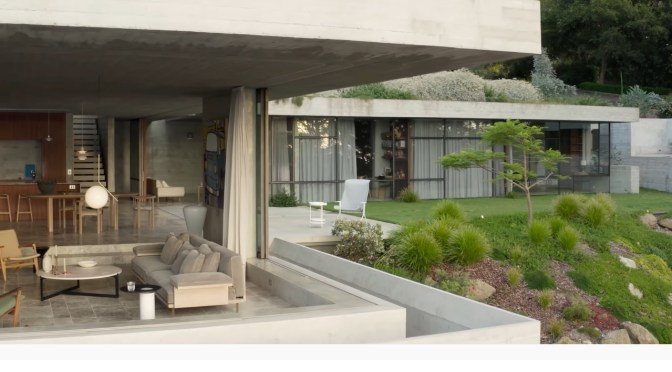
First appearing as a brutalist compound of concrete, the guesthouse is softened by foliage that cascades over the sides of it like a form of art. Organic in its design, the structure features a bedroom, kitchen, living space and bathroom. As the house tour leads around the space, the open plan layout allows for an effortless flow to the outdoors and enforces the feeling of jungle living. In the bathroom, the view through the windowed wall offers a unique view of the home’s material make up.
Additionally, the light that is gifted to the finished structure allows for the guesthouse to breath and emphasises the idea of jungle living. Using only authentic and natural materials, David Fewson and his family have added an element of truth to the interior palette. Using a combination of concrete, real timber and brass, the architect and designers extend their idea of the home forming the shape of a crashed spaceship. Found only a few metres away, the hot tub is settled into the landscape and allows guests to immerse themselves further into jungle living.
At one with the landscape, Ground House 107R’s unique architecture and design elements offer a take on the bygone era and transports it to the contemporary age in which David Fewson hopes guest will find alluring. Located in northern New South Wales, the guesthouse is shrouded in a layer of secrecy that only deepens the charm and characteristics of the site. With its jungle living ideals and employed naturally made materials, Ground House 107R is a place in which serenity can be found in every detail.
Pointing towards the future of urban living, Laneway Glass House is an extended terrace house and a designer’s own inner-city home. Collaborating with Brad Swartz Architects, Henry Wilson reconfigures the spatial plan of an existing residence, establishing an exemplar contemporary space.
Video timeline:00:00 – Introduction to Laneway Glass House 00:21 – The Architect and The Home Owner 00:47 – An Inner-City Location 01:25 – A Rear Lane Addition 01:43 – The Original Brief 02:21 – Flipping The Typical Terrace House 02:56 – The Creation of An Efficient Floor Plan 03:20 – The Spiral Staircase 03:56 – Utilising Materials In Unique Ways 04:20 – The Kitchen 05:01 – Taking Inspiration from Maison de Verre 06:00 – The Architect and The Home Owner’s Favourite Aspects
Settled onto a Darlinghurst laneway branching off Oxford Street, Laneway Glass House is a designer’s own inner-city home that aligns with its built context; a compact terrace house set among others of its kind. Organically brought together, Henry Wilson and Brad Swartz Architects quickly acknowledged the opportunity to build on the site, creating a rear lane addition that would serve as a prototype for similar developments in the future.
Materials are uniquely applied to the residence, suggesting the individual character of the project. In contrast to regular dwellings, this is a designer’s own inner-city home that sees materials used to articulate natural forms and subvert expectations for a compact space. In the kitchen, travertine is employed in a standard size without grout lines, enabling a broad, sophisticated and slab-like presentation. A designer’s own inner-city home, the contemporary kitchen is a room of cleans lines and volumes.
A commercial-like, monolithic space, the kitchen features stainless steel and presents as a formation of blocks slotted together to create a cohesive whole. Fisher & Paykel’s products are easily incorporated into the space – the Integrated Refrigerator seamlessly blends into the joinery and the Minimal Oven and Induction Hob complement the kitchen’s sleek aesthetic.
Paying homage to the Maison de Verre in Paris, glass blocks are employed to reflect and refract natural light whilst maintaining the private interior of a designer’s own inner-city home. Integrated into the façade, the blocks present Laneway Glass House as a shining jewel, sitting upon an otherwise mundane road.
Crafted by James Stockwell Architect, Bunkeren could be the best modern house in the world. Considered more landscape than building, the concrete dwelling is a robust insertion within the surrounding natural context. Embedded into a rocky forest edge just south of Newcastle,
Video Timeline: 00:00 – Introduction to the Best Modern House in the World 00:40 – The Concept 01:30 – Designing for Family and the Landscape 02:09 – House Inspired by Danish Design 02:25 – Intimate Spaces 02:44 – Bunker within the Landscape 03:20 – Benefits of a Concrete Bunker House 04:20 – Bringing Natural Light into the House 04:55 – The Cellar 05:30 – Materiality 06:12 – Indoor-Outdoor Living 07:05 – Highlights of the House 07:28 – The Architect’s Favourite Part of the House
Bunkeren sits on the land of the Awabakal people. Externally, the building is reminiscent of the inspiring botanical garden that once occupied the location in the late 1800s; sprouting greenery covers the top of floating concrete platforms where, beneath, the internal spaces are held. A sense of architectural freedom is permitted by minimising necessary supporting columns and removing the need for load-bearing walls, lending structural significance and an impressive silhouette to what is considered the best modern house in the world.
A house tour of Bunkeren – named according to the Danish translation of ‘bunker’ – reveals the negotiated peaks and pitfalls of the bunker configuration. In materiality and position, the home expresses a reassuring invulnerability; partly shielded by the rocky landscape and comprised of concrete, Bunkeren can retain its structural integrity in the event of a bushfire or storm. Crafted by the architect to be low maintenance, the home does not require painting and cannot be eroded by mould or termites. The enveloping botanical element of the design supports the forest ecosystem and microclimates by interacting with natural species. James Stockwell Architect designs the interior to combat the limited natural light and ventilation associated with the architecture of a traditional bunker. Skylights and an internal garden draw light into the underground aspects of the home in an aesthetically engaging manner, whilst the elevated nature of the concrete platforms allows space for fresh air to travel through the dwelling. The interior design of Bunkeren contributes to its potential as the best modern house in the world. Whilst utilising the work of local artists, James Stockwell Architect also takes care to reflect the influence of Danish design culture in consideration of the homeowners’ lifestyle. In application of the Danish principle of proportion, all decoration is scaled to human level, emphasising the togetherness of the family unit. The design also champions the Danish furniture inherited by the homeowners. A restrained approach to styling sees each space defined by a sense of intimacy, with the absence of elaborate ornamentation establishing an unimposing, experientially gentle atmosphere. The most unique aspect of the home – through which James Stockwell Architects proposes Bunkeren as the best modern house in the world – is the cellar, situated at the lowest level. Inside the space, the rock into which the residence is settled within is left exposed, providing visual drama, natural tactility and a reflection of the external environment, blurring the line between the home and landscape. Warmed by the additional materials of wood, concrete and brass, the cellar exudes individuality. In 20 years, the foliage surrounding Bunkeren will have grown, until the building cannot be clearly distinguished from its natural context. It is this foresight that allows Bunkeren to be considered the best modern house in the world.
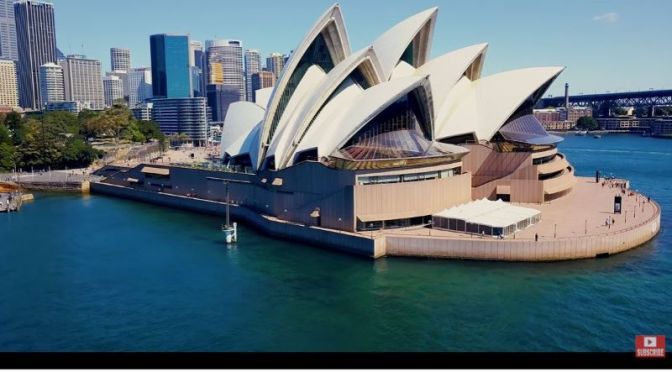
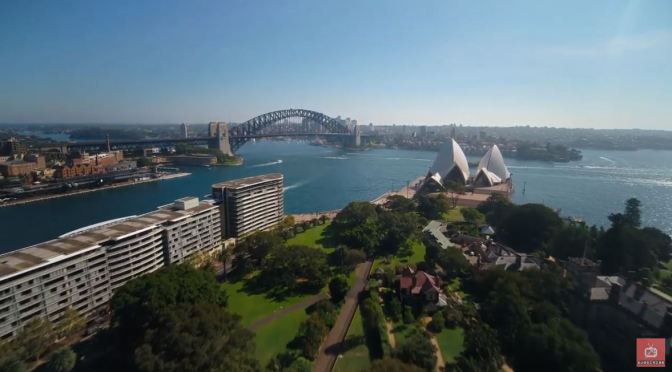
Sydney, capital of New South Wales and one of Australia’s largest cities, is best known for its harbourfront Sydney Opera House, with a distinctive sail-like design. Massive Darling Harbour and the smaller Circular Quay port are hubs of waterside life, with the arched Harbour Bridge and esteemed Royal Botanic Garden nearby. Sydney Tower’s outdoor platform, the Skywalk, offers 360-degree views of the city and suburbs.
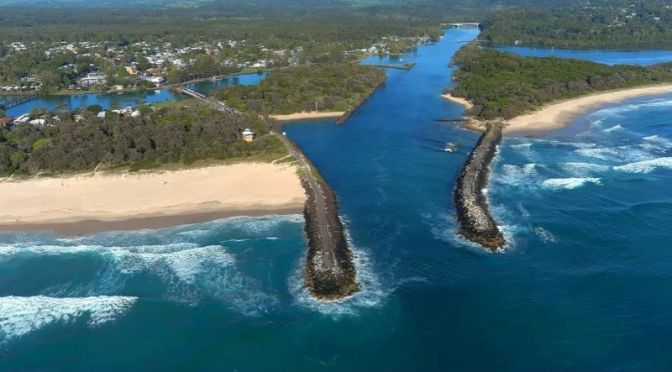
The Tweed Coast on the far North Coast of New South Wales, Australia offers visitors many different attractions – from uncrowded beaches to world-renowned surf breaks, and beautiful rivers which wind their way down their valleys and empty out into the Pacific Ocean. It’s also developing a reputation as a delicious culinary destination for foodies.
Brunswick Heads is a small coastal holiday village situated at the mouth of the Brunswick River. Nestled within the breakwater there is the safe and peaceful Torakina Beach, while a white sandy surf beach stretches to the south. The north bank of the river hosts a protected rainforest and the southern bank provides a harbour and small marina for fishing boats and small craft. Mount Chincogan and Mount Warning provide a spectacular hinterland backdrop to the river that meanders down from the nearby small town of Mullumbimby (“The Biggest Little Town In Australia”).
As the sunny capital of New South Wales, Sydney is surrounded by an abundance of natural life and historic sites. Its sprawling outskirts unfold into the enchanting wilderness of national parks, and you need only follow its golden shoreline a short way up the coast to discover lesser-known towns that were once home to exiled convicts or Aboriginal people.
News, Views and Reviews For The Intellectually Curious




 Boomers Daily