
London Review of Books (LRB) – May 4, 2023 issue: French President Emmanuel Macron and the Pension Crisis, India Prime Minister Narendra Modi’s ‘Big Con’ and more.
Pensions – and ‘the fiscal impact of ageing’ – have long troubled the EU. A European Commission paper published in 2016 noted with relief that ‘most EU member states’ were reforming their pension systems. France is one of them. During his first term in office Emmanuel Macron envisaged an ambitious reform plan, but Covid-19 put paid to it. Re-elected in 2022, he put a different plan on the table; at its core is an increase in the retirement age from 62 to 64. It has been predictably unpopular. Pensions rank high on the list of French state expenditures. They are one of the cornerstones in France’s edifice of public provision, which is why the sound of drilling and hammering sets most citizens’ teeth on edge.
The New York Review of Books – May 11, 2023 issue: The Art Issue features Fintan O’Toole on the return of the Trump circus, Susan Tallman on why Piranesi still speaks to us, Joshua Leifer on democracy deferred in Israel, Ingrid D. Rowland on recycling antiquity, and Julian Bell on Adam Elsheimer’s oceanic immensity.
Bachir Mahieddine/Institut du Monde Arabe, ParisBaya: The Yellow Curtains, 1947
An exhibition of the Algerian painter’s work liberates it from the political symbolism of late colonialism.
In November 1947 a fifteen-year-old prodigy from colonial Algeria named Baya, described variously as Kabyle, Berber, Muslim, and Arab, exhibited her gouaches and clay sculptures at the Parisian gallery of the art dealer Aimé Maeght. Yves Chataigneau, the French governor of Algeria, and Si Kaddour Benghabrit, the rector of the Paris Mosque, were the sponsors of the exhibition, and the opening attracted some of the most influential cultural figures of postwar Paris: the writers Albert Camus, François Mauriac, and André Breton; the painters Henri Matisse and Georges Braque; the designer Christian “Bebè” Bérard.
Giovanni Battista Piranesi: Architectural Fantasy with a Colossal Façade, circa 1743–1745; Morgan Library and Museum, New York
For generations, Giovanni Battista Piranesi’s prints of Roman views defined the popular image of the Eternal City. A profusion of new exhibitions and publications shows why he still speaks to us.
Also in the issue: Jacqueline Rose on C. P. Taylor’s final play, Colin B. Bailey on the Impressionists’ decorations, Wendy Doniger on Bengali tales from the mangrove forests, Christopher Benfey on the Black American potters of the nineteenth century, Jed Perl on high-tech high art, poems by Sasha Debevec-McKenney, Mosab Abu Toha, and Cyrus Console, and much more.
Literary Review of Canada – May 2023: Andrew F. Sullivan’s The Marigold features a brief epigraph attributed to Rob Ford: “Everything is fine.” Those three words would be a lot more convincing coming from Jane Jacobs or perhaps even Drake, but coming from the late Toronto mayor, they smack of comedy, irony, and foreboding.
On the lost art of public conversation: It is right to be suspicious of anyone who claims that some prior epoch was a golden age of anything, whether it be talk shows, family values, civil discourse, or whatever else they find lacking in their own time.
A historical whodunit: Clara at the Door with a Revolver: The Scandalous Black Suspect, the Exemplary White Son, and the Murder That Shocked Toronto by Carolyn Whitzman
The artist discusses artistry, artificial intelligence, and the human experience.
Chatbots and image generators, newly on the rise, have sparked our imaginations—and our fears. As artificial-intelligence machines sharpen their ability to translate written prompts into images that accurately capture both style and substance, some visual artists worry that their specialized skills might be rendered irrelevant.
A new crop of biotech startups want to revolutionize human reproduction.
In 2016, two Japanese reproductive biologists, Katsuhiko Hayashi and Mitinori Saitou, made an announcement in the journal Nature that read like a science-fiction novel. The researchers had taken skin cells from the tip of a mouse’s tail, reprogrammed them into stem cells, and then turned those stem cells into egg cells.
Drug syndicates and other criminal groups bought into the idea that a new kind of phone network couldn’t be infiltrated by cops. They were wrong—big time.
Many criminals have been convicted as a result of encrypted-phone stings—more than four hundred in the U.K. alone.Illustration by Max Löffler
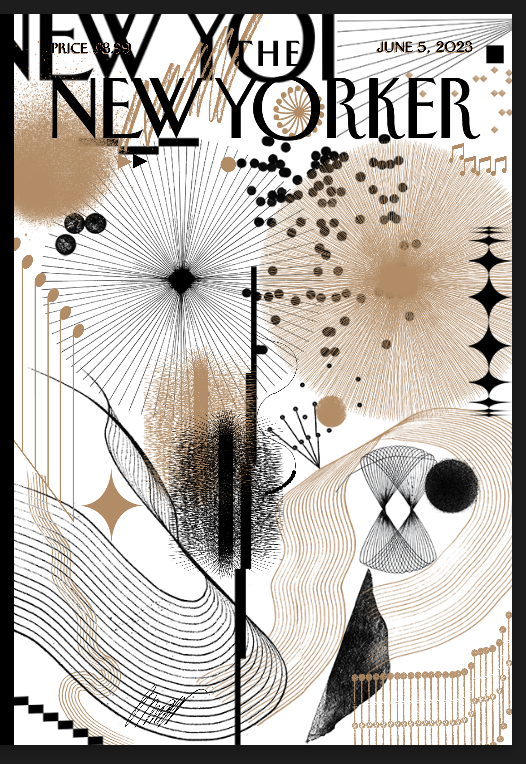
The New Yorker – April 17, 2023 issue:Truth is stranger than fiction: for the first time in its long history, The New Yorker is publishing a courtroom sketch on the cover.
By the time Donald Trump marched out from behind a phalanx of American flags and emerged into the gilded Mar-a-Lago ballroom to speak to cheering supporters on Tuesday night, America’s first indicted ex-President hardly seemed chastened by his historic day as a defendant in a Manhattan courtroom.
The fact that Donald Trump has finally been brought to court for an alleged crime relating to paying hush money may well contradict Alvin Bragg’s key contention.
Following the Manhattan District Attorney’s investigation, the former President was arraigned on felony charges stemming from hush-money payments.
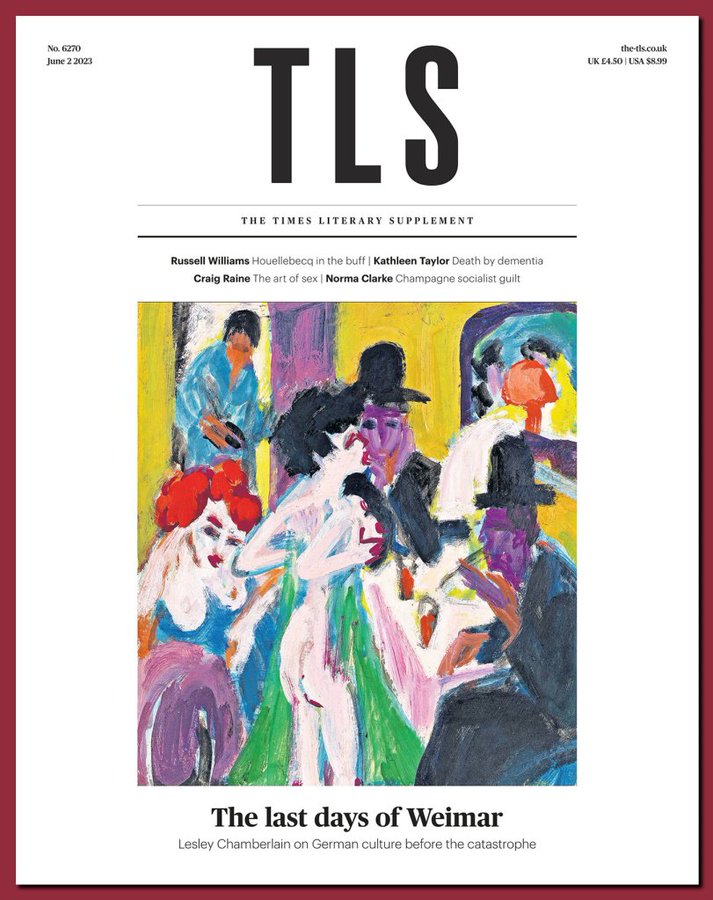
Times Literary Supplement @TheTLS (April 7, 2023) – This week’s @TheTLS, featuring the late Jane Maas on Philip Roth’s great love; David Throsby on consulting firms; an extract from The God Desire by @Baddiel; @LamornaAsh on Max Porter; @funesdamemorius on Mike Nelson; a new poem by Carl Dennis – and more.
Iconicon: A Journey Around the Landmark Buildings of Contemporary Britain
Its appeal is part of the recurrent cycle of the centripetal giving way to the lure of the burbs. Save that, in this instance, it’s not the lure that accounts for an invasion of beards and craft beer but the unaffordability of housing in East London. Let’s go to Croydon! For want of anywhere else.
Which archival sources are used and whose voices are silenced? The Marcoses have – for now – claimed the archive and seized the narrative. They tell the story of a golden age followed by a fall and a quest for redemption. In the Philippines, a deeply Catholic country, the story has a satisfying narrative arc.
News, Views and Reviews For The Intellectually Curious