
Living the Avant-Garde: The Triton Collection Foundation New York
On View in New York through 14 November

On View in New York through 14 November

The works have remained preserved in a Parisian apartment for almost sixty years, and their appearance on the market constitutes an unprecedented opportunity for collectors today”. Says Aurélie Vandevoorde, Director of the Impressionist and Modern Art Department.
Unveiling an unprecedented group of 12 works by some of the greatest masters of the 20th century, which include artists such as Pablo Picasso, Fernand Léger, Nicolas de Staël & Georges Braque, “Le Souffle Moderne” Collections presents an exceptional ensemble embodying the artistic avant-gardes of the 1930s and 1940s.
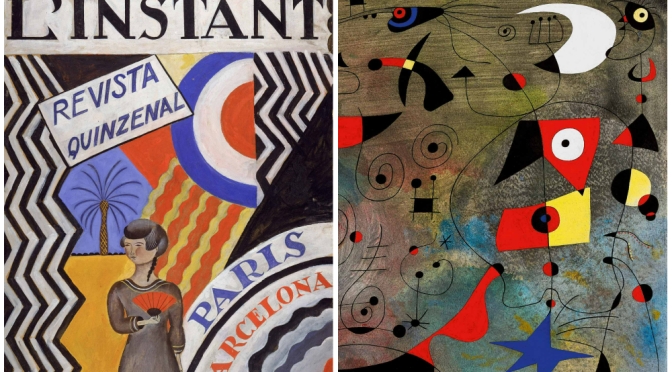
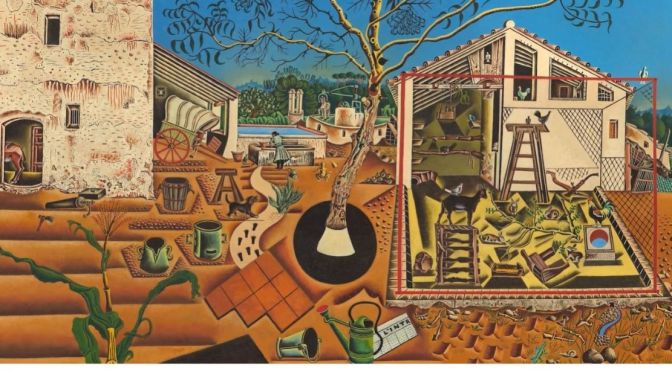
The Guggenheim Museum Bilbao presents Joan Miró. Absolute Reality. Paris, 1920–1945, an exhibition that explores the career between the years 1920 and 1945 of one of the most outstanding artists of the 20th century. The start of this fundamental period in Miró’s oeuvre is marked by the date of his first trip to Paris, a key city in his life and work, and it closes with the year when Miró, after producing his Constellations (1940–41) and then hardly painting at all for some years, created a great series of works on white backgrounds that consolidated his language of signs floating on ambiguous grounds.
In the 25 years of activity covered by the exhibition, there is a constant flow of new ideas ranging from his initial magic realism to his language of constellated signs. In this development, it becomes clear that prehistoric art, including rock paintings, petroglyphs, and statuettes, held a special interest for Miró, a fascination confirmed by his notebooks, where he proposes returning to the dawn of art in order to retrieve its original spiritual sense.

Joan Miró i Ferrà was a Spanish painter, sculptor and ceramicist born in Barcelona. A museum dedicated to his work, the Fundació Joan Miró, was established in his native city of Barcelona in 1975, and another, the Fundació Pilar i Joan Miró, was established in his adoptive city of Palma in 1981.
Excerpts from a Christie’s online article (Feb 28, 2020):
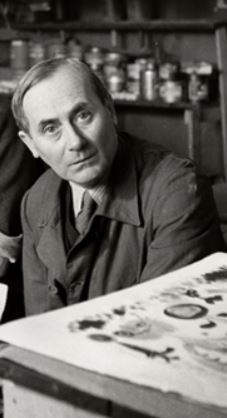
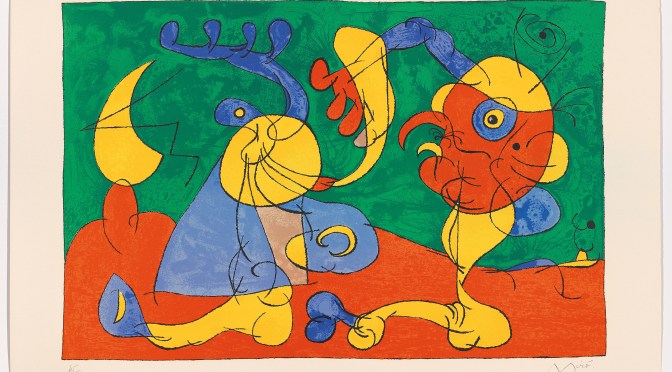
Like Pablo Picasso, his compatriot and peer, Miró had an unwavering commitment to printmaking. Also like Picasso, he created more than 2,000 works in the medium. It’s often said that Miró’s fondness for calligraphic lines — such a distinctive feature of his paintings — lent itself naturally to graphic work.
‘In terms of both the quality and quantity of his output, Joan Miró was one of the most important printmakers of the 20th century,’ says Murray Macaulay, Head of Prints at Christie’s in London.
 The son of a watchmaker, Joan Miró was born in Barcelona in 1893. He moved to Paris in the early 1920s and soon joined the Surrealist movement. He also befriended a host of avant-garde writers, such as Max Jacob, Tristan Tzara, Antonin Artaud, André Breton and Paul Eluard.
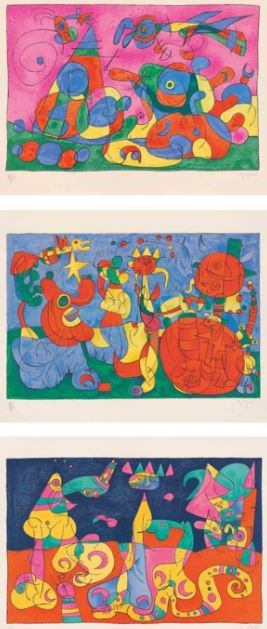
The first prints Miró ever made were illustrations for Tzara’s 1930 book of poems, L’arbre des Voyageurs. Literary sources would prove to be a constant inspiration for him, with notable examples including Alfred Jarry’s play, Ubu Roi; Stephen Spender’s poem, Fraternity; and the mystic, medieval text, Canticle of the Sun, by St Francis of Assisi.
 Boomers Daily