Tag Archives: Home Tours

Design Tours: A Remote Cabin In New Zealand

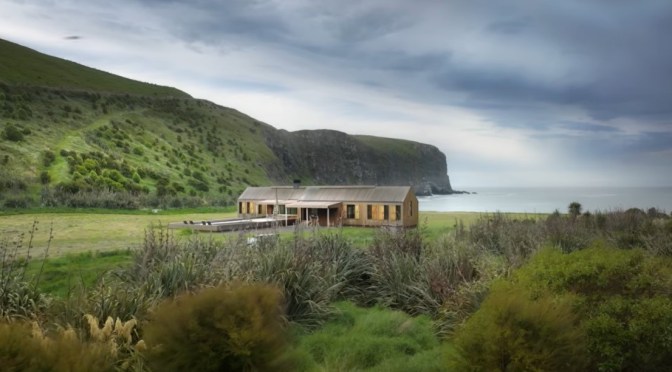
The Local Project (April 19, 2024) – Creating a place for people to reconnect with each other and nature, Patterson Associates built a cabin that sits upon the New Zealand landscape with advantageous coastal views. Located on a working sheep and cattle farm on the Banks Peninsula, Scrubby Bay is extremely remote.

Video timeline: 00:00 – Introduction to the Remote Cabin 01:16 – The History of the Landscape 02:13 – An Insight into the Design Inspiration 03:02 – The Layout of the Cabin 03:57 – Approaching the Bay 05:02 – The Respectful Construction Process 05:30 – A Robust Material Palette 06:31 – The Functionalities of the Cabin 07:23 – A Sustainable Approach to the Build

The cabin home is architectural in its design and faces straight into the sub-Antarctic weather that comes in from the bay and down the mountains. Moreso, due to the home’s location, there is a wide variety of wildlife, including an array of birds, dolphins and whales. Faced with the decision of what to design and how to design it, the architect was drawn to building a residence that responded to the site. Moreover, seen in the house tour of the cabin is the bay, which tends to be covered in driftwood.

This helped influence the architect on choosing the unique materials and timber for the project. Designed to age and get better with time, Scrubby Bay is laid out as two simple gabled barn forms that are slotted together. Specifically arranged for families or large groups renting off Airbnb, the house can accommodate up to 16 people and encourages them to come together and experience the natural landscape. Three main bedrooms have been created for the adults and spread throughout the gabled form of the home. Additionally, seen in the house tour, at each side of the home are two gathering areas, one being an entertainment deck facing the ocean and the other is a pool facing the rear mountains.

Design Tours: A Courtyard Home, Victoria, Australia

The Local Project (March 26, 2024) – Located in Box Hill, Victoria, Naples Street House is a tiny brick home. One of the owners is a keen dancer and consequently, the home sets the scene for a harmonious performance with rooms and outward connections to the landscape.

Video timeline: 00:00 – Introduction to the Tiny Brick Home 00:32 – The Location and The Brief 01:29 – A Walkthrough of the Home 02:52 – Creating A Sanctuary 03:45 – The Conceptualisation Process 04:10 – A Focus on the Kitchen 05:17 – The Material Palette 05:59 – Exciting Aspects

The house tour illustrates how this tiny brick home occupies a small footprint on its site, embracing an intimate relationship with the landscape. In a suburb where interwar-era houses are slowly disappearing, the home, which sits alongside narrow townhouses, provides the street with an unconventional visual intervention – an outcome driven by the clients’ aspirations. For architect Kim Bridgland, director of Edition Office, this tiny brick home offers sanctuary. “The house is located within a dense suburban street and is designed to focus inwards, around an inner courtyard garden room,” he explains.

The courtyard house typology stemmed from the brief for a multigenerational home. Exploring the type of design, decor and floor plan suitable for such occupancy led the team to a design that separates the home’s spaces in a way that allows them to remain visually connected through an inner garden room yet hidden from public sight, as depicted in the house tour. An axial hallway connects sightlines from the front entry to the rear garden and splits the living areas from the bedrooms and bathrooms while leading to a north-facing living, kitchen and dining space. Further into the dwelling is the central garden room and a secluded lounge with fully glazed walls that open to the landscape.

Design Tour: Carwoola Residence In Queensland

The Local Project (March 24, 2024) – Located in Mooloolaba on the Sunshine Coast, Carwoola Residence by Reitsma is a super house surrounded by white beaches and deep water access. Delivering a brief to Reitsma, who were in partnership with Clipsal, the clients listed their essential needs for their super house, which included maximum privacy as well as a place to celebrate their interests of boating and automobiles.

Video timeline: 00:00 – Introduction To The Super House 00:25 – The Waterfront Location 00:36 – Client’s intention 00:53 – Walkthrough Of The Super House 01:47 – Electrical Design With Clipsal 02:16 – Designed For Comfort 02:53 – Exploring The Upper Level 03:41 – Features Of The Saturn Zen Range 04:18 – The Moon Circle 04:36 – A Car Enthusiast’s Basement 05:01 – Materials And Highlights Of The Project

As such, the super house has been built and designed with the intention to allow the owners to store multiple cars, entertain and have access to the rear canal system. The angled shroud of the facade adds a depth to the characteristics of the exterior design and architecture. Upon entry, the house tour leads under a concrete portal, which is used to compress the space before opening up into an expansive void that gives views up to the sky. From here, the oversized pivot front door blurs where the inside and outside of the super house meet. Further inside, the house tour reveals another full-height void that tapers to a frameless window that looks out onto the pool and Mooloolaba wharf.

The interior design brings the essence of water right to the front door and immediately ignites the desire to explore what lies beyond. The privacy walls running north and south of the home are used as a buffer to shield the neighbours’ views and give the owners utmost privacy. However, these walls end at the rear of the home where they then open up to the views of the Mooloolaba wharf. In the outdoor living area, the architect has created a cascading effect where the entertaining areas waterfall towards the wharf to create a beach-like element to the super house. This is also done to create more viewing opportunities from inside.

New Zealand Design Tour: ‘The Folly’ Island Cabin

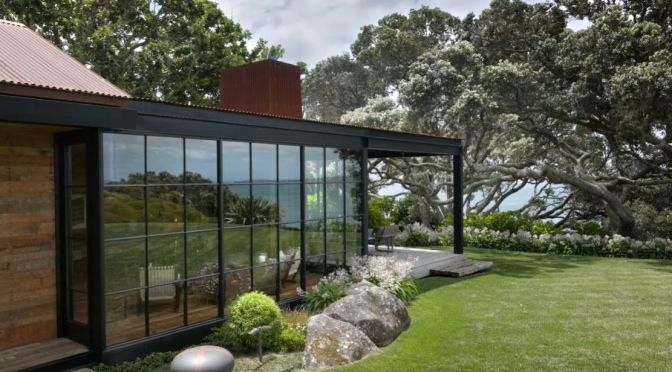
The Local Project (March 19, 2024) – The philosophical intent of The Folly by Chesire Architects is to provide a gentle cabin retreat for its owners. As such, the architect is concerned about employing a built interior quality of calm and repose to the cabin. Positioned on a clifftop in Takapuna, New Zealand,

Video timeline: 00:00 – Introduction to The Secluded Cabin 00:44 – A 25-year Long Process 01:35 – Incorporating Considered Luxury 02:22 – The Cabin Floor Plan 03:17 – A Warm Material Palette 04:30 – The Collaborative Process 05:11 – Inspired by Personal Memories

The Folly is an end piece of a project that started near thirty years prior and is a single house with steps down the clifftop. To complement the original luxurious home, the architect built The Folly on the far northern edge of the landscape to embrace the sun and views. With each Chesire Architects projects there is an element of managed revelation, so that when one arrives there is hint of something before the reveal is slowly rolled out. Designed to look like a modern yet rusted shed, The Folly can be seen across the landscape from the main home, yet it isn’t until approach that its charm is revealed.

Following the house tour through the entry, there is a realisation that there is a level of consideration and luxury provided through the choice of materials, decor and interior design. The cabin appears to look casual and informal yet, through its meticulously planned interior design and architecture, a certain level of luxurious indulgence is felt. The floor plan of the cabin is kept quite simple as the architect has built it to serve two functions. One half is the garden shed and the other is the retreat and guesthouse with kitchen. The inside of the home is rectangular in shape and everything, such as the kitchen, lounge space and two-way fireplace, is visible upon entrance. Outside is an open-air terrace where one can sit and look out to the ocean.

San Francisco Design: Tour Of ‘Hidden House’

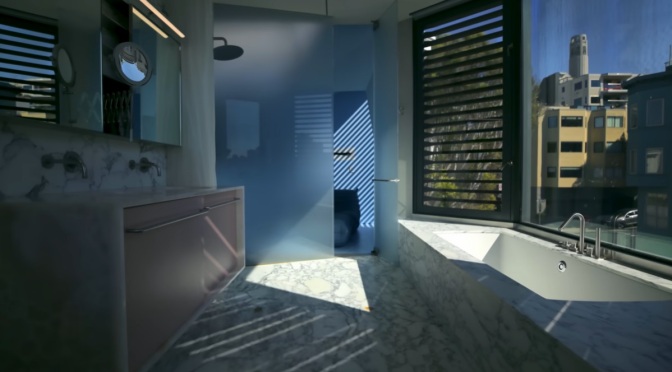
The Local Project (March 9, 2024) – Located on Telegraph Hill, a meticulously preserved locale in San Francisco, Hidden House breaks away from conventional architectural styles and emerges as a contemporary house amid the historical backdrop of the city.

Video timeline: 00:00 – Introduction to the Contemporary House 01:13 – The Three Basic Components and Zones 02:14 – The Collage of Materials 03:05 – Capturing Spontaneity and Dynamism 03:30 – The City of San Francisco 03:56 – Tying Spaces Together Through Light 05:25 – Proud Moments

To realise the project, OPA demonstrates contextual sensitivity with the facade, which features timber as well as a traditional bay window with extensive glazing, fitting for the streetscape. Furthermore, the facade is adorned with wooden panels transitioning from vertical to horizontal orientations, symbolising contemporary innovation over traditional craftmanship. The contemporary house is composed of three fundamental elements. The house tour unveils how the facade of the home serves as a disguise, concealing the inner workings of the residence along with its modern interior design and architecture.

Additionally, the unique house boasts two distinct zones, each with its own character and personality. One zone presents a vertical and abstract aesthetic, where the materiality is obscured by vibrant blue paint, while the other exudes a raw and refined charm. The initial zone aims to immerse visitors in a psychological experience, utilising colour as a bold element within the home’s interior design, despite its relatively low cost compared to other features. Transitioning to the second zone of the contemporary house, OPA has achieved a strikingly contrasting effect. In this area, materials are expressed in their raw and refined forms, all oriented horizontally.

#House#Abstract#TheLocalProject

Design: ‘Invisible House’ In Joshua Tree, California

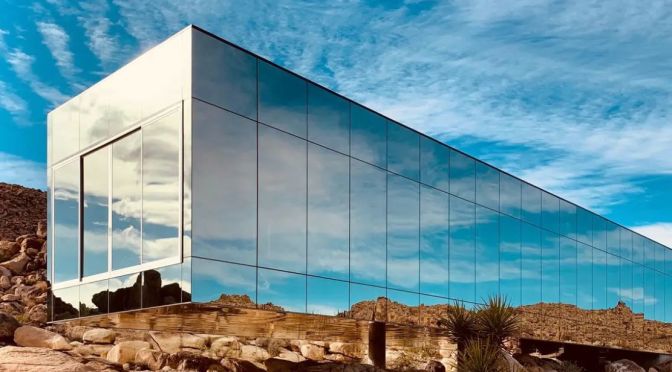
The Local Project (March 5, 2024) – A highly minimalist, almost invisible home, The Invisible House reflects the natural beauty and art of the desert landscape. A 1,680-square-metre, three-bedroom, four-bathroom invisible home cantilevered 30 metres off the ground, Invisible House is the innovative and imaginative collaboration between film producers and owners Chris and Roberta Hanley and architect Tomas Osinski.

Video timeline: 00:00 – Introduction to the Invisible Home 01:07 – The Evolution of the Landscape 01:56 – Conceptualising the Home 02:49 – An External Illusion 03:30 – The Material Palette 04:08 – Surprising Theatrical Moments 04:42 – Proud Moments

The invisible home is located on 36 hectares of land in Joshua Tree National Park and features a mirrored exterior to reflect the ever-changing landscape and create a dialogue between object and site. “We were drawn to the desert of Joshua Tree. We would always come out here, we see it as an escape,” says Chris. “We were looking for a place with rocks … and then we just had to pull it together and do it,” says Roberta. After exploring the site, Chris and Roberta’s vision for the invisible home was quickly conceived.

As filmmakers and creatives, their intention was to create, approaching the house as an art object and a space to facilitate entertainment, creativity and contemplation. They were inspired by their interest in large-scale projects with minimalist design, a vast network of artists and a passion for architecture. Once inside the Airbnb guesthouse there are solar and thermal systems, 68-square-metre projection wall, large kitchen and a 30-metre indoor solar pool. “We drew on the idea of the pool as an ecosystem so there would be more moisture and you wouldn’t dry out here and used glass walls on both sides of the pool.” says Roberta, “it’s a living room, we put the pool in the living room.

Design Tour: Morris Cove House, Long Island, NY

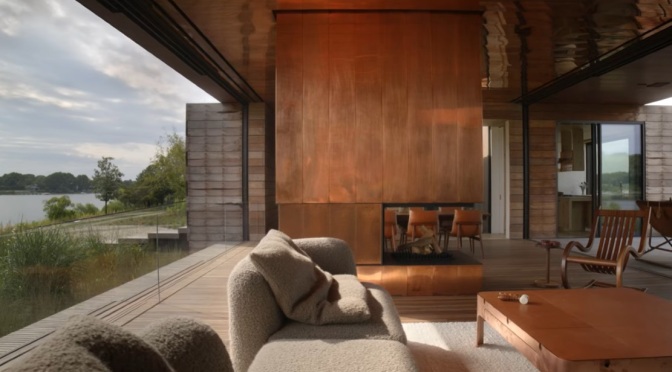
The Local Project (February 28, 2024) – Located on a narrow peninsula in Sag Harbor, with access to water on all sides, Morris Cove by Bates Masi + Architects is a peaceful lake home.

Video timeline: 00:00 – Introduction to the Peaceful Lake Home 00:50 – Designing for the Landscape 02:19 – Accomodating for the Weather 02:44 – The Layout of the Home 03:51 – A Character Filled Material Palette 05:00 – An Extension of the Architecture 05:28 – Favourite Aspects of the Home

The architects, Paul Masi and Aaron Weil, whose personal affinity for this part of the world and appreciation for the site’s heritage enhanced the architecture and interior design of this peaceful lake home, have crafted a family house that will, over time, ameliorate the site’s natural conditions and deepen the residents’ connection to the landscape. Bates Masi + Architects were approached by the clients – a large family “whose love of this special place makes them stewards of the site more than just owners of it,” notes Paul – to conceive a peaceful lake home. “Previously, there was a home here and, frankly, it was contributing to the erosion of the property, so one of our goals was to look at a new design that would be beneficial to the property.”

Therefore, Bates Masi + Architects decided against a renovation or refurbishment, opting instead for a family house that takes cues from Arts and Crafts style architecture and contemporary design ideals. The result is a family house that pays deference to the landscape while responding to the clients’ patterns of living and briefing requirements. Stretching along the peninsula and oriented towards the water, the architecture encompasses five pavilions beneath an overarching roof structure, including a kitchen, dining and living area as well as bedrooms and bathrooms.

Architecture: Cliffside House In New South Wales

The Local Project (February 16, 2024) – Cliffside by Thomas Hamel & Associates is an interior designers own home located on the South Coast of NSW, with an enchanting character and scenic setting that captures immediate attention.

Video timeline: 00:00 – Introduction to An Interior Designers Own Home 00:41 – A Magical Site 01:35 – The Evolution of the Style and Mood 02:13 – Robust Materials and Textures 03:53 – Blending the Old and New 04:33 – A New Passion for Gardening 04:52 – Favourite Aspects

Nestled amid boulders, Cliffside emerges as a dream home that caters to every need. Located an hour south of Sydney within the Royal National Park, the home boasts a layout that closely aligns with the owners’ preferences, yet it lacked a personalised touch to truly make it their own. To address this during the design process, Thomas Hamel of Thomas Hamel & Associates – who is also the client – focused on fulfilling his and his partner’s needs and desires for a residence that would serve as their forever home.

As seen in the house tour of an interior designers own home, the style and mood of the interior have evolved organically, shaped by the owners’ cherished collections of treasures and souvenirs. Drawing inspiration from the boulders and the coastal location of the beach house, Thomas Hamel & Associates curated a palette for the interior of Cliffside that harmonised with its environment. This led to the incorporation of cohesive materials throughout the home, such as custom-designed wallpaper from Los Angeles, imparting a natural plaster texture. Complementing this, the furnishings exhibit a similar sense of harmony, featuring rough-hewn timbers reminiscent of forest elements turned into sculptural pieces.

Architecture: A Cliffside Home Tour In Sydney

The Local Project (February 9, 2024) – Grounded in simplicity, GB House’s proximity to Sydney’s Gordons Bay and the nearby precipitous cliffs means the surrounding nature is celebrated as an interior design feature.

00:00 – Introduction to the Cliffside Home 00:55 – An Exciting and Historical Brief 02:13 – The Layout and Walkthrough of the Home 04:28 – Key Materials and Special Aspects 05:21 – Incorporating the Rich Natural World 06:53 – Favourite Aspects

Inside a cliffside home, Renato D’Ettorre Architects creates a minimalist beach house with a strong sensorial and emotional experience through materials and spatial composition. The initial brief focused on bringing this bay inside the architecture of the home and creating an open family home with almost no walls, so you could glimpse the water and cliff faces at every turn. “It is the outside that we wanted to create the magic, not what we’re doing inside – the inside is a frame almost, to frame the view,” says Renato D’Ettorre, lead architect for GB House.

“The entry sequence is one of my favourite parts of the house,” says Renato. The path is deliberately placed to the south to make the entry elongated so that one is encouraged to slow down. “It is a sensorial experience – you can see the end of the pathway, the horizon, but before you get there, you have to navigate this pathway where you have a watercourse and perforated red terracotta breeze blocks on either side of you, before arriving at the front door,” says Renato. The perforations brighten inside a cliffside home with patterns of light, moderate the summer sunlight and enable airflow. In this way, lighting works in harmony alongside the materiality of the dream home.

Architecture Tour: ‘OG House’ In Halifax, Canada

The Local Project (January 23, 2024) – OG House by Omar Gandhi is an architects own home in Halifax, the capital of the Canadian province of Nova Scotia. Defined by a deft understanding of light and form, it is a deeply personal home and a compelling piece of architecture, as seen in The Local Project’s house tour.

Video timeline: 00:00 – Introduction to the Architects Own Home 00:55 – The Family Centred Brief 01:58 – The Layout and Walkthrough of the Home 03:42 – A Focus on the Light and Sculpted Areas 04:28 – The Neutral Material Palette 04:59 – Customised Furniture Pieces 05:57 – Proud Moments and Favourite Aspects

As the project’s architect, Omar, says, the brief for this home was to create a house for his family as well as a new studio space for his budding practice. As it happens, his architecture studio grew rapidly over the course of the build, and as such, the ground floor studio space is now an extension of his original waterfront studio and a place to work on community projects with his team. This project illustrates a seamless understanding of how domestic and non-domestic principles can coexist within an architects own home.

The footprint of this house was heavily defined by the site and its setbacks from abutting properties and to the street. Cleverly, Omar has used these parameters to gently guide the architecture and ensuing build. In the house tour of an architects own home, Omar highlights the site’s various constraints, which have been reinterpreted as opportunities in designing a compelling piece of architecture. As Omar says, “the volume was resolved from the outset, so it became a process of articulation and sculpting, and in some cases, sacrificing overall square footage for moments of joy, delight and surprise.”