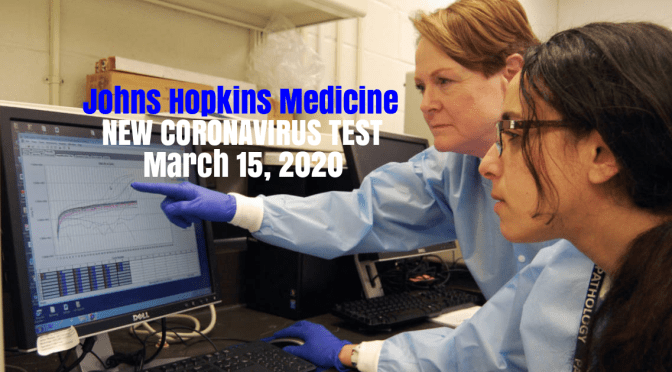
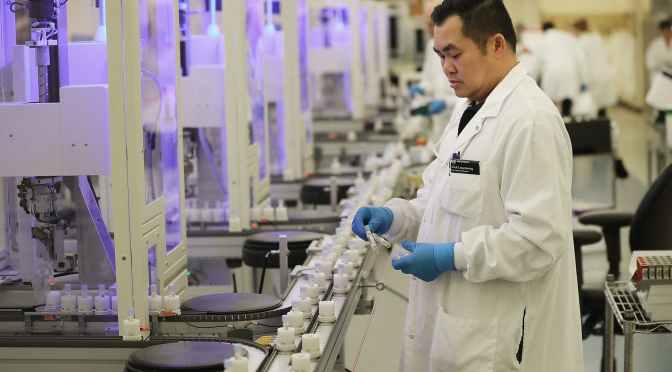
New Coronavirus test developed by Johns Hopkins microbiologists Karen Carroll and Heba Mostafa, look to test as many as 1,000 suspected Covid-19 cases per day in the Johns Hopkins Health System.

New Coronavirus test developed by Johns Hopkins microbiologists Karen Carroll and Heba Mostafa, look to test as many as 1,000 suspected Covid-19 cases per day in the Johns Hopkins Health System.

If you are sick with COVID-19 or suspect you are infected with the virus that causes COVID-19, follow the steps below to help prevent the disease from spreading to people in your home and community.
The team at Mayo Clinic prefer to see patients screened for colorectal cancer before they show symptoms.
 Monocle 24 “The Urbanist” discusses the impact that quarantines can have on cities and what lessons city planners can learn when an outbreak causes borders to close. Here is a report from the ground on the changing nature of city life in Milan.
Dr. Matthew Binnicker oversees Mayo Clinic’s laboratory response in developing a test to detect COVID-19 in clinical samples. A process that usually takes six months to a year, was accomplished in under a month, thanks to a dedicated team working around the clock. The test should help ease the burden currently being felt at the Centers for Disease Control & Prevention and state health labs. That will also mean faster turnaround times for results. Patients can expect results within 24 hours of when samples are collected and sent to Mayo Clinic Laboratories. Initially, Dr. Binnicker says the laboratory has the capacity to run between 200-300 tests daily. Additional equipment has been ordered to double that capacity in the coming weeks.
More health and medical news on the Mayo Clinic News Network. https://newsnetwork.mayoclinic.org/
Global health officials have praised China and South Korea for the success of their efforts to contain the coronavirus. What are those countries getting right — and what can everyone else learn from them?
Guest: Donald G. McNeil Jr., a science and health reporter for The New York Times. For more information on today’s episode, visit nytimes.com/thedaily.
Background reading:
When is elbow pain an emergency? Can the elbow joint be replaced? What’s that weird feeling when you hit your funny bone? Orthopedic Surgeon, William Seitz Jr., MD, sits down to answer these questions and more.
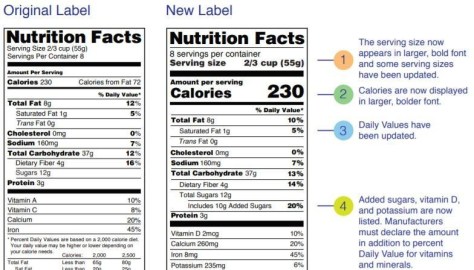
What’s new about the new Nutrition Facts label? Watch this Q&A with Susan T. Mayne, Ph.D., Director of FDA’s Center for Food Safety and Applied Nutrition.
From an MIT Technology Review article (March 11, 2020):
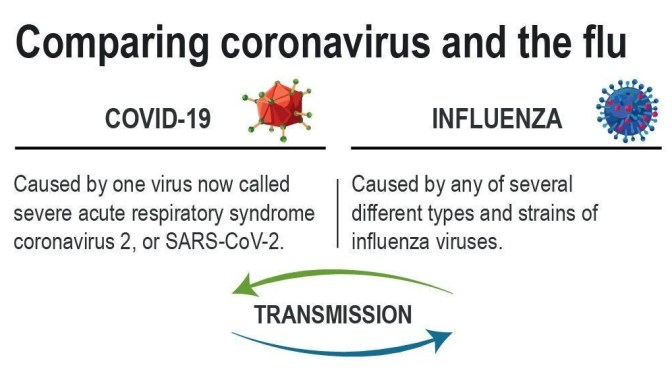
Here are six differences between coronavirus and the flu:
 Coronavirus appears to spread more slowly than the flu. This is probably the biggest difference between the two. The flu has a shorter incubation period (the time it takes for an infected person to show symptoms) and a shorter serial interval (or the time between successive cases). Coronavirus’s serial interval is around five to six days, while flu’s gap between cases is more like three days, the WHO says. So flu still spreads more quickly.
 Don’t blame snotty kids—adults are passing coronavirus around. While kids are the primary culprits for flu transmission, this coronavirus seems to be passed between adults. That also means adults are getting hit hardest—especially those who are older and have underlying medical conditions. Experts are baffled as to why kids seem protected from the worst effects of the coronavirus, according to the Washington Post. Some say they might already have some immunity from other versions of the coronavirus that appear in the common cold; another theory is that kids’ immune systems are always on high alert and might simply be faster than adults’ in battling Covid-19.





 Boomers Daily